377 results for "Educational"

Encouraging Children to Learn

Dreikurs, Rudolf
Encouragement is the basis for development of human potential in children and adults. It is the source of motivation for effective actions, goals and interpersonal relationships. Encouragement permits individuals to overcome setbacks and adversities, to have respect for self and for others, to be optimistic and to meet life's challenges. In an era that has witnessed high rates of depression, anxiety, suicide and violence, Encouraging Children to Learn provides crucial and well tested encouragement methods for improving attitudes, goals and actions.
Routledge 2016-08-26 174 pages

Multilevel statistical models

Goldstein, Harvey
This book provides a clear introduction to this important area of statistics. The author provides a wide of coverage of different kinds of multilevel models, and how to interpret different statistical methodologies and algorithms applied to such models. This 4th edition reflects the growth and interest in this area and is updated to include new chapters on multilevel models with mixed response types, smoothing and multilevel data, models with correlated random effects and modeling with variance.
Wiley 2011-01 358 pages

Fail U.: the false promise of higher education

Sykes, Charles J.
"The cost of a college degree has increased by 1,125% since 1978 - four times the rate of inflation. Total student debt is $1.3 trillion. Many private universities charge tuitions ranging from $60-70,000 per year. Nearly 2/3 of all college students must borrow to study, and the average student graduates with more than $30,000 in debt. 53% of college graduates under 25 years old are unemployed or underemployed (working part-time or in low-paying jobs that do not require college degrees). Professors - remember them? - rarely teach undergraduates at many major universities. 76% of all university classes are taught by part-time, untenured faculty. In Fail U., Charles J. Sykes asks, "Is it worth it?" With chapters exploring the staggering costs of a college education, the sharp decline in tenured faculty and teaching loads, the explosion of administrator jobs, the grandiose building plans (gyms, food courts, student recreation centers), and the hysteria surrounding the "epidemic" of campus rapes, "triggers," "micro-aggressions," and other forms of alleged trauma, Fail U. concludes by offering a different vision of higher education; one that is affordable, more productive, and better-suited to meet the needs of a diverse range of students. Provocative, persuasive, clear-eyed, and even amusing, Fail U. strips the academic emperor of its clothes to reveal the American university system as it really is - and how it must change"--
St. Martin's Press 2016-08-09 278 pages

Writing for television, radio, and new media

Hilliard, Robert L.
Writing for Television, Radio, and New media has been the leading work in its field for more than fifty years. Its frequently updated revisions, including the eleventh edition, combine the best principles and examples of the past with those of contemporary practice. Its thorough coverage of concepts, approaches, and techniques concentrates on the key media formats of commercials; news and sports; documentaries; reality programs; talk shows; interviews; music programs; corporate, educational, and children's formats; and drama and sitcoms. The text also presents basic information that writers need to know about production techniques, demographics, copyrights, and career opportunities. New material on social media allows today's students to understand the continued importance of clear writing and shows them how their digital skills can transfer to career opportunities.
Cengage Learning 2015 503 pages

Democracies in flux: the evolution of social capital in contemporary society

Putnam, Robert D.
In his national bestseller Bowling Alone, Robert Putnam illuminated the decline of social capital in the US. Now, in Democracies in Flux, Putnam brings together a group of leading scholars who broaden his findings as they examine the state of social capital in eight advanced democracies around the world. The book is packed with many intriguing revelations. The contributors note, for instance, that waning participation in unions, churches, and political parties seems to be virtually universal, a troubling discovery as these forms of social capital are especially important for empowering less educated, less affluent portions of the population. Indeed, in general, the researchers found more social grouping among the affluent than among the working classes and they find evidence of a younger generation that is singularly uninterested in politics, distrustful both of politicians and of others, cynical about public affairs, and less inclined to participate in enduring social organizations. Yet social capital appears as strong as ever in Sweden, where 40% of the adult population participate in "study circles"--small groups who meet weekly for educational discussions. Social capital--good will, fellowship, sympathy, and social intercourse--is vitally important both for the health of our communities and for our own physical and psychological well being. Offering a panoramic look at social capital around the world, this book makes an important contribution to our understanding of these phenomena and why they are important in today's world.
Oxford University Press 2004 516 pages

Doing It

Hannah Witton
"Empowering, modern, and judgment-free."--Booklist CONSENT. SEXTING. VIRGINITY. THE BIG O. Sex-positive vlogger Hannah Witton covers it all in this informative and accessible must-have sex education resource for teens Nobody really has sex all figured out. So Hannah Witton wrote a book full of honest, hilarious (and sometimes awkward) anecdotes, confessions, and revelations. Hannah talks about doing it safely. Doing it joyfully. Doing it when you're ready. Not doing it. Basically, doing it the way you want, when you want (if you want). Doing It works as both an educational introduction to sex as well as a guidebook for those who are already sexually active. It offers valuable insight on important topics that teens don't always learn about in sex ed at school, such as healthy relationships, porn, contraception, sex shaming, and more. Approachable and empowering, this is the go-to resource for all things s-e-x.
Sourcebooks Fire 2018 352 pages

Do what feels good: recipes, remedies, and routines to treat your body right

Bronfman, Hannah,Bark, Sandra
As a food lover, beauty product addict, exercise junkie, and wellness entrepreneur, Hannah Bronfman practically radiates confidence and health. But she'll be the first one to admit that the road to wellness and self-acceptance hasn't been easy. As a woman of color who grew up watching a close family member struggle with an eating disorder, Hannah's had to forge her own path and create her own standards of beauty. And what she's learned is this: Healthy is beautiful. And healthy should feel good. In Do What Feels Good, Hannah offers real talk about getting in touch with your body's needs, baring her soul and sharing her story along the way. Hannah provides insight on everything from gut health to nutrition to fitness to skincare, sharing insight from top experts on how to understand your body's unique chemistry so that you can fuel it with more of the things that feel good and less of the things that don't. And since delicious food is one of the things that makes everyone feel good, Hannah shares more than 50 of her favorite recipes for healthy hedonism (desserts and cocktails included!). Enlightening, empowering, and educational, this is an approach to wellness that is holistic, hedonistic, and real. Because self-care should not feel self-punishing, and every body deserves to feel good. --
Harper Wave, an imprint of HarperCollins Publishers 2019-01-08 321 pages

Antisemitism: what everyone needs to know

Harris, David
Explores how, in the 21st century, antisemitism is once again resurgent. In recent years, the FBI reported that well over half of all religiously motivated hate crimes in the United States targeted Jews, even though Jews comprise just over two percent of the population. It is striking how little understood antisemitism, including the term itself, still is. This extends quite widely to political leaders, educational authorities, law enforcement and the judiciary, civic groups, and media outlets. Polls have also shown how knowledge of the Holocaust, which was widely considered to be a firewall against the resurgence of antisemitism, is declining, notwithstanding ongoing attention to the topic in education, museums and memorials, and culture. -- Publisher.
Oxford University Press 2025 260 pages

War on Woke Why the New McCarthyism Is More Dangerous Than the Old

Alan Dershowitz
In War on Woke: Why the New McCarthyism Is More Dangerous Than the Old, Alan Dershowitz—#1 New York Times bestselling author and one of America’s most respected legal scholars—warns of the danger to the future of civil liberties and equality in America. Alan Dershowitz has been called “one of the most prominent and consistent defenders of civil liberties in America” by Politico and “the nation’s most peripatetic civil liberties lawyer and one of its most distinguished defenders of individual rights” by Newsweek . War on Woke exposes new McCarthyite tendencies and tactics of academia, the media, and the business community, especially high tech, that promote closed-minded intolerance. Dershowitz explains that the new woke McCarthyism challenges the basic tenets of the classic liberal (in the traditional sense) state: Freedom of expression; due process; presumption of innocence, right to counsel, equal application of the law; tolerance and respect for differing viewpoints, and that these bedrock principles are rejected by McCarthyite extremists on both the hard left and the hard right. Analyzing the impact of this new woke McCarthyism through the relentless attempts to “get” Trump, the attention on the Bidens, and even its international manifestation relative to anti-Semitism, Israel, and the world, Dershowitz investigates the role of media and asks whether the US Supreme Court can constrain this growing threat as new woke McCarthyism becomes mainstream Americanism—especially as the current generation of students and young professionals become our political, media, business, educational, religious, and “influencer” leaders.
Hot Books 2024-03-19 240 pages

Language City The Fight to Preserve Endangered Mother Tongues in New York

Ross Perlin
From the co-director of the Endangered Language Alliance, a captivating portrait of contemporary New York City through six speakers of little-known and overlooked languages, diving into the incredible history of the most linguistically diverse place ever to have existed on the planet Half of all 7,000-plus human languages may disappear over the next century and--because many have never been recorded--when they're gone, it will be forever. Ross Perlin, a linguist and co-director of the Manhattan-based non-profit Endangered Language Alliance, is racing against time to map little-known languages across the most linguistically diverse city in history: contemporary New York. In Language City , Perlin recounts the unique history of immigration that shaped the city, and follows six remarkable yet ordinary speakers of endangered languages deep into their communities to learn how they are maintaining and reviving their languages against overwhelming odds. Perlin also dives deep into their languages, taking us on a fascinating tour of unusual grammars, rare sounds, and powerful cultural histories from all around the world. Seke is spoken by 700 people from five ancestral villages in Nepal, a hundred of whom have lived in a single Brooklyn apartment building. N'ko is a radical new West African writing system now going global in Harlem and the Bronx. After centuries of colonization and displacement, Lenape, the city's original Indigenous language and the source of the name Manhattan ("the place where we get bows"), has just one fluent native speaker, bolstered by a small band of revivalists. Also profiled in the book are speakers of the Indigenous Mexican language Nahuatl, the Central Asian minority language Wakhi, and the former lingua franca of the Lower East Side, Yiddish. A century after the anti-immigration Johnson-Reed Act closed America's doors for decades and on the 400th anniversary of New York's colonial founding, Perlin raises the alarm about growing political threats and the onslaught of "killer languages" like English and Spanish. Both remarkable social history and testament to the importance of linguistic diversity, Language City is a joyful and illuminating exploration of a city and the world that made it.
Grove/Atlantic, Incorporated 2025-02-11 432 pages

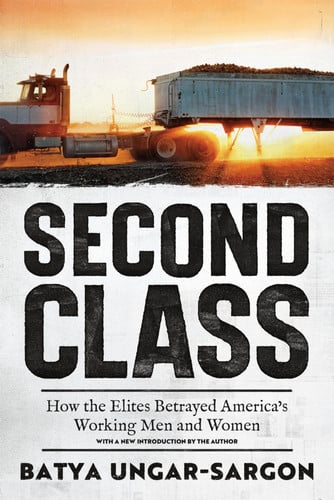
Second class: how the elite betrayed America's working men and women

Ungar-Sargon, Batya
A personal, journalistic ethnography of the modern American working class, based on the travels and interactions of the author through the American heartland. " Second Class is the most important book you will read all year. A political realignment is coming, and it's my hope that the end result will work in favor of our all-too-neglected American working class. When that realignment comes, Batya and her book will help lead the way." --Greg Lukianoff, CEO of the Foundation for Individual Rights in Education, and co-author of The Coddling of the American Mind Who is the American working class? Do they still have a fair shot at the American Dream? What do they think about their chances to secure the hallmarks of a middle-class life? While writing this book, Batya Ungar-Sargon visited states across the nation to speak with members of the American working class who are fighting tooth and nail to survive. In Second Class , working-class Americans of all races, political orientations, and occupations share their stories--cleaning ladies, health care aides, cops, truck drivers, fast food workers, electricians, and more. In their own words, these working-class Americans explain the struggles and triumphs of their increasingly precarious lives--as well as what policies they think would improve them. Second Class combines deep reporting with a look at the data and expert opinions on America's emergent class divide, in which the most basic elements of a secure and stable life are increasingly out of reach for those without a college education. America has broken its contract with its laboring class. So, how do we get back to the American Dream? How do we once again become the land of opportunity, the promised land, where hard work and commitment to family are enough to protect you from poverty? It's not that hard actually. All it would take, as this book illustrates, is for those in power to once again respect the dignity of work--and the American worker.
Encounter Books 2025 248 pages

Roll over Beethoven: the return of cultural strife

Aronowitz, Stanley
Product Description The question of culture has become central for a new generation of scholars raised in a world of television and mass production. At the same time debates about culture have become a point of reference for criticism of current trends in academia and society, variously defended or derided on the grounds of "multiculturalism," "canonicity," and political correctness." In his re-examination off these debates, Stanley Aronowitz traces the history of the cultural issue - in both its British and American manifestations - and relates it to the contemporary rethinking of the nature of knowledge and culture. Roll Over Beethoven analyzes topics as diverse as the history of American radicalism, the sociology if science, the impact of the Library of Congress on the organization of knowledge, and the institutionalization of film studies. Aronowitz's account of recent controversies over "political correctness" reveals that the current culture wars reflect profound differences among scholars over the proper role of the university and the character of legitimate intellectual knowledge. Within this broad reappraisal of the cultural question, which is embedded in the intellectual history of the 20th century, Aronowitz offers an "interpretive genealogy" of cultural studies that describes both the evolution of the field and the political and social contexts in which it developed. He argues that cultural studies exhibit a tendency toward transgression that is rarely explicit but always present and, at its best, not merely interdisciplinary but anti-disciplinary. From Publishers Weekly In this "interpretive genealogy of cultural studies," sociologist Aronowitz ( The Politics of Identity ) offers a history of this field with an eye toward examining how the nature of intellectual knowledge is defined. Though the book meanders from present-day politics to the historical debate over "high" and "low" culture to the role of the New Left in popular culture, Aronowitz's style is fairly accessible. Some arguments are undeveloped, as when he urges the Left to vigorously support the First Amendment but then suggests that "any community has a right to set limits on what it considers acceptable speech." In a chapter on the cultural politics of the Popular Front, Aronowitz offers an engaging memoir of his Bronx boyhood, recalling his rich encounters with classical and popular music and his study of political economy at a Communist Party school; he then analyzes novels and plays of the era, defending them against charges of populist oversimplification. After addressing current debates over the idea of an academic "canon," he notes that "virtually any significant educational innovation already has a history somewhere in the annals of the American academic system." Copyright 1993 Reed Business Information, Inc. From Library Journal Through his books on the labor movement, social theory, education theory, and the politics of science, Aronowitz has become one of the most interesting intellectuals on the contemporary scene. His latest work traces the emergence of "Cultural Studies" and emphasizes its invigorating impact on the humanities and social sciences. Written in an entertaining and informative style, Roll Over Beethoven could become the book that helps introduce large numbers of readers to the exciting new field of cultural interpretation. Individual chapters explore such topics as "high" versus "low" culture, culture and politics in the 1930s, the state of popular culture in contemporary America, and the relationship of cultural studies to the literary and philosophical canon. Along the way, Aronowitz offers a sophisticated critique of the revanchist critics of the modern university (Allan Bloom, William Bennett, et al.). This is a first-rate text that deserves the widest possible readership. - Kent Worcester, Social Science Research Council, New York Copyright 1993 Reed Business Information, Inc.
Wesleyan University Press 1993 277 pages

Think Straight Talk for Women to Stay Smart in a Dumbed-Down World

Lisa Bloom
"According to Lisa Bloom, the women and girls of today represent a stark paradox. While American women excel in education at every level, they likewise obsessively focus on celebrity media. While women outperform their male counterparts in employment in urban areas for the first time in history, they simultaneously spend countless hours staring in the mirror contemplating plastic surgery. Lisa Bloom fears that women are in danger of spiraling into a nation of dumbed down, tabloid media obsessed, reality TV addicts. Too often, they outsource matters to "experts" and in doing so neglect to truly think for themselves. Lisa Bloom has the solution and it involves one simple word: Think. In this provocative, entertaining, educational, and thoroughly researched book, Lisa outlines the ways that we as a society, and particularly women, have fallen off the intellectual path, and, very specifically, points to how damaging this has been to us on many levels. Lisa shows us the fallout--but she also provides the solutions for "Reclaiming the Brain God Gave You" and seizing back control of your mind and your life. Think is delivered in a no-nonsense manner that will make you laugh, make you question yourself, make you squirm, but, most important, make you start thinking again"--
Hachette Books 2012-04-03 288 pages

Ours was the shining future: the story of the American dream

Leonhardt, David
"The stagnation of living standards for most Americans over the past few decades has been the defining trend of modern life in the United States. Wealth and educational attainment have all slowed to a crawl in the twenty first century, while life expectancy has declined, economic inequality has soared, and the Black-White wage gap is as large as it was when Harry Truman was president. How did this happen in the world's most powerful country? Drawing from decades of writing about the economy for the New York Times, as well as years spent digging through archives, Pulitzer Prize-winning writer David Leonhardt tells the story of the past century of the American economy, starting with the Great Depression and the invention of the term "American dream." UNTITLED explains how the United States built the most prosperous mass economy in history after the Depression, then examines how that economy unraveled after our postwar boom. Its central argument is that three forces, above all, have dictated the economy's rise and fall: political power through grass-roots movement, culture, and investment in making life better for the future. Filled with the clear, lucid writing for which Leonhardt is known, UNTITLED is an enlightening economic history, featuring the unforgettable figures who helped shape the American dream: Frances Perkins, Eisenhower, Cesar Chavez, Betty Friedan, Robert Kennedy, Grace Hopper, Paul Hoffman, and more"--
Random House 2023-10-24 492 pages

Rockonomics

Krueger, Alan B.
'An entertaining guide to economics by a former adviser to Barack Obama that uses the lessons of the music business to explain what is happening in the rest of the world' The Times , Books of the Year 'A key voice on a vast array of economic issues for more than two decades' Barack Obama 'An absolutely brilliant mind. The definition of left and right brain balance' Quincy Jones 'The music business keeps re-inventing itself (from records, to tape, to CDs to streaming) and Alan Krueger covers all the bases. As one former LSE student once sang: 'its only rock and roll but I like it, like it, yes I do.' That applies to this book too' Richard Thaler, Nobel Prize Recipient and author of 'Nudge' ' Rockonomics is entertaining, educational and enlightening. Alan Krueger gives us a backstage tour of the music industry - and in doing so, he creates a brilliant metaphor for our entire economy. Highly recommended' Harlan Coben Alan Krueger, the former chairman of the president's Council of Economic Advisers, uses the music industry, from rock artists to music executives, from managers to promoters, as a way in to explain the principles of economics, and the forces shaping our economic lives. The music industry is often a leading indicator of today's economy; it is among the first to be disrupted by the latest wave of technology, and examining the ins and outs of how musicians create and sell new songs and plan concert tours offers valuable lessons for what is in store for businesses and employees in other industries that are struggling to adapt. Drawing on interviews with leading band members, music executives, managers, promoters, and using the latest data on revenues, royalties, tour dates, and merchandise, Rockonomics takes readers backstage to show how the music industry really works - who makes money, how the economics of the music industry has undergone a radical transformation during the last twenty years, and what this tells us about our wider economy today.
John Murray 2020-08-20 325 pages

Kay's brilliant brains

Kay, Adam
KAY'S BRILLIANT BRAINS is a mini book written and illustrated for World Book Day 2023 by the record-breaking Adam Kay and Henry Paker. It's a hilarious celebration of the world's most ingenious geniuses and all that their brilliant brains achieved. One hundred billion people have lived on earth. Unfortunately, this book would be too heavy if it talked about them all, so it's about ten of them. You'll meet Amelia Earhart, who flew across a huge ocean in a tiny plane, back in the days when planes were basically made out of old bits of wood (and worst of all, they didn't have in-flight movies) and Thomas Edison, who invented light bulbs and movie cameras (but only went to school until he was twelve). Plus a whole bunch more other brilliant people with brilliant brains who woke up one day and thought 'Oh, I've got an idea . . . !' and changed the world forever. Praise for Kay's Anatomy: 'An enjoyably gross look at the human body. Hours of gruesome fun guaranteed' i 'Like listening to a teacher who makes pupils fall about' Sunday Times 'Totally brilliant!' Jacqueline Wilson 'Fun and informative' Malorie Blackman 'Very funny - this exciting book is bound to inspire the next generation of medics' Sunday Express Praise for Kay's Marvellous Medicine: 'A ridiculously funny read that will delight, gross out and educate all at the same time' Independent 'Educational and entertaining. It should be on the national curriculum!' Harry Hill 'Completely marvellous and very funny' BookTrust
Puffin 2023-02-16 96 pages

The tyranny of the meritocracy: democratizing higher education in America

Guinier, Lani
"Standing on the foundations of America's promise of equal opportunity, our universities purport to "serve as engines of social mobility" and "practitioners of democracy." But as acclaimed scholar and pioneering civil rights advocate Lani Guinier argues, the merit systems that dictate the admissions practices of these institutions are functioning to select and privilege elite individuals rather than create learning communities geared to advance democratic societies. Having studied and taught at schools such as Harvard University, Yale Law School, and the University of Pennsylvania Law School, Guinier has spent years examining the experiences of ethnic minorities at the nation's top institutions of higher education, and here she lays bare the practices that impede the stated missions of these schools. Guinier argues for reformation, not only of the very premises of admissions practices but of the shape of higher education itself, and she offers many examples of new collaborative initiatives that prepare students for engaged citizenship in our increasingly multicultural society"--
Beacon Press 2015 160 pages

Motherland: a feminist history of modern Russia, from revolution to autocracy

Ioffe, Julia
"Award-winning journalist Julia Ioffe tells the story of modern Russia through the history of its women, from revolution to utopia to autocracy. In 1990, seven-year-old Julia Ioffe and her family fled the Soviet Union. Nearly twenty years later, Ioffe returned to Moscow-only to discover just how much Russian society had changed while she had been living in America. The Soviet women she had known growing up-doctors, engineers, scientists-had seemingly been replaced with women desperate to marry rich and become stay-at-home moms. How had Russia gone from portraying itself as the vanguard of world feminism to the last bastion of conservative Christian values? In Motherland, Ioffe turns modern Russian history on its head, telling it exclusively through the stories of its women. From her own physician great-grandmothers to Lenin's lover, a feminist revolutionary; from the hundreds of thousands of Soviet girls who fought in World War II to the millions of single mothers who rebuilt and repopulated a devastated country; from the members of Pussy Riot to Yulia Navalnaya, wife of opposition leader Alexei Navalny, she chronicles one of the most audacious social experiments in history and how it failed the very women it was meant to liberate-and documents how that failure paved the way to the revanche of Vladimir Putin. Part memoir, part journalistic exploration, part history, Motherland paints a portrait of modern Russia through the women who shaped it. With deep emotion, Ioffe shows what it means to live through the cataclysms of revolution, war, idealism, and heartbreak-and reveals how the story of Russia today is inextricably tied to the history of its women"-- Provided by publisher.
Ecco, an imprint of Harper Collins Publishers 2025-10 489 pages