73 results for "Educational"

The schools we need and why we don't have them

Hirsch, E. D.
The author of Cultural Literacy offers a powerful, compelling, and unassailable argument for reforming America's schooling methods and ideas. From kindergarten through high school, the American education is the worst in the developed world, and the causes of its failure and any possible solutions to it are hotly disputed. For over fifty years, American schools have operated on the assumption that challenging children is bad for them, teachers do not need to know the subjects they teach, that the learning "process" should be emphasised over the facts taught within it. Yet, as renowned educator and author E. D. Hirsch shows in The Schools We Need, this establishment ideology is a tragedy of good intentions gone awry. Hirsch argues that in eschewing content-based curricula for abstract--and disproved--theories of congnitive development, the educational establishment has done irreparable harm to America's students, and instead of preparing them for the country's highly competitive, information-based economy, the process-oriented curricula the establishment practices has severely curtailed their ability, and desire, to learn. Suggesting a curriculum based on hard work, knowledge aquisition, and rigorous testing that has been proven successful time after time, The Schools We Need offers a proficient and workable solution. By providing evidence of numerous studies proving that fact-based education works, and a glossary of brief, authoritative explanations of educational phrases often used to dazzle teachers and the general public, Hirsch proves that if children are taught substantial knowledge and skills, and learn to work hard to acquire them, their test scores will rise, their love of learning will grow, and they will become enthusiastic participants in the information-age civilization. The Schools We Need is a passionate and thoughtful book that will appeal to the millions of people who can't understand why American schools just don't work.
Doubleday 1996 317 pages

The schools we need and why we don't have them

Hirsch, E. D.
From kindergarten through high school, our public educational system is among the worst in the developed world. For over fifty years, the assumption that challenging children academically is unnatural for them, that teachers do not need to know the subjects they teach, that the learning "process" should by emphasized over the facts taught has prevailed. all this is tragically wrong. As renowned educator and author E.D. Hirsch, Jr., argues in The Schools We Need, in disdaining content-based curricula for abstract - and discredited - theories of how a child learns, the ideas uniformly taught by our schools have done terrible harm to America's students. Instead of preparing our children for the highly competitive, information-based economy in which we now live, our school practices have severely curtailed their ability, and desire, to learn. There is a solution. Mainstream research has shown that if children - all children, not just the privileged - are taught in ways that emphasize hard work, the learning of facts, and rigorous testing, their enthusiasm for school will grow, their test scores will rise, and they will become successful citizens in the information-age civilization.
Doubleday 1996 317 pages

Howard Zinn on democratic education

Zinn, Howard
Perhaps no other historian has had a more profound and revolutionary impact on American education than Howard Zinn. This is the first book devoted to his views on education and its role in a democratic society. Howard Zinn on Democratic Education describes what is missing from school textbooks and in classrooms-and how we move beyond these deficiencies to improve student education. Critical skills of citizenship are insufficiently developed in schools, according to Zinn. Textbooks and curricula must be changed to transcend the recitation of received wisdom too common today in schools. In these respects, recent Bush Administration and educational policies of most previous US presidents have been on the wrong track in meeting educational needs. This book seeks to redefine national goals at a time when public debates over education have never been more polarised--nor higher in public visibility and contentious debate. Zinn's essays on education-many never before published--are framed in this book by a dialogue between Zinn and Donaldo Macedo, a distinguished critic of literacy and schooling, whose books with Paulo Freire, Noam Chomsky and other authors have received international acclaim.
Paradigm Publishers 2005 213 pages

With God on our side: one man's war against an evangelical coup in America's military

Weinstein, Michael L.
One of the most elite educational institutions in the world, the Air Force Academy has, from its inception, attracted the best and the brightest, producing leaders not only in the military but throughout American society. In recent years, however, the Academy has also been producing a cadre of zealous evangelical Christians intent on creating a fundamentalist power base at the highest levels of our country. With God on Our Side is shocking exposé of life inside the United States Air Force Academy and the systematic program of indoctrination sanctioned, coordinated, and carried out by fundamentalist Christians within the U.S. military. It is also the story of Michael L. Weinstein, a proud Academy graduate and the father of two graduates and a current cadet, who single-handedly brought to light the evangelicals' utter disregard of the constitutional principle of separation of church and state that is so essential to the nation's military mission. Weinstein's war would pit him and his small band of fellow graduates, cadets, and concerned citizens against a program of Christian fundamentalist indoctrination that could transform our fighting men and women into "right-thinking" warriors more befitting a theocracy. In the process, he would come face to face with religious bigotry and at its most extreme and fight an unrelenting battle to save his beloved Academy, the ideals it stood for, and the very future of the country. An important book at a critical time in our nation's history, With God on Our Side is the story of one man's courageous struggle to thwart a creeping evangelism permeating America's military and to prevent a taxpayer-funded theocracy in which only the true believers have power.
Thomas Dunne Books 2006-10-03 258 pages

The emancipatory promise of charter schools: toward a progressive politics of school choice

Eric Rofes,Lisa M. Stulberg
This book opens up a critical conversation among progressive educators of various generations, races, perspectives, and social locations concerning one specific school reform initiative—charter schools. Eric Rofes and Lisa M. Stulberg bring together scholars who both study and actively participate in school choice reform and charge them to be “bold in their questioning and assertive in their own ambivalence” about this complex, controversial public issue and to include issues that are underexamined in the school literature, such as the impact of school choice on race and class politics and inequalities. The editors argue that charter schools are playing a powerful role in reviving participation in public education, expanding opportunities for progressive methods in public school classrooms, and generating new energy for community-based, community-controlled school initiatives. The result is a groundbreaking volume that pushes boundaries, questions assumptions, and rocks foundations of progressive thought.
State University of New York Press 2004-10-14 314 pages

These schools belong to you and me: why we can't afford to abandon our public schools

Meier, Deborah,Gasoi, Emily
"A challenge to narrow, profit-driven conceptions of school success and an argument for protecting public education to ensure that all students become competent citizens in a vibrant democracy MacArthur award-winning educator, reformer, and author Deborah Meier draws on her fifty-plus years of experience in education to argue that the purpose of universal education is to provide young people with an "apprenticeship for citizenship in a democracy." Through an intergenerational exchange with her former colleague and fellow educator Emily Gasoi, the coauthors share their experiences working in democratically governed schools and analyze the last several decades of education reform. Reflecting on the trajectory of education and social policies that are leading our country further from rule "of, for, and by the people," the authors apply their extensive knowledge and years of research to address the question of how public education must change in order to counter the erosion of democratic spirit and practice in schools and in the nation as a whole"--
Beacon Press 2017-09-19 195 pages

Mixing races: from scientific racism to modern evolutionary ideas

Farber, Paul Lawrence
This book explores changing American views of race mixing in the twentieth century, showing how new scientific ideas transformed accepted notions of race and how those ideas played out on college campuses in the 1960s. In the 1930s, it was not unusual for medical experts to caution against miscegenation, or race mixing, espousing the common opinion that it would produce biologically dysfunctional offspring. By the 1960s the scientific community roundly refuted this theory. The author traces this revolutionary shift in scientific thought, explaining how developments in modern population biology, genetics, and anthropology proved that opposition to race mixing was a social prejudice with no justification in scientific knowledge. In the 1960s, this new knowledge helped to change attitudes towards race and discrimination, especially among college students. Their embrace of social integration caused tension on campuses across the country. Students rebelled against administrative interference in their private lives, and university regulations against interracial dating became a flashpoint in the campus revolts that revolutionized American educational institutions. The author's provocative study is a personal one, featuring interviews with mixed-race couples and stories from the author's student years at the University of Pittsburgh. As such, this book offers a unique perspective on how contentious debates taking place on college campuses reflected shifts in race relations in the larger society. -- from Back Cover
Johns Hopkins University Press 2011-02-01 120 pages

The real world of college: what higher education is and what it can be

Fischman, Wendy,Gardner, Howard
"For The Real World of College, Wendy Fischman and Howard Gardner analyzed in-depth interviews with more than 2,000 students, alumni, faculty, administrators, parents, trustees, and others, which were conducted at ten institutions ranging from highly selective liberal arts colleges to less-selective state schools. What they found challenged characterizations in the media: students are not preoccupied by political correctness, free speech, or even the cost of college. They are most concerned about their GPA and their resumes; they see jobs and earning potential as more important than learning. Many say they face mental health challenges, fear that they don't belong, and feel a deep sense of alienation. Given this daily reality for students, has higher education lost its way? Fischman and Gardner contend that US universities and colleges must focus sharply on their core educational mission. Fischman and Gardner, both recognized authorities on education and learning, argue that higher education in the United States has lost sight of its principal reason for existing: not vocational training, not the provision of campus amenities, but to increase what Fischman and Gardner call "higher education capital"--to help students think well and broadly, express themselves clearly, explore new areas, and be open to possible transformations. Fischman and Gardner offer cogent recommendations for how every college can become a community of learners who are open to change as thinkers, citizens, and human beings."--
The MIT Press 2022 384 pages

The making of Americans: democracy and our schools

Hirsch, E. D.
From the bestselling author of Cultural Literacy , a passionate and cogent argument for reforming the way we teach our children "Ought to be read by anyone interested in the education and training of the next generation of Americans."--Glenn C. Altschuler, Boston Globe Why, after decades of commissions, reforms, and efforts at innovation, do our schools continue to disappoint us? In this comprehensive and thought-provoking book, educational theorist E. D. Hirsch, Jr. offers a masterful analysis of how American ideas about education have veered off course, what we must do to right them, and most importantly why . He argues that the core problem with American education is that educational theorists, especially in the early grades, have for the past sixty years rejected academic content in favor of "child-centered" and "how-to" learning theories that are at odds with how children really learn. The result is failing schools and widening inequality, as only children from content-rich (usually better-off) homes can take advantage of the schools' educational methods. Hirsch unabashedly confronts the education establishment, arguing that a content-based curriculum is essential to addressing social and economic inequality. A nationwide, specific, grade-by-grade curriculum established in the early school grades can help fulfill one of America's oldest and most compelling dreams: to give all children, regardless of language, religion, or origins, the opportunity to participate as equals and become competent citizens. Hirsch not only reminds us of these inspiring ideals, he offers an ambitious and specific plan for achieving them.
Yale University Press 2009 261 pages

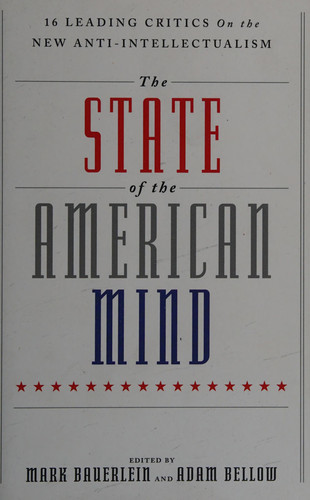
The state of the American mind: 16 leading critics on the new anti-intellectualism

Mark Bauerlein,Adam Bellow
In 1987, Allan Bloom’s The Closing of the American Mind was published; a wildly popular book that drew attention to the shift in American culture away from the tenants that made America—and Americans—unique. Bloom focused on a breakdown in the American curriculum, but many sensed that the issue affected more than education. The very essence of what it meant to be an American was disappearing. That was over twenty years ago. Since then, the United States has experienced unprecedented wealth, more youth enrolling in higher education than ever before, and technology advancements far beyond what many in the 1980s dreamed possible. And yet, the state of the American mind seems to have deteriorated further. Benjamin Franklin’s “self-made man” has become a man dependent on the state. Independence has turned into self-absorption. Liberty has been curtailed in the defense of multiculturalism. In order to fully grasp the underpinnings of this shift away from the self-reliant, well-informed American, editors Mark Bauerlein and Adam Bellow have brought together a group of cultural and educational experts to discuss the root causes of the decline of the American mind. The writers of these fifteen original essays include E. D. Hirsch, Nicholas Eberstadt, and Dennis Prager, as well as Daniel Dreisbach, Gerald Graff, Richard Arum, Robert Whitaker, David T. Z. Mindich, Maggie Jackson, Jean Twenge, Jonathan Kay, Ilya Somin, Steve Wasserman, Greg Lukianoff, and R. R. Reno. Their essays are compiled into three main categories: States of Mind: Indicators of Intellectual and Cognitive Decline These essays broach specific mental deficiencies among the population, including lagging cultural IQ, low Biblical literacy, poor writing skills, and over-medication. Personal and Cognitive Habits/Interests These essays turn to specific mental behaviors and interests, including avoidance of the news, short attention spans, narcissism, and conspiracy obsessions. National Consequences These essays examine broader trends affecting populations and institutions, including rates of entitlement claims, voting habits, and a low-performing higher education system. The State of the American Mind is both an assessment of our current state as well as a warning, foretelling what we may yet become. For anyone interested in the intellectual fate of America, The State of the American Mind offers an accessible and critical look at life in America and how our collective mind is faring.
Templeton Press 2015-06-16 260 pages

Fortunate sons: the 120 Chinese boys who came to America, went to school, and revolutionized an ancient civilization

Leibovitz, Liel
In 1872, the Qing Empire sent 120 boys to America in the hope that they would unlock the mysteries of Western innovation. They studied at New England's finest schools, befriended luminaries such as Mark Twain and Ulysses S. Grant, and exchanged ideas with their American peers that would change the course of both nations. But when anti-Chinese fervor forced them back home, the young men faced a new set of obstacles, having to overcome a suspicious imperial court and a culture deeply resistant to change. Filled with colorful characters and vivid historical detail, this book unearths the dramatic stories of these young men who led China at the pivotal moment when it teetered between modernity and tradition.--From publisher description.
W.W. Norton 2011 319 pages

Too soon to tell

Trillin, Calvin
The topical essays of Too Soon to Tell reveal Calvin Trillin at his barbed and irrepressible best. Dealing with matters of the family, he tells the tale of a couple who were at first pleased that their twenty-six-year-old son had finally moved out ("If Jeffrey's going to find himself, it would probably help for him to look somewhere other than his own room") and then realized that they had lost the ability to videotape. Grappling with educational issues, he discusses whether the presence of Michael Milken as a lecturer at the UCLA business school means that its religion department will get around to employing Jim Bakker ("Church Management 101: Imaginative Ideas in Religious Fund-Raising"). In the field of world affairs, he deals with the role of astrologers ("The planets are perfect for trading arms for hostages and saying you didn't") and whether the language laws in Quebec really require the hiring of a mime who doesn't speak French rather than a mime who doesn't speak English. Trillin's short takes send us back to life refreshed and delighted.
Farrar, Straus, Giroux 1995 292 pages