43 results for "Environment"

Food justice

Gottlieb, Robert
In today's food system, farm workers face difficult and hazardous conditions, low-income neighborhoods lack supermarkets but abound in fast-food restaurants and liquor stores, food products emphasize convenience rather than wholesomeness, and the international reach of American fast-food franchises has been a major contributor to an epidemic of "globesity." To combat these inequities and excesses, a movement for food justice has emerged in recent years seeking to transform the food system from seed to table. In Food Justice , Robert Gottlieb and Anupama Joshi tell the story of this emerging movement. A food justice framework ensures that the benefits and risks of how food is grown and processed, transported, distributed, and consumed are shared equitably. Gottlieb and Joshi recount the history of food injustices and describe current efforts to change the system, including community gardens and farmer training in Holyoke, Massachusetts, youth empowerment through the Rethinkers in New Orleans, farm-to-school programs across the country, and the Los Angeles school system's elimination of sugary soft drinks from its cafeterias. And they tell how food activism has succeeded at the highest level: advocates waged a grassroots campaign that convinced the Obama White House to plant a vegetable garden. The first comprehensive inquiry into this emerging movement, Food Justice addresses the increasing disconnect between food and culture that has resulted from our highly industrialized food system.
MIT Press 2010 290 pages

Warming the world: economic models of global warming

Nordhaus, William D.
This book presents in detail a pair of models of the economics of climate change. The models, called RICE-99 (for the Regional Dynamic Integrated model of Climate and the Economy) and DICE-99 (for the Dynamic Integrated Model of Climate and the Economy) build on the authors' earlier work, particularly their RICE and DICE models of the early 1990s. Humanity is risking the health of the natural environment through a myriad of interventions, including the atmospheric emission of trace gases such as carbon dioxide, the use of ozone-depleting chemicals, the engineering of massive land-use changes, and the destruction of the habitats of many species. It is imperative that we learn to protect our common geophysical and biological resources. Although scientists have studied greenhouse warming for decades, it is only recently that society has begun to consider the economic, political, and institutional aspects of environmental intervention. To do so raises formidable challenges of data modeling, uncertainty, international coordination, and institutional design. Attempts to deal with complex scientific and economic issues have increasingly involved the use of models to help analysts and decision makers understand likely future outcomes as well as the implications of alternative policies. This book presents in detail a pair of models of the economics of climate change. The models, called RICE-99 (for the Regional Dynamic Integrated model of Climate and the Economy) and DICE-99 (for the Dynamic Integrated Model of Climate and the Economy) build on the authors' earlier work, particularly their RICE and DICE models of the early 1990s. They can help policy makers design better economic and environmental policies.
MIT Press 2000 232 pages

Cities for a small planet

Rogers, Richard
Nothing else damages the earth's environment more than our cities. As the world's population has grown, our cities have burgeoned, and their impact on the environment worsened. Meanwhile, from the isolated, gated communities within Houston and Los Angeles, to the millions of residents of Bombay living in squalor, the city has failed to serve its ideal function—as the cradle of civilization, the engine of culture, and the inspiration for community and citizenship. In Cities for a Small Planet , Sir Richard Rogers, one of the world's leading architects and the designer of the Pompidou Center in Paris, demonstrates how future cities could provide the springboard for restoring humanity's harmony with its environment.Rogers outlines the disastrous impact cities have had and will continue to have on our world, from waste-saturated Tokyo Bay, to the massive plumes of pollution caused by London's traffic, to the depleted water resources of Mexico City. He traces these problems to the underlying social and cultural values that create them—unchecked commercial zeal, selfish individualism, and a lack of community. Bringing to bear concepts such as that of “open-minded” space—places within cities that serve multiple functions such as markets, parks, and sidewalk cafes—he explains how urban design can be used to give citizens a sense of shared experience. The city built with comfortable and safe public space can bring diverse groups together and breed a sense of tolerance, awareness, identity, and mutual respect. He calls for a new theoretical shift in the way cities do business and interact with the environment, arguing that many products come to market and are sold without figuring their social or environmental cost.Rogers goes on to describe the city of the future: one that is sustainable within its own environment; that can make a positive impact on its surroundings; that encourages communication among its citizens; that is compact and focused around neighborhoods; and that is beautiful, a city whose buildings and spaces spark the creative potential of its inhabitants.As our population grows larger, our planet grows smaller. Cities for a Small Planet is a passionate and eloquent blueprint for the cities we must create in response, cities that provide for the needs of both their residents and the earth on which they live.
Faber and Faber 1997 180 pages

One billion Americans: the case for thinking bigger

Yglesias, Matthew
"A bold case for massive population growth in the name of national greatness--from Vox co-founder and host of "The Weeds" podcast Matt Yglesias. America is in decline. Fewer children are born each year due to financial pressure. Thousands flee our iconic cities with their housing shortages and broken infrastructure. While we tie ourselves into knots trying to stop the flow of immigrants, our exhausted economy deflates the heartland's already shrinking population. To survive China's impending global takeover (not to mention Russia), we can't afford to be weak. We need to get bigger, much bigger. We need one billion Americans. In this timely and provocative book, Matthew Yglesias makes the case for massive population growth through humane family and immigration policy. Of course, more people requires more housing, not to mention better transportation, improved education, a revitalized welfare system, and climate change mitigation. Why not do it all, and stay on top forever? Written with Yglesias's signature humor and analytic rigor, One Billion Americans challenges readers across the political spectrum to take decline seriously. Drawing on economic theory and research from leading policy experts, he offers ideas from around the globe--from Singapore's approach to traffic jams to Canada's town planning--that move us beyond left-right divides, to explore the practical and creative solutions our times call for"--
Portfolio / Penguin, an imprint of Penguin Random House LLC 2020-09-15 267 pages

Crop chemophobia: will precaution kill the green revolution?

Jon Entine
The Green Revolution of 1960s introduced herbicides, pesticides, and advanced agricultural technologies to third world countries-rescuing hundreds of millions of people from malnutrition and starvation and transforming low-yield, labor-intensive farming into the high-tech, immensely productive industry it is today. Despite these stunning gains, critics of chemical farming remain vocal. Recently, the European Union passed a ban on twenty-two chemicals-about 15 percent of the EU pesticides market-to begin in 2011. In Crop Chemophobia, Jon Entine and his coauthors examine the "precautionary principle" that underlies the EU's decision and explore the ban's potential consequences-including environmental degradation, decreased food safety, impaired disease-control efforts, and a hungrier world.
AEI Press 2011 158 pages

Greenhouse solutions with sustainable energy

Diesendorf, Mark
Global warming is the hottest political issue of the day, and it is likely to become even more pressing over the coming years. It is arguably the most dangerous environmental problem and the most difficult political issue to be faced by the world in the 21st century. This important and proactive new book by Mark Diesendorf critically assesses the various technologies that have been put forward as solutions and constructs feasible scenarios for their effective implementation. based on energy efficiency, renewable energy and natural gas are commercially available today, and that their implementation could halve Australia's greenhouse gas emissions within just a few decades. To implement these technologies, new policies must be developed and implemented by all three levels of government.
University of New South Wales Press 2007 413 pages

The greening of trade law: international trade organizations and environmental issues

Richard H. Steinberg
"Trade and the environment" issues have engaged powerful non-governmental organizations in the United States, Europe, and elsewhere. Environmentalists and labor union leaders have been concerned that falling international trade barriers, along with international trade organizations associated with free trade, are undermining environmental protection. In contrast, business leaders and developing-country governments have been concerned that purported environmental regulations may be used as disguised barriers to trade. Those with competing perspectives on these issues have clashed in scholarly journals, the editorial pages of leading newspapers, the halls of government-and in the streets. This is the first book that systematically compares how each of the world's major international trade organizations has been addressing environmental issues. It provides background, up-to-date information, and analysis on the development of trade-environment rules in the World Trade Organization, the European Union, the North American Free Trade Agreement, the Free Trade Area of the Americas, the Asia Pacific Economic Cooperation forum, the International Organization for Standardization, and other key organizations. All of the essays are both policy-oriented and conscious of their theoretical underpinnings. Together they offer a range of realist, liberal, and institutionalist perspectives. The book concludes by suggesting that the treatment of environmental issues in international trade organizations is best explained by understanding the trade and environment interests of the world's most powerful countries.
Rowman & Littlefield Publishers 2002 324 pages

The enemy of nature: the end of capitalism or the end of the world?

Kovel, Joel
We live in and from nature, but the way we have evolved of doing this is about to destroy us. capitalism and its by-products–imperialism, war, neoliberal globalization, racism, poverty and the destruction of community–are all playing a part in the destruction of our ecosystem. only now are we beginning to realize the depth of the crisis and the kind of transformation that will have to occur to ensure our survival. This second, thoroughly updated, edition of The Enemy of Nature speaks to this new environmental awareness. By suggesting a radical new way forward, a new kind of “ecosocialism,” Joel Kovel offers real hope and vision for a more sustainable future.
Zed Books 2007 329 pages

To be a water protector: the rise of the Wiindigoo slayers

LaDuke, Winona
"Winona LaDuke is a leader in cultural-based sustainable development strategies, renewable energy, sustainable food systems and Indigenous rights. To Be a Water Protector, explores issues that have been central to her activism for many years -- sacred Mother Earth, our despoiling of Earth and the activism at Standing Rock and opposing Line 3. For this book, Winona discusses several elements of a New Green Economy and the lessons we can take from activists outside the US and Canada. Also featured are her annual letters to Al Monaco, the CEO of Enbridge, in which she takes him to task for the company's role in the climate crisis and presents him with an invoice for climate damages. In her unique way of storytelling, Winona LaDuke is inspiring, always a teacher and an utterly fearless activist, writer and speaker."--
Fernwood Publishing 2020 311 pages

Broadband networks, smart grids and climate change

Eli M. Noam,Lorenzo Pupillo,Johann J. Kranz
In smart grids the formerly separated worlds of energy and telecommunication converge to an interactive and automated energy supply system. Driven by social, legal, and economic pressures, energy systems around the globe are updated with information and communication technology. These investments aim at enhancing energy efficiency, securing affordable energy supply, and mitigate climate change. In Broadband Networks, Smart Grids and Climate Change, renowned scholars and managers from the fields of energy and telecommunication address key questions related to technological, strategic, and regulatory issues revealing consequences and opportunities for businesses evolving with smart grids. In particular, this book analyzes: (1) the effects on climate change protection (2) national energy and broadband politics (3) regulatory approaches and requirements (4) emerging business models
Springer 2013 255 pages

The case against the global economy: and for a turn toward the local

Jerry Mander,Edward Goldsmith
Expressed in such new institutions as GATT, NAFTA, the World Trade Organizations, and Maastricht, as well as by the development schemes of the World Bank and the International Monetary Fund, economic globalization has been bulldozed through legislative bodies throughout the world, with scant public debate or discourse. These tremendous changes are hailed by their backers as leading to a new era or prosperity and peace, but is this true? Now, for the first time, we have a comprehensive point-by-point analysis of the workings of the global economy, its premises, and its dire implications told by more than forty of the world's leading social, environmental, and economic thinkers from the America's, Europe, Asia, and the Pacific. They charge that free trade and economic globalization create exactly the opposite results from what is promised. Each of the forty-three chapters in The Case Against the Global Economy takes one part of the story and delves into it, to show both the root assumptions of globalism and its multiple failures. In the end, it is clear that we need to reverse course; away from the global toward a revitalization of local political and economic control, self-sufficiency, and ecological health.
Sierra Club Books 1996 550 pages

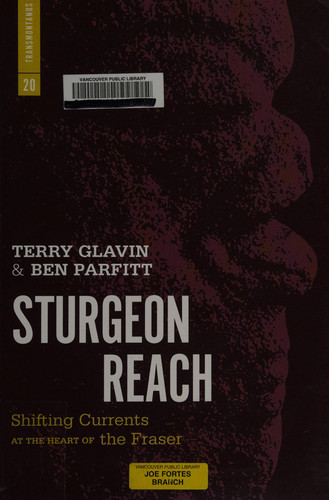
Sturgeon Reach: shifting currents at the heart of the Fraser

Glavin, Terry
Sturgeon Reach is the name some have given to a stretch of the Fraser River between Hope and Pitt Meadows, where its flow slows, and it deposits the gravel it's been carrying from the province's interior. Its story is one of rocks and stones, from its geological origins, from the mythic beginnings of human settlement, and from the arrival of Simon Fraser through to the onslaught of dykes and roads and bridges and foundations that today threaten the river's essential nature. Sturgeon Reach hosts an incredible array of life, from giant black cottonwoods to a creature that dates from the age of dinosaurs –– the remarkable white sturgeon. This stretch of river is the spawning ground for major salmon runs. And for millennia, it has also been the home of the Sto:lo Indians. How can we now live well along a river that has a ceaseless desire to overflow its banks and set its own course? How can we allow the life that the river's character fosters to persist in the face of overwhelming development? In the 20th book in the Transmontanus series, Terry Glavin and Ben Parfitt explore Sturgeon Reach — its geography, its history, its critical role in the coastal ecosystem, and the compelling story it tells about competing human needs.
New Star Books 2012-11-15 69 pages