898 results for "Evolution"

The four horsemen: the conversation that sparked an atheist revolution

Hitchens, Christopher,Dawkins, Richard,Harris, Sam,Dennett, D. C.
"At the dawn of the new atheist movement, the thinkers who became known as "the four horsemen," the heralds of religion's unravelling--Christopher Hitchens, Richard Dawkins, Sam Harris, and Daniel Dennett--sat down over cocktails for a filmed discussion. The video of the enthralling, path breaking evening that followed was released on YouTube and soon went viral. This is intellectual inquiry at its best: sincere and probing, funny and unpredictable, reminding us just how varied and colorful the threads of modern atheism are. Now, this landmark event is being published for the first time. The living participants, Dawkins, Harris, and Dennett, have all contributed new material to mark the evolution of their own thinking and highlight particularly resonant aspects of this epic exchange. Each of these men contends with the most fundamental questions of human existence as they challenge each other to articulate their own stance on god and religion, cultural criticism, spirituality without religion, debate with people of faith, and living an ethical life"--
Random House 2019-03-19 134 pages

Classic Drucker: essential wisdom of Peter Drucker from the pages of Harvard Business Review

Drucker, Peter F.
For nearly half a century, Peter Drucker inspired and educated managers--and powerfully shaped the nature of business--with his landmark articles in Harvard Business Review . Here, framed by a thoughtful introduction from "HBR" editor Thomas A. Stewart, is a priceless collection of Drucker's most significant work. Through his unique lens, Drucker traces the evolution of the great shifts in organizations and the role of managers in the ongoing effort to balance change with continuity. He paints a clear, comprehensive picture of management thinking and practice--as it was and as it will be. Revealing a celebrated thinker at his best, Classic Drucker offers a wealth of insights and practical guidelines for managers seeking to address today's thorniest organizational challenges.For example, you'll find selections on how to enhance your company's innovative prowess, make effective decisions, raise knowledge workers' productivity, remain engaged and productive during a long work life, know when the assumptions on which your business was founded must change, and get the data you need to execute your company's competitive strategy. Doing what's right for your company will always be challenging. But thanks to the clear focus, broad vision, and practical wisdom of Peter Drucker, the task is now a little less daunting.
Harvard Business Review Book 2006 221 pages

I Remember Nothing And Other Reflections

Nora Ephron
Nora Ephron returns with her first book since the astounding success of I Feel Bad About My Neck, taking a cool, hard, hilarious look at the past, the present, and the future, bemoaning the vicissitudes of modern life, and recalling with her signature clarity and wisdom everything she hasn’t (yet) forgotten. Ephron writes about falling hard for a way of life (“Journalism: A Love Story”) and about breaking up even harder with the men in her life (“The D Word”); lists “Twenty-five Things People Have a Shocking Capacity to Be Surprised by Over and Over Again” (“There is no explaining the stock market but people try”; “You can never know the truth of anyone’s marriage, including your own”; “Cary Grant was Jewish”; “Men cheat”); reveals the alarming evolution, a decade after she wrote and directed You’ve Got Mail, of her relationship with her in-box (“The Six Stages of E-Mail”); and asks the age-old question, which came first, the chicken soup or the cold? All the while, she gives candid, edgy voice to everything women who have reached a certain age have been thinking . . . but rarely acknowledging. Filled with insights and observations that instantly ring true—and could have come only from Nora Ephron— I Remember Nothing is pure joy. From the Hardcover edition.
Random House Large Print 2010 147 pages

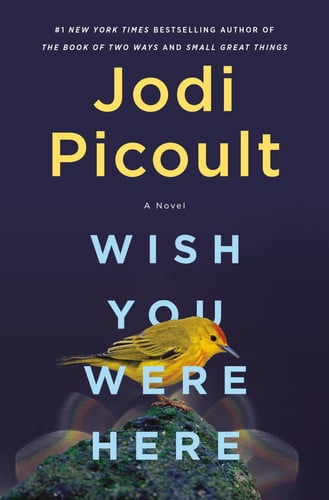
Wish you were here: a novel

Picoult, Jodi
"From the #1 New York Times bestselling author of Small Great Things and The Book of Two Ways comes a deeply moving novel about the resilience of the human spirit in a moment of crisis. Diana O'Toole is perfectly on track. She will be married by thirty, done having kids by thirty-five, and move out to the New York City suburbs, all while climbing the professional ladder in the cutthroat art auction world. She's an associate specialist at Sotheby's now, but her boss has hinted at a promotion if she can close a deal with a high-profile client. She's not engaged just yet, but she knows her boyfriend, Finn, a surgical resident, is about to propose on their romantic getaway to the Galapagos-days before her thirtieth birthday. Right on time. But then a virus that felt worlds away has appeared in the city, and on the eve of their departure, Finn breaks the news: It's all hands on deck at the hospital. He has to stay behind. You should still go, he assures her, since it would be a shame for all of their nonrefundable trip to go to waste. And so, reluctantly, she goes. Almost immediately, Diana's dream vacation goes awry. Her luggage is lost, the Wi-Fi is nearly nonexistent, and the hotel they'd booked is shut down due to the pandemic. In fact, the whole island is now under quarantine, and she is stranded until the borders reopen. Completely isolated, she must venture beyond her comfort zone. Slowly, she carves out a connection with a local family when a teenager with a secret opens up to Diana, despite her father's suspicion of outsiders. In the Galapagos Islands, where Darwin's theory of evolution by natural selection was formed, Diana finds herself examining her relationships, her choices, and herself-and wondering if when she goes home, she too will have evolved into someone completely different"--
Ballantine Books 2021 321 pages

Becoming Grandma The Joys and Science of the New Grandparenting

Lesley Stahl
The New York Times Bestseller From one of the country’s most recognizable journalists, Lesley Stahl of CBS's 60 Minutes : How becoming a grandmother transforms a woman’s life. After four decades as a reporter, Lesley Stahl’s most vivid and transformative experience of her life was not covering the White House, interviewing heads of state, or researching stories at 60 Minutes . It was becoming a grandmother. She was hit with a jolt of joy so intense and unexpected, she wanted to “investigate” it—as though it were a news flash. And so, using her 60 Minutes skills, she explored how grandmothering changes a woman’s life, interviewing friends like Whoopi Goldberg, colleagues like Diane Sawyer (and grandfathers, including Tom Brokaw), as well as the proverbial woman next door. Along with these personal accounts, Stahl speaks with scientists and doctors about physiological changes that occur in women when they have grandchildren; anthropologists about why there are grandmothers, in evolutionary terms; and psychiatrists about the therapeutic effects of grandchildren on both grandmothers and grandfathers. Throughout Becoming Grandma , Stahl shares stories about her own life with granddaughters Jordan and Chloe, about how her relationship with her daughter, Taylor, has changed, and about how being a grandfather has affected her husband, Aaron. In an era when baby boomers are becoming grandparents in droves and when young parents need all the help they can get raising their children, Stahl’s book is a timely and affecting read that redefines a cherished relationship.
Penguin 2017-04-04 288 pages

Survival of the Sickest LP

Dr. Sharon Moalem,Jonathan Prince
Joining the ranks of modern myth busters, Dr. Sharon Moalem turns our current understanding of illness on its head and challenges us to fundamentally change the way we think about our bodies, our health, and our relationship to just about every other living thing on earth, from plants and animals to insects and bacteria. So why does disease exist? Moalem proposes that most common ailments--diabetes, hemochromatosis, cystic fibrosis, sickle cell anemia--came into existence for very good reasons. At some point they helped our ancestors survive some grand challenge to their existence. Examining the evolution of man, Moalem reveals the role genetic and cultural differences have played in the health and well-being of various races, including their susceptibility to disease. With mesmerizing insight, Moalem offers groundbreaking insight into: - How diabetes may be a biproduct of a mechanism that helped humans survive the Ice Age - Why African Americans living in the north might suffer from vitamin D deficiencies, - Why Asians can't drink as much alcohol as Europeans Revelatory, utterly engaging, and timely--Moalem ponders strongN1, the emerging Avian Flu virus--Why Redheads Feel More Pain and Asians Can't Drink will irrevocably change the way we think about our bodies and ourselves.
Harper Collins 2007-05-22 372 pages

Paper: paging through history

Kurlansky, Mark
From the New York Times best-selling author of Cod and Salt , a definitive history of paper and the astonishing ways it has shaped today’s world. Paper is one of the simplest and most essential pieces of human technology. For the past two millennia, the ability to produce it in ever more efficient ways has supported the proliferation of literacy, media, religion, education, commerce, and art; it has formed the foundation of civilizations, promoting revolutions and restoring stability. By tracing paper’s evolution from antiquity to the present, with an emphasis on the contributions made in Asia and the Middle East, Mark Kurlansky challenges common assumptions about technology’s influence, affirming that paper is here to stay. Paper will be the commodity history that guides us forward in the twenty-first century and illuminates our times.
W.W. Norton and Company 2017-05-23 389 pages

The men who stare at goats

Ronson, Jon
In 1979 a secret unit was established by the most gifted minds within the U.S. Army. Defying all known accepted military practice -- and indeed, the laws of physics -- they believed that a soldier could adopt a cloak of invisibility, pass cleanly through walls, and, perhaps most chillingly, kill goats just by staring at them. Entrusted with defending America from all known adversaries, they were the First Earth Battalion. And they really weren't joking. What's more, they're back and fighting the War on Terror. With firsthand access to the leading players in the story, Ronson traces the evolution of these bizarre activities over the past three decades and shows how they are alive today within the U.S. Department of Homeland Security and in postwar Iraq. Why are they blasting Iraqi prisoners of war with the theme tune to Barney the Purple Dinosaur? Why have 100 debleated goats been secretly placed inside the Special Forces Command Center at Fort Bragg, North Carolina? How was the U.S. military associated with the mysterious mass suicide of a strange cult from San Diego? "The Men Who Stare at Goats" answers these and many more questions. Ronson's "Them: Adventures with Extremists," a highly acclaimed international bestseller, examined the paranoia at the fringes of hate-filled extremist movements around the globe. "The Men Who Stare at Goats" reveals extraordinary and very nutty military secrets at the core of George W. Bush's War on Terror.
Simon & Schuster 2006 259 pages

Inherit the Wind: The Powerful Drama of the Greatest Courtroom Clash of the Century

Lawrence, Jerome,Lee, Robert E.
A classic work of American theatre, based on the Scopes Monkey Trial of 1925, which pitted Clarence Darrow against William Jennings Bryan in defense of a schoolteacher accused of teaching the theory of evolution The accused was a slight, frightened man who had  deliberately broken the law. His trial was a Roman circus. The chief gladiators were two great legal giants of the century. Lik[Bokinfo]
Penguin Random House USA 2003-11-04 144 pages

Milk! a 10,000-year history

Kurlansky, Mark
Mark Kurlansky's first global food history since the bestselling Cod and Salt; the fascinating cultural, economic and culinary story of milk and all things dairy - with recipes throughout. According to the Greek creation myth, we are so much spilt milk; a splatter of the goddess Hera's breast milk became our galaxy, the Milky Way. But while mother's milk may be the essence of nourishment, it is the milk of other mammals that humans have cultivated ever since the domestication of animals more than 10,000 years ago. Today, milk is a test case in the most pressing issues in food politics, from industrial farming and animal rights to GMOs, the locavore movement and advocates for raw milk, who controversially reject pasteurisation. Profoundly intertwined with human civilization, milk has a compelling and a surprisingly global story to tell, and historian Mark Kurlansky is the perfect person to tell it. Tracing the liquid's diverse history from antiquity to the present, he details its curious and crucial role in cultural evolution, religion, nutrition, politics, and economics.
Bloomsbury 2019 384 pages

Out of the Corner A Memoir

Jennifer Grey
NEW YORK TIMES BESTSELLER • A deeply candid and refreshingly spirited memoir of identity lost and found from the star of the iconic film Dirty Dancing “A funny, dishy, occasionally heartbreaking coming-of-age story.”— The New York Times “Savage and engaging . . . Grey’s memoir is interesting not only for her journey out of darkness but also for what her story reveals about what women encounter in the entertainment business, and the fortitude required to make it.”— The Washington Post In this beautiful, close-to-the bone account, Jennifer Grey takes readers on a vivid tour of the experiences that have shaped her, from her childhood as the daughter of Broadway and film legend Joel Grey, to the surprise hit with Patrick Swayze that made her America’s sweetheart, to her inspiring season eleven win on ABC’s Dancing with the Stars . Throughout this intimate narrative, Grey richly evokes places and times that were defining for a generation—from her preteen days in 1970s Malibu and wild child nights in New York’s club scene, to her roles in quintessential movies of the 1980s, including The Cotton Club, Red Dawn, and her breakout performance in Ferris Bueller’s Day Off . With self-deprecating humor and frankness, she looks back on her unbridled, romantic adventures in Hollywood. And with enormous bravery, she shares the devastating fallout from a plastic surgery procedure that caused the sudden and stunning loss of her professional identity and career. Grey inspires with her hard-won battle back, reclaiming her sense of self from a culture and business that can impose a narrow and unforgiving definition of female worth. She finds, at last, her own true north and starts a family of her own, just in the nick of time. Distinctive, moving, and powerful, told with generosity and pluck, Out of the Corner is a memoir about a never-ending personal evolution, a coming-of-age story for women of every age.
Random House Publishing Group 2023-05-02 352 pages

Reconstruction: America's unfinished revolution, 1863-1877

Foner, Eric
Historian Eric Foner chronicles the way in which Americans -- black and white -- responded to the unprecedented changes unleashed by the war and the end of slavery. He addresses the quest of emancipated slaves searching for economic autonomy and equal citizenship, and describes the remodeling of Southern society, the evolution of racial attitudes and patterns of race relations, and the emergence of a national state possessing vastly expanded authority and committed, for a time, to the principle of equal rights for all Americans.
HarperPerennial 2014-12-02 690 pages

I like to watch: arguing my way through the TV revolution

Nussbaum, Emily
"From her creation of the first 'Approval Matrix' in New York magazine in 2004 to her Pulitzer Prize-winning columns for The New Yorker, Emily Nussbaum has known all along that what we watch is who we are. In this collection, including several substantive, never-before-published essays, Nussbaum writes about her passion for television beginning with Buffy--as she writes, a show that was so much more than its critical assessment--the evolution of female protagonists over the last decade, the complex role of sexual violence on TV, and what to do about art when the artist is revealed to be a monster. And, she also explores the links between the television antihero and the rise of Trump. The book is an argument, not a collection of reviews. Through it all, Nussbaum recounts her fervent search, over fifteen years, for a new kind of criticism that resists the false hierarchy that places one kind of culture over another. It traces her own development as she has struggled to punch through stifling notions of 'prestige television,' searching for a wilder and freer and more varied idea of artistic ambition--one that acknowledges many types of beauty and complexity, and that opens to more varied voices. It's a book that celebrates television as television, even as each year warps the definition of just what that might mean"--
Random House 2019 366 pages

Heart: an American medical odyssey

Cheney, Dick
"For as long as he has served at the highest levels of business and government, Vice President Dick Cheney has also been one of the world's most prominent heart patients. Now, for the first time ever, Cheney, together with his longtime cardiologist Jonathan Reiner, MD, shares the very personal story of his courageous thirty-five-year battle with heart disease, from his first heart attack in 1978 to the heart transplant he received in 2012. In 1978, when Cheney suffered his first heart attack, he received essentially the same treatment as President Eisenhower had in 1955. Since then, cardiac medicine has evolved in extraordinary ways, and Cheney has benefited from nearly every medical and technological breakthrough along the way. At each juncture, when Cheney faced a new health challenge, the technology was one step ahead of his disease. In many ways, Cheney's story is the story of the evolution of modern cardiac care. Heart is the riveting, singular memoir of both doctor and patient, tracking their relationship as it unfolds over many years and crises. Like no US politician has before him, Cheney opens up about his health struggles, sharing harrowing, never-before-told stories about the challenges he faced during a perilous time in our nation's history. Dr. Reiner provides his perspective on Cheney's case and also gives readers a fascinating glimpse into his own education as a doctor. He masterfully chronicles the important discoveries, radical innovations, and cutting-edge science that have changed the face of medicine and saved countless lives. Powerfully braiding science with story and the personal with the political, Heart is a sweeping, inspiring, and ultimately optimistic book that will give hope to the millions of Americans affected by heart disease"--
Scribner 2013-10-22 344 pages

Not in God's name: confronting religious violence

Sacks, Jonathan
There are many conflicts around the world at present which claim to be in the name of God - in Iraq, in Syria, in Gaza, as well as elsewhere. However, Rabbi Lord Sacks argues forcefully that a true understanding of religion will enable and inspire us to bring peace, not war - that far from leaving religion on the sidelines, we must put it at the heart of our peacemaking efforts. From Darwinian evolution to game theory, Sacks shows how the common human problem - that we pass on our genes as individuals, but can only survive in groups - drives a tendency to violence which can subvert even the most loving of religions; but as he explores the biblical stories that underpin monotheism he uncovers the hidden truth that even as God establishes his own chosen people, so his sympathies and his protection are as much or more upon the losers and the apparently disadvantaged.-- Provided by the publisher.
Hodder & Stoughton 2015 305 pages

She has her mother's laugh: the powers, perversions, and potential of heredity

Zimmer, Carl
Shortlisted for The Baillie Gifford Prize for Non-Fiction 2018She Has Her Mother's Laugh presents a profoundly original perspective on what we pass along from generation to generation. Charles Darwin played a crucial part in turning heredity into a scientific question, and yet he failed spectacularly to answer it. The birth of genetics in the early 1900s seemed to do precisely that. Gradually, people translated their old notions about heredity into a language of genes. As the technology for studying genes became cheaper, millions of people ordered genetic tests to link themselves to missing parents, to distant ancestors, to ethnic identities . . . But, Zimmer writes, 'Each of us carries an amalgam of fragments of DNA, stitched together from some of our many ancestors. Each piece has its own ancestry, traveling a different path back through human history. A particular fragment may sometimes be cause for worry, but most of our DNA influences who we are-our appearance, our height, our penchants-in inconceivably subtle ways.' Heredity isn't just about genes that pass from parent to child. Heredity continues within our own bodies, as a single cell gives rise to trillions of cells that make up our bodies. We say we inherit genes from our ancestors-using a word that once referred to kingdoms and estates-but we inherit other things that matter as much or more to our lives, from microbes to technologies we use to make life more comfortable. We need a new definition of what heredity is and, through Carl Zimmer's lucid exposition and storytelling, this resounding tour de force delivers it. Weaving together historical and current scientific research, his own experience with his two daughters, and the kind of original reporting expected of one of the world's best science journalists, Zimmer ultimately unpacks urgent bioethical quandaries arising from new biomedical technologies, but also long-standing presumptions about who we really are and what we can pass on to future generations.
Picador 2019-06-11 672 pages

She has her mother's laugh: the powers, perversions, and potential of heredity

Zimmer, Carl
"In this thought-provoking book, award-winning New York Times columnist and science writer Carl Zimmer presents a history of our understanding of heredity, in a wide-ranging, ambitious and original investigation of a force that has crucially shaped human society--and is set to shape our future even more radically. Heredity isn't a simple matter of genes that pass from parent to child. It continues within our own bodies, as a single cell gives rise to the trillions that make up an adult. We say we inherit genes from our ancestors--using a verb that once specifically referred to kingdoms and aristocratic estates--but we also inherit other things that matter as much or more to our lives, from microbes to the technologies we use to make life more comfortable. We need a new--broader-ranging--definition of what heredity is. Weaving historical and current scientific research, original reporting and his own experience as a father of two daughters, Zimmer unpacks the urgent ethical quandries that arise from new biomedical technologies, but also long-standing presumptions about who we really are and what it is that we can pass on to future generations"--Back cover.
Picador 2018 656 pages

Genesis: artificial intelligence, hope, and the human spirit

Kissinger, Henry,Mundie, Craig,Schmidt, Eric,Runde, Eleanor
"As it absorbs data, gains agency, and intermediates between humans and reality, AI (artificial intelligence) will help us to address enormous crises, from climate change to geopolitical conflicts to income inequality. It might well solve some of the greatest mysteries of our universe and elevate the human spirit to unimaginable heights. But it will also pose challenges on a scale and of an intensity that we have never seen--usurping our power of independent judgment and action, testing our relationship with the divine, and perhaps even spurring a new phase in human evolution. The last book of elder statesman Henry Kissinger, written with technologists Craig Mundie and Eric Schmidt, 'Genesis' charts a course between blind faith and unjustified fear as it outlines an effective strategy for navigating the age of AI."--
Little, Brown and Company 2024-11-19 249 pages

Shadows of Forgotten Ancestors

Carl Sagan,Ann Druyan
NATIONAL BESTSELLER • “Exciting and provocative . . . A tour de force of a book that begs to be seen as well as to be read.”— The Washington Post Book World World renowned scientist Carl Sagan and acclaimed author Ann Druyan have written a Roots for the human species, a lucid and riveting account of how humans got to be the way we are. Shadows of Forgotten Ancestors is a thrilling saga that starts with the origin of the Earth. It shows with humor and drama that many of our key traits—self-awareness, technology, family ties, submission to authority, hatred for those a little different from ourselves, reason, and ethics—are rooted in the deep past, and illuminated by our kinship with other animals. Sagan and Druyan conduct a breathtaking journey through space and time, zeroing in on critical turning points in evolutionary history, and tracing the origins of sex, altruism, violence, rape, and dominance. Their book culminates in a stunningly original examination of the connection between primate and human traits. Astonishing in its scope, brilliant in its insights, and an absolutely compelling read, Shadows of Forgotten Ancestors is a triumph of popular science.
Random House Publishing Group 1993-09-07 528 pages