86 results for "Evolution"

Confessions of an Alien Hunter

Seth Shostak
Aliens are big in America. Whether they've arrived via rocket, flying saucer, or plain old teleportation, they've been invading, infiltrating, or inspiring us for decades, and they've fascinated moviegoers and television watchers for more than fifty years. About half of us believe that aliens really exist, and millions are convinced they've visited Earth. For twenty-five years, SETI has been looking for the proof, and as the program's senior astronomer, Seth Shostak explains in this engrossing book, it's entirely possible that before long conclusive evidence will be found. His informative, entertaining report offers an insider's view of what we might realistically expect to discover light-years away among the stars. Neither humanoids nor monsters, says Shostak; in fact, biological intelligence is probably just a precursor to machine beings, enormously advanced artificial sentients whose capabilities and accomplishments may have developed over billions of years and far exceed our own. As he explores what, if anything, they would tell us and what their existence would portend for humankind and the cosmos, he introduces a colorful cast of characters and provides a vivid, state-of-the-art account of the past, present, and future of our search for extraterrestrial intelligence.
National Geographic Society 2009-03 320 pages

Darwin for Beginners

Jonathan Miller,Borin Van Loon
The Beginner Books -- "Their cartoon format and irreverent wit make difficult ideas accessible and entertaining." -- Newsday aking us through the upheavals in biological thought which made The Origins of Species possible, Jonathan Miller introduces us to that odd revolutionary, Charles Darwin -- a remarkably timid man who spent most of his life in seclusion; a semi-invalid riddled with doubts, fearing the controversy his theories might unleash; yet also the man who finally undermined belief in God's creation. Along the way we meet a fascinating cast of characters: Darwin's scientific predecessors, his contemporaries (including Alfred Russell Wallace, whose anticipation of natural selection forced Darwin to publish), his opponents, and his successors whose work in modern genetics provided necessary modifications to Darwin's own work. Splendidly illustrated, this clever, witty, highly informative book is the perfect introduction to Darwin's life and thought.
National Geographic Books 2003-07-15 176 pages

The global brain: the evolution of mass mind from the big bang to the 21st century

Bloom, Howard
In this extraordinary follow-up to the critically acclaimed The Lucifer Principle, Howard Bloom--one of today's preeminent thinkers offers us a bold rewrite of the evolutionary saga. As someone who has spent forty years in psychology with a long-standing interest in evolution, I'll just assimilate Howard Bloom's accomplishment and my amazement. David Smillie, Visiting Professor of Zoology, Duke University. He shows how plants and animals (including humans) have evolved together as components of a worldwide learning machine. He describes the network of life on Earth as one that is, in fact, a complex adaptive system, a global brain in which each of us plays a sometimes conscious, sometimes unknowing role, and he reveals that the World Wide Web is just the latest step in the development of this brain. These are theories as important as they are radical. Informed by twenty years of interdisciplinary research, Bloom takes us on a spellbinding journey back to the big bang to let us see how its fires forged primordial sociality. As he brings us back via surprising routes, we see how our earliest bacterial ancestors built multitrillion-member research and development teams a full 3.5 billion years ago. We watch him unravel the previously unrecognized strands of interconnectedness woven by crowds of trilobites, hunting packs of dinosaurs, feathered flying lizards gathered in flocks, troops of baboons making communal decisions, and adventurous tribes of protohumans spreading across continents but still linked by primitive forms of information networking. We soon find ourselves reconsidering our place in the world. Along the way, Bloom offers us exhilarating insights into the strange tricks of body and mind that have organized a variety of life forms: spiny lobsters, which, during the Paleozoic age, participated in communal marching rituals; and bees, which, during the age of dinosaurs, conducted collective brainwork. This fascinating tour continues on to the sometime brutal subculture wars that have spurred the growth of human civilization since the Stone Age. Bloom shows us how culture shapes our infant brains, immersing us in a matrix of truth and mass delusion that we think of as reality. Global Brain is more than just a brilliantly original contribution to the ongoing debate on the inner workings of evolution. It is a grand vision, says the eminent evolutionary biologist David Sloan Wilson, a work that transforms our very view of who we are and why.
Wiley 2000 370 pages

Global Brain The Evolution of Mass Mind from the Big Bang to the 21st Century

Howard Bloom
"As someone who has spent forty years in psychology with a long-standing interest in evolution, I'll just assimilate Howard Bloom's accomplishment and my amazement." --DAVID SMILLIE, Visiting Professor of Zoology, Duke University In this extraordinary follow-up to the critically acclaimed The Lucifer Principle, Howard Bloom--one of today's preeminent thinkers--offers us a bold rewrite of the evolutionary saga. He shows how plants and animals (including humans) have evolved together as components of a worldwide learning machine. He describes the network of life on Earth as one that is, in fact, a "complex adaptive system," a global brain in which each of us plays a sometimes conscious, sometimes unknowing role, and he reveals that the World Wide Web is just the latest step in the development of this brain. These are theories as important as they are radical. Informed by twenty years of interdisciplinary research, Bloom takes us on a spellbinding journey back to the big bang to let us see how its fires forged primordial sociality. As he brings us back via surprising routes, we see how our earliest bacterial ancestors built multitrillion-member research and development teams a full 3.5 billion years ago. We watch him unravel the previously unrecognized strands of interconnectedness woven by crowds of trilobites, hunting packs of dinosaurs, feathered flying lizards gathered in flocks, troops of baboons making communal decisions, and adventurous tribes of protohumans spreading across continents but still linked by primitive forms of information networking. We soon find ourselves reconsidering our place in the world. Along the way, Bloom offers us exhilarating insights into the strange tricks of body and mind that have organized a variety of life forms: spiny lobsters, which, during the Paleozoic age, participated in communal marching rituals; and bees, which, during the age of dinosaurs, conducted collective brainwork. This fascinating tour continues on to the sometimes brutal subculture wars that have spurred the growth of human civilization since the Stone Age. Bloom shows us how culture shapes our infant brains, immersing us in a matrix of truth and mass delusion that we think of as reality. Global Brain is more than just a brilliantly original contribution to the ongoing debate on the inner workings of evolution. It is a "grand vision," says the eminent evolutionary biologist David Sloan Wilson, a work that transforms our very view of who we are and why.
Turner Publishing Company 2001-08 384 pages

Biology under the influence: dialectical essays on ecology, agriculture, and health

Lewontin, Richard C.
How do we understand the world? While some look to the heavens for intelligent design, others argue that it is determined by information encoded in DNA. Science serves as an important activity for uncovering the processes and operations of nature, but it is also immersed in a social context where ideology influences the questions we ask and how we approach the material world. Biology Under the Influence: Dialectical Essays on the Coevolution of Nature and Society breaks from the confirms of determinism, offering a dialectical analysis for comprehending a dynamic social and natural world. In Biology Under the Influence , Richard Lewontin and Richard Levins provide a devastating critique of genetic determinism and reductionism within science while exploring a broad range of issues including the nature of science, biology, evolution, the environment, pubic health, and dialectics, They dismantle the ideology that attempts to naturalize social inequalities, unveil the alienation of science and nature, and illustrate how a dialectical position serves as a basis for grappling with historical developments and a world characterized by change. Biology Under the Influence brings together the illuminating essays of two prominent scientists who work to demystify and empower the public's understanding of science and nature.
Monthly Review Press 2007-11-01 400 pages

Cannibals and kings: the origins of cultures

Harris, Marvin
Since time began, man has been threatened by growing populations and diminishing resources. In response, he has created idiosyncratic cultures whose forms and functions can - to the outsider - seem incomprehensible. In fascinating and at times bizarre detail a distinguished American anthropologist traces the evolution of cultures in terms not of traditionally accepted notions of the inexorable march of material progress but rather of man's supremely rational survival tactics and adaptability in a world which ever threatens him with extinction.
Fontana 1978 255 pages

Neural Darwinism: the theory of neuronal group selection

Edelman, Gerald M.
Already the subject of considerable pre-publication discussion, this magisterial work by one of the nation's leading neuroscientists presents a radically new view of the function of the brain and nervous system. Its central idea is that the nervous system in each individual operates as a selective system resembling natural selection in evolution, but operating by different mechanisms. By providing a fundamental neural basis for categorization of the things of this world it unifies perception, action, and learning. The theory also completely revises our view of memory, which it considers to be a dynamic process of recategorization rather than a replicative store of attributes. This has deep implications for the interpretation of various psychological states from attention to dreaming. Neural Darwinism ranges over many disciplines, focusing on key problems in developmental and evolutionary biology, anatomy, physiology, ethology, and psychology. This book should therefore prove indispensable to advanced undergraduate and graduate students in these fields, to students of medicine, and to those in the social sciences concerned with the relation of behavior to biology. Beyond that, this far-ranging theory of brain function is bound to stimulate renewed discussions of such philosophical issues as the mind-body problem, the origins of knowledge, and the perceptual basis of language.
Basic Books 1987-12-06 371 pages

The evolution of childhood: relationships, emotion, mind

Konner, Melvin
Takes a comprehensive Darwinian interpretation of human development. Looking at the entire range of human evolutionary history, Konner tells the story of how cross-cultural and universal characteristics of our growth from infancy to adolescence became rooted in genetically inherited characteristics of the human brain--From publisher description.
Belknap Press of Harvard University Press 2010-05-31 943 pages

The Hologenome Concept: Human, Animal and Plant Microbiota

Eugene Rosenberg,Ilana Zilber-Rosenberg
Groundbreaking research over the last 10 years has given rise to the hologenome concept of evolution. This concept posits that the holobiont (host plus all of its associated microorganisms) and its hologenome (sum of the genetic information of the host and its symbiotic microorganisms), acting in concert, function as a unique biological entity and therefore as a level of selection in evolution. All animals and plants harbor abundant and diverse microbiota, including viruses. Often the amount of symbiotic microorganisms and their combined genetic information far exceed that of their host. The microbiota with its microbiome, together with the host genome, can be transmitted from one generation to the next and thus propagate the unique properties of the holobiont. The microbial symbionts and the host interact in a cooperative way that affects the health of the holobiont within its environment. Beneficial microbiota protects against pathogens, provides essential nutrients, catabolizes complex polysaccharides, renders harmful chemicals inert, and contributes to the performance of the immune system. In humans and animals, the microbiota also plays a role in behavior. The sum of these cooperative interactions characterizes the holobiont as a unique biological entity. Genetic variation in the hologenome can be brought about by changes in either the host genome or the microbial population genomes (microbiome). Evolution by cooperation can occur by amplifying existing microbes, gaining novel microbiota and by acquiring microbial and viral genes. Under environmental stress, the microbiome can change more rapidly and in response to more processes than the host organism alone and thus influences the evolution of the holobiont. Prebiotics, probiotics, synbiotics and phage therapy are discussed as applied aspects of the hologenome concept.
Springer International Publishing 2016-08-27 178 pages

Our kind: who we are, where we came from, where we are going

Harris, Marvin
Before consciousness formed and tools were made, before speech was learned and cultures were established, before religion, society, politics, and war, came a simple evolutionary change: one primate, our common ancestor, took the first upright step. So begins our family history ... the story told by Marvin Harris in Our Kind. The tale explores topics as varied as how the different races arose; why marriage and the nuclear family were established; why we overeat; how men came to dominate politics; why women have longer life-spans; why yuppies are such conspicuous consumers; how war has come to overshadow us, and whether it always will ... and a great deal more. --
HarperPerennial 1990-09-26 547 pages

Nothing created everything: the scientific impossibility of atheistic evolution

Comfort, Ray
Richard Dawkins is arguably the modern poster boy for Charles Darwin. However, a key difference radically separates the two men. Darwin believed in the existence of God and calls God the "Creator" seven times in "The Origin of Species." Dawkins, in contrast, claims, "The more you understand the significance of evolution, the more you are pushed...towards atheism." It seems Professor Dawkins thinks Charles Darwin didn't understand his own theory. Just months after the 2009 discovery of the supposed "missing link," author Ray Comfort turns the tables on evolutionists. In "Nothing Created Everything," he examins the evidence for evolution and shows it is lacking. He demonstrates that when it comes to explaining how life began, atheists and evolutionists offer faith not facts. Ironically, atheists insist nothing created everything, a scientific impossibility. In a conversational tone, Comfort speaks to both atheists and believers and urges this discussion be based on hard evidence. And when it is, he insists, people will realize evolution is a theory that can't be tested or measured and therefore can't be scientific.
WND Books 2009 222 pages

Women after all: sex, evolution, and the end of male supremacy

Konner, Melvin
Overview: A lively, richly informed argument for the natural superiority of women from the acclaimed author of The Tangled Wing. There is a human genetic fluke that is surprisingly common, due to a change in a key pair of chromosomes. In the normal condition the two look the same, but in this disorder one is malformed and shrunken beyond recognition. The result is a shortened life span, higher mortality at all ages, an inability to reproduce, premature hair loss, and brain defects variously resulting in attention deficit, hyperactivity, conduct disorder, hypersexuality, and an enormous excess of both outward and self-directed aggression. It is called maleness. In Women After All, Melvin Konner traces the arc of evolution to explain the relationships between women and men. With patience and wit he explores the knotty question of whether men are necessary in the biological destiny of the human race. He draws on multiple, colorful examples from the natural world-such as the mating habits of the octopus, black widow, angler fish, and jacana-and argues that maleness in humans is hardly necessary to the survival of the species. In characteristically humorous and engaging prose, Konner sheds light on our biologically different identities, while noting the poignant exceptions that challenge the male/female divide. We meet hunter-gatherers such as those in Botswana, whose culture gave women a prominent place, invented the working mother, and respected women's voices around the fire. Recent human history has upset this balance, as a dense world of war fostered extreme male dominance. But our species has been recovering over the past two centuries, and an unstoppable move toward equality is afoot. It will not be the end of men, but it will be the end of male supremacy and a better, wiser world for women and men alike. Provocative and richly informed, Women After All is bound to be controversial across the sexes
W.W. Norton & Company 2015-02-24 404 pages

Six Impossible Things Before Breakfast The Evolutionary Origins of Belief

Lewis Wolpert
Why do 70 percent of Americans believe in angels, while others are convinced that they were abducted by aliens? What makes people believe in improbable things when all the evidence points to the contrary? And don't almost all of us, at some time or another, engage in magical thinking? In Six Impossible Things Before Breakfast, evolutionary biologist Lewis Wolpert delves into the important and timely debate over the nature of belief, looking at its psychological foundations to discover just what evolutionary purpose it could serve. Wolpert takes us through all that science can tell us about the beliefs we feel are instinctive. He deftly explores different types of belief those of children, of the religious, and of those suffering from psychiatric disorders and he asks whether it is possible to live without belief, or whether it is a necessary component of a functioning society."
W.W. Norton & Company 2007 243 pages

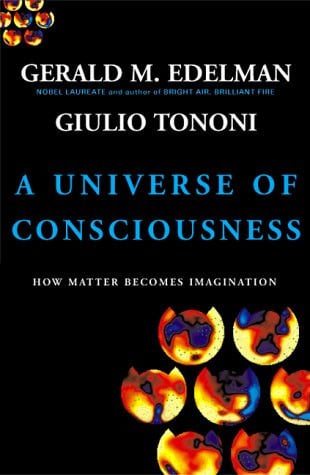
A universe of consciousness: how matter becomes imagination

Edelman, Gerald Maurice
In A Universe of Consciousness, Gerald Edelman builds on the radical ideas he introduced in his monumental trilogy-Neural Darwinism, Topobiology, and The Remembered Present-to present for the first time an empirically supported full-scale theory of consciousness. He and the neurobiolgist Giulio Tononi show how they use ingenious technology to detect the most minute brain currents and to identify the specific brain waves that correlate with particular conscious experiences. The results of this pioneering work challenge the conventional wisdom about consciousness.
Basic Books 2000 274 pages

Gene sharing and evolution: the diversity of protein functions

Piatigorsky, Joram
"Gene sharing" means that the different functions of a protein may share the same gene--that is, a protein produced by a gene evolved to fulfill a specialized function for one biological role may also perform alternate functions for other biological roles. In the 1980s and early 1990s, Joram Piatigorsky and colleagues coined the term "gene sharing" to describe the use of multifunctional proteins as crystallins in the eye lens. In Gene Sharing and Evolution Piatigorsky explores the generality and implications of gene sharing throughout evolution and argues that most if not all proteins perform a variety of functions in the same and in different species, and that this is a fundamental necessity for evolution. How is a gene identified, by its structure or its function? Do the boundaries of a gene include its regulatory elements? What is the influence of gene expression on natural selection of protein functions, and how is variation in gene expression selected in evolution? These are neither new nor resolved questions. Piatigorsky shows us that the extensiveness of gene sharing and protein multifunctionality offers a way of responding to these questions that sheds light on the complex interrelationships among genes, proteins, and evolution.
Harvard University Press 2007-02-28 320 pages