63 results for "Evolution"

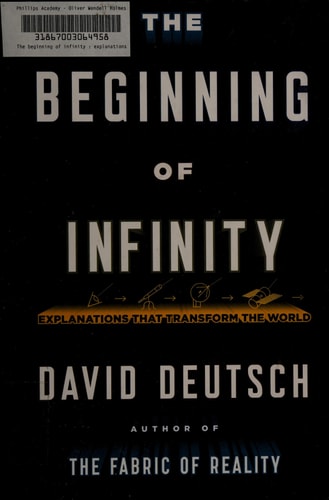
The beginning of infinity: explanations that transform the world

Deutsch, David
"A bold and all-embracing exploration of the nature and progress of knowledge from one of today's great thinkers. Throughout history, mankind has struggled to understand life's mysteries, from the mundane to the seemingly miraculous. In this important new book, David Deutsch, an award-winning pioneer in the field of quantum computation, argues that explanations have a fundamental place in the universe. They have unlimited scope and power to cause change, and the quest to improve them is the basic regulating principle not only of science but of all successful human endeavor. This stream of ever improving explanations has infinite reach, according to Deutsch: we are subject only to the laws of physics, and they impose no upper boundary to what we can eventually understand, control, and achieve. In his previous book, The Fabric of Reality, Deutsch describe the four deepest strands of existing knowledge-the theories of evolution, quantum physics, knowledge, and computation-arguing jointly they reveal a unified fabric of reality. In this new book, he applies that worldview to a wide range of issues and unsolved problems, from creativity and free will to the origin and future of the human species. Filled with startling new conclusions about human choice, optimism, scientific explanation, and the evolution of culture, The Beginning of Infinity is a groundbreaking book that will become a classic of its kind"--
Viking 2011 487 pages

The Jesuit and the Skull Teilhard de Chardin, Evolution, and the Search for Peking Man

Amir Aczel
From the New York Times bestselling author of Fermat?s Last Theorem , ?an extraordinary story?( Philadelphia Inquirer ) of discovery, evolution, science, and faith. In 1929, French Jesuit priest Pierre Teilhard de Chardin was a part of a group of scientists that uncovered a skull that became known as Peking Man, a key evolutionary link that left Teilhard torn between science and his ancient faith, and would leave him ostracized by his beloved Catholic Church. His struggle is at the heart of The Jesuit and the Skull , which takes readers across continents and cultures in a fascinating exploration of one of the twentieth century?s most important discoveries, and one of the world?s most provocative pieces of evidence in the roiling debate between creationism and evolution.
Penguin 2008-11-04 320 pages

The River of Consciousness

Oliver Sacks
From the bestselling author of Gratitude and Musicophilia , a collection of essays that displays Oliver Sacks's passionate engagement with the most compelling ideas of human endeavor: evolution, creativity, memory, time, consciousness, and experience. Oliver Sacks, scientist and storyteller, is beloved by readers for the extraordinary neurological case histories ( Awakenings , An Anthropologist on Mars ) in which he explored many now-familiar disorders--autism, Tourette syndrome, face blindness. He was also a memoirist who wrote with honesty and humor about the remarkable experiences that shaped him ( Uncle Tungsten , On the Move , Gratitude ). In the pieces that comprise The River of Consciousness (many first published in The New York Review of Books , among other places), Dr. Sacks takes on evolution, botany, chemistry, medicine, neuroscience, and the arts, and calls upon his great scientific and creative heroes--above all, Darwin, Freud, and William James. For Sacks, these thinkers were constant companions from an early age. The questions they explored--the meaning of evolution, the roots of creativity, and the nature of consciousness--lie at the heart of science and of this book. The River of Consciousness demonstrates Sacks's unparalleled ability to make unexpected connections, his sheer joy in knowledge, and his unceasing, timeless endeavor to understand what makes us human.
National Geographic Books 2018-10-09 256 pages

Global Brain The Evolution of Mass Mind from the Big Bang to the 21st Century

Howard Bloom
"As someone who has spent forty years in psychology with a long-standing interest in evolution, I'll just assimilate Howard Bloom's accomplishment and my amazement." --DAVID SMILLIE, Visiting Professor of Zoology, Duke University In this extraordinary follow-up to the critically acclaimed The Lucifer Principle, Howard Bloom--one of today's preeminent thinkers--offers us a bold rewrite of the evolutionary saga. He shows how plants and animals (including humans) have evolved together as components of a worldwide learning machine. He describes the network of life on Earth as one that is, in fact, a "complex adaptive system," a global brain in which each of us plays a sometimes conscious, sometimes unknowing role, and he reveals that the World Wide Web is just the latest step in the development of this brain. These are theories as important as they are radical. Informed by twenty years of interdisciplinary research, Bloom takes us on a spellbinding journey back to the big bang to let us see how its fires forged primordial sociality. As he brings us back via surprising routes, we see how our earliest bacterial ancestors built multitrillion-member research and development teams a full 3.5 billion years ago. We watch him unravel the previously unrecognized strands of interconnectedness woven by crowds of trilobites, hunting packs of dinosaurs, feathered flying lizards gathered in flocks, troops of baboons making communal decisions, and adventurous tribes of protohumans spreading across continents but still linked by primitive forms of information networking. We soon find ourselves reconsidering our place in the world. Along the way, Bloom offers us exhilarating insights into the strange tricks of body and mind that have organized a variety of life forms: spiny lobsters, which, during the Paleozoic age, participated in communal marching rituals; and bees, which, during the age of dinosaurs, conducted collective brainwork. This fascinating tour continues on to the sometimes brutal subculture wars that have spurred the growth of human civilization since the Stone Age. Bloom shows us how culture shapes our infant brains, immersing us in a matrix of truth and mass delusion that we think of as reality. Global Brain is more than just a brilliantly original contribution to the ongoing debate on the inner workings of evolution. It is a "grand vision," says the eminent evolutionary biologist David Sloan Wilson, a work that transforms our very view of who we are and why.
Turner Publishing Company 2001-08 384 pages

A sense of the future

Bronowski, Jacob
Jacob Bronowski truly educated an enormous number of members of that diffuse population usually referred to, with a hint of condescension, as "educated laymen" through his widely shared television series on the concepts of science and through such highly regarded books as The Identity of Man and The Ascent of Man. This volume extends the process to a further level of insight, and it may be more than suggestive that its final essay is entitled "The Fulfillment of Man." Bronowski was an extraordinary teacher precisely because he did not condescend to his audience. He did not talk down to them; he knew how to talk them up to something near his own level, however briefly. He felt that if human beings are taken seriously, they can be led to respond to serious and difficult subjects that relate to the deepest aspects of nature, both beyond and within themselves. A Sense of the Future succeeds brilliantly in this respect, in part because it is a collection of essays that can be read independently as self-contained, delimited presentations; and in part because the book is more than the sum of these individual essays—it is a unified whole in which Bronowski's most abiding concerns are interrelated, juxtaposed, and tested for consistency in various intellectual contexts. The major unifying theme of the work is the intensely creative and human nature of the scientific enterprise—its kinship, at the highest levels of individual achievement, with comparable manifestations of the artistic imagination, and its ethical imperatives, evolved within the community of scientists over the centuries, which both embody and forge the values of civilized life at large. Still, the book's diversity of topics is as striking as the unity of its aim. Among the subjects within the realm of Bronowski's mind that are presented here are the limitations of formal logic and experimental methods, the epistemology of science, the distinctive nature of human language and the human mind, and the bases of biological and cultural evolution. Bronowski also contrasts the findings of science as the "here and now" of man's understanding with the ongoing activity of science as the open-ended search for truth, and he undertakes to demonstrate that the factual, individual is and the ethical, societal ought can be derived each from the other. A mathematician by training, Bronowski published poetry as well as books on literature and intellectual history. In addition to those mentioned above, The Common Sense of Science and Science and Human Values are among the most widely read of his books. Before his death in 1974, he was for many years a Senior Fellow at the Salk Institute for Biological Studies, where his formal area of research was concerned with the questions of human specificity and uniqueness. Clearly, his interests ranged far beyond this area, and in many directions.
MIT Press 1978 286 pages

The Hologenome Concept: Human, Animal and Plant Microbiota

Eugene Rosenberg,Ilana Zilber-Rosenberg
Groundbreaking research over the last 10 years has given rise to the hologenome concept of evolution. This concept posits that the holobiont (host plus all of its associated microorganisms) and its hologenome (sum of the genetic information of the host and its symbiotic microorganisms), acting in concert, function as a unique biological entity and therefore as a level of selection in evolution. All animals and plants harbor abundant and diverse microbiota, including viruses. Often the amount of symbiotic microorganisms and their combined genetic information far exceed that of their host. The microbiota with its microbiome, together with the host genome, can be transmitted from one generation to the next and thus propagate the unique properties of the holobiont. The microbial symbionts and the host interact in a cooperative way that affects the health of the holobiont within its environment. Beneficial microbiota protects against pathogens, provides essential nutrients, catabolizes complex polysaccharides, renders harmful chemicals inert, and contributes to the performance of the immune system. In humans and animals, the microbiota also plays a role in behavior. The sum of these cooperative interactions characterizes the holobiont as a unique biological entity. Genetic variation in the hologenome can be brought about by changes in either the host genome or the microbial population genomes (microbiome). Evolution by cooperation can occur by amplifying existing microbes, gaining novel microbiota and by acquiring microbial and viral genes. Under environmental stress, the microbiome can change more rapidly and in response to more processes than the host organism alone and thus influences the evolution of the holobiont. Prebiotics, probiotics, synbiotics and phage therapy are discussed as applied aspects of the hologenome concept.
Springer International Publishing 2016-08-27 178 pages

Six Impossible Things Before Breakfast The Evolutionary Origins of Belief

Lewis Wolpert
Why do 70 percent of Americans believe in angels, while others are convinced that they were abducted by aliens? What makes people believe in improbable things when all the evidence points to the contrary? And don't almost all of us, at some time or another, engage in magical thinking? In Six Impossible Things Before Breakfast, evolutionary biologist Lewis Wolpert delves into the important and timely debate over the nature of belief, looking at its psychological foundations to discover just what evolutionary purpose it could serve. Wolpert takes us through all that science can tell us about the beliefs we feel are instinctive. He deftly explores different types of belief those of children, of the religious, and of those suffering from psychiatric disorders and he asks whether it is possible to live without belief, or whether it is a necessary component of a functioning society."
W.W. Norton & Company 2007 243 pages

Imagining the future: science and American democracy

Levin, Yuval
From stem cell research to global warming, human cloning, evolution, and beyond, political debates about science have raged in recent years - and, to the chagrin of most observers, have increasingly fallen into the familiar categories of America's culture wars. In Imagining the Future: Science and American Democracy, Yuval Levin explores the complicated meanings of science and technology in American politics and finds that the science debates have a lot to teach us about our political life. These debates, Levin argues, reveal some serious challenges to American self-government, and put on stark display the deepest strengths and greatest weaknesses of both the left and the right. American life has been profoundly shaped by science and technology, and will be all the more so in the coming decades, making it crucial that we understand how to think and speak about science in politics. Yuval Levin's smart and eminently well-reasoned book makes the important point that the purpose of science is a moral one -- to improve human life -- and that judging what that involves is sometimes a job for more than science alone in a democratic society. Levin's insights speak directly to today's political debates and make his book a must-read for policymakers and all those who care about science and society. --Newt Gingrich, former Speaker of the House Imagining the Future goes far beyond the contemporary polarized debates over science to unpack the moral premises of the modern scientific project and its consequences for American democracy. In the process, Yuval Levin provides us with a deep understanding of policy issues from genetic engineering to global warming. --Francis Fukuyama, Johns Hopkins University This book is important to the thinking of both progressives and conservatives. Clearly and incisively, it shows how science and technology are shaping humanity's future and world views. Levin alerts democratic societies that human dignity and equality are imperiled unless we provide political and moral guidance to prevent the submergence of humanity in its own ingenuity. --Edmund Pellegrino, Chairman, President's Council on Bioethics
Encounter Books 2008 145 pages

A Source Book in the History of Psychology

Richard J. Herrnstein,Edwin Garrigues Boring
This is a source book unique in its scope, clarity, and general interest. Its 116 excerpts range in time from Epicurus (ca. 300 B.C.) to the turn of the twentieth century and sometimes, when continuity requires, a little beyond (as to K. S. Lashley, 1929). It includes excerpts from Kepler (1604) on the inverted retinal image, Descartes (1650) on the soul's interaction with the machine of the body, Newton (1675) on the seven colors of the spectrum, Locke (1700) on association of ideas, Whytt (1751) on the spinal reflex, Weber (1834) on Weber's law, Darwin (1859) on evolution, Sechenov (1863) on reflexology, Hughlings Jackson (1884) on nervous dissolution, William James (1890) on associationism, Thorndike, Pavlov, Wertheimer, Watson, and 70 other great figures in the history of psychology. Arranged by topic rather than in the usual strict chronological order, each of the first fourteen chapters traces the development of one important subject in experimental and quantitative psychology. The final chapter discusses the history of thinking about the nature of psychology itself. The editors provide an introduction to each chapter and each excerpt, indicating the significance of the content to follow and establishing historical continuity.
Harvard University Press 1965 636 pages

The collapse of chaos: discovering simplicity in a complex world

Cohen, Jack S.
"The Collapse of Chaos is the first post-chaos, post-complexity book, a groundbreaking inquiry into how simplicity in nature is generated from chaos and complexity. Rather than asking science's traditional question of how to break the world down into its simplest components, Jack Cohen and Ian Stewart ask something much more interesting: why does simplicity exist at all? Their story combines chaos and complexity and - surprisingly - derives simplicity from the interaction of the two." "The Collapse of Chaos is composed of two parts. The first half is a witty primer, a guided tour of the islands of Truth that have been mapped out by conventional science. This section provides a streamlined and accessible introduction to the central areas of modern science, including cosmology, quantum mechanics, the arrow of time, biological development, evolution, and consciousness. The unorthodox and adventurous second half dives into the Oceans of Ignorance that surround what is known. Educated by the first half to appreciate the subtler issues in the second, the reader is introduced to a novel and even heretical world where unconventional possibilities are explored through conversations with characters such as the Victorian computer scientist Augusta Ada Lovelace and - for the more outlandish scenarios - the alien inhabitants of the planet Zarathustra."--Jacket.
Viking 1994-04-01 495 pages

The No-nonsense Guide to Science

Jerome R. Ravetz
Science is still the great intellectual adventure, but now it is also seen as an instrument of profit, power, and privilege. Wrongly used, it might yet make the 21st century our last.To make sense of all this, we need to let go of old ideas and assumptions. In the No-Nonsense Guide to Science, Jerome Ravetz introduces the "post-normal" way of thinking about science. We are to transcend the old simplistic ideas of perfect certainty and objectivity in science-they have failed to protect people and the environment when science has gone wrong and they have enabled flat, dogmatic teaching in our schools. We must now accept that value-loading, uncertainty, and ignorance are very real parts of science, and that citizens must participate in the policies that shape its evolution. The book also includes a refreshing new look at the history of science, and concludes with a series of questions that anyone can use to start their own exploration of the present and future of science.
Between the Lines 2005 143 pages

Words and life

Putnam, Hilary
Hilary Putnam has been convinced for some time that the present situation in philosophy calls for revitalization and renewal; in this latest book he shows us what shape he would like that renewal to take. Words and Life offers a sweeping account of the sources of several of the central problems of philosophy, past and present, and of why some of those problems are not going to go away As the first four part tides in the volume-"The Return of Aristotle," "The Legacy of Logical Positivism," "The Inheritance of Pragmatism," and "Essays after Wittgenstein"-suggest, many of the essays are concerned with tracing the recent, and the not so recent, history of these problems. The goal is to bring out what is coercive and arbitrary about some of our present ways of posing the problems and what is of continuing interest in certain past approaches to them. Various supposedly timeless philosophical problems appear, on closer inspection, to change with altered historical circumstances, while there turns out to be much of permanent value in Aristotle's, Peirce's, Dewey's, and Reichenbach's work on some of the problems that continue to exercise us. A unifying theme of the volume as a whole is that reductionism, scientism, and old-style disenchanted naturalism tend to be obstacles to philosophical progress. The titles of the final three parts of the volume-Truth and Reference," "Mind and Language," and "The Diversity of the Sciences-indicate that the sweep of the problems considered here comprehends all the fundamental areas of contemporary analytic philosophy Rich in detail, the book is also grand in scope, allowing us to trace the ongoing intellectual evolution of one of the most significant philosophers of the century.
Harvard University Press 1994 531 pages

The things that nobody knows: 501 mysteries of life, the universe and everything

Hartston, William
A playful and diverting, yet always scientifically rigorous look at those simple mysteries that are yet to be solved Why are so many giraffes gay? Has human evolution stopped? Where did our alphabet come from? Can robots become self-aware? Can lobsters recognize other lobsters by sight? What goes on inside a black hole? Are cell phones bad for us? Why can't we remember anything from our earliest years? Full of the mysteries of life, the universe, and everything, this is a fascinating and unputdownable exploration of the limits of human knowledge of our planet, its history and culture, and the universe beyond.
Atlantic 2012 384 pages

Mixing races: from scientific racism to modern evolutionary ideas

Farber, Paul Lawrence
This book explores changing American views of race mixing in the twentieth century, showing how new scientific ideas transformed accepted notions of race and how those ideas played out on college campuses in the 1960s. In the 1930s, it was not unusual for medical experts to caution against miscegenation, or race mixing, espousing the common opinion that it would produce biologically dysfunctional offspring. By the 1960s the scientific community roundly refuted this theory. The author traces this revolutionary shift in scientific thought, explaining how developments in modern population biology, genetics, and anthropology proved that opposition to race mixing was a social prejudice with no justification in scientific knowledge. In the 1960s, this new knowledge helped to change attitudes towards race and discrimination, especially among college students. Their embrace of social integration caused tension on campuses across the country. Students rebelled against administrative interference in their private lives, and university regulations against interracial dating became a flashpoint in the campus revolts that revolutionized American educational institutions. The author's provocative study is a personal one, featuring interviews with mixed-race couples and stories from the author's student years at the University of Pittsburgh. As such, this book offers a unique perspective on how contentious debates taking place on college campuses reflected shifts in race relations in the larger society. -- from Back Cover
Johns Hopkins University Press 2011-02-01 120 pages

The last writings of Thomas S. Kuhn: incommensurability in science

Kuhn, Thomas S.
"This book contains the text of Thomas Kuhn's unfinished book, The Plurality of Worlds: An Evolutionary Theory of Scientific Development, which Kuhn himself described as "a return to the central claims of The Structure of Scientific Revolutions, and the problems that it raised but did not resolve." The Plurality of Worlds is preceded by two related texts that Kuhn publicly delivered but never published in English: his paper "Scientific Knowledge as a Historical Product" and his Shearman Memorial Lectures, "The Presence of Past Science." The book opens with an introduction by the editor that describes the origins and structure of The Plurality of Worlds, and sheds light on its central philosophical problems. Kuhn's aims in his last writings are bold. He sets out to develop an empirically grounded theory of meaning that would allow him to make sense of both the possibility of historical understanding and the inevitability of incommensurability between past and present science. Moreover, he intends to show that incommensurability is fully compatible with a robust notion of a real world that science investigates, with the rationality of scientific belief change, and with the idea that scientific development is progressive. This is a must-read follow-up to The Structure of Scientific Revolutions, one of the most important books of the twentieth century"--
University of Chicago Press 2022-11-30 302 pages

Cosmic apprentice: dispatches from the edges of science

Sagan, Dorion
In the pursuit of knowledge, Dorion Sagan argues in this dazzlingly eclectic, rigorously crafted, and deliciously witty collection of essays, scientific authoritarianism and philosophical obscurantism are equally formidable obstacles to discovery. As science has become more specialized and more costly, its questing spirit has been constrained by dogma. And philosophy, perhaps the discipline best placed to question orthodoxy, has retreated behind dense theoretical language and arcane topics of learning. Guided by a capacious, democratic view of science inspired by the examples set by his late parents--Carl Sagan, who popularized the study of the cosmos, and Lynn Margulis, an evolutionary biologist who repeatedly clashed with the scientific establishment--Sagan draws on classical and contemporary philosophy to intervene provocatively in often-charged debates on thermodynamics, linear and nonlinear time, purpose, ethics, the links between language and psychedelic drugs, the search for extraterrestrial intelligence, and the occupation of the human body by microbial others. Informed by a countercultural sensibility, a deep engagement with speculative thought, and a hardheaded scientific skepticism, he advances controversial positions on such seemingly sacrosanct subjects as evolution and entropy. At the same time, he creatively considers a wide range of thinkers, from Socrates to Bataille and Descartes to von Uexkull, to reflect on sex, biopolitics, and the free will of Kermit the Frog. Refreshingly nonconformist and polemically incisive, "Cosmic Apprentice" challenges readers to reject both dogma and cliche and instead recover the intellectual spirit of adventure that should--and can once again--animate both science and philosophy.
University of Minnesota Press 2013-12-01 293 pages

Cosmic apprentice: dispatches from the edges of science

Sagan, Dorion
In the pursuit of knowledge, Dorion Sagan argues in this dazzlingly eclectic, rigorously crafted, and deliciously witty collection of essays, scientific authoritarianism and philosophical obscurantism are equally formidable obstacles to discovery. As science has become more specialized and more costly, its questing spirit has been constrained by dogma. And philosophy, perhaps the discipline best placed to question orthodoxy, has retreated behind dense theoretical language and arcane topics of learning. Guided by a capacious, democratic view of science inspired by the examples set by his late parents--Carl Sagan, who popularized the study of the cosmos, and Lynn Margulis, an evolutionary biologist who repeatedly clashed with the scientific establishment--Sagan draws on classical and contemporary philosophy to intervene provocatively in often-charged debates on thermodynamics, linear and nonlinear time, purpose, ethics, the links between language and psychedelic drugs, the search for extraterrestrial intelligence, and the occupation of the human body by microbial others. Informed by a countercultural sensibility, a deep engagement with speculative thought, and a hardheaded scientific skepticism, he advances controversial positions on such seemingly sacrosanct subjects as evolution and entropy. At the same time, he creatively considers a wide range of thinkers, from Socrates to Bataille and Descartes to von Uexküll, to reflect on sex, biopolitics, and the free will of Kermit the Frog. Refreshingly nonconformist and polemically incisive, Cosmic Apprentice challenges readers to reject both dogma and cliché and instead recover the intellectual spirit of adventure that should--and can once again--animate both science and philosophy.
University of Minnesota Press 2013 293 pages