31 results for "Evolution"

From Empathy to Denial Arab Responses to the Holocaust

Meir Litvak,Esther Webman
Based on years of research conducted mostly in Arabic sources, Meir Litvak and Ester Webman track the evolution of post-World War II perceptions of the Holocaust and their parallel emergence in the wake of the Arab-Israeli conflict of 1948. Following the establishment of the State of Israel, Arab attitudes toward the Holocaust became entangled with broader anti-Zionist and anti-Semitic sentiments. Litvak and Webman track this discourse through the work of leading intellectuals and turn to representations of the Holocaust in the media and culture of Egypt, Lebanon, Jordan, and among the Palestinian people. Their chronological history, which spans sixty years, provides a remarkable perspective on the origins, development, and tenaciousness of anti-Holocaust belief. From Empathy to Denial is the first comprehensive investigation of Holocaust denial in the Arab world, and is based on years of painstaking historical research of mostly Arabic language sources. The authors explore how Holocaust denial emerged after the Second World War, how it paralleled the wider Arab-Israeli conflict after the establishment of the State of Israel in 1948 and how it subsequently became entangled with broader anti-Zionist and anti-Semitic sentiment. In particular Litvak and Webman look at the role of leading intellectuals, the media and other cultural forms in Egypt, Lebanon, Jordan and among the Palestinians and how their representation of the Holocaust has evolved in the last sixty years.
Oxford University Press 2011-04-19 416 pages

Moala Culture and Nature on a Fijian Island

Marshall D. Sahlins
For nearly a year Marshall D. Sahlins lived in villages on the Fijian island of Moala, learning the "way of the land," as the Moalans call their customs. From this experience he has written a book that is at once an intensive field study and a new approach to the methods of studying primitive communities. It marks an important departure from the standard trait-listing form of anthropological reports, for Sahlins does not isolate such factors as economics, kinship, and political organization. Rather he shows how closely they are interwoven in a primitive culture and why they must be interpreted with reference to the organic whole.This book, frankly evolutionary in its approach, views Moalan culture as an adaptive organization, a human means of dealing with nature so as to ensure survival. Proceeding from the smallest kinship groups, families, to the larger organization of village and island, Sahlins shows how kinship structure can organize the polity and economy. In a culture such as Moalan, kinship behavior is economics and often politics as well. By fully appreciating this fact, the author claims, we are made aware of the wide evolutionary gap between primitive societies and the impersonal structure of modern civilization.
University of Michigan Press 2016-10-30 470 pages

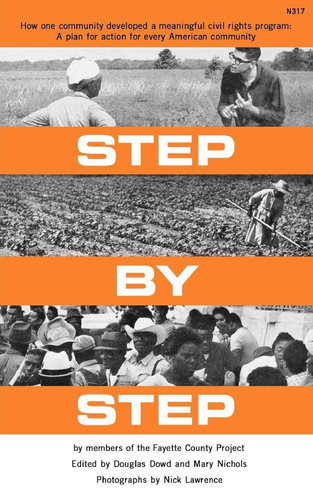
Step by Step Evolution and Operation of the Cornell Students' Civil-Rights Project in Tennessee, Summer, 1964

Douglas Dowd
The book arose out of the authors' experiences in a project which was itself unique: The Cornell-Tompkins Committee for Free and Fair Elections in Fayette County, Tennessee. The project entailed six to eight weeks of living in Fayette County by forty-five volunteers, mostly students from Cornell University, in the summer of 1964. The project was financed entirely, to an amount exceeding fifteen thousand dollars, by the contributions of students, faculty, and townspeople in and around Cornell University, and by contributions from more distant places solicited by those involved at Cornell.Of the many things learned from the Cornell project, one of the most important was how responsive a community can become when confronted with a concrete civil rights program, one with which it can identify, one small enough to be feasible and intelligible, but still compelling in terms of the needs involved.The authors believe that many thousands of Americans can find no good answer to the questions "What can I do." not because they are unwilling to do much, nor because there is little to be done, but because they lack the knowledge of what is needed where, and how and with whom one can go about responding to such needs. The book therefore undertakes, step by step, to describe and explain the development of the project at Cornell and its workings during the summer in Tennessee, and reasons that similar steps can be taken by others, with appropriate variations. It concludes with a detailed appendix listing civil rights projects and organizations desperately in need of help, whether in terms of money or volunteers or both.
W. W. Norton, Incorporated 1965-04 132 pages

Culture and Cultural Entities - Toward a New Unity of Science

Joseph Margolis
Culture and Cultural Entities provides an original philosophical analysis of the nature and explanation of cultural phenomena, with special attention to ontology and methodology. It addresses in depth such topics as: the relation between physical and biological nature and cultural phenomena; the analysis of intentionality; the nature and explanation of action; causality; causal explanation and the unity of science; theories of language; historicity; animal and human intelligence; psychological and social phenomena; technology and evolution. Its approach features a form of non-reductive materialism, examines a wide range of views, and is highly readable, making it suitable for professionals, advanced undergraduate and graduate students, and an informed general audience. A new chapter was added to give a sense of pertinent trends since the appearance of the first edition, particularly with respect to the history of philosophy, pragmatism, the unity of science, and evolution. The unity, scope, and simplicity of the theory are well-regarded.
Springer Netherlands 2010-10-28 156 pages

Greater Ethiopia The Evolution of a Multiethnic Society

Donald N. Levine
Greater Ethiopia combines history, anthropology, and sociology to answer two major questions. Why did Ethiopia remain independent under the onslaught of European expansionism while other African political entities were colonized? And why must Ethiopia be considered a single cultural region despite its political, religious, and linguistic diversity? Donald Levine's interdisciplinary study makes a substantial contribution both to Ethiopian interpretive history and to sociological analysis. In his new preface, Levine examines Ethiopia since the overthrow of the monarchy in the 1970s. "Ethiopian scholarship is in Professor Levine's debt. . . . He has performed an important task with panache, urbanity, and learning."--Edward Ullendorff, Times Literary Supplement "Upon rereading this book, it strikes the reader how broad in scope, how innovative in approach, and how stimulating in arguments this book was when it came out. . . . In the past twenty years it has inspired anthropological and historical research, stimulated theoretical debate about Ethiopia's cultural and historical development, and given the impetus to modern political thinking about the complexities and challenges of Ethiopia as a country. The text thus easily remains an absolute must for any Ethiopianist scholar to read and digest."-J. Abbink, Journal of Modern African Studies
University of Chicago Press 1974 229 pages

Man's Future Birthright

Hermann Joseph Muller
Hermann Joseph Muller (1890-1967) was a member of the early genetics group at Columbia University that developed the chromosome theory of inheritance. T. H. Morgan received the Nobel Prize in Medicine and Physiology for this work in 1934, and Muller, his student, received the Nobel Prize in 1946 for his discovery of radiation-induced mutation. Muller's writings extended beyond contributions to technical journals. He was an active critic of social abuse of science; he advocated eugenic programs based on free choice; and he played a major role in the reform of high school biology. Muller's social views were published in magazines and journals which are accessible to scholars more than to the lay reader or student. They have been collected here to show how extensively he thought our lives are affected by radiation, evolution, modern medicine, and gene theory. He attempted to alert humanity to the dangers of neglect and abuse of their genetic heritage. He also used humanistic values to urge mankind to improve itself, to foster cooperativeness, to increase health and intelligence, and to adopt and evolutionary outlook. A companion collection of essays, The Modern Concept of Nature: Essays on Theoretical Biology by H. J. Muller, also published by State University of New York Press, deals with Muller's scientific contributions to genetics and evolution. It was Muller who developed the relation between genes and mutation; his views on the primacy of the gene in biology are reflected today in the similar primacy of nucleic acids as the basis of life. For students of the history of ideas, a collection of these essays would illustrate how genetic thinking prepared the world view for molecular biologists. The relation of science to values is often neglected because of the inaccessibility of the written contributions of famous scientists. To read Muller's major essays in these two areas is an important way to evaluate a scientist's career, his maturation of ideas, and his developing application of science to society.
State University of New York Press 1973 164 pages

Why Humans Vary in Intelligence

Seymour W. Itzkoff
The third volume in a projected four-part series on the evolution of human intelligence, a series acknowledged by opponents and supporters alike as one of the most important recent investigations into the sources and nature of human intelligence. Professor Itzkoff first sets forth the evolutionary facts as a beacon to illuminate his biological theory of variable intelligence. Filling out the evidence from the psychological and brain sciences presented in THE FORM OF MAN and TRIUMPH OF THE INTELLIGENT, he here develops a full-scale model of the mind that more fully explains the relationship between I.Q. and the broader expressions of human intelligence as experienced in daily life. (His model of variable intelligence further delves into the historical consequences of our ancient biological and psychoneurological heritage. Issues such as gender, race, and ethnic variability are treated factually and responsibly, taking into account the full range of empirical evidence available to scholars.) The result is a theory having three complementary bodies of evidence - evolutionary, psychoneurological, and historical - building into a perspective on the factual «why» of human intellectual differences. These differences can best be observed in the richness and diversity of individual personality as well as in the cultures of our world. Itzkoff here takes the first tentative steps toward a biological explanation of the nature and structure of culture. WHY HUMANS VARY IN INTELLIGENCE is an appeal for the rational study of human nature, a plea to allow for further nonideological research into this most crucial area of contemporary concern.
Peter Lang Publishing, Incorporated 1989-09 392 pages

The Form of Man

Seymour W. Itzkoff
The Form of Man presents a new interpretation, consonant with Darwinian evolutionary theory, recent evidence of human evolution, and the realities of cultural life. The exploration begins with the study of the form of life, traversing the tentative gropings of intelligent organic matter in its long struggle to establish itself as life's major adaptation. Seymour Itzkoff explains how intelligence as an adaptation is the slowest and most complex of life's vehicles to escape the degradation of energy predicted by the second law of thermodynamics. Dr. Itzkoff proposes that two evolutionary processes were keys to shaping human nature along its own particular path. Paedomorphosis (infantilization) explains many of man's unique anthropoid features. Orthoselection (evolution in a straight line) allows us to complete a picture of mankind's rapid catapult in brain size expansion almost into our own day. Both concepts reveal how man could have escaped the close selective honing that would have made him a far more practical creature. The final dramatic moment came with the sudden icy extrusion of a super sapient, Homo sapiens sapiens, sometime after 100,000 B.P. It ransformed the structure of all existing transitional hominids and created the conditions for both the growth of civilization and the paradoxical dilemmas and tragedies in our present polyglot humanity.
Peter Lang Publishing, Incorporated 1989-09 336 pages

Island Networks Communication, Kinship, and Classification Structures in Oceania

Per Hage,Frank Harary
Contrary to common perception and belief, most island societies of the Pacific were not isolated, but were connected to other island societies by relations of kinship and marriage, trade and tribute, language and history. Using network models from graph theory the authors analyze the formation of island empires, dialect groups, economic and political centers; the evolution and devolution of social stratification; and the development of kinship terminologies, marriage systems and descent groups.
Cambridge University Press 2007-01-25 320 pages

Continuity And Change In Rural Russia A Geographical Perspective

Ioffe, G. V.
Contrary to the viewpoint of many Western scholars, the authors of this penetrating analysis argue that private farming is not a viable option in Russia's future. Instead, a convergence of Soviet-style subsidiary farming with traditional and reorganized collective farms is the most plausible path of evolution in most rural areas.Grigory Ioffe and Tatyana Nefedova arrive at this conclusion by a careful examination of ongoing reform efforts in Russian agriculture against the backdrop of European and Russian agrarian history and rural spatial development since the late nineteenth century. The comparisons at the national level are then filled in with consideration of a number of Russian provinces (oblasti) and regions (raiony). Their research reveals the substantial negative impact of rural depopulation on the Russian agrarian economy. Seventy original maps richly complement and support the narrative.
Routledge 2019-06-13 327 pages