47 results for "History"

Jewish reactions to the Holocaust

Bauer, Yehuda
A revised version of two courses of lectures delivered as part of the Broadcast University series of Israel Army Radio. Discusses the struggle of Jews for survival under Nazi rule, and attempts at aid and rescue by Jews in the Western democracies and Palestine, by foreign governments, and by "Righteous Gentiles". Emphasizes that the Nazis decided to murder all the Jews only in autumn 1940; until then no one could have foreseen the Holocaust to come. When the first reports of mass murder were received, they met with disbelief on the part of most Jews as well as non-Jews. This lack of awareness explains why the potential victims were slow to escape or resist; and, in conjunction with the prevalence of antisemitism and the political impotence of world and Palestinian Jewry, it also explains the failure of the outside world to come to their rescue. Among the topics covered are the search for countries of asylum; the Transfer Agreement; illegal immigration to Palestine; the ghettos and the Judenräte; the resistance groups and armed uprisings in the ghettos; Jewish partisans; underground rescue groups; negotiations with SS functionaries for Jewish lives; and the British Foreign Office's blocking of rescue proposals.
MOD Books 1989 226 pages

The fall of the house of Roosevelt: brokers of ideas and power from FDR to LBJ

Janeway, Michael
In the 1930s a band of smart and able young men, some still in their twenties, helped Franklin D. Roosevelt transform an American nation in crisis. They were the junior officers of the New Deal. Thomas G. Corcoran, Benjamin V. Cohen, William O. Douglas, Abe Fortas, and James Rowe helped FDR build the modern Democratic Party into a progressive coalition whose command over power and ideas during the next three decades seemed politically invincible. This is the first book about this group of Rooseveltians and their linkage to Lyndon Johnson's Great Society and the Vietnam War debacle. Michael Janeway grew up inside this world. His father, Eliot Janeway, business editor of Time and a star writer for Fortune and Life magazines, was part of this circle, strategizing and practicing politics as well as reporting on these men. Drawing on his intimate knowledge of events and previously unavailable private letters and other documents, Janeway crafts a riveting account of the exercise of power during the New Deal and its aftermath. He shows how these men were at the nexus of reform impulses at the electoral level with reform thinking in the social sciences and the law and explains how this potent fusion helped build the contemporary American state. Since that time efforts to reinvent government by "brains trust" have largely failed in the U.S. In the last quarter of the twentieth century American politics ceased to function as a blend of broad coalition building and reform agenda setting, rooted in a consensus of belief in the efficacy of modern government. Can a progressive coalition of ideas and power come together again? The Fall of the House of Roosevelt makes such a prospect both alluring and daunting.
Columbia University Press 2004 284 pages

Hitler's spies: German military intelligence in World War II

Kahn, David
A German patrol wiggles through Russian lines to return with details of Soviet defenses. An expert Luftwaffe interrogator teases secret information from downed Allied airmen. Two spies steal ashore in Maine and make their way into New York City. Filled with episodes of intrigue and adventure, Hitler's Spies reveals the workings of German intelligence-the famed Abwehr, the dreaded SD, the codebreakers, the spies, and the intelligence gatherers of the Foreign Office-and explains its failure to best the Allies. Draws on original documents and extensive interviews.
Macmillan 1978 671 pages

Generation exodus: the fate of young Jewish refugees from Nazi Germany

Laqueur, Walter
Relates the multiple ways adopted by young German Jews (born mainly between 1914-28) to escape from Nazi Germany. Their destinations included Palestine, Great Britain, the USA, South America, and China. Dwells on the routes of escape - sometimes dangerous, and on the organizational framework of the escape - sometimes part of a political underground. Some young persons managed to survive in Germany. Many Jews, both those who escaped and those who remained in Germany, joined the anti-Nazi struggle in multiple forms - from the underground in Berlin to joining up with the Red Army. Many countries of destination were reluctant to accept the refugees, in part due to antisemitism. Other possible frameworks (e.g. communists) were also not eager to help Jews. The majority of the émigrés did not return to Germany after the war.
Brandeis University Press, Published by University Press of New England 2001 345 pages

Jews in Nazi Berlin: from Kristallnacht to liberation

Beate Meyer,Hermann Simon,Chana Schütz
Though many of the details of Jewish life under Hitler are familiar, historical accounts rarely afford us a real sense of what it was like for Jews and their families to live in the shadow of Nazi Germany’s oppressive racial laws and growing violence. With Jews in Nazi Berlin , those individual lives—and the constant struggle they required—come fully into focus, and the result is an unprecedented and deeply moving portrait of a people. Drawing on a remarkably rich archive that includes photographs, objects, official documents, and personal papers, the editors of Jews in Nazi Berlin have assembled a multifaceted picture of Jewish daily life in the Nazi capital during the height of the regime’s power. The book’s essays and images are divided into thematic sections, each representing a different aspect of the experience of Jews in Berlin, covering such topics as emigration, the yellow star, Zionism, deportation, betrayal, survival, and more. To supplement—and, importantly, to humanize—the comprehensive documentary evidence, the editors draw on an extensive series of interviews with survivors of the Nazi persecution, who present gripping first-person accounts of the innovation, subterfuge, resilience, and luck required to negotiate the increasing brutality of the regime. A stunning reconstruction of a storied community as it faced destruction, Jews in Nazi Berlin renders that loss with a startling immediacy that will make it an essential part of our continuing attempts to understand World War II and the Holocaust.
University of Chicago Press 2009-12-15 392 pages

The method of freedom

Lippmann, Walter
The Method of Freedom was written at a time of deep anxiety for America and Europe. The worst depression in modem history gripped the world and the rise of dictatorships in Europe and Asia posed a mortal challenge to the essentials of free government. In this volume of a continuing series on the major works of Walter Lippmann, a model for economic recovery and social stability is outlined under a "regime of liberty." Lippmann's work takes on a special pertinence in the 1990s as the nations of Eastern Europe embark on the historically unprecedented transition from Communist centralization to democracy and free market economies. Rejecting both laissez-faire and centrally enforced collectivization, Lippmann described the salutory economic functions of a government with a mandate that rested on the consent of a middle-class constituency, which he termed a "free collectivism." Capitalism, in his view, had become too complex to be regulated by private initiative, and it became the function of government to ensure a compensatory redistribution of income and property in order to make its citizens comfortably secure. Lippmann recognized that market regulation needed to be safeguarded from political demagoguery and the tyranny of the majority. The Method of Freedom calls for the formation of an informed and competent managerial class to direct economic policy within the bounds of legislative consent. Lippmann's effort to balance the competing claims of capitalism and democracy anticipated the New Deal achievements of the 1930s and influenced a generation of American statesmen in their understanding of what constituted a good society. The Method of Freedom is a work of enduring interest
Transaction Publishers 1992 117 pages

Go-betweens for Hitler

Urbach, Karina
This is the untold story of how some of Germany's top aristocrats contributed to Hitler's secret diplomacy during the Third Reich, providing a direct line to their influential contacts and relations across Europe, especially in Britain, where their contacts included the press baron and Daily Mail owner Lord Rothermere and the future King Edward VIII. Using previously unexplored sources from Britain, Germany, the Netherlands, the Czech Republic, and the USA, this book unravels the story of top-level go-betweens such as the Duke of Coburg, grandson of Queen Victoria, and the seductive Stephanie von Hohenlohe, who rose from a life of poverty in Vienna to become a princess and an intimate of Adolf Hitler. As Urbach shows, Coburg and other senior aristocrats were tasked with some of Germany's most secret foreign policy missions from the First World War onwards, culminating in their role as Hitler's trusted go-betweens, as he readied Germany for conflict during the 1930s and later, in the Second World War. Tracing what became of these high-level go-betweens in the years after the Nazi collapse in 1945, from prominent media careers to sunny retirements in Marbella, the book concludes with an assessment of their overall significance in the foreign policy of the Third Reich.
Oxford University Press 2015 389 pages

New Deal thought

Howard Zinn
A reprint of the 1966 Bobbs-Merrill edition. This anthology assembles the contemporary writings not only of the New Dealers--the men who devised and executed the programs of the government in the era of Franklin D. Roosevelt--but also of the "social critics" who "gathered in various stances and at various distances around the Roosevelt fires." Here is a sampling of the famous movers and shakers of the 1930's: Thurman Arnold, Henry Wallace, Rexford Tugwell, David Lilienthal, Harry Hopkins, Harold Ickes, Frances Perkins, John Maynard Keynes, and of course Roosevelt himself. Here too are the voices of those who thought the New Dealers were going "too far" such as Walter Lippmann and Raymond Moley, and of those who thought they were not going "far enough"; like John Dewey, W. E. B. DuBois, Norman Thomas, Lewis Mumford, and Carey McWilliams. In his Introduction Howard Zinn defines the boundaries of the New Deal's experimentalism and attempts to explain why it sputtered out. The result is a book that captures the spirit of the New Deal--hopeful, pragmatic, humane--yet remains hardheaded about its accomplishments and failures.
Hackett Pub. Co 2003 431 pages

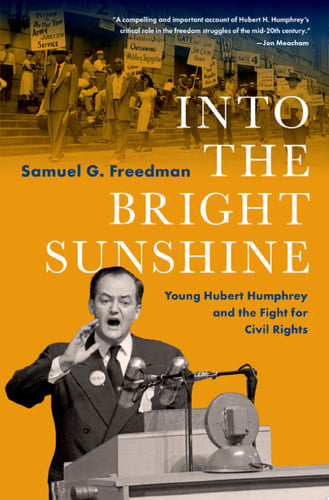
Into the bright sunshine: young Hubert Humphrey and the fight for civil rights

Freedman, Samuel G.
"Hubert Humphrey, a fallen hero and a dying man, rose on rickety legs to approach the podium of the Philadelphia Convention Hall, his pulpit for the commencement address at the University of Pennsylvania. He clutched a sheaf of paper with his speech for the occasion, typed and double-spaced by an assistant from his extemporaneous dictation, and then marked up in pencil by Humphrey himself. A note on the first page, circled to draw particular attention, read simply, "30 years ago--Here." In this place, at that time, twenty-nine years earlier to be precise, he had made history. From the dais now, Humphrey beheld five thousand impending graduates, an ebony sea of gowns and mortarboards, broken by one iconoclast in a homemade crown, two in ribboned bonnets, and another whose headgear bore the masking-tape message HI MA PA. In the horseshoe curve of the arena's double balcony loomed eight thousand parents and siblings, children, and friends. Wearing shirtsleeves and cotton shifts amid the stale heat, they looked like pale confetti from where Humphrey stood, and their flash cameras flickered away, a constellation of pinpricks"--
Oxford University Press 2023 488 pages

The bear boy

Ozick, Cynthia
The Bear Boy is a story specific to time and place, and about the dislocation of time and place too. It is set in 1935 at the only moment in history when the idea of socialism flickered to life in the United States, when Jewish intellectuals were fleeing out of the country where they were once respected writers and professors, and when a great many people were equal to each other in that the most had little material wealth. The oversize Mitwisser clan are German refugees who survive at the whim of their vagabond benefactor, James Albair. James is heir to the fortune amassed by his father, the author of a wildly popular series of children's books called The Bear Boy. Wayward, feckless and with money to burn, James has taken up the eccentric Mitwissers - scholarly patriach, invalid wife, and five scrappy children - as his latest caprice. Into this chaotic household comes Rose Meadows, orphaned at the age of eighteen. Rose quickly becomes indispensable as assistant to Professor Mitwisser in his research on an arcane sect and then, inevitably, as general nursemaid, nanny and companion to the entire family. Her sole inheritance is a book: the first title in the Bear Boy series. When the actual Bear Boy appears on the Mitwisser doorstep, Rose must resist the pull of his reckless orbit as she pursues her own desires. The Bear Boy evokes Depression-era New York from the perspective of perpetual outsiders. Brought together by coincidence and fate, the hard times they inherit still hold glimmers of past wonders and future dreams.
Weidenfeld & Nicolson 2005 310 pages

Harmful and undesirable: book censorship in Nazi Germany

Lewy, Guenter
" Like every authoritarian regime in history, Nazi Germany tried to control intellectual freedom through book censorship. Between 1933 and 1945, Hitler's party orchestrated a massive campaign to take control of all forms of communication in the nation. Book burnings abounded-- in 1933 alone, there were 93 book burnings in 70 German cities. Indeed, Werner Schlegel, an official in the Ministry of Propaganda, called the book burnings "a symbol of the revolution." Bookstores, libraries, and universities were pillaged, while German authors were targeted by the regime. Yet surprisingly, Nazi book censorship has been largely overlooked by modern historians. In Harmful and Undesirable, Guenter Lewy analyzes the various strategies that the Nazis employed to enact censorship and the people, including Martin Bormann, Philipp Bouhler, Joseph Goebbels, and Alfred Rosenberg, who led the attack on intellectual life. The Propaganda Ministry played a leading role in the censorship campaign, supported by an array of organizations at both the local and state levels. Because of the many overlapping jurisdictions and organizations, censorship was disorderly and erratic. Beyond the implementation of censorship, Lewy also describes the plight of authors, publishers, and bookstores who clashed with the Nazi regime. Some authors were imprisoned, tortured, and even killed. Meanwhile others, such as Gottfried Benn, Gerhart Hauptmann, Ernst Jünger, Jochen Klepper, and Ernst Wiechert became controversial "inner emigrants" who chose to remain in Germany and criticize the Nazi regime through allegories and parables. Ultimately, Lewy paints a fascinating portrait of intellectual life under the Nazi dictatorship, revealing the fate of those who were caught in the wheels of censorship. "--
Oxford University Press 2016 268 pages

The lion and the star: gentile-Jewish relations in three Hessian communities, 1919-1945

Friedman, Jonathan C.
A survey of Jewish-Gentile relations in Frankfurt am Main, Giessen, and Geisenheim on the eve of and during the Nazi dictatorship. Gives a demographic, social, and historical portrait of the three Jewish communities and a picture of Jewish-Gentile interaction in the Weimar years. Even in these years some anti-Jewish tendencies became evident, e.g. hostility toward the "Ostjuden, " broad popular indifference toward the Jews in the of the growing Nazi movement. Ch. 5-7 present a case study of Nazi anti-Jewish policy in Hesse, focusing on Jewish-Gentile relations there in the Nazi period. States that the persecution of Jews was facilitated by the indifference and passivity of ordinary Germans. A latent antisemitism (though not "eliminationist") combined with apathy and acquiescence to a brutal dictatorship in the conditions of war and paved the way to the mass murder. Dwells on the legal exclusion of Jews in 1933-38, on the "Kristallnacht" pogrom, and on the deportations of Hessian Jews in 1941-43.
University Press of Kentucky 1998 292 pages

German resistance against Hitler: the search for allies abroad, 1938-1945

Von Klemperer, Klemens
Klemens von Klemperer's scholarly and detailed study uncovers the beliefs and activities of numerous individuals who fought against Nazism within Germany, and traces their many efforts to forge alliances with Hitler's opponents outside the Third Reich. Measured by conventional standards of diplomacy, the foreign ventures of the German Resistance ended in failure. The Allied agencies, notably the British Foreign Office and the US State Department, were ill prepared to deal with the unorthodox approaches of the Widerstand. Ultimately, the Allies' policy of 'absolute silence', the Grand Alliance with the Soviet Union, and the demand for 'unconditional surrender' pushed the war to its final denouement, disregarding the German Resistance. However, Professor von Klemperer shows that many of the principles and strategies of the Widerstand had distinct moral and historical consequences when considered in their context. This context includes changes in the nature of international diplomacy which became evident in the resisters' contacts with the churches, the international intelligence community, and the Resistance movements outside Germany. All of these turned out to be attuned to the ultimate concerns of the German Resistance: overcoming the nation-state, the movement towards a more united Europe, and human rights. The foreign policy of the German Resistance thus helped prepare the agenda for international relations in the post-war world.
Clarendon Press 1993 487 pages

Heritage of our times

Bloch, Ernst
First published in Switzerland in 1935 and now available for the first time in English translation, Heritage of Our Times is a bold work of cultural criticism by a major twentieth-century German philosopher. Recalling work by Walter Benjamin and the Frankfurt School, Ernst Bloch's study of everyday life and politics during the Weimar Republic and Nazi Germany is a brilliant historical analysis of the cultural conditions leading to German fascism.A half-century later, Bloch's prescient meditations on culture and politics still retain their explosive power and are certain to provoke controversy and discussion among cultural critics, philosophers, social theorists, and historians. In their Introduction, the translators contextualize the book within the political and intellectual tendencies of the period and Bloch's other work.
University of California Press 1991 377 pages