113 results for "History"

Never again? the threat of the new anti-Semitism

Foxman, Abraham H.
Responding to what is perceived as the reemergence of worldwide antisemitism from 1998-99, and especially from 2000, surveys the new outbreak of this spiritual and psychological illness now thriving globally. After discussing the history of Christian antisemitism and modern racism, proceeds to illuminate aspects of antisemitism in America (on the political and religious Right, among Blacks, and in popular culture), as well as Islamic fundamentalism and antisemitism in the Arab press. Clarifies how racists, including antisemites, exploit the Internet. Foxman also relates his experiences as a hidden child during the Holocaust, and his activities as head of the Anti-Defamation League.
HarperSanFrancisco 2003-10-21 305 pages

Nazi propaganda for the Arab world

Herf, Jeffrey
Jeffrey Herf, a leading scholar in the field, offers the most extensive examination to date of Nazi propaganda activities targeting Arabs and Muslims in the Middle East during World War II and the Holocaust. He draws extensively on previously unused and little-known archival resources, including the shocking transcriptions of the "Axis Broadcasts in Arabic" radio programs, which convey a strongly anti-Semitic message.
Yale University Press 2010 335 pages

Critical theories of Anti-Semitism

Judaken, Jonathan
"Despite its millennia-long history and frightening contemporary resurgence, unlike other forms of exclusion and discrimination, anti-Semitism (the author makes a case for the hyphenated spelling and the term's relation to Judeophobia, which explicitly references intersectional categories such as Islamophobia, xenophobia, homophobia, Negrophobia [Fanon], and others) remains undertheorized. This book is a corrective. The first systematic, comparative, and integrative analysis of the major theories and theorists, Anti-Semitism undertakes three urgently needed tasks. First, it explores key methodological and conceptual issues. Second, it identifies and considers seven major paradigms for understanding the underlying causes. Third, it applies the insights of these theories and theorists to contemporary debates about Judeophobia, offering rigor and clarity to existing disputes. Anti-Semitism as a theoretical construct dates back to the period of the Dreyfus affair (1894-1906) when historians sought to dismantle enduring myths about Jews and challenged the idea that Jews were a distinct race. Following World War I, studies focused on the links between nationalism and anti-Semitism and considered the dynamics of group formation against outsiders and minorities. The aftermath of World War II and the Holocaust saw important contributions from existentialists, critical theorists, and sociologists, leading to the formation of Holocaust studies as a discipline, but with the advent of the civil rights movement and anticolonialism in the 1950s social theorists interested in the problem of racism began to focus primarily on anti-Black prejudice, and theoretical debates on anti-Semitism receded to the background, where they remain unresolved. Jonathan Judaken evaluates anti-Semitism's internal theoretical concerns and engages in a comparative analysis with other critical race theories. In our moment of widespread racial reckoning, it is critical to reexamine the major approaches to anti-Semitism, their concepts, narratives, and assumptions, and how they are linked to other racisms in order to gain new insights in confronting its global upsurge"--
Columbia University Press 2024 348 pages

The American axis

Wallace, Max
Henry Ford and Charles Lindbergh have long been exalted as two of the greatest American icons of the twentieth century. Now award-winning journalist Max Wallace uncovers groundbreaking and astonishing revelations about the poisonous effect these two so-called American heroes had on Western democracy and how the two of them---acting in league with the Nazis---almost brought democratic Europe to the verge of extinction. With unprecedented access to declassified FBI and military intelligence files, Wallace reveals how the close friendship and ideological bond between automotive pioneer Ford and aviator Lindbergh culminated in an abuse of power that helped strengthen Hitler's regime and undermined the Allied war effort. Devastating, thoroughly researched, and engagingly written, The American Axis is not only a mesmerizing, cautionary tale, but a compelling historical exposé.
St. Martin's 2005 488 pages

Contemporary left antisemitism

Hirsh, David
Today's antisemitism is difficult to recognize because it does not come dressed in a Nazi uniform and it does not openly proclaim its hatred or fear of Jews. This book looks at the kind of antisemitism which is tolerated or which goes unacknowledged in apparently democratic spaces: trade unions, churches, left-wing and liberal politics, social gatherings of the chattering classes and the seminars and journals of radical intellectuals. It analyses how criticism of Israel can mushroom into antisemitism and it looks at struggles over how antisemitism is defined. It focuses on ways in which those who raise the issue of antisemitism are often accused of doing so in bad faith in an attempt to silence or smear. Hostility to Israel has become a signifier of identity, connected to opposition to imperialism, neo-liberalism and global capitalism; the 'community of the good' takes on toxic ways of imagining most living Jewish people.
Routledge 2017 314 pages

The deadliest lies: the Israel lobby and the myth of Jewish control

Foxman, Abraham H.
While the special relationship of all ethnic and religious minorities in the USA with their old countries and the existence of their pressure groups is regarded as normal, the support given by U.S. Jews to Israel and the pro-Israeli lobby causes some Americans to view the Jews as disloyal to the USA. Examines the "paper" by John J. Mearsheimer and Stephen M. Walt, "The Israeli Lobby and U.S. Foreign Policy" (first published in 2006 on the Internet and then in the "London Review of Books"; an expanded book appeared later, in 2007). The authors contend that U.S. support of Israel is harmful to American interests, and is due to pressure exerted by a mighty Israel Lobby which acts to the detriment of the state. They argue that the Israel Lobby had a crucial part in the decision to attack Iraq in 2003. Notes that despite the academic style of their paper, Mearsheimer and Walt have revived the myths of a Jewish conspiracy, of Jewish control of the mass media, and of a Jewish secret power. Dwells, also, on the Tony Judt affair. In 2006 Judt, who supported Mearsheimer and Walt, was to deliver a lecture on a binational alternative for Israel. His lecture was cancelled, which he ascribed to pressure by the Anti-Defamation League. Supporters of Mearsheimer and Walt used it as a demonstration of the Israel Lobby's intervention. Criticizes Jimmy Carter's book "Palestine: Peace Not Apartheid" (2006) for its clear anti-Israel bias.
Palgrave Macmillan 2007-09-04 256 pages

Three faces of antisemitism: right, left and Islamist

Herf, Jeffrey
"Three Faces of Antisemitism examines the three primary forms of antisemitism as they emerged in modern and contemporary Germany, and then in other countries. Essays draw on the author's historical scholarship over the years on the form antisemitism assumed on the far right in Weimar and Nazi Germany, in the Communist regime in East Germany, and in the West German radical left, and in Islamist organizations during World War II and the Holocaust, and afterwards in the Middle East. The resurgence of antisemitism since the attacks of September 11, 2001 has origins in the ideas, events and circumstances in Europe and the Middle East in the half century from the 1920s to the 1970s. This book covers the period since 1945 when neo-Nazism was on the fringes of Western and world politics, and the persistence of antisemitism took place primarily when its leftist and Islamist forms combined antisemitism with anti-Zionism in attacks on the state of Israel. The collection includes recent essays of commentary that draw attention to the simultaneous presence of antisemitism's three faces. While scholarship on the antisemitism of the Nazi regime and the Holocaust remains crucial, the scholarly, intellectual and political effort to fight antisemitism in our times requires examination of antisemitism's leftist and Islamist forms as well. This book will be of interest to scholars researching antisemitism, racism, conspiracy theories, the far right, the far left, and Islamism"--
Routledge Taylor & Francis Group 2024 269 pages

Why we watched: Europe, America, and the Holocaust

Hamerow, Theodore S.
While today the Nazi genocide of Jews is seen as a massacre unique in its savagery and a central feature of World War II, in 1933-45 it was accepted in the USA, and in the Western world in general, as one of the many wartime brutalities, almost understandable and predictable. Political leaders, public opinion, and later the Allied military greeted the first news concerning the Nazi persecution and murder of Jews with disbelief; later, when the facts of the Nazi mass murder of Jews became apparent, they tended to conflate the Nazi victimization of Jews with that of other ethnic groups. There was a tendency to diminish the scope of the genocide and even to see it as, at least partly, deserved by the victims. These views found expression in a commonly shared reluctance to receive Jewish refugees from Nazism. Opinion polls of the late 1930s-early 1940s show that the American public was consistently against any relaxation of immigration restrictions. In Western Europe and the rest of the Americas, sentiments were similar: some countries were ready to admit Poles, Czechs, and other refugees, but not Jews. These sentiments can only partly be ascribed to the economic hardships of the 1930s; their main cause was antisemitism, ethnic opposition to the Jewish alien. In the postwar years, the tendency to silence and trivialize the Holocaust persevered; it was only in the 1960s that public opinion recognized the Holocaust as unique. Argues against Peter Novick's view, according to which Holocaust memory initially fell victim to the Cold War. Contends that, in the 1960s, most people thought that the "Jewish question" was finally solved - by emancipation, assimilation and, last but not least, by the Nazi mass murder.
W.W. Norton & Co 2008 520 pages

The changing face of antisemitism: from ancient times to the present day

Laqueur, Walter
An overview of the history of antisemitism throughout the ages, with emphasis on the modern period. Ch. 3 (pp. 39-70) deals with ancient and medieval anti-Judaism, and the rest of the book describes antisemitism from the Enlightenment to the present day. The 19th century saw the development of racialism and theories of a Jewish conspiracy. The dramatic rise of antisemitism after World War I ended with the Holocaust. Afterwards antisemitism appeared in the guise of anti-Zionism, Holocaust denial, neo-fascism and other forms. Subsequently, antisemitism was adopted by the Left and by the Muslim world. Nowadays the radical Left, radical Right, and radical Muslim antisemitisms are undistinguishable and form all kinds of alliances with one another. It is difficult to differentiate between anti-Zionism and antisemitism. At present, antisemitism, by whatever name, is still much more than a mere historical memory.
Oxford University Press 2008-06-30 228 pages

The lie that wouldn't die: the Protocols of the elders of Zion

Ben-Itto, Hadassa
Of all the libels that have served as a means of incitement of hate against Jews, and as intellectual justification of anti-Semitism, the myth of the so-called 'Jewish Conspiracy' to gain domination of the whole world, as embodied in the forged Protocols of the Elders of Zion, is probably the most devious and the most dangerous. Previously only analyzed in academic, footnoted studies, the history of the Protocols is presented here by Judge Hadassa Ben-Itto in an eminently readable, fascinating account, telling the stories of the numerous people involved over the hundred years that the forgery has existed. Above all, this is the story of a judge who follows the Protocols into lawyers' chambers and into courtrooms in Switzerland, in South Africa, in Germany, in the United States and in Russia, and presents the reader with a detailed critical analysis of legal proceedings which culminated in fascinating courtroom drama. The truth is revealed again and again, but the lie wouldn't die.
Vallentine Mitchell 2005 390 pages

The 7 deadly myths: antisemitism from the time of Christ to Kanye West

Ryvchin, Alex
"The 7 Deadly Myths traces antisemitism from its earliest origins to the present day and uncovers the dangerous conspiracy theories that have corrupted reasoning and led people and nations to diabolical acts. Exploring some of the most significant events in history and uncovering little-known villains, this book answers the questions of how antisemitism takes hold, how it is transmitted and how it inspires violence to the present day. Written in a clear and compelling style, The 7 Deadly Myths is essential to understanding why this ancient hatred continues to plague society, inspiring pop stars, athletes and demagogues alike. It is a crucial resource for policy makers, students and the reading public seeking to understand racism and how it can be stopped"--
Cherry Orchard Books 2023 111 pages

The Temple Bombing

Greene, Melissa Fay
Describes the bombing of the Temple, Atlanta's oldest synagogue, in October 1958, against the background of anti-Black and anti-Jewish violence prevalent in the South at the time. States that "whites aimed at blacks through the Jews, " and that 10% of the bombs in the South in 1954-59 exploded at synagogues, rabbis' homes, and Jewish community centers. The target of the Atlanta bombing was the Temple's rabbi, Jacob M. Rothschild, a vigorous advocate of racial integration. Describes Rothschild's activities, as well as those of George Michael Bright, a member of the neo-Nazi Columbians and the racist National States' Rights Party, one of five men indicted in the Temple bombing. Describes the trials of the accused, none of whom were convicted; Bright's trial ended in a deadlock and declaration of a mistrial, while the other four were acquitted.
Da Capo Press 1996 502 pages

Why the Dreyfus Affair matters

Begley, Louis
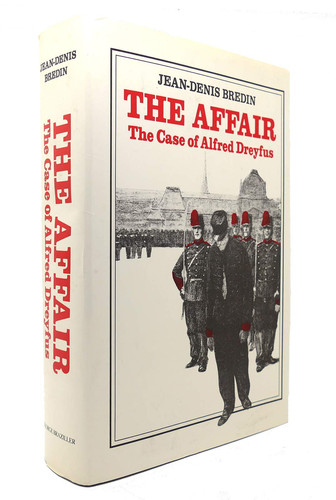
In December 1894, Captain Alfred Dreyfus, a brilliant French artillery officer and a Jew of Alsatian descent, was court-martialed for selling secrets to the German military attaché in Paris based on perjured testimony and trumped-up evidence. The sentence was military degradation and life imprisonment on Devil's Island, a hellhole off the coast of French Guiana. Five years later, the case was overturned, and eventually Dreyfus was completely exonerated. Meanwhile, the Dreyfus Affair tore France apart, pitting Dreyfusards - committed to restoring freedom and honor to an innocent man convicted of a crime committed by another - against nationalists, anti-Semites, and militarists who preferred having an innocent man rot to exposing the crimes committed by ministers of war and the army's top brass in order to secure Dreyfus's conviction.
Yale University Press 2009 249 pages

Hating the Jews: the rise of antisemitism in the 21st century

Rickman, Gregg J.
Rickman, the U.S. Special Envoy to Monitor and Combat Anti-Semitism, gives a broad picture of the conspicuous rise of antisemitism worldwide in the 21st century. Factors involved in this increase are the collapse of the USSR and communism, and the simultaneous rise of post-Khomeini Iran and jihadi Islamism, as well as the rise of Europe's second-generation Muslims, who have become the main perpetrators of antisemitic violence. The new wave of antisemitism is accompanied by an almost total indifference of European authorities, as well as rhetoric attempting to equate Islamophobia with antisemitism, substituting Muslims for Jews as victims of "antisemitism". Tropes and statements of delegitimization of Israel, denial of a historical connection of Jews with the Land of Israel, and denial of the narratives of Judaism are increasingly gaining currency in Europe and the UN. Most of the Muslim countries remain steadily hostile to the Jews, and antisemitism continues to be a problem in the post-communist countries of Eastern Europe. Contends that in order to reduce antisemitism five practical steps should be taken: stop tolerating intolerance; define antisemitism for what it truly is; end the "tribal" view that each and every Jew bears responsibility for the actions of Israel, good or bad; collect data accurately and compile statistics on antisemitic incidents; and stop applying a double standard to Israel.
Academic Studies Press 2012 183 pages

Divided memory: the Nazi past in the two Germanys

Herf, Jeffrey
The memory of the Nazi past emerged in both postwar German states divided along political lines. In both states the political elites, oriented toward the future (building socialism in the GDR, returning Germany to the West in the FRG), tended not to focus on Nazi crimes, including the Holocaust. In both countries, however, there were minority groups which insisted on preservation of the Holocaust memory in Germany. In the GDR, it was a communist group (including Paul Merker) which had functioned in Mexico during the Nazi period which stressed the centrality of the anti-Jewish policy in Nazi Germany. In the FRG it was a group which included Social Democrats and President Heuss; it regarded the admission of German responsibility for the Holocaust as a precondition for the moral healing of the nation. Contrary to all expectations, it the FRG which faced the memory of the Holocaust, while in the "anti-fascist" GDR it was suppressed. With the rise of the SPD to power in the FRG, and the collapse of communism in the GDR in 1989, the Holocaust emerged as a major topic in German political discourse, preserved in reunified Germany.
Harvard University Press 1997 527 pages

I sleep in Hitler's room: an American Jew visits Germany

Tenenbom, Tuvia
But this is just part of the story, a little part of it. For I Sleep in Hitler's Room is also a book about modern anti-Semitism, about hate that refuses to disappear, about a disease that won't get cured and a curse that won't let go. All told in the clearest of style and most amazing of humor. But this is not fiction. From beginning to end "I Sleep in Hitler's Room" is a true tale, a tale about a country that created the Holocaust and a story about a continent that moves in the direction of creating another. The target group, as in the last round, is the same: the "Jews." Why is Europe, the cradle of our civilization, so obsessed with Jews? Read "I Sleep in Hitler's Room" to find the answer. "I Sleep in Hitler's Room" will make you think, make you worry, make you cry, and make you laugh out loud. It is a book you will never forget. Ever. Buy it today. And run to tell all your friends. Traveling across Germany and seeking out that elusive quality that is the German character, playwright and journalist Tuvia Tenenbom wonders whether he has identified it in any one of several striking social phenomena--the proclivity of Germans to join clubs and group activities; how their aptitude for visual design shapes their architecture and their daily life; how their daily life is suffused with soccer and beer, the omnipresent beverage for all occasions; how they proudly self-define themselves by their achievements in precision technology; and, what is most disturbing to this son of Holocaust survivors, how their crushing awareness of their dark history coexists with virulent anti-Semitism and a stubborn obsession with Israel. Tenenbom integrates deep seriousness with the most lighthearted comic touch in this critical but affectionate look at both left and right in contemporary German politics and society. Listen in on his meetings with leaders in German industry and media, including former chancellor Helmut Schmidt, as well as with scores of private citizens whose everyday conversation Tenenbom ponders even as he gently teases them.
Gefen 2016 334 pages

The Holocaust in the Soviet Union

Arad, Yitzhak
"The Holocaust in the Soviet Union is the most complete account to date of the Soviet Jews during World War II and the Holocaust (1941-45). Reports, records, documents, and research previously unavailable in English enable Yitzhak Arad to trace the Holocaust in the German-occupied territories of the Soviet Union through three separate periods in which German political and military goals in the occupied territories dictated the treatment of the Jews."--BOOK JACKET.
University of Nebraska Press 2009-07-01 700 pages