62 results for "History"

No Snowflake in an Avalanche The Military Religious Freedom Foundation, Its Battle to Defend the Constitution and One Family's Courageous War Against Religious Extremism in High Places

Michael L. Weinstein
No Snowflake in an Avalanche goes deep inside the world of religious extremism in America s military and political infrastructure from the perspective of Michael L. Mikey Weinstein proud Academy graduate and father of graduates who single-handedly brought to light the Evangelicals' utter disregard of the constitutional principle of separation of church and state that is so essential to the nations military mission. Weinsteins war pits him and his small band of fellow graduates, cadets, and concerned citizens of varying religious backgrounds against a program of Christian fundamentalist indoctrination that could transform our fighting men and women into right-thinking warriors more befitting a theocracy than a democracy.
Rare Bird Books 2012-02 224 pages

On settler colonialism: ideology, violence, and justice

Kirsch, Adam
"A prominent public intellectual tackles one of the most crucial political ideas of our moment. Since Hamas's attack on Israel last October 7, the term "settler colonialism" has become central to public debate in the United States. A concept new to most Americans, but already established and influential in academic circles, settler colonialism is shaping the way many people think about the history of the United States, Israel and Palestine, and a host of political issues. This short book is the first to examine settler colonialism critically for a general readership. By critiquing the most important writers, texts, and ideas in the field, Adam Kirsch shows how the concept emerged in the context of North American and Australian history and how it is being applied to Israel. He examines the sources of its appeal, which, he argues, are spiritual as much as political; how it works to delegitimize nations; and why it has the potential to turn indignation at past injustices into a source of new injustices today. A compact and accessible introduction, rich with historical detail, the book will speak to readers interested in the Middle East, American history, and today's most urgent cultural-political debates."-- Dust jacket.
W. W. Norton & Company 2024 142 pages

The lost promise of civil rights

Goluboff, Risa Lauren
Listen to a short interview with Risa Goluboff Host: Chris Gondek | Producer: Heron & Crane In this groundbreaking book, Risa L. Goluboff offers a provocative new account of the history of American civil rights law. The Supreme Court's decision in Brown v. Board of Education has long dominated that history. Since 1954, generations of judges, lawyers, and ordinary people have viewed civil rights as a project of breaking down formal legal barriers to integration, especially in the context of public education. Goluboff recovers a world before Brown , a world in which civil rights was legally, conceptually, and constitutionally up for grabs. Then, the petitions of black agricultural workers in the American South and industrial workers across the nation called for a civil rights law that would redress economic as well as legal inequalities. Lawyers in the new Civil Rights Section of the Department of Justice and in the NAACP took the workers' cases and viewed them as crucial to attacking Jim Crow. By the time NAACP lawyers set out on the path to Brown , however, they had eliminated workers' economic concerns from their litigation agenda. When the lawyers succeeded in Brown , they simultaneously marginalized the host of other harms--economic inequality chief among them--that afflicted the majority of African Americans during the mid-twentieth century. By uncovering the lost challenges workers and their lawyers launched against Jim Crow in the 1940s, Goluboff shows how Brown only partially fulfilled the promise of civil rights.
Harvard University Press 2007 376 pages

Remembering America A Voice from the Sixties

Richard N. Goodwin
From the speechwriter and top adviser to presidents Kennedy and Johnson: A behind-the-scenes history of the most momentous decade in American politics. Richard N. Goodwin entered public service in 1958 as a law clerk for Supreme Court Associate Justice Felix Frankfurter. He left politics ten years later in the aftermath of Senator Robert F. Kennedy's assassination. Over the course of one extraordinary decade, Goodwin orchestrated some of the noblest achievements in the history of the US government and bore witness to two of its greatest tragedies. His eloquent and inspirational memoir is one of the most captivating chronicles of those turbulent years ever published. From the Twenty-One quiz-show scandal to the heady days of John F. Kennedy's presidential campaign to President Lyndon Johnson's heroic vote wrangling on behalf of civil rights legislation, Remembering America brings to life the most fascinating figures and events of the era. As a member of the Kennedy administration, Goodwin charted a new course for US relations with Latin America and met in secret with Che Guevara in Uruguay. He wrote Johnson's historic civil rights speech, "We Shall Overcome," in support of the Voting Rights Act of 1965 and formulated the concept of the Great Society and its programs, which sought to eradicate poverty and racial injustice. After breaking with Johnson over the president's commitment to the Vietnam War, Goodwin played a pivotal role in bringing antiwar candidate Eugene McCarthy to within a few hundred votes of victory in the 1968 New Hampshire primary. Three months later, he was with his good friend Robert F. Kennedy in Los Angeles the night that the young senator's life--and the progressive movement that had rapidly brought about such significant change--came to a devastating end. Throughout this critical decade, Goodwin held steadfast to the passions and principles that had first led him to public service. Remembering America is a thrilling account of the breathtaking victories and heartbreaking disappointments of the 1960s, and a rousing call to action for readers committed to justice today.
Open Road Integrated Media, Incorporated 2014-09-30 828 pages

Making constitutional law: Thurgood Marshall and the Supreme Court, 1961-1991

Tushnet, Mark V.
Making Constitutional Law: Thurgood Marshall and the Supreme Court, 1961-1991 focuses on the second half of a brilliant and unique career. When tapped by LBJ in 1967 to ascend to the High Court, the seasoned Marshall - as the first African-American Justice - brought desegregation to the bench in word, thought, and deed. But as Mark V. Tushnet illustrates in this book, Marshall, a Great Society liberal, brought many other progressive concepts and convictions.
Oxford University Press 1997 246 pages

Fundamental liberties of a free people: religion, speech, press, assembly

Konvitz, Milton R.
Of the American Bill of Rights, perhaps the forty-five words that comprise the First Amendment-allowing freedom of religion, speech, press, and assembly, and the guaranty of the writ of habeas corpus-are the most precious. Only a legal expert could lay claim to truly understanding the meaning and intention of those basic freedoms. Yet it is precisely the expert, knowing the complexity of the subject, who would be the first to hesitate to claim to possess such a thorough understanding. In analyzing such freedoms basic to American society, Milton Konvitz helps make comprehending our fundamental liberties easier. The book is divided into three parts: I. Freedom of Religion; II. Freedom of Speech, Press, and Assembly; III. Freedom of Speech, Press, and Assembly: The Clear and Present Danger Doctrine. The reader will find included such topics as the debate over the scope of the separation of Church and State, whether or not freedom of religion is an absolute right, religious freedom prior to 1776, the liberty of private schools, heresy, the right for a religious group to seek converts, the freedoms not to speak and listen, obscene literature, picketing in labor disputes, the freedom to think and believe, abridgments of speech and press, and loyalty oaths and guilt by association. Konvitz's work includes an important chapter on the history of the adoption of the Bill of Rights. His careful tracing of the development of constitutional attitudes to the freedoms protected by the First Amendment is a scholarly benchmark, and is still an archetype for students doing research and writing about these issues. It is of critical importance to anyone seeking an authoritative statement on the basic liberties guaranteed by the First Amendment to the United States Constitution. Fundamental Liberties of a Free People is a relevant and practical guide to understanding the liberties so fundamental to a free society. In his new introduction and afterword, author Milton Konvitz brings First Amendment developments up to 2002. It will be welcomed by students and scholars of constitutional law, government, politics, religion, and American history.
Transaction Publishers 2003 452 pages

Rainbow Solidarity in Defense of Cuba

Leslie Feinberg
Featuring an insightful look at lesbian, gay, bisexual, and transgender (LGBT) life in Cuba, this chronicle illuminates the progress the country has made from centuries of backward attitudes and oppression to the current state of enlightenment. From the mores of the Colonial period to the roles that Hollywood, the CIA, and Wall Street played in depicting Cuba as a "police state" for gays and in reinforcing the oppression, this overview provides a backdrop of the past and illustrates the persecution and exploitation originally planted by Spanish colonialism and further cultivated by U.S. capitalism. Details on the gradual transformation follow as the narrative examines the impact of the political and institutional initiatives taken by Fidel Castro and the Cuban leadership to overcome bigotry and prejudice against LGBT people--among them free health care and education, guaranteed jobs and housing, special health care for AIDS victims, and widespread sex education.
World View Forum 2009 116 pages

Wrestling with the Angel of Democracy On Being an American Citizen

Susan Griffin
What does is it mean to be a citizen of the United States? Susan Griffin’s provocative investigation of that question takes us from the Declaration of Independence to the Iraq War, with many stops in between. Her conclusion: democracy is nothing less than a revolution of consciousness, and the revolution has just begun.
Shambhala Publications, Incorporated 2009-11-10 291 pages

Fear in Chile: lives under Pinochet

Politzer Kerekes, Patricia
"Like a García Márquez novel that has suddenly, horrifyingly, come to real life" ( New York Newsday ), Fear in Chile is an extraordinary collection of firstperson accounts of life under dictatorship. In the 1980s, shortly after Chile emerged from one of the century's most notorious reigns of terror, Chilean journalist Patricia Politzer interviewed figures including a revolutionary activist, a military leader loyal to General Augusto Pinochet, a bank clerk concerned with the status quo, the mother of one of the "disappeared," as well as a dozen other men and women from every political position and social stratum of Chilean life. The result is a broad, vivid, yet nonideological view of modern life under military rule, about which Ariel Dorfman writes, "I can think of no better introduction to my country." With the October 1998 arrest of General Pinochet in Great Britain and renewed world awareness of the horrendous crimes committed during his regime, Fear in Chile , updated with a new afterword by the author that considers the recent attempts to prosecute Pinochet for human-rights violations, offers a vivid portrait of Chile's Pinochet era.
New Press 2001 254 pages

Madison's music: on reading the First Amendment

Neuborne, Burt
"Are you sitting down? It turns out that everything you learned about the First Amendment is wrong. For too long, we've been treating small, isolated snippets of the text as infallible gospel without looking at the masterpiece of the whole. Legal luminary Burt Neuborne argues that the structure of the First Amendment as well as of the entire Bill of Rights was more intentional than most people realize, beginning with the internal freedom of conscience and working outward to freedom of expression and finally freedom of public association. This design, Neuborne argues, was not to protect discrete individual rights--such as the rights of corporations to spend unlimited amounts of money to influence elections--but to guarantee that the process of democracy continues without disenfranchisement, oppression, or injustice. Neuborne, who was the legal director of the ACLU and has argued numerous cases before the Supreme Court, invites us to hear the "music" within the form and content of Madison's carefully formulated text. When we hear Madison's music, a democratic ideal flowers in front of us, and we can see that the First Amendment gives us the tools to fight for campaign finance reform, the right to vote, equal rights in the military, the right to be full citizens, and the right to prevent corporations from riding roughshod over the weakest among us. Neuborne gives us an eloquent lesson in democracy that informs and inspires."--
The New Press 2015 260 pages

The biggest prison on Earth: a history of the occupied territories

Pappé, Ilan
Shortlisted for the Palestine Book Awards 2017 A powerful, groundbreaking history of the Occupied Territories from one of Israel's most influential historians From the author of the bestselling study of the 1948 War of Independence comes an incisive look at the Occupied Territories, picking up the story where The Ethnic Cleansing of Palestine left off. In this comprehensive exploration of one of the world’s most prolonged and tragic conflicts, Pappe uses recently declassified archival material to analyse the motivations and strategies of the generals and politicians – and the decision-making process itself – that laid the foundation of the occupation. From a survey of the legal and bureaucratic infrastructures that were put in place to control the population of over one million Palestinians, to the security mechanisms that vigorously enforced that control, Pappe paints a picture of what is to all intents and purposes the world’s largest ‘open prison’.
Oneworld 2018 273 pages

And Then I Danced Traveling the Road to LGBT Equality

Mark Segal
"[A] swiftly written debut memoir...[Segal] vividly describes his firsthand experience as a teenager inside the Stonewall bar during the historic riots, his participation with the Gay Liberation Front, and amusing encounters with Elton John and Patti LaBelle . . . A jovial yet passionately delivered self-portrait inspiring awareness about LGBT history from one of the movement's true pioneers." --Kirkus Reviews "With great verve and spirit, Segal has rendered a lively and dramatic memoir of the early days of the gay rights struggle; the infighting over strategies and objectives; the long, hard road of progress; and a look at the challenges still ahead." --Booklist On December 11, 1973, Mark Segal disrupted a live broadcast of the CBS Evening News when he sat on the desk directly between the camera and news anchor Walter Cronkite, yelling, "Gays protest CBS prejudice!" He was wrestled to the studio floor by the stagehands on live national television, thus ending LGBT invisibility. But this one victory left many more battles to fight, and creativity was required to find a way to challenge stereotypes surrounding the LGBT community. Mark Segal's job, as he saw it, was to show the nation who gay people are: our sons, daughters, fathers, and mothers. Because of activists like Mark Segal, whose life work is dramatically detailed in this poignant and important memoir, today there are openly LGBT people working in the White House and throughout corporate America. An entire community of gay world citizens is now finding the voice that they need to become visible.
Open Lens 2015 302 pages

Civil War on Race Street The Civil Rights Movement in Cambridge, Maryland

Peter B. Levy
Civil War on Race Street, so named because Race Street was the road that divided blacks and whites in Cambridge, Maryland, is a detailed examination of one of the most vibrant locally based struggles for racial equality during the 1960s. Beginning with an overview of Cambridge, particularly its history of racial and class relations, Peter Levy traces the emergence of the modern civil rights movement in this city on Maryland's Eastern Shore. Catalyzed by the arrival of freedom in 1962, the movement in Cambridge expanded in 1963 and 1964 under the leadership of Gloria Richardson, one of the most prominent (and one of the few female) civil rights leaders in the nation. In the years after her departure from Cambridge, the movement went into decline until 1967, when it underwent a brief revival that culminated with a riot allegedly incited by black power spokesman H. Rap Brown. In the wake of the riot, blacks and whites in Cambridge sought to rebuild their city and return to a politics of moderation. However, Spiro Agnew, then governor of Maryland, used the riot to advance his political career and the fortunes of the New Right, thereby garnering the attention of the public (as well as Richard Nixon) and achieving the vice-presidency in 1968. At the same time, H. Rap Brown saw his influence and that of the civil rights movement decline.
University Press of Florida 2003-01-31 264 pages

Redemption: the last battle of the Civil War

Lemann, Nicholas
A century after Appomattox, the civil rights movement won full citizenship for black Americans in the South. It should not have been necessary: by 1870 those rights were set in the Constitution. This is the story of the terrorist campaign that took them away. Nicholas Lemann opens his extraordinary new book with a riveting account of the horrific events of Easter 1873 in Colfax, Louisiana, where a white militia of Confederate veterans-turned-vigilantes attacked the black community there and massacred hundreds of people in a gruesome killing spree. This was the start of an insurgency that changed the course of American history: for the next few years white Southern Democrats waged a campaign of political terrorism aiming to overturn the Fourteenth and Fifteenth Amendments and challenge President Grant'ssupport for the emergent structures of black political power. The remorseless strategy of well-financed "White Line" organizations was to create chaos and keep blacks from voting out of fear for their lives and livelihoods. "Redemption" is the first book to describe in uncompromising detail this organized racial violence, which reached its apogee in Mississippi in 1875. Lemann bases his devastating account on a wealth of military records, congressional investigations, memoirs, press reports, and the invaluable papers of Adelbert Ames, the war hero from Maine who was Mississippi's governor at the time. When Ames pleaded with Grant for federal troops who could thwart the white terrorists violently disrupting Republican political activities, Grant wavered, and the result was a bloody, corrupt election in which Mississippi was "redeemed"--that is, returned to white control. """Redemption "makes clear that this is what led to the death of Reconstruction--and of the rights encoded in the Fourteenth and Fifteenth Amendments. We are still living with the consequences.
Farrar, Straus and Giroux 2006 257 pages

We the people. Volume 3. The Civil Rights revolution

Ackerman, Bruce A.
The Civil Rights Revolution carries Bruce Ackerman’s sweeping reinterpretation of constitutional history into the era beginning with Brown v. Board of Education . From Rosa Parks’s courageous defiance, to Martin Luther King’s resounding cadences in “I Have a Dream,” to Lyndon Johnson’s leadership of Congress, to the Supreme Court’s decisions redefining the meaning of equality, the movement to end racial discrimination decisively changed our understanding of the Constitution. “The Civil Rights Act turns 50 this year, and a wave of fine books accompanies the semicentennial. Ackerman’s is the most ambitious; it is the third volume in an ongoing series on American constitutional history called We the People . A professor of law and political science at Yale, Ackerman likens the act to a constitutional amendment in its significance to the country’s legal development.” —Michael O’Donnell, The Atlantic “Ackerman weaves political theory with historical detail, explaining how the civil rights movement evolved from revolution to mass movement and then to statutory law...This fascinating book takes a new look at a much-covered topic.” —Becky Kennedy, Library Journal
The Belknap Press of Harvard University Press 2018-07-09 432 pages

Colored travelers: mobility and the fight for citizenship before the Civil War

Pryor, Elizabeth Stordeur
"Americans have long regarded the freedom of travel a central tenet of citizenship. Yet, in the United States, freedom of movement has historically been a right reserved for whites. In this book, Elizabeth Stordeur Pryor shows that African Americans fought obstructions to their mobility over 100 years before Rosa Parks refused to give up her seat on a Montgomery bus. These were "colored travelers," activists who relied on steamships, stagecoaches, and railroads to expand their networks and to fight slavery and racism. This book tells the story of how the basic act of traveling emerged as a front line in the battle for African American equal rights before the Civil War"--
The University of North Carolina Press 2016 218 pages

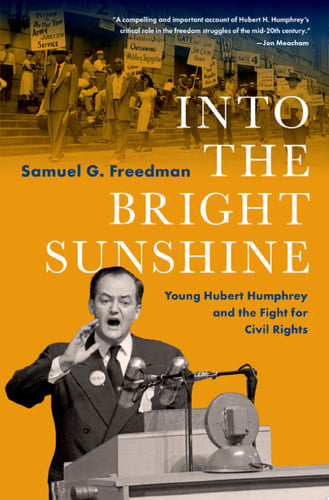
Into the bright sunshine: young Hubert Humphrey and the fight for civil rights

Freedman, Samuel G.
"Hubert Humphrey, a fallen hero and a dying man, rose on rickety legs to approach the podium of the Philadelphia Convention Hall, his pulpit for the commencement address at the University of Pennsylvania. He clutched a sheaf of paper with his speech for the occasion, typed and double-spaced by an assistant from his extemporaneous dictation, and then marked up in pencil by Humphrey himself. A note on the first page, circled to draw particular attention, read simply, "30 years ago--Here." In this place, at that time, twenty-nine years earlier to be precise, he had made history. From the dais now, Humphrey beheld five thousand impending graduates, an ebony sea of gowns and mortarboards, broken by one iconoclast in a homemade crown, two in ribboned bonnets, and another whose headgear bore the masking-tape message HI MA PA. In the horseshoe curve of the arena's double balcony loomed eight thousand parents and siblings, children, and friends. Wearing shirtsleeves and cotton shifts amid the stale heat, they looked like pale confetti from where Humphrey stood, and their flash cameras flickered away, a constellation of pinpricks"--
Oxford University Press 2023 488 pages

Hell no: your right to dissent in 21st-century America

Ratner, Michael
"Includes chapters on what today's activists must know about the threats posed by federal law enforcement agents and their tactics, as well as the actual text of the recently released FBI Domestic Investigations and Operations Guide in which the FBI spells out its approach to policing dissent. Hell No also includes information on several key security practices that offer the best protection from government surveillance and interference. With an introduction on What's Happened to Dissent Today looking at the protests at the Republican National Convention by CCR board chair Michael Ratner and constitutional rights expert Margaret Ratner Kunstler Hell Nois an indispensable tool in the effort to give free speech true meaning in a post-9/11 world"--
New Press, The 2011 164 pages