60 results for "History"

Oaxaca journal

Sacks, Oliver
Since childhood, Oliver Sacks has been fascinated by ferns: an ancient class of plants able to survive and adapt in many climates. Along with a delightful group of fellow fern aficionados—mathematicians, poets, artists, and assorted botanists and birders—he embarks on an exploration of Southern Mexico, a region that is also rich in human history and culture. He muses on the origins of chocolate and mescal, pre-Columbian culture and hallucinogens, the vibrant sights and sounds of the marketplace, and the peculiar passions of botanists. What other species would comb ancient Zapotec ruins on their hands and knees, searching for a new type of fern? Combining Sacks's enthusiasm for natural history and the richness of humanity with his sharp and observant eye for detail, Oaxaca Journal is a rare treat.
Vintage Books 2012-03-06 159 pages

The year I was Peter the Great

Kalb, Marvin L.
The year 1956 was an extraordinary year in modern Russian history. It was called "the year of the thaw"--a time when Stalin's dark legacy of dictatorship died in February only to be reborn later that December. This historic arc from rising hope to crushing despair opened with a speech by Nikita Khrushchev, then the unpredictable leader of the Soviet Union. He astounded everyone by denouncing the one figure who, up to that time, had been hailed as a "genius," a wizard of communism--Josef Stalin himself. Now, suddenly, this once unassailable god was being portrayed as a "madman" whose idiosyncratic rule had seriously undermined communism and endangered the Soviet state. This amazing switch from hero to villain lifted a heavy overcoat of fear from the backs of ordinary Russians. It also quickly led to anti-communist uprisings in Eastern Europe, none more bloody and challenging than the one in Hungary, which Soviet troops crushed at year's end. Marvin Kalb, then a young diplomatic attaché at the U.S. Embassy in Moscow, observed this tumultuous year that foretold the end of Soviet communism three decades later. Fluent in Russian, a doctoral candidate at Harvard, he went where few other foreigners would dare go, listening to Russian students secretly attack communism and threaten rebellion against the Soviet system, traveling from one end of a changing country to the other and, thanks to his diplomatic position, meeting and talking with Khrushchev, who playfully nicknamed him Peter the Great. In this, his fifteenth book, Kalb writes a fascinating eyewitness account of a superpower in upheaval and of a people yearning for an end to dictatorship
The Brookings Institution 2017-10-10 290 pages

City of lions

Sands, Philippe
“A loving, sensuous, but also gently ironic reconstruction of a lost city” — LA Review of Books A timely reissue of the classic portrayal of the Ukrainian city of Lviv by 2 authors in 2 acts, separated by time and circumstance With an illuminating preface by Eva Hoffman and stunning new photographs by Diana Matar, City of Lions is a powerful and melancholy evocation of Ukraine in the twentieth century, with a special resonance for today. Lviv, Lwów, Lvov, Lemberg. Known by a variety of names, the City of Lions is now in western Ukraine. Situated in different countries during its history, it is a city located along the fault-lines of Europe's history. City of Lions presents two essays, written more than half a century apart - but united by one city. Józef Wittlin's lyrical paean to his Lwów, written in exile, is a deep cry of love and pain for his city, where most people he knew have fled or been killed. Philippe Sands' finely honed exploration of what has been lost and what remains interweaves a lawyer's love of evidence with the emotional heft of a descendant of Lviv.
Pushkin Press 2023-09-12 176 pages

Marvelous possessions: the wonder of the New World : with a new preface

Greenblatt, Stephen
A masterwork of history and cultural studies, Marvelous Possessions is a brilliant meditation on the interconnected ways in which Europeans of the Age of Discovery represented non-European peoples and took possession of their lands, particularly in the New World. In a series of innovative readings of travel narratives, judicial documents, and official reports, Stephen Greenblatt shows that the experience of the marvelous, central to both art and philosophy, was manipulated by Columbus and others in the service of colonial appropriation. Much more than simply a collection of the odd and exotic, Marvelous Possessions is both a highly original extension of Greenblatt’s thinking on a subject that has permeated his career and a thrilling tale of wandering, kidnapping, and go-betweens—of daring improvisation, betrayal, and violence. Reaching back to the ancient Greeks, forward to the present, and, in his new preface, even to fantastical meetings between humans and aliens in movies like Close Encounters of the Third Kind , Greenblatt would have us ask: How is it possible, in a time of disorientation, hatred of the other, and possessiveness, to keep the capacity for wonder—for tolerant recognition of cultural difference—from being poisoned?
The University of Chicago Press 2017-10-20 202 pages

We are here: memories of the Lithuanian Holocaust

Cassedy, Ellen
Winner of the 2013 National Book Prize from Grub Street, the Towson Prize for Literature, and the 2013 Prakhin International Literary Foundation Award. Ellen Cassedy's longing to recover the Yiddish she'd lost with her mother's death eventually led her to Lithuania, once the "Jerusalem of the North." As she prepared for her journey, her uncle, sixty years after he'd left Lithuania in a boxcar, made a shocking disclosure about his wartime experience, and an elderly man from her ancestral town made an unsettling request. Gradually, what had begun as a personal journey broadened into a larger exploration of how the people of this country, Jews and non-Jews alike, are confronting their past in order to move forward into the future. How does a nation--how do successor generations, moral beings--overcome a bloody past? How do we judge the bystanders, collaborators, perpetrators, rescuers, and ourselves? These are the questions Cassedy confronts in We Are Here, one woman's exploration of Lithuania's Jewish history combined with a personal exploration of her own family's place in it. Digging through archives with the help of a local whose motives are puzzling to her; interviewing natives, including an old man who wants to "speak to a Jew" before he dies; discovering the complications encountered by a country that endured both Nazi and Soviet occupation--Cassedy finds that it's not just the facts of history that matter, but what we choose to do with them.
University of Nebraska Press 2012 273 pages

Diario de Oaxaca

Kuper, Peter
Painting a vivid, personal portrait of social and political upheaval in Oaxaca, Mexico, this unique memoir employs comics, bilingual essays, photos, and sketches to chronicle the events that unfolded around a teachers' strike and led to a seven-month siege. When award-winning cartoonist Peter Kuper and his wife and daughter moved to the beautiful, 15th-century colonial town of Oaxaca in 2006, they planned to spend a quiet year or two enjoying a different culture and taking a break from the U.S. political climate under the Bush administration. What they hadn't counted on was landing in the epicenter of Mexico's biggest political struggle in recent years. Timely and compelling, this extraordinary firsthand account presents a distinct artistic vision of Oaxacan life, from explorations of the beauty of the environment to graphic portrayals of the fight between strikers and government troops that left more than 20 people dead, including American journalist Brad Will.
PM Press 2009 208 pages

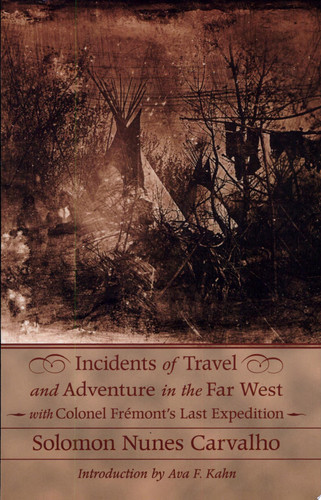
Incidents of travel and adventure in the Far West: with Colonel Fremont's last expedition across the Rocky Mountains, including three months' residence in Utah, and a perilous trip across the great American desert to the Pacific

Carvalho, Solomon Nunes
n August 1853, an American-born Sephardic Jew, Solomon Nunes Carvalho, accepted John Fremont's invitation to join his fifth expedition to find the best overland route to California. A Baltimore artist, inventor, and daguerreotypist, Carvalho was given the job of creating a photographic record of the lands and peoples along the way. Fremont's party left the Missouri on September 14, 1853, traveled up the Kansas River, overland to the Arkansas, upriver past Bent's Fort to the Huerfano, and traversed the Sandhill Pass into the Rocky Mountains. Beset by heavy snows and intense cold, they were reduced to eating their horses and mules and the occasional beaver or porcupine while making their way in midwinter across the Grand, Green, and Sevier Rivers. Suffering from frostbite, scurvy, and dysentery, Carvalho left the expedition in Utah; spent four months among the Mormons in Salt Lake City, where he observed with keen interest their system of spiritual wives; and reached California in 1854. Carvalho became the first Jewish writer to publish accounts of the Great American West and was also one of the first people to photograph the American West. Although only one of his plates is known to survive, others became the models for wood and steel engravings that broadcast the image of the West throughout the world. This Bison Books edition restores the discourses on Mormon doctrine omitted from previous twentieth-century editions. Ava F. Kahn is a visiting scholar at the California Studies Center, University of California, Berkeley. Her books include Jewish Voices of the California Gold Rush: A Documentary History, 1849-1880; Jewish Life in the American West: Perspectives on Migration, Settlement, and Community; and California Jews (coedited with Marc Dollinger).
University of Nebraska Press 2004-01-01 130 pages

No vulgar hotel: the desire and pursuit of Venice

Martin, Judith
Love of Venice can strike anyone, not just romantic wusses. Among the toughies with serious cases were Lord Byron, Richard Wagner, Ezra Pound, and Ernest Hemingway. Symptoms include: Wishing that the movie stars in films set in Venice would move aside so that you can get a better view of the scenery. Wondering why people ask if you had good weather when you were thereas if rain could dampen your love. Thinking that people who go to Tuscany or Provence must be nuts. Believing that the Per San Marco street sign with arrows pointing in opposite directions makes perfect sense. Consoling yourself when you leave by remembering the generations of Venetian merchants who, as they were borne away from Venice, vowed to be back as soon as they had more money. There is no cure for this affliction. This is a guide to managing it
W.W. Norton & Co 2007 330 pages

Land of dust: Palestine at the turn of the century

Friedman, Saul S.
Product description The author studies the nature of the land of Palestine and the level of civilization attained by its residents at the turn of the century, employing the reactions of contemporary eyewitnesses along with a set of photographs prepared by T.W. Ingersoll and G. Eric Matson (the original photographs were color-tinted, and copyrighted by Ingersoll in 1904). Review ...provides the texture of old Palestine in a manner that is graphic and almost tactile. I recommend it heartily for students both of the region and of the problem.>>>> (Howard Sechar) ...This is a reading MUST for all the parties concerned in the problem of Israel and her Arab neighbours.>>>> (Prof. William J. Fishman) About the Author Saul S. Friedman is Associate Professor of History at Youngstown State University in Youngstown, Ohio. He is the author of Amcha: An Oral Testament of the Holocaust (UPA, 1979).
University Press of America 1982-04-21 248 pages

A visit to Don Otavio

Bedford, Sybille
Before returning to the Old World after World War II, Sybille Bedford resolved to see something more of the New. "I had a great longing to move," she said, "to hear another language, eat new food, to be in a country with a long nasty history in the past and as little present history as possible." And so she set out for Mexico - and, incidentally, to write what Bruce Chatwin called the best travel book of the twentieth century, "a book of marvels, to be read again and again and again."
Eland 2002 312 pages

The golden dream: seekers of El Dorado

Silverberg, Robert
One of the most persistent legends in the annals of New World exploration is that of the Land of Gold. This mythical site was located over vast areas of South America (and later, North America); the search for it drove some men mad with greed and, as often as not, to their untimely deaths. In this history of quest and adventure, Robert Silverberg traces the fate of Old World explorers lured westward by the myth of El Dorado. From the German conquistadores licensed by the Spanish king to operate out of Venezuela, to the journeys of Gonzalo Pizarro in the Amazon basin, and to the nearly miraculous voyage of Francisco Orellana to the mouth of the Amazon River, encountering the warlike women who gave the river its name, violence and bloodshed accompanied the determined adventurers. Sir Walter Raleigh and a host of other explorers spent small fortunes and many lives trying to locate Manoa, a city that was rumored to be El Dorado—City of Gold. Celebrated science fiction author Robert Silverberg recreates these legendary quests in The Golden Dream: Seekers of El Dorado.
Ohio University Press 1996 437 pages

Tiny lights for travellers

Lewis, Naomi K.
"When her marriage suddenly ends, and a diary documenting her beloved grandfather's escape from Nazi-occupied Netherlands in the summer of 1942 is discovered, Naomi K. Lewis decides to retrace his journey to learn about her family history. Despite suffering from extreme disorientation and a lifetime of anxiety, she travels alone for the first time. Moving from Amsterdam to Lyon--relying on the marvels of GPS--she discovers family secrets and her own narrative as a second-generation Jewish Canadian. With vulnerability, humour, and wisdom, Lewis's memoir asks tough questions about her identity as a secular Jew, the accuracy of family stories, and the impact of the Holocaust on subsequent generations. How do immigrants weave their sense of identity into their chosen countries? Must we be able to locate ourselves within family and cultural geography to belong?"--
University of Alberta Press 2019-05-15 281 pages

This year in Jerusalem

Richler, Mordecai
"Part memoir, part history, part political commentary - and all Richler - This Year in Jerusalem is a personal, passionate, and quirkily comic examination of the idea of Israel-as-homeland: for Jews, for Palestinians, and, not least, for the author himself. Richler re-creates the Montreal of his adolescence - the local Zionist youth organization functioning as an escape from the zealous Hasidism of his grandfathers; the idea of emigration to Israel growing into a shimmering dream for himself and his friends. And, going to Israel to look up his old pals from St. Urbain Street, he shows us what happened to those who actually did "make aliyah"--Who settled in the cities and on the kibbutzim, survived the turmoils of war, and are faced today with the opportunities and dangers of peace with the Palestinians. He shows us, as well, the course of his own migration - away from Zionism and through the maze of his own sense of Judaism until he rediscovers his true homeland: "I owe as much to the thin gruel of my Canadian experience as I do to my Jewish provenance." Woven through his story are his fond (and not so fond) recollections of his family, his encounters in today's Israel with the kids he grew up with in Montreal a million years ago, and his most mordant observations on the state of the state of Israel and the Israeli-Palestinian conflict. Witty, intelligent, well reasoned, and across-the-board provocative, here is Mordecai Richler at his inimitable - and controversial - best." -- dust jacket
Knopf 1994-09-06 291 pages

Engel's England: thirty-nine counties, one capital and one man

Engel, Matthew
England, says Matthew Engel, is the most complicated place in the world. And, as he travels through each of the historic English counties, he discovers that's just the start of it. Every county is fascinating, the product of a millennium or more of history: still a unique slice of a nation that has not quite lost its ancient diversity.He finds the well-dressers of Derbyshire and the pyromaniacs of Sussex; the Hindus and huntsmen of Leicestershire; the goddess-worshippers of Somerset. He tracks down the real Lancashire, hedonistic Essex, and the most mysterious house in Middlesex. In Durham he goes straight from choral evensong to the dog track. As he seeks out the essence of each county - from Yorkshire's broad acres to the microdot of Rutland - Engel always finds the unexpected .Engel's England is a totally original look at a confused country: a guidebook for people who don't think they need a guidebook. It is always quirky, sometimes poignant and often extremely funny.
Profile Books 2014 538 pages