135 results for "History"

Money and Government The Past and Future of Economics

Robert Skidelsky
A critical examination of economics's past and future, and how it needs to change, by one of the most eminent political economists of our time The dominant view in economics is that money and government should play only a minor role in economic life. Economic outcomes, it is claimed, are best left to the "invisible hand" of the market. Yet these claims remain staunchly unsettled. The view taken in this important new book is that the omnipresence of uncertainty makes money and government essential features of any market economy. Since Adam Smith, classical economics has espoused nonintervention in markets. The Great Depression brought Keynesian economics to the fore, but stagflation in the 1970s brought a return to small-state orthodoxy. The 2008 global financial crash should have brought a reevaluation of that stance; instead the response has been punishing austerity and anemic recovery. This book aims to reintroduce Keynes's central insights to a new generation of economists, and embolden them to return money and government to the starring roles in the economic drama that they deserve.
Yale University Press 2018 491 pages

Finance capital: a study of the latest phase of capitalist development

Hilferding, Rudolf
This is the first English translation of one of the classical works of Marxist economic theory. When Rudolf Hilferding’s Finance Capitalwas first published in 1919 it was acclaimed by reviewers as a continuation of Marx’s Capital, and it has a major influence upon subsequent Marxist thought, especially in the analysis of imperialism where it provided some of the fundamental ideas for the theories of Bukharin and Lenin. But Hilferding’s work was much more than a study of imperialism, which was presented only in the last section of the book. It set out to examine the main tendencies in the development of the capitalist mode of production as a whole at the beginning of the twentieth century, beginning with an exposition of the theory of money (in which particular attention was paid to the growth of credit money), then analysing the increasingly important role of the banks in the mobilization of capital, along with the development of large corporations, cartels and trusts, and finally outlining a theory of economic crises. Hilferding’s book has, however, more than an historical interest. It is a model for any renewed attempt to understand the ‘latest phase of capitalist development’ in the closing decades of the twentieth century, and Hilferdin’s ideas still provide essential elements for the elaboration of theoretically enlightened and realistic policies in the socialist movement.
Routledge 2019 466 pages

Marx's concept of man

Fromm, Erich
"In publishing Marx's Concept of Man in 1961, Erich Fromm presented to the English-speaking world for the first time Karl Marx's then recently discovered Economic and Philosophical Manuscripts. Including the Manuscripts and many other philosophical writings by Marx as well as Fromm's own extended response, many of these writings have since become recognised as important works in their own right. Fromm stresses Marx's humanist philosophy and challenges both contemporary Western ignorance of Marx and Soviet corruptions of his work. Fromm's analysis of Marx's work and his dissemination of these neglected writings by Marx himself fundamentally altered the prevailing discourse about Marxism, revolutionising contemporary thought and providing a formative influence for the development of the New Left"--
Bloomsbury Academic, An imprint of Bloomsbury Publishing Plc 2017 219 pages

Bankers and Pashas: International Finance and Economic Imperialism in Egypt

David S. Landes
فى نهاية الخمسينات عثر الباحث الإقتصادى الأمريكى ديفيد لاندز على أرشيف سرى فى باريس يحتوى على مراسلات اثنين من كبار ممولى الخديوى اسماعيل الأجانب. وقد ألقت هذه المراسلات ضوءا جديدا على قصة النهب الأوروبى لثروة مصر فى عهد أسرة محمد على, والوصول بها إلى مرحلة الخراب ثم الإحتلال ...يحتوى الكتاب أيضا على دراسة للمترجم وهو المفكر اليسارى د. عبد العظيم أنيس - أحد رواد النضال الوطنى والتقدمى منذ الأربعينات - بعنوان : الخراب الحديث لمصر المحروسة
Harper Torchbooks 1969-01-01 354 pages

The crisis of vision in modern economic thought

Heilbroner, Robert L.
A deep and widespread crisis affects modern economic theory, a crisis that derives from the absence of a "vision"--a set of widely shared political and social preconceptions--on which all economics ultimately depends. This absence, in turn, reflects the collapse of the Keynesian view that provided such a foundation from 1940 through the early 1970s, comparable to earlier visions provided by Smith, Ricardo, Mill, and Marshall. The "unraveling" of Keynesianism has been followed by a division into discordant and ineffective camps whose common denominator seems to be their shared analytical refinement and lack of practical applicability. This provocative analysis attempts both to describe this state of affairs, and to suggest the direction in which economic thinking must move if it is to regain the relevance and remedial power it now pointedly lacks.
Cambridge University Press 1995 131 pages

Inside the economist's mind: conversations with eminent economists

Paul A. Samuelson,William A. Barnett
By focusing on the human side as well as the intellectual dimensions of how economists work and think, this collection of interviews with top economists of the 20th century becomes a startling and lively introduction to the modern world of macroeconomics. A fun read! For more information, frequent updates, and to comment on the forthcoming book, visit William A. Barnett's weblog at http://economistmind.blogspot.com/. Acclaim for Inside the Economist's Mind "In candid interviews, these great economists prove to be fabulous story tellers of their lives and times. Unendingly gripping for insiders, this book should also help non-specialists understand how economists think." Professor Julio Rotemberg, Harvard University Business School, and Editor, Review of Economics and Statistics. "Economics used to be called the 'dismal science'. It will be impossible for anybody to hold that view anymore ... This is science with flesh and blood, and a lot of fascinating stories that you will find nowhere else." Dr. Jean-Pascal Bénassy, Paris-Jourdan Sciences Économiques, Paris, France "This book provides a rare and intriguing view of the personal and professional lives of leading economists ... It is like A Beautiful Mind , scaled by a factor of 16 [the number of interviews in the book]." Professor Lee Ohanian, University of California at Los Angeles " ... if you want an insider view of how economics has been developing in the last decades, this is the (only) book for you." Professor Giancarlo Gandolfo, University of Rome ‘La Sapienza,’ Rome "Here we see the HUMAN side of path-breaking research, the personalities and pitfalls, the DRAMA behind the science." Professor Francis X. Diebold, University of Pennsylvania, Philadelphia
Blackwell Pub 2007 419 pages

A Theory of the Consumption Function

Milton Friedman
What is the exact nature of the consumption function? Can this term be defined so that it will be consistent with empirical evidence and a valid instrument in the hands of future economic researchers and policy makers? In this volume a distinguished American economist presents a new theory of the consumption function, tests it against extensive statistical J material and suggests some of its significant implications. Central to the new theory is its sharp distinction between two concepts of income, measured income, or that which is recorded for a particular period, and permanent income, a longer-period concept in terms of which consumers decide how much to spend and how much to save. Milton Friedman suggests that the total amount spent on consumption is on the average the same fraction of permanent income, regardless of the size of permanent income. The magnitude of the fraction depends on variables such as interest rate, degree of uncertainty relating to occupation, ratio of wealth to income, family size, and so on. The hypothesis is shown to be consistent with budget studies and time series data, and some of its far-reaching implications are explored in the final chapter.
Must Have Books 2022-03-15 254 pages

On the Principles of Political Economy and Taxation

David Ricardo
On the Principles of Political Economy and Taxation (19 April 1817) is a book by David Ricardo on economics. The book concludes that land rent grows as population increases. It also presents the theory of comparative advantage, the theory that free trade between two or more countries can be mutually beneficial, even when one country has an absolute advantage over the other countries in all areas of production.
CreateSpace Independent Publishing Platform 2018-08-19 244 pages

Keynes for Our Times

Skidelsky, Robert
"John Maynard Keynes (1883-1946) was arguably the most important economist of the twentieth century; his ideas have fundamentally altered the way governments approach economic policy. Exploring the enduring relevance of his ideas, Robert Skidelsky emphasizes Keynes's conception of economics as a moral science. Keynes was deeply invested in the broader societal implications of economic policies, and this book highlights his belief in economics as a tool for achieving the good life. Skidelsky sheds new light on Keynes's views on capitalism, discusses his advocacy of low interest rates, and delves into his thoughts on economic instability. He also offers fresh insight into Keynes's ideas about money, his philosophical foundations, and his unique approach to uncertainty and probability. Ultimately, Skidelsky shows how Keynes's vision of an economic policy that prioritizes the common good can be adapted to help solve our current economic and political challenges"--
Yale University Press 2026-06-23 186 pages

Principles of Political Economy and Taxation

David Ricardo
David Ricardo's On the Principles of Political Economy and Taxation the implications of land rent increases along with population among other things. Ricardo argues for the acceptance of free trade and shows how it's both short and long term advantages. The arguments laid out in this book form the basis of modern trade theory and are, therefore, of interest in today's global economy.
CreateSpace Independent Publishing Platform 2010-09-24 220 pages

National Power and the Structure of Foreign Trade

Albert Hirschman
This study begins with a brief survey of economic thought on the relationship between foreign trade and national power, from the Mercantilists on. Chapter II attempts a systematic theoretical approach to the subject. It first makes clear the fundamental basis of the possible use of foreign trade as an instrument of national power policy. Using well-known concepts of economic analysis, it proceeds to show under what conditions and by means of what policies this instrument is likely to attain its highest efficiency. The principles of power policy thus deduced theoretically are then compared with the actual practices followed by German trading methods in recent years. Toward the end of this chapter the reader will be carried into a detailed discussion of certain problems of the theory of international trade, which are touched upon earlier in the chapter. Chapter III is applied to the historical background of our problem. It gives a survey of the literature on "economic aggression" before and during World War I and brings out the importance of the Paris Economic Conference of the Allies in 1916 for the Versailles Treaty and postwar economic policies. In Chapter IV we review in the light of our theoretical and historical analyses certain safeguards or remedies which could be or have been proposed to prevent the use of foreign trade as an instrument of national power policies. Certain questions raised in Part 1 can be answered in quantitative terms. Part 2 consists, therefore, of an exposition of various trends of international trade in recent years disclosed by statistical analysis. In Chapter V we calculate an index number expressing the extent to which the trade of the large trading nations is or has been directed by preference toward the smaller trading countries. Chapter VI gives index numbers for the degree of concentration of their foreign trade on one or a few big markets or sources of supply. Finally, in Chapter VII we measure the extent to which world trade has been based primarily on an exchange of manufactures against raw materials and foodstuffs. This title is part of UC Press's Voices Revived program, which commemorates University of California Press’s mission to seek out and cultivate the brightest minds and give them voice, reach, and impact. Drawing on a backlist dating to 1893, Voices Revived makes high-quality, peer-reviewed scholarship accessible once again using print-on-demand technology. This title was originally published in 1945, with an expanded edition published in 1980.
Univ of California Press 2024-06-14 194 pages

A Living Wage American Workers and the Making of Consumer Society

Lawrence B. Glickman
The fight for a "living wage" has a long and revealing history as documented here by Lawrence B. Glickman. The labor movement's response to wages shows how American workers negotiated the transition from artisan to consumer, opening up new political possibilities for organized workers and creating contradictions that continue to haunt the labor movement today. Nineteenth-century workers hoped to become self-employed artisans, rather than permanent "wage slaves." After the Civil War, however, unions redefined working-class identity in consumerist terms, and demanded a wage that would reward workers commensurate with their needs as consumers. This consumerist turn in labor ideology also led workers to struggle for shorter hours and union labels. First articulated in the 1870s, the demand for a living wage was voiced increasingly by labor leaders and reformers at the turn of the century. Glickman explores the racial, ethnic, and gender implications, as white male workers defined themselves in contrast to African Americans, women, Asians, and recent European immigrants. He shows how a historical perspective on the concept of a living wage can inform our understanding of current controversies.
Cornell University Press 1999-03-11 240 pages

For a new West: essays, 1919-1958

Polanyi, Karl
At a recent meeting of the World Economic Forum in Davos, it was reported that a ghost was haunting the deliberations of the assembled global elite - that of the renowned social scientist and economic historian, Karl Polanyi. In his classic work, The Great Transformation, Polanyi documented the impact of the rise of market society on western civilization and captured better than anyone else the destructive effects of the economic, political and social crisis of the 1930s. Today, in the throes of another Great Recession, Polanyi's work has gained a new significance. To understand the profound challenges faced by our democracies today, we need to revisit history and revisit his work. In this new collection of unpublished texts - lectures, draft essays and reports written between 1919 and 1958 - Polanyi examines the collapse of the liberal economic order and the demise of democracies in the inter-war years. He takes up again the fundamental question that preoccupied him throughout his work - the place of the economy in society - and aims to show how we might return to an economy anchored in society and its cultural, religious and political institutions. For anyone concerned about the danger to democracy and social life posed by the unleashing of capital from regulatory control and the dominance of the neoliberal ideologies of market fundamentalism, this important new volume by one of the great thinkers of the twentieth century is a must-read.--
Polity Press 2014 258 pages

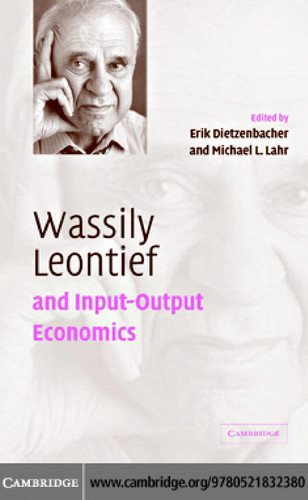
Wassily Leontief and input-output economics

Wassily Leontief,Erik Dietzenbacher,Michael L. Lahr
Wassily Leontief (1905–1999) was the founding father of input-output economics, for which he received the Nobel Prize in 1973. This book offers a collection of papers in memory of Leontief by his students and close colleagues. The first part, 'Reflections on Input-Output Economics', focuses upon Leontief as a person and scholar as well as his personal contributions to economics. It includes contributions by Nobel Laureate Paul A. Samuelson who shares his memories of a young Professor Leontief at Harvard and ends with the last joint interview with Wassily and his wife, to date previously unpublished. The second part, 'Perspectives of Input-Output Economics', includes theoretical and empirical research inspired by Leontief's work and offers a wide-ranging sample of the state of interindustry economics, a field Leontief founded. This is a strong collection likely to appeal to a wide range of professionals in universities, government, industry and international organizations.
Cambridge University Press 2004-03-25 396 pages

Keynes: useful economics for the world economy

Temin, Peter
As the global economic crisis continues to cause damage, some policy makers have called for a more Keynesian approach to current economic problems. In this book, the economists Peter Temin and David Vines provide an accessible introduction to Keynesian ideas that connects Keynes's insights to today's global economy and offers readers a way to understand current policy debates. John Maynard Keynes (1883-1946) created the branch of economics now known as macroeconomics. He played a major role in the reconstruction of Europe and the world economy after the Second World War. Keynesian economics came to be identified with efforts to mitigate the Great Depression and with postwar economic policies that helped power a golden age of economic growth. Temin and Vines argue that Keynes also provided a way to understand the interactions among nations, and therein lies his relevance for today's global crisis. Temin and Vines survey economic thinking before Keynes and explain how difficult it was for Keynes to escape from conventional wisdom. They set out the Keynesian analysis of a closed economy and expand the analysis to the international economy, using a few simple graphs to present Keynes's formal analyses in an accessible way. They discuss problems of today's world economy, showcasing the usefulness of a simple Keynesian approach to current economic policy choices. Keynesian ideas, they argue, can lay the basis for a return to economic growth.
The MIT Press 2014-09-12 117 pages