47 results for "History"

Encyclopedia of drug policy

Mark A. R. Kleiman,James E. Hawdon
"The Encyclopedia of Drug Policy, with a target publication date of 2011, marks the 40th anniversary of the longest "war" in American history. In 1971, President Richard M. Nixon declared drugs "public enemy number one" and waged the War on Drug after tests on returning Vietnam War veterans revealed alarming levels of heroin use. Spanning two volumes of approximately 450 articles in an A-to-Z format, the encyclopedia explores this controversial war through the lens of varied disciplines, and a full spectrum of articles explains topics from Colombian cartels and Mexican kingpins to television reportage; from "just say no" advertising to heroin production; from narco-terrorism to over $500 billion in U.S. government expenditures. These articles, a range of pedagogical elements in the front matter and back matter, and availability in both print and electronic formats combine to comprise an outstanding reference source for students and the general public"--
Sage Publications, Inc 2011-01-12 962 pages

The war of return: how Western indulgence of the Palestinian dream has obstructed the path to peace

Schwartz, Adi,Wilf, Einat
"Two prominent Israeli liberals argue that for the conflict between Israel and the Palestinians to end with peace, Palestinians must come to terms with the fact that there will be no "right of return." In 1948, seven hundred thousand Palestinians were forced out of their homes by the first Arab-Israeli War. More than seventy years later, most of their houses are long gone, but millions of their descendants are still registered as refugees, with many living in refugee camps. This group-unlike countless others that were displaced in the aftermath of World War II and other conflicts-has remained unsettled, demanding to settle in the state of Israel. Their belief in a "right of return" is one of the largest obstacles to successful diplomacy and lasting peace in the region. In The War of Return, Adi Schwartz and Einat Wilf-both liberal Israelis supportive of a two-state solution-reveal the origins of the idea of a right of return, and explain how UNRWA - the very agency charged with finding a solution for the refugees - gave in to Palestinian, Arab and international political pressure to create a permanent "refugee" problem. They argue that this Palestinian demand for a "right of return" has no legal or moral basis and make an impassioned plea for the US, the UN, and the EU to recognize this fact, for the good of Israelis and Palestinians alike. A runaway bestseller in Israel, the first English translation of The War of Return is certain to spark lively debate throughout America and abroad"--
All Points Books 2020-04-28 283 pages

Israel's occupation

Gordon, Neve
This first complete history of Israel's occupation of the West Bank and the Gaza Strip allows us to see beyond the smoke screen of politics in order to make sense of the dramatic changes that have developed on the ground over the past forty years. Looking at a wide range of topics, from control of water and electricity to health care and education as well as surveillance and torture, Neve Gordon's panoramic account reveals a fundamental shift from a politics of life—when, for instance, Israel helped Palestinians plant more than six-hundred thousand trees in Gaza and provided farmers with improved varieties of seeds—to a macabre politics characterized by an increasing number of deaths. Drawing attention to the interactions, excesses, and contradictions created by the forms of control used in the Occupied Territories, Gordon argues that the occupation's very structure, rather than the policy choices of the Israeli government or the actions of various Palestinian political factions, has led to this radical shift.
University of California Press 2008-10-02 318 pages

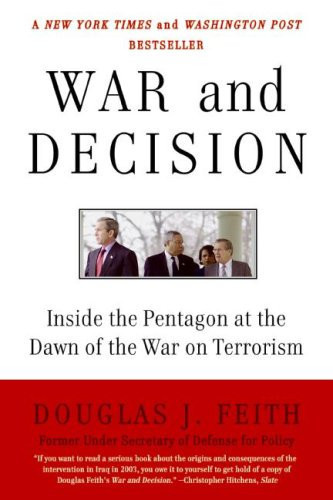
War and decision: inside the Pentagon at the dawn of the War on Terrorism

Feith, Douglas J.
Of all the players in the planning and evolution of the Bush Administration's war on terrorism, few were more integral--or more controversial--than Douglas Feith, the chief strategist on Donald Rumsfeld's Pentagon policy team. A highly influential international policy analyst for more than a quarter century, Feith worked closely with Rumsfeld, Paul Wolfowitz, Colin Powell, Condoleezza Rice, Vice President Cheney, and President Bush in defining the U.S. response to the attacks of 9/11--from the successful war on Afghanistan to the more challenging invasion of Iraq and its aftermath. Now, in this candid and revealing memoir, Feith--a charter member of the neoconservative movement and an architect of the administration's preventive strategy in the war on terrorism--offers the most in-depth and authoritative account yet of the Pentagon's evolving stance during one of the most controversial eras of American history. Drawing upon a unique trove of documents and records, this extraordinary chronicle will put the reader in the room for scores of previously unreported senior-level meetings, showing how hundreds of critical decisions were made in defense of American interests during and after the crisis of 9/11--decisions both successful and controversial. Where journalists like Bob Woodward could only speculate, Feith is the first inside player to reveal the inner workings of the Pentagon, at a time when history hung in the balance.--From publisher description.
HarperCollins 2009-02-03 674 pages

Divided memory: the Nazi past in the two Germanys

Herf, Jeffrey
The memory of the Nazi past emerged in both postwar German states divided along political lines. In both states the political elites, oriented toward the future (building socialism in the GDR, returning Germany to the West in the FRG), tended not to focus on Nazi crimes, including the Holocaust. In both countries, however, there were minority groups which insisted on preservation of the Holocaust memory in Germany. In the GDR, it was a communist group (including Paul Merker) which had functioned in Mexico during the Nazi period which stressed the centrality of the anti-Jewish policy in Nazi Germany. In the FRG it was a group which included Social Democrats and President Heuss; it regarded the admission of German responsibility for the Holocaust as a precondition for the moral healing of the nation. Contrary to all expectations, it the FRG which faced the memory of the Holocaust, while in the "anti-fascist" GDR it was suppressed. With the rise of the SPD to power in the FRG, and the collapse of communism in the GDR in 1989, the Holocaust emerged as a major topic in German political discourse, preserved in reunified Germany.
Harvard University Press 1997 527 pages

Major Farran's hat: murder, scandal and Britain's war against Jewish terrorism, 1945-1948

Cesarani, David
The gripping true story of the murder, in Palestine in 1947, of a Jewish activist by a British counter-terrorist officer, and the subsequent cover-up. In May 1947, a Jewish teenager, active in a Zionist underground group fighting British rule in Palestine, was abducted. He was never seen again. Witnesses said he was seized by British policeman. A hat found at the scene was traced to Major Roy Farran, an ex-SAS officer leading a covert counter-terrorist squad. A sensational court martial followed, but Farran was acquitted, and the Zionist underground swore vengeance. Drawing on recently declassified files of the security services, the book explores the reasons why Britain lost Palestine and reveals the full extent and ambition of Jewish terrorist attacks on Britain in the late 1940s. Part Boys' Own adventure, part narrative history, Major Farran's Hat solves a murder mystery and exposes a shady episode in the final years of the British empire, and throws light on Britain's legacy in the Middle East.
William Heinemann 2009-04-21 290 pages

The trial of Donald Rumsfeld: a prosecution by book

Ratner, Michael
The Case Against Donald Rumsfeld lays out the evidence that high–level officials of the Bush administration ordered, authorized, implemented, and permitted war crimes, in particular the crimes of torture and cruel, inhuman, and degrading treatment. Using primary source documents ranging from Rumsfeld's "techniques chart" and Iraqi plaintiffs' statements to the testimony of whistleblowers and key pieces of reportage, the book sets forth evidence of a torture program that took place throughout the world: in Afghanistan, Iraq, Guantánamo, secret CIA prisons, and other places unknown. The accused are accorded a defense drawn from their memos and public statements. Readers are allowed to judge whether the Bush administration has engaged in torture and whom among the administration to hold responsible. Reminiscent of Christopher Hitchens's bestselling The Trial of Henry Kissinger, The Case Against Donald Rumsfeld constitutes one of the only attempts to hold high–ranking Bush administration officials criminally responsible for their actions.
New Press 2008 242 pages

Britain and the Jews of Europe, 1939-1945

Wasserstein, Bernard
Examines British policy towards the "Jewish problem" during World War II. Based on archival sources, the book explores the reasons for the near-total ban on Jewish refugee immigration into Britain, the restrictive immigration policy in Palestine, the failure to aid Jewish resistance in Europe and the rejection of the scheme for the Allied bombing of Auschwitz. The author presents a story of bureaucratic complacency, inhumanity and blindness to the Jewish catastrophe in Europe. This revised edition takes into account papers opened since the first edition, including intelligence materials, and subsequent scholarship.
Leicester University Press 1999 352 pages

FDR and the Jews

Breitman, Richard,Lichtman, Allan J.
In an extensive examination of this impassioned debate, Richard Breitman and Allan J. Lichtman find that the president was neither savior nor bystander. In "FDR and the Jews," they draw upon many new primary sources to offer an intriguing portrait of a consummate politician--compassionate but also pragmatic--struggling with opposing priorities under perilous conditions
The Belknap Press of Harvard University Press 2014 433 pages

The war at home: the domestic costs of Bush's militarism

Piven, Frances Fox
Frances Fox Piven, one of the country's most celebrated social scientists, raises questions others have not. She examines the ways the war on terror served to shore up the Bush administration's political base and analyzes the manner in which flag-waving politicians used the emotional fog of war to further their regressive social and economic agendas. Always in the past governments that made war sooner or later tried to reward their peoples for the blood and wealth they were forced to sacrifice. During World War II, tax rates on the wealthy rose to 90 percent; toward the end of the Vietnam War, eighteen-year-olds were given the right to vote. In this war, taxes on the rich have been slashed, and democratic rights are being rolled back. Even veteran's benefits have been sharply reduced. The War at Home makes sense of these developments by putting the current domestic fallout of war in the context of history - and by turning an unsentimental eye on the domestic motivations of American militarism.
New Press 2004 165 pages

Moynihan's moment: America's fight against Zionism as racism

Troy, Gil
On November 10, 1975, the UN General Assembly passed a resolution declaring Zionism a form of racism. The move shocked millions, especially in the United States-- the country largely responsible for founding the UN. Daniel Patrick Moynihan, the American Ambassador to the UN, denounced this attack on Israel as an anti-Semitic assault on democracy and stood up to the Soviet-backed alliance of Communist dictatorships and Third World autocracies that supported the resolution. His eloquent stand brought him celebrity in the U.S., but ultimately shortened his tenure at the UN by alienating American allies, adversaries, and much of the foreign policy establishment--including Secretary of State Henry Kissinger. Nevertheless, Moynihan's moment was a turning point: a harbinger of a shift in American culture and politics that would culminate in the Reagan Revolution. Moynihan paved the way for a more muscular, idealistic, neoconservative foreign policy and for a new style of defiant "cowboy" diplomacy. In this book, Gil Troy argues that America's idea of itself--still torn, in the mid-'70s, between post-Vietnam and -Watergate defeatism and a growing sense of optimism--changed with Moynihan, altering both the left and the right in ways that continue to play out in the 21st century. Much of the rhetoric of this era survives in domestic foreign policy debates and the ongoing conflict between Israel and Palestine, suggesting that Moynihan's struggle has much to reveal about American politics and its position on the world stage--Publisher's summary.
Oxford University Press 2013 357 pages

Citizenship, nationality and migration in Europe

Cesarani, David
Throughout Europe longstanding ideas of what it means to be a citizen are being challenged. The sense of belonging to a nation has never been more in flux. Simultaneously, nationalistic and racist movements are gaining ground and barriers are being erected against immigration. This volume examines how concepts of citizenship have evolved in different countries and varying contexts. It explores the interconnection between ideas of the nation, modes of citizenship and the treatment of migrants. Adopting a multi-disciplinary and international approach, this collection brings together experts from several fields including political studies, history, law and sociology. By juxtaposing four European countries - Britain, France, Germany and Italy - and setting current trends against a historical background, it highlights important differences and exposes similarities in the urgent questions surrounding citizenship and the treatment of minorities in Europe today.
Routledge 1996 225 pages

The one-state condition: occupation and democracy in Israel/Palestine

Azoulay, Ariella,Ophir, Adi
"Since the start of the occupation of Palestinian territories in 1967, Israel's domination of the Palestinians has deprived an entire population of any political status or protection. But even decades on, most people speak of this rule - both in everyday political discussion and in legal and academic debates - as temporary, as a state of affairs incidental and external to the Israeli regime. In The One-State Condition, Ariella Azoulay and Adi Ophir directly challenge this belief. Looking closely at the history and contemporary formation of the ruling apparatus - the technologies and operations of the Israeli army, the General Security Services, and the legal system imposed in the Occupied Territories - Azoulay and Ophir outline the one-state condition of Israel/Palestine: the grounding principle of Israeli governance is the perpetuation of differential rule over populations of differing status. Israeli citizenship is shaped through the active denial of Palestinian citizenship and civil rights. Though many Israelis, on both political right and left, agree that the occupation constitutes a problem for Israeli democracy, few ultimately admit that Israel is no democracy or question the very structure of the Israeli regime itself. Too frequently ignored are the lasting effects of the deceptive denial of the events of 1948 and 1967, and the ways in which the resulting occupation has reinforced the sweeping militarization and recent racialization of Israeli society. Azoulay and Ophir show that acknowledgment of the one-state condition is not only a prerequisite for considering a one- or two-state solution; it is a prerequisite for advancing new ideas to move beyond the trap of this false dilemma."--Publisher's description
Stanford University Press 2013 316 pages

The road to financial reformation: warnings, consequences, reforms

Kaufman, Henry
Our financial crisis: what happened, how we got here, and what needs to be done Henry Kaufman-an esteemed economist and statesman-is one of the most preeminent financial figures of the day, with a history of success from the 1980s, when his firm, Salomon Brothers, ruled the bond markets. In The Road to Financial Reformation , Dr. Kaufman, who has spent a lifetime entrenched in the world of finance, provides an insightful account of the history and impact of post-World War II financial markets on the economy-what happened, how we got to where we are today, and what needs to be done. Drawing on his vast breadth of knowledge and experience, Kaufman reveals the mistakes that got us into this debacle, the consequences-as they have not been fully realized-and how to put our derailed economy back on track. This book details Dr. Kaufman's warnings and concerns expressed repeatedly throughout the last quarter century, and shows that what he predicted came to pass. Provides an insightful account of the history and impact of post-World War II financial markets on the economy Explores the erosion of credit ratings on corporate debt in the late 1980s and the rapid increase in financial concentration of institutions Discusses the blinding faith in models that rely on historical data but fail to take into account economic and financial market structural changes With his breadth of knowledge and experience, Kaufman details that this crisis was foreseeable (he saw it coming), and how we created this history-making financial crisis. He also explains the consequences still to come, and presents solutions on how we can recover and reform the markets.
John Wiley & Sons 2009-08-03 260 pages