32 results for "History"

The rise and fall of the man of letters: aspects of English literary life since 1800

Gross, John
In this new edition of his landmark book, John Gross traces the shifting fortunes of the men who shaped literary opinion in England during the Victorian, Edwardian, and contemporary eras. He brings together famous or forgotten critics and editors-prophets, aesthetes, statesmen, dons, radicals, social climbers, idealists, gossipmongers, and literary lions-and explores not only their critical ideas but also their personalities, careers, social backgrounds, and politics. He looks at "the higher journalism;" the expansion of the reading public, the byways of British liberalism, and the rise of literature as an academic subject, and the impact of modernism. In all a remarkable survey, to which Mr. Gross has now added updates on several literary careers, the new style of critics who have evolved from the universities, and the dominant role of the media. "A brilliant account of English literary culture which is as engaging as it is illuminating"-Lionel Trilling. "Extremely readable.... The book is strewn with marvelous bits: deft aperçus, biographical portraits of great subtlety and force, wit, commonsensical intelligence everywhere. It is a book that no one who cares about the state of literature can afford to neglect."-Joseph Epstein.
Elephant Paperbacks 1992-08-01 361 pages

The Best of Hal Lebovitz Great Sportswriting from Six Decades in Cleveland

Hal Lebovitz
"A Hall of Fame writer at the top of his game." -- The Beacon Journal The best sports writing of Hall-of-Fame sportswriter Hal Lebovitz, longtime dean of Cleveland sports journalists. Several generations of sports fans grew up reading Hal Lebovitz on the sports pages. Hal covered just about every major sports event over 60 years, reporting on each with honest, straightforward words and firm opinions--and most likely a scoop on the competition. He wrote about the greats--Jim Brown, Bob Feller, Ted Williams, Woody Hayes ... and the great moments--the Indians' 1948 playoff game, the Browns' 1964 championship season, Rocky Colavito's four consecutive home runs. His writing was featured 17 times in the annual Best Sports Stories and selected for numerous other anthologies. He won countless writing awards and been inducted into 12 halls of fame--including the National Baseball Hall of Fame. Always, Hal has written for the fans. And for as long as anyone can remember, fans have been reading Hal for his particular take on events. His constant, steady presence in the local sports pages for so many decades has made Hal Lebovitz a legitimate icon in Cleveland sports--a guy who, with his typewriter, has been as remarkable and consistent and rare as a .400 hitter.
Gray & Company 2006-04 338 pages

The Muse Is Always Half-Dressed in New Orleans And Other Essays

Andrei Codrescu
In twenty-six essays, Codrescu turns his skeptical, amused gaze to such topics as Plato's effect on American sex, the cultural meaning of Ed McMahon, baseball's literary underpinnings, his own conception in a Romanian darkroom, an cuisine under the Ceausescu dictatorship, as well as to larger subjects, including the suicide of communism, American culture and politics, and his adopted city of New Orleans.
Macmillan 1995-05-15 208 pages

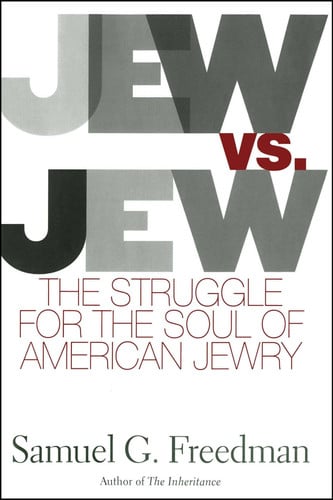
Jew Vs Jew The Struggle For The Soul Of American Jewry

Samuel G. Freedman
At a time when American Jews should feel more secure and cohesive than ever, civil war is tearing apart their community. Congregations, neighborhoods, even families are taking sides in battles about Jewish identity and Jewish authenticity. The conflict pits fundamentalist against secularist, denomination against denomination, even liberal against conservative within each branch of Jewry. Jew vs. Jew tells the story of how American Jewry has increasingly -- and perhaps terminally -- broken apart in the last forty years. Jew vs. Jew stretches in time from 1960 to 2000. It travels the country from Florida to New England, from Los Angeles to the Catskills in New York, from Cleveland to Denver, and it also crosses the ocean to Israel to show how tensions within the Jewish state inflame those among American Jews. The flash-points range from conversion standards to the role of women, from the peace process in Israel to the sexual climate on an Ivy League campus. But behind them all, as Samuel Freedman writes, lie common causes. First, far from unifying American Jews, Israel now divides them on both political and religious grounds. Second, neither America nor the larger world presents Jews with a single enemy against whom to coalesce. Third, and most important, nothing in the Jewish history of persecution, oppression, and exile prepared the Chosen People for the challenge posed by America, the challenge of being absorbed into a tolerant and diverse nation, being accepted so thoroughly that the intermarriage rate tops 50 percent. Jew vs. Jew introduces readers to memorable places and characters. Freedman describes one of the final summers at a Labor Zionist camp in the Catskills whose brand of secular Jewishness is becoming obsolete because Zionism succeeded in creating Israel. He tells the story of Orthodox and Reform Jews in a Cleveland suburb who are fighting about the construction of several synagogues -- and, on a deeper level, about whether unity or pluralism ought to be the goal of Jewish life. He portrays a Florida Jew so violently opposed to the Oslo peace accords that he planted a bomb in a synagogue where Shimon Peres was speaking. He tells about a Los Angeles congregation that spent three years debating whether or not to honor the Biblical matriarchs in its liturgy.We come to know the Long Island neighbors who cannot tolerate sharing even a property line because their versions of Jewish identity are so irreconcilably different. Jew vs. Jew is a work of vigorous reporting, lucid writing, and intellectual curiosity. And even as it chronicles an embittered and polarized community, it refuses to take sides or pass judgment. Instead, with compassion and acuity, Jew vs. Jew bears witness.
Simon & Schuster 2007-09-21 400 pages

Berlin! Berlin! Dispatches from the Weimar Republic

Kurt Tucholsky
Berlin! Berlin! is a satirical selection from the "man with the acid pen and the perfect pitch for hypocrisy," as New York author and Tucholsky-expert Peter Wortsman writes. This book os a complete collection of Tucholsky's news stories, features, satirical pieces, and poems about his hometown Berlin. It depicts Weimar Berlin, its cabarets, its policies, its follies, its ticks, and its celebrities, such as Pola Negri, Gussy Holl, Bert Brecht, Max Reinhardt, or Heinrich Zille. The book contains some of Tucholsky's most famous pieces, among them Berlin! Berlin!, a feature of the stereotypical Berliner on the phone, on vacation or doing "bizness", more than one satirical biography of the author himself, and some of his most famed stories such as where the holes in the cheese come from, or about the lion who escaped the Berlin zoo. Herr Wendriner, the chatty Berlin businessman makes an appearance, as well as Lottchen, the flapper, modelled after one of Tucholsky's real-life gilrfriends. Also Tucholsky's long-term friends Karlchen and Jakopp are part of this book. In Weimar Germany, Tucholsky was big, the most brilliant, prolific and witty cultural journalist of his time. He poured scorn on the reactionary institutions of the old regime, the follies of the Weimar Republic, and the peculiarities of the German character. - William Grimes, The New York Times Imagine a writer with the acid voice of Christopher Hitchens and the satirical whimsy of Jon Stewart. That's Tucholsky in a nutshell. - Anne Nelson, author of "The Red Orchestra" and "The Guys" Kurt Tucholsky was one of the most brilliant German-Jewish writers of his time. Today's Berliners adore him as one of their greatest sons. The world has yet to discover his genius. -Peter Schneider, author of "The Wall Jumper" and "Eduard's Homecoming" A selection from the man with the acid pen and the perfect pitch for hypocrisy, who was as much the voice of 1920s Berlin as Georg Grosz was its face. - Peter Wortsman, author of "Ghost Dance in Berlin" . . . a small, fat Berliner, who wanted to stop a catastrophe with his typewriter. -Erich Kästner, author of "Emil and the Detectives"
Berlinica 2017-05 202 pages

An almost English life

Gross, Miriam
Miriam Gross, as a journalist and editor, has worked with some of the most influential figures of the 20th century poets, philosophers, playwrights and politicians. This book offers recollections from 40 years at the heart of English cultural life. Brought up in wartime Jerusalem, she was deposited by her parents, speaking no English, at the bohemian Dartington Hall School; and then continued her education at Oxford where eschewing her quiet, tea-drinking contemporaries at St Anne s she found her way into more glamorous academic circles. From there it was a short hop to pre-spell-check Fleet Street. Her descriptions whether she is having to mend her boss's bra on her first day at work, or rewriting Angus Wilson's slapdash book reviews, or being asked to make the women s pages of the Observer more raunchy show a merciless eye for the bogus and the absurd. Alongside reflections on everything from feminism and motherhood to education and anti-semitism, she recounts her numerous infatuations, both requited and unrequited, with the sort of self-deprecating candour that makes this memoir a classic of its kind.
Short Books 2012 200 pages

You Wake Me Each Morning

Lawn Connie Lawn,Connie Lawn
You Wake Me Each Morning That is what listeners around the world have said to Connie for years, as they heard her radio broadcasts in this country and around the world. The first time she heard the phrase was from Sam Lewis, America's long - time Ambassador to Israel. Some listeners have called the voice sexy, authoritative, funny, snobby, or sophisticated. Connie tries to incorporate it all, as she tells the stories that make the news or change history. Of the many compliments she has received, the most important came from Nelson Mandela. The former South African President said he listened to her broadcasts for years while in prison. He told her, during a Washington news conference, "You Gave My People Hope." Then he went onto say, "You are not as big as I thought you were!" In her autobiography, Connie tells of the struggles of a one-woman news bureau. She recounts such events as the unrest in Washington in 1968; the killing of Robert Kennedy (she had one of the last interviews with him); the Invasion of Czechoslovakia, where she stayed for six months; a brief kidnapping in Lebanon in l982, and White House coverage of Presidents from Lyndon Johnson to Barack Obama and beyond. Connie received the Lifetime Achievement Award for Excellence in Journalism from the New Zealand National Press Club at the New Zealand Parliament on August 15, 2006. This is a book for people of all ages, but especially those who are working the hardest to find themselves. To all the message is - never give up, be different from the crowd, and have fun!
iUniverse 2010-02 356 pages

Control of Information in the United States An Annotated Bibliography of Books

James R. Bennett
An essential reference book to the most important and relevant publications on the control of information in the United States, it includes books and articles on every aspect of this highly topical subject--from philosophical theory to the freedom of the press. It is the first bibliography to deal exclusively with this area and will be of interest to all those concerned with research in journalism, law, communications, and general American history.
Bloomsbury Academic 1987-12-31 616 pages