44 results for "History"

The Reader of Gentlemen's Mail

David Kahn
One of the most colorful and controversial figures in American intelligence, Herbert O. Yardley (1889-1958) gave America its best form of information, but his fame rests more on his indiscretions than on his achievements. In this highly readable biography, a premier historian of military intelligence tells Yardley's story and evaluates his impact on the American intelligence community. Yardley established the nation's first codebreaking agency in 1917, and his solutions helped the United States win a major diplomatic victory at the 1921 disarmament conference. But when his unit was closed in 1929 because "gentlemen do not read each other's mail," Yardley wrote a best-selling memoir that introduced-and disclosed-codemaking and codebreaking to the public. David Kahn de-scribes the vicissitudes of Yardley's career, including his work in China and Canada, offers a capsule history of American intelligence up to World War I, and gives a short course in classical codes and ciphers. He debunks the accusations that the publication of Yardley's book caused Japan to change its codes and ciphers and that Yardley traitorously sold his solutions to Japan. And he asserts that Yardley's disclosures not only did not hurt but actually helped American codebreaking during World War II.
Yale University Press 2011-03-08 368 pages

Literary Dissent in Communist China

Merle Goldman
In modern China, literature has been regarded as a vehicle of political and idea logical dissent, a concept that has persisted under communism. This study exhaustively analyzes the conflict between the Chinese Communist party and the intellectuals, particularly the writers, in the crucial decades of the 1940's and 1950's. By singling out individual writers as egregious examples, party leaders, through a series of thought-control campaigns, have tried to mold intellectuals along orthodox doctrinal lines. But these same leaders, holding to the paradoxical conviction that personal initiative and creativity are necessary catalysts in the effort to construct a Communist state, have not wanted to stifle these qualities altogether. The result has been a pattern of permissiveness and pressure, as illustrated by the ill-fated "Hundred Flowers" movement and the subsequent return to a policy of harsh regimentation. In depicting the views, feelings, frustrations, and tragic fates of many individual intellectuals in the confrontation with an oppressive party bureaucracy, the author reveals, in an unprecedented way, the nature of the authoritarian society that has evolved in Communist China. Her study convincingly demonstrates that totalitarian rule has not guaranteed the subservience of the Chinese intelligentsia and, even more important, that the alienated, critical intellectual remains a significant and vital force.
Harvard University Press 2013-10 360 pages

Linguistics and Literary History Essays in Stylistics

Leo. Spitzer
Spitzer discusses the method he evolved for bringing together the two disciplines, linguistics and literary history, and examines the work of Cervantes, Racine, Diderot, and Claudel in the light of this theory. Originally published in 1967. The Princeton Legacy Library uses the latest print-on-demand technology to again make available previously out-of-print books from the distinguished backlist of Princeton University Press. These editions preserve the original texts of these important books while presenting them in durable paperback and hardcover editions. The goal of the Princeton Legacy Library is to vastly increase access to the rich scholarly heritage found in the thousands of books published by Princeton University Press since its founding in 1905.
Princeton University Press 2015-12-08 246 pages

The Treehouse Eccentric Wisdom from My Father on How to Live, Love, and See

Naomi Wolf
Leonard Wolf, a retired professor now in his early eighties, is the kind of person who likes to use a medieval astrolabe, dress in Basque shepherd's clothing, and convince otherwise sensible people to quit their jobs and follow their passions. Leonard believes that inside everyone is an artist, and that happiness in life depends on valuing and acting upon one's creative impulse. In The Treehouse, her most personal book yet, Naomi Wolf outlines her father's lessons in creating lasting success and happiness, and offers inspiration for the artist in all of us. Drawn from Leonard's lecture notes, the chapters of The Treehouse remind us to "Be Still and Listen," "Use Your Imagination," and "Do Nothing Without Passion," and that "Your Only Wage Will Be Joy" and "Mistakes Are Part of the Draft." This is a journey of self-discovery in which the creative endeavor is paramount. The Treehouse is a stirring personal history, a meditation on fathers and daughters, an argument for honoring the creative impulse, and a unique instruction in the art of personal happiness.
Simon and Schuster 2006-05-03 288 pages

The Jewish King Lear A Comedy in America

Jacob Gordin
The Jewish King Lear , written by the Russian-Jewish writer Jacob Gordin, was first performed on the New York stage in 1892, during the height of a massive emigration of Jews from eastern Europe to America. This book presents the original play to the English-speaking reader for the first time in its history, along with substantive essays on the play’s literary and social context, Gordin’s life and influence on Yiddish theater, and the anomalous position of Yiddish culture vis-à-vis the treasures of the Western literary tradition. Gordin’s play was not a literal translation of Shakespeare’s play, but a modern evocation in which a Jewish merchant, rather than a king, plans to divide his fortune among his three daughters. Created to resonate with an audience of Jews making their way in America, Gordin’s King Lear reflects his confidence in rational secularism and ends on a note of joyful celebration.
Yale University Press 2011-06-23 192 pages

The Best of Hal Lebovitz Great Sportswriting from Six Decades in Cleveland

Hal Lebovitz
"A Hall of Fame writer at the top of his game." -- The Beacon Journal The best sports writing of Hall-of-Fame sportswriter Hal Lebovitz, longtime dean of Cleveland sports journalists. Several generations of sports fans grew up reading Hal Lebovitz on the sports pages. Hal covered just about every major sports event over 60 years, reporting on each with honest, straightforward words and firm opinions--and most likely a scoop on the competition. He wrote about the greats--Jim Brown, Bob Feller, Ted Williams, Woody Hayes ... and the great moments--the Indians' 1948 playoff game, the Browns' 1964 championship season, Rocky Colavito's four consecutive home runs. His writing was featured 17 times in the annual Best Sports Stories and selected for numerous other anthologies. He won countless writing awards and been inducted into 12 halls of fame--including the National Baseball Hall of Fame. Always, Hal has written for the fans. And for as long as anyone can remember, fans have been reading Hal for his particular take on events. His constant, steady presence in the local sports pages for so many decades has made Hal Lebovitz a legitimate icon in Cleveland sports--a guy who, with his typewriter, has been as remarkable and consistent and rare as a .400 hitter.
Gray & Company 2006-04 338 pages

The Muse Is Always Half-Dressed in New Orleans And Other Essays

Andrei Codrescu
In twenty-six essays, Codrescu turns his skeptical, amused gaze to such topics as Plato's effect on American sex, the cultural meaning of Ed McMahon, baseball's literary underpinnings, his own conception in a Romanian darkroom, an cuisine under the Ceausescu dictatorship, as well as to larger subjects, including the suicide of communism, American culture and politics, and his adopted city of New Orleans.
Macmillan 1995-05-15 208 pages

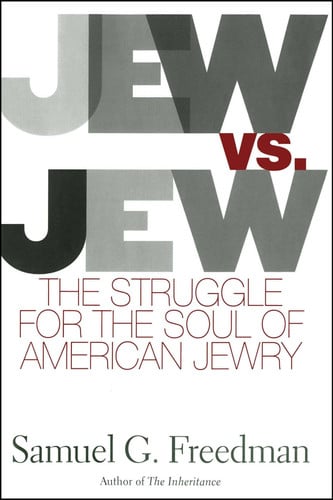
Jew Vs Jew The Struggle For The Soul Of American Jewry

Samuel G. Freedman
At a time when American Jews should feel more secure and cohesive than ever, civil war is tearing apart their community. Congregations, neighborhoods, even families are taking sides in battles about Jewish identity and Jewish authenticity. The conflict pits fundamentalist against secularist, denomination against denomination, even liberal against conservative within each branch of Jewry. Jew vs. Jew tells the story of how American Jewry has increasingly -- and perhaps terminally -- broken apart in the last forty years. Jew vs. Jew stretches in time from 1960 to 2000. It travels the country from Florida to New England, from Los Angeles to the Catskills in New York, from Cleveland to Denver, and it also crosses the ocean to Israel to show how tensions within the Jewish state inflame those among American Jews. The flash-points range from conversion standards to the role of women, from the peace process in Israel to the sexual climate on an Ivy League campus. But behind them all, as Samuel Freedman writes, lie common causes. First, far from unifying American Jews, Israel now divides them on both political and religious grounds. Second, neither America nor the larger world presents Jews with a single enemy against whom to coalesce. Third, and most important, nothing in the Jewish history of persecution, oppression, and exile prepared the Chosen People for the challenge posed by America, the challenge of being absorbed into a tolerant and diverse nation, being accepted so thoroughly that the intermarriage rate tops 50 percent. Jew vs. Jew introduces readers to memorable places and characters. Freedman describes one of the final summers at a Labor Zionist camp in the Catskills whose brand of secular Jewishness is becoming obsolete because Zionism succeeded in creating Israel. He tells the story of Orthodox and Reform Jews in a Cleveland suburb who are fighting about the construction of several synagogues -- and, on a deeper level, about whether unity or pluralism ought to be the goal of Jewish life. He portrays a Florida Jew so violently opposed to the Oslo peace accords that he planted a bomb in a synagogue where Shimon Peres was speaking. He tells about a Los Angeles congregation that spent three years debating whether or not to honor the Biblical matriarchs in its liturgy.We come to know the Long Island neighbors who cannot tolerate sharing even a property line because their versions of Jewish identity are so irreconcilably different. Jew vs. Jew is a work of vigorous reporting, lucid writing, and intellectual curiosity. And even as it chronicles an embittered and polarized community, it refuses to take sides or pass judgment. Instead, with compassion and acuity, Jew vs. Jew bears witness.
Simon & Schuster 2007-09-21 400 pages

Berlin! Berlin! Dispatches from the Weimar Republic

Kurt Tucholsky
Berlin! Berlin! is a satirical selection from the "man with the acid pen and the perfect pitch for hypocrisy," as New York author and Tucholsky-expert Peter Wortsman writes. This book os a complete collection of Tucholsky's news stories, features, satirical pieces, and poems about his hometown Berlin. It depicts Weimar Berlin, its cabarets, its policies, its follies, its ticks, and its celebrities, such as Pola Negri, Gussy Holl, Bert Brecht, Max Reinhardt, or Heinrich Zille. The book contains some of Tucholsky's most famous pieces, among them Berlin! Berlin!, a feature of the stereotypical Berliner on the phone, on vacation or doing "bizness", more than one satirical biography of the author himself, and some of his most famed stories such as where the holes in the cheese come from, or about the lion who escaped the Berlin zoo. Herr Wendriner, the chatty Berlin businessman makes an appearance, as well as Lottchen, the flapper, modelled after one of Tucholsky's real-life gilrfriends. Also Tucholsky's long-term friends Karlchen and Jakopp are part of this book. In Weimar Germany, Tucholsky was big, the most brilliant, prolific and witty cultural journalist of his time. He poured scorn on the reactionary institutions of the old regime, the follies of the Weimar Republic, and the peculiarities of the German character. - William Grimes, The New York Times Imagine a writer with the acid voice of Christopher Hitchens and the satirical whimsy of Jon Stewart. That's Tucholsky in a nutshell. - Anne Nelson, author of "The Red Orchestra" and "The Guys" Kurt Tucholsky was one of the most brilliant German-Jewish writers of his time. Today's Berliners adore him as one of their greatest sons. The world has yet to discover his genius. -Peter Schneider, author of "The Wall Jumper" and "Eduard's Homecoming" A selection from the man with the acid pen and the perfect pitch for hypocrisy, who was as much the voice of 1920s Berlin as Georg Grosz was its face. - Peter Wortsman, author of "Ghost Dance in Berlin" . . . a small, fat Berliner, who wanted to stop a catastrophe with his typewriter. -Erich Kästner, author of "Emil and the Detectives"
Berlinica 2017-05 202 pages

Language and Myth

Ernst Cassirer
In this important study Ernst Cassirer analyzes the non-rational thought processes that go to make up culture. He demonstrates that beneath both language and myth there lies an unconscious "grammar" of experience, whose categories and canons are not those of logical thought. He shows that this prelogical "logic" is not merely an undeveloped state of rationality, but something basically different, and that this archaic mode of thought still has enormous power over even our most rigorous thought, in language, poetry and myth. The author analyzes brilliantly such seemingly diverse (yet related) phenomena as the metaphysics of the Bhagavat Gita, the Melanesian concept of Mana, the Naturphilosophie of Schelling, modern poetry, Ancient Egyptian religion, and symbolic logic. He covers a vast range of material that is all too often neglected in studies of human thought. These six essays are of great interest to the student of philosophy or the philosophy of science, the historian, or the anthropologist. They are also remarkably timely for students of literature, what with the enormous emphasis placed upon "myth" in modern literary speculation. This book is not superficial speculation by a dabbler, but a penetrating study by one of the most profound and sensitive philosophic minds of our time.
Dover Publications, Incorporated 2013-12-03 128 pages

Modernist Patterns: In Literature and the Visual Arts

Roston, M.
In this stimulating study, the author explores how Conrad, T.S.Eliot, Woolf, Joyce, Faulkner, Hemingway, Huxley and others responded to the immediate challenges of their time, to the implications of Freudian psychology, molecular theory, relativist theory, and the general weakening of religious faith. Assuming that artists and writers, in coping with those problems, would develop techniques in many ways comparable, even where there was no direct contact, he positions Modernist literature within the context of contemporary painting, architecture and sculpture, thereby providing some fascinating insights into the nature of the literary works themselves.
Palgrave Macmillan 2016 316 pages

The Double Disappointment

Moses Mendez
The double disappointment by Moses Mendez The 18th century was a wealth of knowledge, exploration and rapidly growing technology and expanding record-keeping made possible by advances in the printing press. In its determination to preserve the century of revolution, Gale initiated a revolution of its own: digitization of epic proportions to preserve these invaluable works in the largest archive of its kind. Now for the first time these high-quality digital copies of original 18th century manuscripts are available in print, making them highly accessible to libraries, undergraduate students, and independent scholars. Western literary study flows out of eighteenth-century works by Alexander Pope, Daniel Defoe, Henry Fielding, Frances Burney, Denis Diderot, Johann Gottfried Herder, Johann Wolfgang von Goethe, and others. Experience the birth of the modern novel, or compare the development of language using dictionaries and grammar discourses. We are delighted to publish this classic book as part of our extensive Classic Library collection. Many of the books in our collection have been out of print for decades, and therefore have not been accessible to the general public. The aim of our publishing program is to facilitate rapid access to this vast reservoir of literature, and our view is that this is a significant literary work, which deserves to be brought back into print after many decades. The contents of the vast majority of titles in the Classic Library have been scanned from the original works. To ensure a high quality product, each title has been meticulously hand curated by our staff. Our philosophy has been guided by a desire to provide the reader with a book that is as close as possible to ownership of the original work. We hope that you will enjoy this wonderful classic work, and that for you it becomes an enriching experience.
CreateSpace Independent Publishing Platform 2018-07-03 58 pages

Prolegomena to a Critical Grammar

Josef Schächter
This book is the first English version of Prolegomena zu einer kritischen Grammatik, published by Julius Springer, Vienna, 1935, as Volume 10 of the Vienna Circle's series Schriften zur wissenschaftlichen Weltauffassung. The prefatory remarks of both editor and author acknowledge the influence ofWittgenstein in a general way. However, in aim and approach, the work differs from Wittgenstein's Philosophische Grammatik (l969). This is indeed based on material going back to 1932, some of which Schachter must have known. On the other hand, the present Prolegomena not only explains the general, philosophical principles to be followed, but in the light of these proceeds to cover the entire range of conventional grammar, showing where that is uncritical. Whether Wittgenstein in his turn knew of Schachter's work has never been explored. Schachter's object is universal grammar. As is natural, the examples in the original are largely drawn from German grammar, with occasional minor excursions into other languages. For English readers, what matters are the general problems of grammar: there is no point in tying these to the linguistic peculiarities of German, let alone a local variety of it. One who can grasp German at that level might as well read the original. The translation is therefore twofold: the text as a whole has been rendered into English, and the entire apparatus of examples has been replaced, as far as this can be done, by illustrations from English grammar, chosen so as to bring out the same kinds of problem as in the original.
Springer 2011-11-08 192 pages

A Grammar of Freethought

Cohen Chapman
This work has been selected by scholars as being culturally important, and is part of the knowledge base of civilization as we know it. This work is in the "public domain in the United States of America, and possibly other nations. Within the United States, you may freely copy and distribute this work, as no entity (individual or corporate) has a copyright on the body of the work. Scholars believe, and we concur, that this work is important enough to be preserved, reproduced, and made generally available to the public. We appreciate your support of the preservation process, and thank you for being an important part of keeping this knowledge alive and relevant.
Creative Media Partners, LLC 2022-10-27 238 pages

You Wake Me Each Morning

Lawn Connie Lawn,Connie Lawn
You Wake Me Each Morning That is what listeners around the world have said to Connie for years, as they heard her radio broadcasts in this country and around the world. The first time she heard the phrase was from Sam Lewis, America's long - time Ambassador to Israel. Some listeners have called the voice sexy, authoritative, funny, snobby, or sophisticated. Connie tries to incorporate it all, as she tells the stories that make the news or change history. Of the many compliments she has received, the most important came from Nelson Mandela. The former South African President said he listened to her broadcasts for years while in prison. He told her, during a Washington news conference, "You Gave My People Hope." Then he went onto say, "You are not as big as I thought you were!" In her autobiography, Connie tells of the struggles of a one-woman news bureau. She recounts such events as the unrest in Washington in 1968; the killing of Robert Kennedy (she had one of the last interviews with him); the Invasion of Czechoslovakia, where she stayed for six months; a brief kidnapping in Lebanon in l982, and White House coverage of Presidents from Lyndon Johnson to Barack Obama and beyond. Connie received the Lifetime Achievement Award for Excellence in Journalism from the New Zealand National Press Club at the New Zealand Parliament on August 15, 2006. This is a book for people of all ages, but especially those who are working the hardest to find themselves. To all the message is - never give up, be different from the crowd, and have fun!
iUniverse 2010-02 356 pages

Control of Information in the United States An Annotated Bibliography of Books

James R. Bennett
An essential reference book to the most important and relevant publications on the control of information in the United States, it includes books and articles on every aspect of this highly topical subject--from philosophical theory to the freedom of the press. It is the first bibliography to deal exclusively with this area and will be of interest to all those concerned with research in journalism, law, communications, and general American history.
Bloomsbury Academic 1987-12-31 616 pages

Form and Sense

Wolfgang Paalen,Martica Sawin
Wolfgang Paalen was a central figure in internationalist surrealist circles in the late 1930s. Artist and intellectual, he was a European whose fascination with archaic cultures led him finally to Mexico, where he founded the influential magazine DYN in 1941. In the bold texts from DYN that make up Form and Sense, we encounter a unique artistic mind and an oracular voice. Paalen’s book is an intellectual delight with essays on cubism, surrealism, the universality of forms in architecture, and the relationships that exist between art and science. He weaves together the new ideas and archaic inspirations in twentieth-century painting and sculpture. His nuanced and original considerations of some key figures—Mondrian, Kandinsky, Picasso—marked Paalen in turn as a significant thinker in the world of modern art. This painter’s book, illustrated with carefully chosen examples of the art he examines, makes us not only understand but also experience the rich interplay between idea and image that informs the art of our own time. A new introduction by the scholar Martica Sawin examines Paalen’s career, particularly his influential writing on surrealism and abstraction.
Arcade 2013-06-04 112 pages

The Director Young Woman's Best Companion

Sarah Jackson
The director - Young woman's best companion is an unchanged, high-quality reprint of the original edition of 1770. Hansebooks is editor of the literature on different topic areas such as research and science, travel and expeditions, cooking and nutrition, medicine, and other genres.As a publisher we focus on the preservation of historical literature.Many works of historical writers and scientists are available today as antiques only. Hansebooks newly publishes these books and contributes to the preservation of literature which has become rare and historical knowledge for the future.
hansebooks 2016-05-05 174 pages

Sanskrit Syntax

Jacob Samuel Speyer
This work has been selected by scholars as being culturally important, and is part of the knowledge base of civilization as we know it. This work is in the "public domain in the United States of America, and possibly other nations. Within the United States, you may freely copy and distribute this work, as no entity (individual or corporate) has a copyright on the body of the work. Scholars believe, and we concur, that this work is important enough to be preserved, reproduced, and made generally available to the public. We appreciate your support of the preservation process, and thank you for being an important part of keeping this knowledge alive and relevant.
Creative Media Partners, LLC 2022-10-26 412 pages