252 results for "History"

A Picture Book of Patrick Henry

David A. Adler
Adler tells the story of Patrick Henry from his childhood on a tobacco plantation through his career as a lawyer, politician, and governor of Virginia. The author skillfully integrates quotations from primary sources into the narrative. There is no fictionalizing of thoughts or dialogue. Since Henry was known for his oratory prowess, excerpts from his most famous speeches are included and put into context with events of the time. Personal details, such as his wife's mental illness and his ownership of slaves, are mentioned but not explored in great detail. The subject matter is presented in a manner appropriate to its intended audience. The illustrations, all on double-page spreads, are softly colored and full of historical detail. Although the pictures do not have the stiff and formal look of period portraits, they do reflect the clothing styles and furnishings of the time. Teachers and students will appreciate this introduction to the patriot's life.This famous patriot served five terms as governor of Virginia.
Holiday House, Incorporated 2001-06 32 pages

Jinnah of Pakistan

Stanley A. Wolpert
“Few individuals significantly alter the course of history. Fewer still modify the map of the world. Hardly anyone can be credited with creating a nation-state. Muhammad Ali Jinnah did all three.” Stanley Wolpert These are the opening lines of the preface of Stanley Wolpert’s book, “Jinnah of Pakistan” and serves to entice you to read an extremely thorough, comprehensive and detailed study about one of the most pragmatic and charismatic leaders of South Asia, Muhammad Ali Jinnah. Stanley Wolpert is an American academic who is considered to be one of the world's foremost authorities on the political history of modern South Asia. During a trip to Bombay in 1948, he became interested in the complexities of Indian culture, history and politics. Since 1962, he has published many fictional and non-fictional books on his favorite subject. In the preface, Wolpert “For more than a quarter century, I have been intrigued by the apparent paradox of Jinnah’s strange story which has to date never been told in all the fascinating complexity of its brilliant light and tragic darkness.” “Jinnah of Pakistan” was published in 1984. This unique and insightful biography explores the fascinating public and private life of founder of Pakistan, Muhammad Ali Jinnah from his birth in 1876 till his death in 1948. In recording the events that unfold and shape Jinnah’s life, Wolpert also chronicles almost eight decades of Indian history to the point where India achieves independence from British rule amid growing Muslim-Hindu antagonism. It is a tragedy that the new generation of Pakistan knows about the founder of their country only through text books, a few websites and television programs. These limited resources do not tell the complete picture of a very intelligent, shrewd and resilient lawyer, politician and statesman who altered the map of South Asia through his sheer indomitable will against all odds. It is almost a standard statement in Pakistani text books that Muhammad Ali Jinnah was a great man but after reading Stanley Wolpert’s “Jinnah of Pakistan” one can get a better understanding of why Jinnah can be….. and should be…. regarded as such a great leader. Physically a frail man, he alone gave courage, hope, strength and voice to millions of Muslims of South Asia who were dismissed as second class citizens in United India before partition in 1947. The biography is placed on a huge canvas and takes the readers to the bustling port of Karachi where Jinnah was born and follows him to London, Bombay, Calcutta, Lucknow, Nagpur, Amritsar, New Delhi, Simla, Lahore, Peshawar, Quetta, Ziarat and finally Karachi again where lies buried “ one of history’s most remarkable, tenacious, enigmatic figures.” The book reveals Jinnah’s failings, his loneliness, his pain, his broken marriage, his estrangement from his only daughter, his long and fatal disease which he kept under wraps and yet the true worth of his gigantic accomplishment can only be more appreciated when viewed alongside his human weaknesses. The book also brings under spotlight, Jinnah’s love and marriage to the beautiful and vivacious “flower of Bombay" Ruttie. The whole episode is dealt with great deal of compassion as Wolpert gives a rare glimpse into Jinnah’s most private moments and thoughts___ and his ultimate pain when due to Jinnah’s extremely demanding political and legal career, the marriage breaks down and ends with Ruttie’s tragic death when she was only 29. An excerpt from the “It (the funeral) was a painfully slow ritual. Jinnah sat silent through all of its five hours. As Ruttie’s body was being lowered into the grave, Jinnah as the nearest relative was the first to throw the earth on the grave. He broke down suddenly and wept and sobbed like a child for minutes together. That was the only time when I found Jinnah betraying some shadow of human weakness.” The best thing about the book is that is very impartial and does not gloss over any facts or resort to hyperbole. Li
Oxford University Press 1989 421 pages

The Paranoid Style in American Politics

Richard Hofstadter
This timely reissue of Richard Hofstadter's classic work on the fringe groups that influence American electoral politics offers an invaluable perspective on contemporary domestic affairs. In The Paranoid Style in American Politics, acclaimed historian Richard Hofstadter examines the competing forces in American political discourse and how fringe groups can influence — and derail — the larger agendas of a political party. He investigates the politics of the irrational, shedding light on how the behavior of individuals can seem out of proportion with actual political issues, and how such behavior impacts larger groups. With such other classic essays as “Free Silver and the Mind of 'Coin' Harvey” and “What Happened to the Antitrust Movement?”, The Paranoid Style in American Politics remains both a seminal text of political history and a vital analysis of the ways in which political groups function in the United States. "Recent months have witnessed an attack of unprecedented passion and ferocity against the national government. The Republican Party has apparently embarked on a crusade to destroy national standards, national projects, and national regulations and to transfer domestic governing authority from the national government to the states. A near majority of the Supreme Court even seems to want to replace the Constitution by the Articles of Confederation… "Unbridled rhetoric is having consequences far beyond anything that antigovernment politicians intend. The flow of angry words seems to have activated and in a sense legitimized what the historian Richard Hofstadter called the 'paranoid strain' in American politics." - Arthur Schlesinger, Jr., Wall Street Journal, June 7, 1995
Cape 1966 348 pages

The confidence trap: a history of democracy in crisis from World War I to the present

Runciman, David
"Why do democracies keep lurching from success to failure? The current financial crisis is just the latest example of how things continue to go wrong, just when it looked like they were going right. In this wide-ranging, original, and compelling book, David Runciman tells the story of modern democracy through the history of moments of crisis, from the First World War to the economic crash of 2008. A global history with a special focus on the United States, The Confidence Trap examines how democracy survived threats ranging from the Great Depression to the Cuban missile crisis, and from Watergate to the collapse of Lehman Brothers. It also looks at the confusion and uncertainty created by unexpected victories, from the defeat of German autocracy in 1918 to the defeat of communism in 1989. Throughout, the book pays close attention to the politicians and thinkers who grappled with these crises: from Woodrow Wilson, Nehru, and Adenauer to Fukuyama and Obama.The Confidence Trap shows that democracies are good at recovering from emergencies but bad at avoiding them. The lesson democracies tend to learn from their mistakes is that they can survive them--and that no crisis is as bad as it seems. Breeding complacency rather than wisdom, crises lead to the dangerous belief that democracies can muddle through anything--a confidence trap that may lead to a crisis that is just too big to escape, if it hasn't already."--
Princeton University Press 2015-03-21 393 pages

Age of ambition: chasing fortune, truth, and faith in the new China

Osnos, Evan
"A vibrant, colorful, and revelatory inner history of China during a moment of profound transformation From abroad, we often see China as a caricature: a nation of pragmatic plutocrats and ruthlessly dedicated students destined to rule the global economy--or an addled Goliath, riddled with corruption and on the edge of stagnation. What we don't see is how both powerful and ordinary people are remaking their lives as their country dramatically changes. As the Beijing correspondent for The New Yorker, Evan Osnos was on the ground in China for years, witness to profound political, economic, and cultural upheaval. In Age of Ambition, he describes the greatest collision taking place in that country: the clash between the rise of the individual and the Communist Party's struggle to retain control. He asks probing questions: Why does a government with more success lifting people from poverty than any civilization in history choose to put strict restraints on freedom of expression? Why do millions of young Chinese professionals--fluent in English and devoted to Western pop culture--consider themselves "angry youth," dedicated to resisting the West's influence? How are Chinese from all strata finding meaning after two decades of the relentless pursuit of wealth? Writing with great narrative verve and a keen sense of irony, Osnos follows the moving stories of everyday people and reveals life in the new China to be a battleground between aspiration and authoritarianism, in which only one can prevail"--
Farrar, Straus and Giroux 2015-05-05 403 pages

The beginning comes after the end: notes on a world of change

Solnit, Rebecca
"Rebecca Solnit offers a thrilling account of the sheer breadth and scale of social, political, scientific, and cultural change over the past three quarters of a century. In this sequel to her enduring bestseller Hope in the Dark, Solnit surveys a world that has changed dramatically since the year 1960. Despite the forces seeking to turn back the clock on history, change is not a possibility; it is an inevitability. The changes amount to nothing less than dismantling an old civilization and building a new one, whose newness is often the return of the old ways and wisdoms. In this rising worldview, interconnection is a core idea and value. But because the transformation is obscured within a longer arc of history, its scale is seldom recognized. While the white nationalist and authoritarian backlash drives individualism and isolation, this new world embraces antiracism, feminism, a more expansive understanding of gender, environmental thinking, scientific breakthroughs, and Indigenous and non-Western ideas, pointing toward a more interconnected, relational world." -- Provided by publisher
Haymarket Books 2026-04-21 147 pages

Liberalism: the life of an idea

Fawcett, Edmund
Despite playing a decisive role in shaping the past two hundred years of American and European politics, liberalism is no longer the dominant force it once was. In this expanded and updated edition of what has become a classic history of liberalism, Edmund Fawcett traces its ideals, successes, and failures through the lives and ideas of exemplary thinkers and politicians from the early nineteenth century to today. Significant revisions - including a new conclusion - reflect recent changes affecting the world political order that many see as presenting new and very potent threats to the survival of liberal democracy as we know it. A richly detailed account of a vulnerable but critically important political creed, this book reminds us that to defend liberalism it is vital to understand its character and history
Princeton University Press 2018-05-22 513 pages

A Picture Book of Thurgood Marshall

David A. Adler
A brilliant lawyer, a leader of the Civil Rights movement, and the first African-American justice of the US Supreme Court. A strong-willed boy, Marshall grew up in Baltimore, MD with the guidance of his parents who believed in the power of equality, education, and the importance of hard work. His determination carried him through law school at Howard University where he graduated at the top of his class. Marshall worked for the NAACP (National Association for ther Advancement of Colored People) and was the first African American to win a case before the United States Supreme Court. He argued thirty-two cases before the Supreme Court—winning twenty-nine. His greatest court victory was the case of Brown vs. Board of Education of Topek a—a turning point in the battle against segregation. Ultimately, Marshall would be appointed as a justice on the Supreme Court. When he retired in 1991, he was called a true American hero and the most significant lawyer of his time. For almost thirty years, David Adler’s Picture Book Biography series has profiled famous people who changed the world. Colorful, kid-friendly illustrations combine with Adler’s “expert mixtures of facts and personality” ( Booklist ) to introduce young readers to history through compelling biographies of presidents, heroes, inventors, explorers, and adventurers. These books are ideal for first and second graders interested in history or who need reliable sources for school book reports.
Candlewick Press 1997-01-01 32 pages

The Only Language They Understand Forcing Compromise in Israel and Palestine

Nathan Thrall
In a myth-busting analysis of the world's most intractable conflict, a star of Middle East reporting, "one of the most important writers" in the field ( The New York Times ), argues that only one weapon has yielded progress: force. Scattered over the territory between the Jordan River and the Mediterranean Sea lie the remnants of failed peace proposals, international summits, secret negotiations, UN resolutions, and state-building efforts. The conventional story is that these well-meaning attempts at peacemaking were repeatedly, perhaps terminally, thwarted by violence. Through a rich interweaving of reportage, historical narrative, and powerful analysis, Nathan Thrall presents a startling counter-history. He shows that force—including but not limited to violence—has impelled each side to make its largest concessions, from Palestinian acceptance of a two-state solution to Israeli territorial withdrawals. This simple fact has been neglected by the world powers, which have expended countless resources on initiatives meant to diminish friction between the parties. By quashing any hint of confrontation, promising an imminent negotiated solution, facilitating security cooperation, developing the institutions of a still unborn Palestinian state, and providing bounteous economic and military assistance, the United States and Europe have merely entrenched the conflict by lessening the incentives to end it. Thrall’s important book upends the beliefs steering these failed policies, revealing how the aversion of pain, not the promise of peace, has driven compromise for Israelis and Palestinians alike. Published as Israel's occupation of East Jerusalem, the West Bank, and Gaza reaches its fiftieth anniversary, which is also the centenary of the Balfour Declaration that first promised a Jewish national home in Palestine, The Only Language They Understand advances a bold thesis that shatters ingrained positions of both left and right and provides a new and eye-opening understanding of this most vexed of lands.
Henry Holt and Company 2018-05-15 336 pages

Lenin's Tomb

David, Remnick
Remnick es el mejor periodista de su generación, y "La tumba de Lenin" es el libro que le consagró y con el que obtuvo el Premio Pulitzer. Inédito en España y con un nuevo prefacio para conmemorar los veinte años de la caída de la Unión Soviética, es un clásico del periodismo y una de las obras fundamentales sobre ese periodo histórico, clave para entender el mundo de hoy.Corresponsal en Moscú del Washington Post desde 1988 hasta 1992, Remnick fue un testigo del hundimiento de la Unión Soviética. A partir de sus viajes por el país y sus conversaciones con ciudadanos soviéticos de todos los niveles de la sociedad, logra reflejar el impacto histórico de ese momento. Una obra maestra del mejor periodismo narrativo.
Imprint unknown 1993

The coming of post-industrial society: a venture in social forecasting

Bell, Daniel
In 1976, Daniel Bell€™s historical work predicted a vastly different society developing—one that will rely on the “economics of information€ rather than the “economics of goods.€ Bell argued that the new society would not displace the older one but rather overlie some of the previous layers just as the industrial society did not completely eradicate the agrarian sectors of our society. The post-industrial society€™s dimensions would include the spread of a knowledge class, the change from goods to services and the role of women. All of these would be dependent on the expansion of services in the economic sector and an increasing dependence on science as the means of innovating and organizing technological change.Bell prophetically stated in The Coming of the Post-Industrial Society that we should expect “ new premises and new powers, new constraints and new questions—with the difference that these are now on a scale that had
Basic Books 1973-07-12 507 pages

100 people who are screwing up America

Goldberg, Bernard
The number one New York Times bestselling author of Bias delivers another bombshell—this time aimed at . . . 100 People Who Are Screwing Up America No preaching. No pontificating. Just some uncommon sense about the things that have made this country great—and the culprits who are screwing it up. Bernard Goldberg takes dead aim at the America Bashers (the cultural elites who look down their snobby noses at "ordinary" Americans) . . . the Hollywood Blowhards (incredibly ditzy celebrities who think they're smart just because they're famous) . . . the TV Schlockmeisters (including the one whose show has been compared to a churning mass of maggots devouring rotten meat) . . . the Intellectual Thugs (bigwigs at some of our best colleges, whose views run the gamut from left wing to far left wing) . . . and many more. Goldberg names names, counting down the villains in his rogues' gallery from 100 all the way to 1—and, yes, you-know-who is number 37. Some supposedly "serious" journalists also made the list, including the journalist-diva who sold out her integrity and hosted one of the dumbest hours in the history of network television news. And there are those famous miscreants who have made America a nastier place than it ought to be—a far more selfish, vulgar, and cynical place. But Goldberg doesn't just round up the usual suspects we have come to know and detest. He also exposes some of the people who operate away from the limelight but still manage to pull a lot of strings and do all sorts of harm to our culture. Most of all, 100 People Who Are Screwing Up America is about a country where as long as anything goes, as one of the good guys in the book puts it, sooner or later everything will go. This is serious stuff for sure. But Goldberg will also make you laugh as he harpoons scoundrels like the congresswoman who thinks there aren't enough hurricanes named after black people, and the environmentalist to the stars who yells at total strangers driving SUVs—even though she tools around the country in a gas-guzzling private jet. With Bias, Bernard Goldberg took us behind the scenes and exposed the way Big Journalism distorts the news. Now he has written a book that goes even further. This time he casts his eye on American culture at large—and the result is a book that is sure to become the voice of all those Americans who feel that no one is speaking for them on perhaps the most vital issue of all: the kind of country in which we want to live.
HarperCollins 2005-07-05 305 pages

What this comedian said will shock you

Maher, Bill
The hilarious and controversial host of HBO’s Real Time with Bill Maher has written his funniest, most opinionated, and most necessary book ever—a brilliantly astute and acerbically funny vivisection of American life, politics, and culture. Some of the smartest commentary about what’s happening in America is coming from a comedian—this comedian being Bill Maher. If you want to understand what’s wrong with this country, it turns out that one of the best informed and most thought-provoking analysts is this very funny pothead. The book was inspired by the “editorial” Bill delivers at the end of each episode of Real Time. These editorials are direct-to-camera sermons about culture, politics, and what’s happening in the world. To put this book together, Maher reviewed more than a decade of his editorials, rewriting, reimagining, and updating them, and adding new material to speak exactly to the moment we’re in. Free speech, cops, drugs, race, religion, the generations, cancel culture, the parties, the media, show biz, romance, health—Maher covers it all. The result is a hugely entertaining work of commentary about American culture in the tradition of Mark Twain, Will Rogers, and H. L. Mencken.
Simon & Schuster 2024-05-21 378 pages

The three trillion dollar war: the true cost of the Iraq conflict

Stiglitz, Joseph E.
The true cost of the Iraq War is $3 trillion rather than the $50 billion projected by the White House. Apart from its tragic human toll, the Iraq War will be staggeringly expensive in financial terms. This sobering study by Nobel Prize winner Joseph E. Stiglitz and Harvard professor Linda J. Bilmes casts a spotlight on expense items that have been hidden from the U.S. taxpayer, including not only big-ticket items like replacing military equipment (being used up at six times the peacetime rate) but also the cost of caring for thousands of wounded veterans for the rest of their lives. Shifting to a global focus, the authors investigate the cost in lives and economic damage within Iraq and the region. Finally, with the chilling precision of an actuary, the authors measure what the U.S. taxpayer's money would have produced if instead it had been invested in the further growth of the U.S. economy. Written in language as simple as the details are disturbing, this book will forever change the way we think about the war.
W.W. Norton 2008-02-17 311 pages

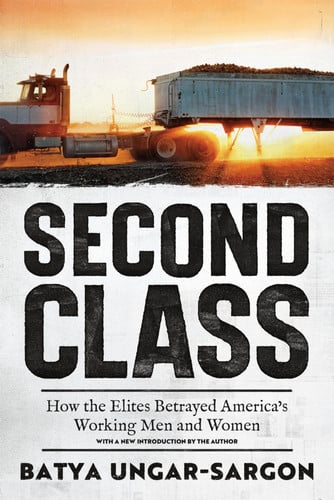
Second class: how the elite betrayed America's working men and women

Ungar-Sargon, Batya
A personal, journalistic ethnography of the modern American working class, based on the travels and interactions of the author through the American heartland. " Second Class is the most important book you will read all year. A political realignment is coming, and it's my hope that the end result will work in favor of our all-too-neglected American working class. When that realignment comes, Batya and her book will help lead the way." --Greg Lukianoff, CEO of the Foundation for Individual Rights in Education, and co-author of The Coddling of the American Mind Who is the American working class? Do they still have a fair shot at the American Dream? What do they think about their chances to secure the hallmarks of a middle-class life? While writing this book, Batya Ungar-Sargon visited states across the nation to speak with members of the American working class who are fighting tooth and nail to survive. In Second Class , working-class Americans of all races, political orientations, and occupations share their stories--cleaning ladies, health care aides, cops, truck drivers, fast food workers, electricians, and more. In their own words, these working-class Americans explain the struggles and triumphs of their increasingly precarious lives--as well as what policies they think would improve them. Second Class combines deep reporting with a look at the data and expert opinions on America's emergent class divide, in which the most basic elements of a secure and stable life are increasingly out of reach for those without a college education. America has broken its contract with its laboring class. So, how do we get back to the American Dream? How do we once again become the land of opportunity, the promised land, where hard work and commitment to family are enough to protect you from poverty? It's not that hard actually. All it would take, as this book illustrates, is for those in power to once again respect the dignity of work--and the American worker.
Encounter Books 2025 248 pages