194 results for "History"

A people's history of sports in the United States: 250 years of politics, protest, people, and play

Zirin, Dave
Book Description: In this long-awaited book from the rising superstar of sports writing, whose blog "The Edge of Sports" is read each week by thousands of people across the country, Dave Zirin offers a riotously entertaining chronicle of larger-than-life sporting characters and dramatic contests and what amounts to an alternative history of the United States as seen through the games its people played. Through Zirin's eyes, sports are never mere games, but a reflection of - and spur toward - the political conflicts that shape American society. Half a century before Jackie Robinson was born, the black ballplayer Moses Fleetwood Walker brandished a revolver to keep racist fans at bay, then took his regular place in the lineup. In the midst of the Depression, when almost no black athletes were allowed on the U.S. Olympic team, athletes held a Counter Olympics where a third of the participants were African American
New Press 2008-09-01 302 pages

In wartime: stories from Ukraine

Judah, Tim
From one of the finest journalists of our time comes a definitive, boots-on-the-ground dispatch from the front lines of the conflict in Ukraine. Ever since Ukraine's violent 2014 revolution, followed by Russia's annexation of Crimea, the country has been at war. Misinformation reigns, more than two million people have been displaced, and Ukrainians fight one another on a second front--the crucial war against corruption. With In Wartime , Tim Judah lays bare the events that have turned neighbors against one another and mired Europe's second-largest country in a conflict seemingly without end. In Lviv, Ukraine's western cultural capital, mothers tend the graves of sons killed on the other side of the country. On the Maidan, the square where the protests that deposed President Yanukovych began, pamphleteers, recruiters, buskers, and mascots compete for attention. In Donetsk, civilians who cheered Russia's President Putin find their hopes crushed as they realize they have been trapped in the twilight zone of a frozen conflict. Judah talks to everyone from politicians to poets, pensioners, and historians. Listening to their clashing explanations, he interweaves their stories to create a sweeping, tragic portrait of a country fighting a war of independence from Russia--twenty-five years after the collapse of the USSR.
Tim Duggan Books 2016 257 pages

Mind change: how digital technologies are leaving their mark on our brains

Greenfield, Susan
"Google. Facebook. Twitter. Repeat. We live in a world unimaginable even a few decades ago, one like no other in human history. It's a parallel world where we can be on the move in the real world, yet always hooked into an alternative time and place. And although it's a two-dimensional world of sight and sound, it offers instant information, connected identities, and constant novelty. In this world, our screen technologies are increasingly where we work, where we unwind, where we relieve our boredom and where we learn. The subsequent transformation in how we live and think is a vitally important issue, perhaps even the most important issue of our time. When toddlers are given iPads, and adults spend ten hours a day staring at a screen, can we afford to assume that our brave new screen technologies are harmless tools? Blending a wide range of scientific studies, news events, and cultural criticism with brio and verve, Mind Change presents an incisive snapshot of the global 'now.' Greenfield examines how the dawn of the Digital Age has already altered our cultural landscape, fueled an epidemic of oversharing, and transformed how we learn, remember and spread information -- and how these innovations are changing our physical brains. A warning cry, a shot across the bow, and a call to action, Mind Change explores the social, cultural and physiological ramifications of our new digital lifestyle"--
Random House 2015-02-10 348 pages

My age of anxiety: fear, hope, dread, and the search for peace of mind

Stossel, Scott
The author recounts his lifelong battle with anxiety, showing the many manifestations of the disorder as well as the countless treatments that have been developed to counteract it, and provides a history of the efforts of scientists, philosophers, and writers to understand this common form of mental illness. He reports on famous individuals who struggled with anxiety, as well as on the afflicted generations of his own family. This portrait of anxiety reveals the anguish it produces, and describes anxiety's human toll, it's crippling impact, its devasting power to paralyze, while at the same time exploring how those who suffer from it find ways to manage and control it. Here the author guides us across the terrain of an affliction that is pervasive (it is the most common form of officially classified mental illness), yet too often misunderstood. -- From book jacket.
Alfred A. Knopf 2013 400 pages

How free is free? the long death of Jim Crow

Litwack, Leon F.
In 1985, a black veteran of the civil rights movement offered a bleak vision of a long and troubled struggle. For more than a century, black southerners learned to live with betrayed expectations, diminishing prospects, and devastated aspirations. Their odyssey includes some of the most appalling examples of terrorism, violence, and dehumanization in the history of this nation. But, as Leon Litwack graphically demonstrates, it is at the same time an odyssey of resilience and resistance defined by day-to-day acts of protest: the fight for justice poignantly recorded in the stories, songs, images, and movements of a people trying to be heard. For black men and women, the question is: how free is free? Despite two major efforts to reconstruct race relations, injustices remain. From the height of Jim Crow to the early twenty-first century, struggles over racism persist despite court decisions and legislation. Few indignities were more pronounced than the World War II denial of basic rights and privileges to those responding to the call to make the world safe for democratic values—values that they themselves did not enjoy. And even the civil rights movement promise to redeem America was frustrated by change that was often more symbolic than real. Although a painful history to confront, Litwack’s book inspires as it probes the enduring story of racial inequality and the ongoing fight for freedom in black America with power and grace.
Harvard University Press 2009-02-27 187 pages

The human use of human beings: cybernetics and society

Wiener, Norbert
"In 1950, mathematician-philosopher Norbert Wiener ended this classic book on the place of machines in society with a warning: "We shall never receive the right answers to our questions unless we ask the right questions.... The hour is very late, and the choice of good and evil knocks at our door." Wiener, the founder of the science of cybernetics--the study of the relationship between computers and the human nervous system--was widely mislabeled as an advocate for the automation of human life. As The Human Use for Human Beings reveals, his vision was much more complex and interesting, and is more relevant in today's world of AI than anyone could have anticipated. In his new introduction, Brian Christian aptly calls Wiener the "progenitor of contemporary AI-safety discourse." Wiener hoped that machines would release people from relentless and repetitive drudgery to achieve more creative pursuits, yet he anticipated the danger of dehumanizing and displacement. His pioneering views on the human-machine relationship as a "communicative process" are only more crucial now, as we carry in our pockets AI devices that we can literally speak to. His prescient warnings illuminate our contemporary relationships with language, art, and even social media. The Human Use of Human Beings examines the implications of cybernetics for education, law, language, science, technology, as Wiener anticipates the enormous impact--in effect, a third industrial revolution--that the computer has had on our lives."-- Provided by publisher
Mariner Classics 2025-08-12 240 pages

Beasts: what animals can teach us about the origins of good and evil

Masson, J. Moussaieff
"There are two supreme predators on the planet with the most complex brains in nature: humans and orcas. In the twentieth century alone, one of these animals killed 200 million members of its own species, the other has killed none. Jeffrey Masson's fascinating new book begins here: There is something different about us. In his previous bestsellers, Masson has showed that animals can teach us much about our own emotions--love (dogs), contentment (cats), grief (elephants), among others. But animals have much to teach us about negative emotions such as anger and aggression as well, and in unexpected ways. In Beasts he demonstrates that the violence we perceive in the "wild" is mostly a matter of projection. We link the basest human behavior to animals, to "beasts" ("he behaved no better than a beast"), and claim the high ground for our species. We are least human, we think, when we succumb to our primitive, animal ancestry. Nothing could be further from the truth. Animals, at least predators, kill to survive, but there is nothing in the annals of animal aggression remotely equivalent to the violence of mankind. Our burden is that humans, and in particular humans in our modern industrialized world, are the most violent animals to our own kind in existence, or possibly ever in existence on earth. We lack what all other animals have: a check on the aggression that would destroy the species rather than serve it. It is here, Masson says, that animals have something to teach us about our own history. In Beasts, he strips away our misconceptions of the creatures we fear, offering a powerful and compelling look at our uniquely human propensity toward aggression"--
Bloomsbury 2014 213 pages

The Judith Butler reader

Butler, Judith
The Judith Butler Reader is a collection of writings that span her impressive career and trace her intellectual history. Judith Butler, author of influential books such as Gender Trouble, has built her international reputation as a theorist of power, gender, sexuality and identity Organized in active collaboration between Judith Butler and Sara Salih Collects together writings that span Butler’s impressive career as a critical philosopher, including selections from both well-known and lesser-known works Includes an introduction and editorial material to assist students in their readings of theories that stand at the forefront of contemporary theoretical and political debates
Blackwell Pub 2003 374 pages

Liquid times: living in an age of uncertainty

Bauman, Zygmunt
The passage from ‘solid’ to ‘liquid’ modernity has created a new and unprecedented setting for individual life pursuits, confronting individuals with a series of challenges never before encountered. Social forms and institutions no longer have enough time to solidify and cannot serve as frames of reference for human actions and long-term life plans, so individuals have to find other ways to organise their lives. They have to splice together an unending series of short-term projects and episodes that don’t add up to the kind of sequence to which concepts like ‘career’ and ‘progress’ could meaningfully be applied. Such fragmented lives require individuals to be flexible and adaptable – to be constantly ready and willing to change tactics at short notice, to abandon commitments and loyalties without regret and to pursue opportunities according to their current availability. In liquid modernity the individual must act, plan actions and calculate the likely gains and losses of acting (or failing to act) under conditions of endemic uncertainty. Zygmunt Bauman’s brilliant writings on liquid modernity have altered the way we think about the contemporary world. In this short book he explores the sources of the endemic uncertainty which shapes our lives today and, in so doing, he provides the reader with a brief and accessible introduction to his highly original account, developed at greater length in his previous books, of life in our liquid modern times.
Polity Press 2007 115 pages

World Without Mind

Franklin Foer
Over the past few decades there has been a revolution in terms of who controls knowledge and information. This rapid change has imperilled the way we think. Without pausing to consider the cost, the world has rushed to embrace the products and services of four titanic corporations. We shop with Amazon; socialise on Facebook; turn to Apple for entertainment; and rely on Google for information. These firms sell their efficiency and purport to make the world a better place, but what they have done instead is to enable an intoxicating level of daily convenience. As these companies have expanded, marketing themselves as champions of individuality and pluralism, their algorithms have pressed us into conformity and laid waste to privacy. They have produced an unstable and narrow culture of misinformation, and put us on a path to a world without private contemplation, autonomous thought, or solitary introspection - a world without mind. In order to restore our inner lives, we must avoid being co-opted by these gigantic companies, and understand the ideas that underpin their success. Elegantly tracing the intellectual history of computer science - from the Descartes and the enlightenment to Alan Turing to Stuart Brand and the hippie origins of today's Silicon Valley - Foer exposes the dark underpinnings of our most idealistic dreams for technology. The corporate ambitions of Google, Facebook, Apple, and Amazon, he argues, are trampling longstanding liberal values, especially intellectual property and privacy. This is a nascent stage in the total automation and homogenization of social, political, and intellectual life. By reclaiming our private authority over how we intellectually engage with the world, we have the power to stem the tide. At stake is nothing less than who we are, and what we will become. There have been monopolists in the past but today's corporate giants have far more nefarious aims. They're monopolists who want access to every facet of our identities and influence over every corner of our decision-making. Until now few have grasped the sheer scale of the threat. Foer explains not just the looming existential crisis but the imperative of resistance.
Jonathan Cape Ltd 2017-09-28 272 pages

Raise a fist, take a knee: race and the illusion of progress in modern sports

Feinstein, John
"Commentators, coaches, and fans alike have long touted the diverse rosters of leagues like the NFL and MLB as sterling examples of a post-racial America. Yet decades after Tommie Smith and John Carlos raised their fists in a display of Black power and pride, and years after Colin Kaepernick shocked the world by kneeling for the national anthem, the role Black athletes and coaches are expected to perform--both on and off the field--still can be determined as much by stereotype and old-fashion ideology as ability and performance. Whether it's the pre-game moments of resistance, the lack of diversity among coaching and managerial staff, or the consistent undervaluation of Black quarterbacks, racial politics impact every aspect of every sport being played--yet the gigantic salaries and glitzy lifestyles of pro athletes often disguise the ugly truths of how minority players are treated and discarded by their White bosses. John Feinstein crisscrossed the country to secure personal interviews with quarterbacks, coaches, and more, revealing the stories none of us have heard (but all of us should know). Seventy-five years after Jackie Robinson broke baseball's color line, race is still a central and defining factor of America's professional sports leagues. With an encyclopedic knowledge of professional sports, and shrewd cultural criticism, bestselling and award-winning author John Feinstein uncovers not just why, but how, pro sports continue to perpetuate racial inequality."--
Little, Brown and Company 2021 366 pages

Liquid fear

Bauman, Zygmunt
Modernity was supposed to be the period in human history when the fears that pervaded social life in the past could be left behind and human beings could at last take control of their lives and tame the uncontrolled forces of the social and natural worlds. And yet, at the dawn of the twenty-first century, we live again in a time of fear. Whether its the fear of natural disasters, the fear of environmental catastrophes or the fear of indiscriminate terrorist attacks, we live today in a state of constant anxiety about the dangers that could strike unannounced and at any moment. Fear is the name we give to our uncertainty in the face of the dangers that characterize our liquid modern age, to our ignorance of what the threat is and our incapacity to determine what can and can't be done to counter it. This new book by Zygmunt Bauman one of the foremost social thinkers of our time is an inventory of liquid modern fears. It is also an attempt to uncover their common sources, to analyse the obstacles that pile up on the road to their discovery and to examine the ways of putting them out of action or rendering them harmless. Through his brilliant account of the fears and anxieties that weigh on us today, Bauman alerts us to the scale of the task which we shall have to confront through most of the current century if we wish our fellow humans to emerge at its end feeling more secure and self-confident than we feel at its beginning.
Polity Press 2006-10-06 188 pages

The postmodern turn: new perspectives on social theory

Steven Seidman
Counter The Postmodern Turn gathers together in one volume some of the most important statements of the postmodern approach to human studies. In addressing postmodern social theory and emphasising the social role of knowledge, this book abandons the disciplinary boundaries separating the sciences and the humanities. The first collection of its kind, it provides the classic essays of authors such as Lyotard, Haraway, Foucault and Rorty. Contributors include well-known theorists in the fields of sociology, anthropology, women's and gay studies, philosophy, and history.
Cambridge University Press 1994-11-25 312 pages

The baseball: stunts, scandals, and secrets beneath the stitches

Hample, Zack
The Baseball is a salute to the ball, filled with insider trivia, anecdotes, and generations of ball-induced insanity—f rom Zack Hample, the bestselling author of Watching Baseball Smarter • Which Hall of Famer once caught a ball dropped from an airplane? • Why do balls get stamped with invisible ink? • What’s the best ticket to buy for catching a foul ball? • Which part of the ball once came from dog food companies? • How could a 10,000-year-old glacier help a pitcher grip the ball? In this enlightening, entertaining, and often wildly funny book, Zack Hample shares ballpark legends and lore, explores the history of the baseball souvenir craze, and also details the evolution of the ball. Finally, Hample—who has snagged more than 4,600 balls from 48 different major league stadiums—offers up his secret methods for snagging your own ball from major league games. Features a ballhawk glossary, profiles of legendary ballhawks, top 10 lists, and black-and-white photos throughout.
Anchor Books 2011-03-08 356 pages

The long emergency: surviving the converging catastrophes of the twenty-first century

Kunstler, James Howard
With his classics of social commentary "The Geography of Nowhere and "Home from Nowhere, James Howard Kunstler has established himself as one of the great commentators on American space and place. Now, with "The Long Emergency, he offers a shocking vision of a post-oil future. The last two hundred years have seen the greatest explosion of progress and wealth in the history of mankind. But the oil age is at an end. The depletion of nonrenewable fossil fuels is about to radically change life as we know it, and much sooner than we think. As a result of artificially cheap fossil-fuel energy we have developed global models of industry, commerce, food production, and finance that will collapse. "The Long Emergency tells us just what to expect after we pass the tipping point of global peak oil production and the honeymoon of affordable energy is over, preparing us for economic, political, and social changes of an unimaginable scale. Are we laboring under a Jiminy Cricket syndrome when we tell ourselves that alternative means of energy are just a few years away? Even once they are developed, will they ever be able to sustain us in the way that fossil fuels once did? What will happen when our current plagues of global warming, epidemic disease, and overpopulation collide to exacerbate the end of the oil age? Will the new global economy be able to persevere, or will we be forced to revert to the more agrarian, localized economy we once knew? Could corporations like Wal-Mart and McDonald's, built on the premise of cheap transportation, become a thing of the past? Will the misguided experiment of suburbia--considered a birthright and a reality by millions of Americans--collapse when the car culturebecomes obsolete? Riveting and authoritative. "The Long Emergency is a devastating indictment that brings new urgency and accessibility to the critical issues that will shape our future, and that we can no longer afford to ignore. It is bound to become a classic of social science.
Atlantic Monthly Press 2005 307 pages

Big game: the NFL in dangerous times

Leibovich, Mark
The New York Times bestseller! From the #1 New York Times bestselling author of This Town , an equally merciless probing of America's biggest cultural force, pro football, at a moment of peak success and high anxiety Like millions of Americans, Mark Leibovich has spent more of his life tuned into pro football than he'd care to admit. Being a lifelong New England Patriots fan meant growing up on a steady diet of lovable loserdom. That is, until the Tom Brady/Bill Belichick era made the Pats the most ruthlessly efficient and polarizing sports dynasty of the modern NFL, and its fans the most irritating in all of Pigskin America. Leibovich kept his obsession quiet, making a nice career for himself covering that other playground for rich and overgrown children, American politics. Still, every now and then Leibovich would reach out to Tom Brady to gauge his willingness to subject himself to a profile. He figured that the chances of Brady agreeing were a Hail Mary at best, but Brady returned Mark's call in summer 2014 and kept on returning his calls through epic Patriots Super Bowl victory and defeat, and a scandal involving Brady--Deflategate--whose grip on sports media was as profound as its true significance was ridiculous. So began a four-year odyssey that took Mark Leibovich deeper inside the NFL than anyone has gone before. From the owners' meeting to the draft to the sidelines of crucial games, he takes in the show at the elbow of everyone from Brady to big-name owners to the cordially despised NFL Commissioner, Roger Goodell. Ultimately, BIG GAME is a chronicle of "peak football"--the high point of the sport's economic success and cultural dominance, but also the time when the dark side began to show. It is an era of explosive revenue growth, but also one of creeping existential fear. Players have long joked that NFL stands for "not for long," but as the true impact of concussions becomes inescapable background noise, it's increasingly difficult to enjoy the simple glory of football without the buzz-kill of its obvious consequences. And that was before Donald Trump. In 2016, Mark's day job caught up with him, and the NFL slammed headlong into America's culture wars. BIG GAME is a journey through an epic storm. Through it all, Leibovich always keeps one eye on Tom Brady and his beloved Patriots, through to the 2018 Super Bowl. Pro football, this hilarious and enthralling book proves, may not be the sport America needs, but it is most definitely the sport we deserve.
The Penguin Press 2018 373 pages

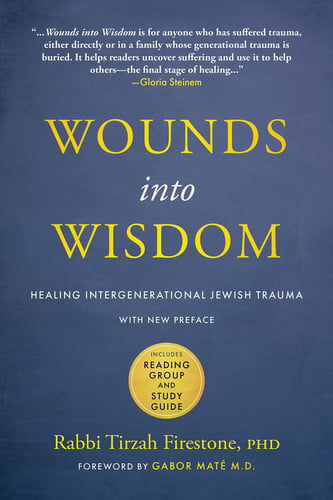
Wounds into wisdom: healing intergenerational Jewish trauma

Firestone, Tirzah
"Our past does not simply disappear. The painful history of our ancestors and their rich cultural wisdom intertwine within us to create the patterns of our future. Even when past trauma remains unspoken or has long been forgotten, it becomes part of us and our children-a legacy of both strength and woundedness that shapes our lives. In this book, Tirzah Firestone brings to life the profound impact of protracted historical trauma through the compelling narratives of those whose lives were marred by racial persecution and displacement. The tragic story of Firestone's own family lays the groundwork for these revealing testimonies of recovery, forgiveness, and moral leadership. Throughout, Firestone interweaves their voices with neuroscientific and psychological findings, as well as relevant and inspiring Jewish teachings. Seven principles emerge from these wise narratives-powerful prescriptive tools that speak to anyone dealing with the effects of past traumatic injury. At the broadest level, these principles are directives for staying morally awake in a world rife with terror"--
Monkfish Book Publishing Company 2022 258 pages