50 results for "History"

Because It Is Wrong Torture, Privacy and Presidential Power in the Age of Terror

Beneficial Professor of Law Charles Fried,Charles Fried,Gregory Fried
Can torture ever be justified? When is eavesdropping acceptable? Should a kidnapper be waterboarded to reveal where his victim has been hidden? Ever since 9/11 there has been an intense debate about the government's application of torture and the pervasive use of eavesdropping and data mining in order to thwart acts of terrorism. To create this seminal statement on torture and surveillance, Charles Fried and Gregory Fried have measured current controversies against the philosophies of Aristotle, Locke, Kant, and Machiavelli, and against the historic decisions, large and small, of Jefferson, Lincoln, and Pope Sixtus V, among many others. Because It Is Wrong not only discusses the behavior and justifications of Bush government officials but also examines more broadly what should be done when high officials have broken moral and legal norms in an attempt to protect us. This is a moral and philosophical meditation on some of the most urgent issues of our time.
W. W. Norton, Incorporated 2010-09-06 224 pages

Political Evil What It Is and How to Combat It

Alan Wolfe
A timely, eye-opening examination of political evil, a concept widely misunderstood and desperately in need of clarification in our ever more chaotic world. In an age of genocide, terrorism, ethnic cleansing, and torture, evil threatens us in ways radically different from tsunamis and financial panics. Nature unleashes its wrath and people rush to help the victims. Evil shows its face and we are paralyzed over how to respond. It was not always this way. During the twentieth century, thinkers as diverse as Hannah Arendt, Reinhold Niebuhr, Arthur Koestler, and George Orwell made evil central to everything they wrote. Acclaimed political scientist Alan Wolfe argues that in an age of partisan blame-assigning, therapeutic excuse-making, and theological question-dodging, we need to get serious about the problem of evil once again. While there will always be something incomprehensible about evil, we are very much capable of understanding and combating the use of evil means to obtain political ends. Looking at examples of political evil around the globe—in the Middle East, Darfur, the Balkans, and at home in the West—Wolfe shows us how seemingly small distinctions can make an immense difference in international response. And he makes clear that much-needed change can be initiated with a shift in how we talk and think about political evil. At once impassioned and pragmatic, Political Evil sheds essential light on the creation of policy and on a concrete path to a more practicable and just future.
Knopf Doubleday Publishing Group 2012-09-04 352 pages

Hostage

Eli Sharabi
In a raw and unflinching memoir, Eli Sharabi, a survivor of 491 days in Hamas captivity, recounts the harrowing ordeal of his abduction from Kibbutz Be'eri on October 7th, 2023, the loss of his wife and daughters, and his unyielding resolve to survive. "I refuse to let myself drown in pain. I am surviving. I am a hostage. In the heart of Gaza. A stranger in a strange land. In the home of a Hamas-supporting family. And I'm getting out of here. I have to. I'm getting out of here. I'm coming home."--Eli Sharabi On October 7, 2023, Hamas terrorists stormed Kibbutz Be'eri, shattering the peaceful life Eli Sharabi had built with his British wife, Lianne, and their teenage daughters, Noiya and Yahel. Dragged barefoot out his front door while his family watched in horror, Sharabi was plunged deep into the suffocating darkness of Gaza's tunnels. As war raged above him, he endured a grueling 491 days in captivity, all the while holding onto the hope that he would one day be reunited with his loved ones. Eli Sharabi's story is one of hunger and heartache, of physical pain, longing, loneliness and a helplessness that threatens to destroy the soul. But it is also a story of strength, of resilience, and of the human spirit's refusal to surrender. It is about the camaraderie forged in captivity, the quiet power of faith, and one man's unrelenting decision to choose life, time and time again. In the first memoir by a released Israeli hostage, and the fastest-selling book in Israel's history, Sharabi offers a searing firsthand account of survival under unimaginable conditions--starvation, isolation, physical beatings, and psychological abuse at the hands of his captors. Compared to Elie Wiesel's Night and Laura Hillenbrand's Unbroken, Hostage is a profound witness to history, so it shall be neither forgotten nor erased.
HarperCollins Publishers 2025-10-21 368 pages

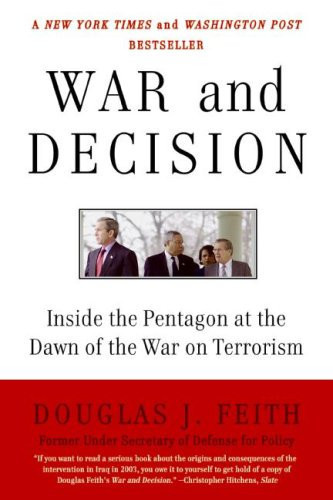
War and decision: inside the Pentagon at the dawn of the War on Terrorism

Feith, Douglas J.
Of all the players in the planning and evolution of the Bush Administration's war on terrorism, few were more integral--or more controversial--than Douglas Feith, the chief strategist on Donald Rumsfeld's Pentagon policy team. A highly influential international policy analyst for more than a quarter century, Feith worked closely with Rumsfeld, Paul Wolfowitz, Colin Powell, Condoleezza Rice, Vice President Cheney, and President Bush in defining the U.S. response to the attacks of 9/11--from the successful war on Afghanistan to the more challenging invasion of Iraq and its aftermath. Now, in this candid and revealing memoir, Feith--a charter member of the neoconservative movement and an architect of the administration's preventive strategy in the war on terrorism--offers the most in-depth and authoritative account yet of the Pentagon's evolving stance during one of the most controversial eras of American history. Drawing upon a unique trove of documents and records, this extraordinary chronicle will put the reader in the room for scores of previously unreported senior-level meetings, showing how hundreds of critical decisions were made in defense of American interests during and after the crisis of 9/11--decisions both successful and controversial. Where journalists like Bob Woodward could only speculate, Feith is the first inside player to reveal the inner workings of the Pentagon, at a time when history hung in the balance.--From publisher description.
HarperCollins 2009-02-03 674 pages

A history of terrorism

Laqueur, Walter
Assassinations, bombings, hijackings, diplomatic kidnappings-terrorism is the most publicized form of political violence. The history of terrorism goes back a very long time, but the very fact that there is such a history has frequently been ignored, even suppressed. This may be because terrorism has not appeared with equal intensity at all times. When terrorism reappeared in the late twentieth century after a period of relative calm, there was the tendency to regard it as a new phenomenon, without precedent. The psychological study of terrorism has never been much in fashion. But this neglect has left a number of crucial questions unanswered. Among these are why some people who share the same convictions turn to terrorism and others do not. What is terrorism's true impact on international politics? What influence might it exert in the future? A History of Terrorism completes Walter Laqueur's pioneering and authoritative study of guerilla warfare and terrorist activity. He charts the history of political terror from nineteenth-century Europe, through the anarchists of the 1880s and 1890s, the left- and right-wing clashes during the twentieth century, and the multinational operations of Arab and other groups today. Laqueur examines the sociology of terrorism: funding, intelligence gathering, weapons and tactics, informers and countermeasures, and the crucial role of the media. He probes the "terrorist personality" and how terrorists have been depicted in literature and films. The doctrine of systematic terrorism and current interpretations of terrorism, its common patterns, motives, and aims, are unflinchingly faced and clearly explicated. Finally, Laqueur considers the effectiveness of terrorism and examines the ominous possibility of nuclear blackmail. Challenging accepted assumptions, forecasting the changes in terrorist activity that will affect tomorrow's headlines, Walter Laqueur demystifies terrorism without belittling its importance. Together with its companion volume, Guerrilla Warfare , also available from Transaction, A History of Terrorism is an essential tool for assessing and understanding this all-too-often sensationalized modern expression of extreme political action.
Transaction 2001 277 pages

Major Farran's hat: murder, scandal and Britain's war against Jewish terrorism, 1945-1948

Cesarani, David
The gripping true story of the murder, in Palestine in 1947, of a Jewish activist by a British counter-terrorist officer, and the subsequent cover-up. In May 1947, a Jewish teenager, active in a Zionist underground group fighting British rule in Palestine, was abducted. He was never seen again. Witnesses said he was seized by British policeman. A hat found at the scene was traced to Major Roy Farran, an ex-SAS officer leading a covert counter-terrorist squad. A sensational court martial followed, but Farran was acquitted, and the Zionist underground swore vengeance. Drawing on recently declassified files of the security services, the book explores the reasons why Britain lost Palestine and reveals the full extent and ambition of Jewish terrorist attacks on Britain in the late 1940s. Part Boys' Own adventure, part narrative history, Major Farran's Hat solves a murder mystery and exposes a shady episode in the final years of the British empire, and throws light on Britain's legacy in the Middle East.
William Heinemann 2009-04-21 290 pages

The Mind of the Islamic State

Robert Manne
So often in history, it is ideas that kill ... What are the ideas that drive the Islamic State? How did it develop and systematise its unique form of apocalyptic violence? In this gripping account, Robert Manne shows how the Islamic State's worldview evolved, from the 1960s prison writings of Sayyid Qutb all the way to its elegant online magazine of horror, Dabiq. This gripping account reveals the crucial role of texts such as The Management of Savagery, and figures such as al-Zarqawi, who set out to pit Sunni against Shi'a, tearing Iraq apart. Shortly after the fall of Mosul in June 2014, US General Michael Nagata said of the new jihadist threat: 'We have not defeated the idea. We do not even understand the idea. By examining the beliefs and strategies at the heart of the Islamic State, Manne shows how a dark ideology came into being.
ReadHowYouWant.com, Limited 2016-10-24 224 pages

The Mandela Plot

Kenneth Bonert
The second novel from GG finalist and international award winner Kenneth Bonert, who brought Jewish Johannesburg to explosive life in his 2013 debut, The Lion Seeker . As the 1980s draw to a close, apartheid is in its death throes and South Africa is a maelstrom of political violence. Young Martin Helger has problems of his own. Out of place at an elite private school, he is the son of a rough-handed scrap dealer and lives in the shadow of his enigmatic brother, a neighbourhood legend. When an irresistible young American boards at the Helger home, a transfixed Martin soon finds himself wrenched out of the isolated bubble of his white privilege and thrust into the raw heart of South Africa's racial struggle. At the same time, secrets from the past begin to emerge and old sins long-buried return in terrifying new ways, tearing at the Helgers, a second-generation Jewish family, even as the larger forces of history and politics tear apart the country. Migration, terrorism, revolution, identity and memory--these are just some of the bold themes brilliantly and honestly explored in this powerful novel. At once a riveting literary thriller, a moving coming-of-age tale, and an unforgettable journey through a fascinating world , The Mandela Plot entertains and terrifies in equal measure, and resonates profoundly in light of current affairs.
Knopf Canada 2018-05-29 480 pages

The war at home: the domestic costs of Bush's militarism

Piven, Frances Fox
Frances Fox Piven, one of the country's most celebrated social scientists, raises questions others have not. She examines the ways the war on terror served to shore up the Bush administration's political base and analyzes the manner in which flag-waving politicians used the emotional fog of war to further their regressive social and economic agendas. Always in the past governments that made war sooner or later tried to reward their peoples for the blood and wealth they were forced to sacrifice. During World War II, tax rates on the wealthy rose to 90 percent; toward the end of the Vietnam War, eighteen-year-olds were given the right to vote. In this war, taxes on the rich have been slashed, and democratic rights are being rolled back. Even veteran's benefits have been sharply reduced. The War at Home makes sense of these developments by putting the current domestic fallout of war in the context of history - and by turning an unsentimental eye on the domestic motivations of American militarism.
New Press 2004 165 pages

The Jewish Defense Organization's A History of Islamist Terrorism in America

Jewish Organization
Secret history of Islamist terrorism in America from Sirhan Sirhan to Major Hasan and how the JDO fights it. The JDO was founded in March 1982 in reaction to the demise of the Jewish Defense League (JDL). The JDO was never and never will be a Kahanist organization; instead it is based on principles first set forth by the Honorable Zev Jabotinsky, the founder of Revisionist Zionism. Jabotinsky, poet, statesman and militarist told Jewish audiences prior to the Holocaust to leave Europe. In 2010 JDO was able to get a meeting of the American Renaissance Party that was to be held at the Skyline Motel in Washington, D.C. cancelled despite the insistence of its manager that it take place. In February 2011 JDO quashed another meeting of this racist group with the help of the NAACP and City Council members Patrick Cannon and Councilman Warren Turner. These men had enough self-respect to stop these KKK jackasses from spewing their racial-hatred in Charlotte, North Carolina. Look what happened in Greensboro, North Carolina in 1979 when the Klan mowed down a "Death to the Klan" march staged by Communists. Declassified FBI documents revealed that JDO Chairman Mordechai Levy warned the FBI that the Klan was planning a violent attack but his intelligence was ignored due to his status as a Jewish militant. Just the opposite should have been true. In March 2011 the JDO was able to convince the landlord of the the Nazi-Holocaust revisionist scumy group The Institute of Historical Review not to renew their lease. In May 2011 the JDO held a demonstration in front of Nazi Headquarters on the Upper East Side of Manhattan. These are our latest actions - we've been staging these events and others for years and years. It is from this militant / activist point of view that the JDO research team studied the history of Islamist terrorism on American soil within certain parameters of interest. Rather than using a shotgun approach we zeroed in on terrorist plots in which bombs were actually constructed or shots were fired and excluded numerous conspiracies that the FBI nipped in the bud. Our researchers obtained the documents from every terrorism court case in the United States, conducted interviews, scoured the Internet in all languages, studied declassified government documents, filed FOIA requests then put the puzzle pieces together. We even collected the trash in front of the Permanent Observer Mission of Palestine to the United Nations at 115 East 65th Street in Manhattan and discovered cable traffic that indicated the PLO was using Syrian diplomatic pouches to smuggle bomb parts to various locations throughout the world. JDO turned these cables over to Israeli intelligence who cautioned JDO not to reveal its methodology as it was going to be applied to other hostile diplomatic installations. JDO waited for a year before revealing its discovery on local television. Shortly thereafter a car with two Arabic looking men parked outside JDO headquarters at 6 Bleecker Street in Manhattan. A JDO member displayed his semi-auto Uzi and invited the thugs upstairs. It was just another day in the 1980's at JDO Headquarters.
Jewish Defense Organization Press 2011 465 pages

The Way of the World A Story of Truth and Hope in an Age of Extremism

Ron Suskind
National Bestseller Fully Updated Ron Suskind’s book promises to be a bracing international thriller – an ensemble of uranium merchants and panicked diplomats, stealthy Jihadist soldiers and CIA operatives, anxious Muslim children and angry world leaders – a diverse cast of players who will define the struggle between hope and fear in the modern era. Suskind will close the Bush years – a period he has helped to define – with a startling glimpse at what America actually faces across the roiling world. In the intelligence and military communities, the overwhelming concern is the uncontrolled spread of nuclear weapons and the ingredients from which weapons can be composed across a globe exploding with conflict and anti-American fervour. It is a failure of government that we are left with this overwhelming security issue – both domestically, where our security is deeply compromised, and internationally, where we face a host of seen and unseen threats. This book will explode in the middle of an election year with unparalleled disclosures and analysis. The book’s nature and timing will place it at the very centre of the election battle as it enters its final six months. It will be a must-read for anyone hoping to exercise truly informed consent.
Doubleday Canada 2009-08-25 448 pages

The Border Canada, the US and Dispatches From the 49th Parallel

James Laxer
Insightful, prescient and often funny, The Border explores what it means to be Canadian and what Canada means to the giant to our south. If good fences make good neighbours, do we have the sort of fence that will allow us to maintain neighbourly relations with the world’s only superpower? In The Border , well-known political scientist and journalist James Laxer explores this question by taking the reader on a compelling 5000-mile journey into culture, politics, history, and the future of Canadian sovereignty. Long ignored (or celebrated) as “the world’s longest undefended border,” the line between us and the US is now a stress point. The attacks on the World Trade Center announced to the world that North America is no longer a quiet neighbourhood and made our relationship with the US one of the most pressing questions facing Canadians. The porousness of the border is sure to be more problematic as the world becomes more troubled. Canadian officials complain of American pornography, drugs, untaxed cigarettes and, especially, guns moving northwards. For their part, the FBI and US Customs Service blame Canada for the infiltration of Chinese gangs smuggling immigrants and, more urgently, third-world terrorist cells based north of the border. Drawing deeply from history and anecdote, Laxer shows that for all our neighbourly good will, the Canada-US border has been contentious since the American War of Independence. In the mid-1800s the Americans tried to seize the west coast up to the 54th parallel. On the other hand, until 1931 the Canadian Army’s “Defence Scheme Number One” was to launch a surprise attack on the US with Mexico and Japan as allies. But beyond the fraught politics of the border, Laxer discovers another legacy as well. Travelling the country from Campobello island in the east to Richmond BC in the west all the way up to the Alaska panhandle in the north, Laxer meets people who live within a stone’s throw of the foreigners on the other side, and who share with him tales of friendship and rivalry, smuggling and trade that have shaped the character of their communities.
National Geographic Books 2004-09-21 400 pages

Winning the Right War The Path to Security for America and the World

Philip H. Gordon
“An absolutely brilliant book . . . the most clearly argued critique yet of the Bush administration’s flawed approach to defeating jihadist terrorism.”—Peter Bergen, author of Holy War, Inc. Six years into the “war on terror,” are the United States and its allies safer than they were before it started? Sadly, we are not, and the reason is that we are fighting—and losing—the wrong war. In this paradigm-shifting book, Philip H. Gordon presents a new way of thinking about the war on terror and a new strategy for winning it. He draws a provocative parallel between the war on terror and the Cold War, showing how defense, development, diplomacy, and the determination to maintain our own values can again be deployed alongside military might to defeat a hostile and insidious ideology. Gordon also asks, “What would victory look like?”—a topic sorely missing from the debate today. He offers a positive vision of the world after the war on terror, which will end not when we kill or capture all potential terrorists but when their hateful ideology collapses. Gordon’s strategy for achieving this goal is achievable and realistic, but only if the United States changes course before it is too late.
Henry Holt and Company 2008-08-05 224 pages

Thou shalt kill: revolutionary terrorism in Russia, 1894-1917

Geifman, Anna
Anna Geifman examines the explosion of terrorist activity that took place in the Russian empire from the years just prior to the turn of the century through 1917, a period when over 17,000 people were killed or wounded by revolutionary extremists. On the basis of new research, she argues that a multitude of assassination attempts, bombings, ideologically motivated robberies, and incidents of armed assault, kidnapping, extortion, and blackmail for party purposes played a primary role in the revolution of 1905 and early twentieth-century Russian political history in general.
Princeton University Press 1993 376 pages

Transatlantic tensions: the United States, Europe, and problem countries

Richard N. Haass
" Americans and Europeans are divided by more than an ocean when it comes to designing and carrying out policies toward countries that repress human rights, develop weapons of mass destruction, and/or support terrorism and subversion. Accounting for this divide are distinct interests, domestic politics, and above all profound disagreements between Americans and their counterparts in European capitals and Brussels over what tools of foreign policy--sanctions, engagement, military force--to empty to change the behavior of problem countries. The result is that Americans and Europeans often work at cross purposes--and that disagreements over policy toward problem countries threaten both to undermine efforts that promote desired change and transatlantic cooperation in other areas, be it within Europe or in building an open world trading system. This book examines the ""problem"" countries of Cuba, Iran, Iraq, Libya, and Nigeria. The authors explain sources of American and European differences, consequences for policies designed to influence problem states, and prospects for bridging transatlantic policy rifts. A conclusion by Richard N. Haass places these differences in perspective and suggests what Europe and the United States need to do to ameliorate this tension--and what could transpire if they do not. "
Brookings Institution Press 1999 251 pages

Bush's Law The Remaking of American Justice

Eric Lichtblau
In the aftermath of 9/11, President Bush declared that the struggle against terrorism would be nothing less than a war—a war that would require new tools and a new mind-set. As legal sanction was given to covert surveillance and interrogation tactics, internal struggles brewed over programs and policies that threatened to tear at the constitutional fabric of the country. Bush's Law is the alarming account of the White House's efforts to prevent the publication of Eric Lichtblau's exposé on warrantless wiretapping—and an authoritative examination of how the Bush administration employed its “war on terror” to mask the most radical remaking of American justice in generations.
Knopf Doubleday Publishing Group 2009-05-05 368 pages

The Degaev affair: terror and treason in Tsarist Russia

Pipes, Richard
A committed terrorist in Russia, an admired professor in America: the astounding story of Sergei Degaev's double life, told in full detail for the first time Sergei Degaev (1857-1921), a political terrorist in tsarist Russia, disappeared after participating in the assassination of the chief of Russia's security organization in 1883. Those who later knew and admired the quietly brilliant Professor Alexander Pell at the University of South Dakota never guessed this was actually Degaev, who had triple-crossed friends and associates while entangled in the revolutionary movement of his homeland. This book is the first in any language to tell in detail the extraordinary story of one of the world's most intriguing revolutionaries, his role in building and betraying the earliest political terrorist network, and his subsequent conventional academic career in America. The well-known historian Richard Pipes uses previously unexplored Russian archives to draw a brilliant psychological, political, and sociological portrait of Degaev. Pipes pursues his protagonist on a twisting journey of changing loyalties and fateful collaborations within the network that provided the model for all modern terrorist organizations. A cunning conspirator, Degaev went on to reinvent himself in the United States as a beloved mathematics professor. Either of his lives would be considered remarkable; that Degaev lived both is nothing short of amazing.
Yale University Press 2003-01-01 153 pages