98 results for "Jewish Children"

Between worlds: the autobiography of Leo Lionni

Lionni, Leo
Born in Holland, half Jewish, raised in Amsterdam, Brussels, Genoa, Philadelphia - Lionni is a man of many languages and cultures but no real home. His story is one of a constant search, a search that takes him from an ideal early childhood to a strict education in Italy that proved largely irrelevant to his future, and then to exile from Fascist Italy in America; from being a highly political aspiring artist to becoming a highly successful advertising director (he invented the famous "Never underestimate the power of a woman" campaign) and a powerful force in the world of graphics as the art director of Fortune magazine; from life in the affluent commuter world of Connecticut to a return to Italy and the life of an artist. After all this - a full life by any account - he finds yet another successful vocation as the author and illustrator of children's books that have sold millions of copies throughout the world.
Knopf 1997 295 pages

God, faith & identity from the ashes: reflections of children and grandchildren of Holocaust survivors

Menachem Z. Rosensaft
Almost ninety children and grandchildren of Holocaust survivors--theologians, scholars, spiritual leaders, authors, artists, political and community leaders and media personalities--from sixteen countries on six continents reflect on how the memories transmitted to them have affected their lives.--Publisher information.
Jewish Lights Publishing, a division of LongHill Partners, Inc 2014-11-04 309 pages

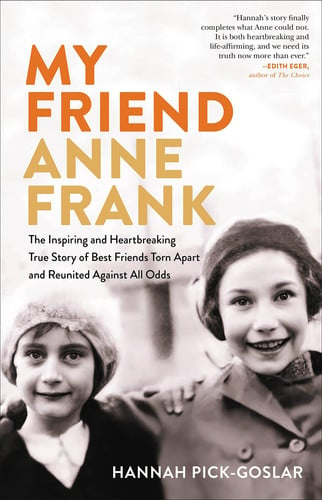
My friend Anne Frank: the inspiring and heartbreaking true story of best friends torn apart and reunited against all odds

Pick-Goslar, Hannah,Kraft, Dina
"In 1933, Hannah Pick-Goslar and her family fled Nazi Germany to live in Amsterdam, where she struck up a close friendship with her next-door neighbor, an outspoken and fun-loving young girl named Anne Frank. For several years, the inseparable pair enjoyed a carefree childhood of games, sleepovers, and treats with the other children in their neighborhood of Rivierenbuurt. But in 1942, Hannah and Anne's lives abruptly changed forever. As the Nazi occupation of Amsterdam progressed, Anne and the Frank family seemingly vanished, leaving behind unmade beds and dishes in the sink--but no trace of Anne's precious diary. Torn from her dear friend without warning, Hannah spent the next two years tormented by questions about Anne's fate, wondering if she had, by some miracle, managed to escape danger. In this long-awaited memoir, Hannah shares the story of her childhood during the Holocaust, from the introduction of anti-Jewish laws in Amsterdam to the gradual disappearance of classmates and, eventually, the Frank family, to Hannah and her family's imprisonment in the Bergen-Belsen concentration camp. As Hannah chronicles the experiences of her own life during and after the war, she provides a searing look at what countless children endured at the hands of the Nazi regime, as well as an intimate, never-before-seen portrait of the most recognizable victim of the Holocaust. Culminating in an astonishing fateful reunion, My Friend Anne Frank is the profoundly moving story of childhood and friendship during one of the darkest periods in the world's history"--Dust jacket flap.
Little, Brown Spark 2023 313 pages

My name is Anne, she said, Anne Frank

Maarsen, Jacqueline van
A touching and intimate autobiography, this account recalls the author's remarkable childhood friendship with Anne Frank while attending a special school for Jewish children in Amsterdam during the late 1930s. With the story of her initial meeting and bonding with Anne Frank, Jacqueline van Maarsen's memoir recollects her family's near escape from the Netherlands only months after the Frank family went into hiding-or moved to Switzerland, as van Maarsen was lead to believe-and provides a revealing look into life under Nazi occupation. Written by a one-time friend who only discovered the truth about Anne's fate after the war ended, this memoir is a moving, firsthand recollection of a youthful friendship in the foreboding days of World War II.
Arcadia 2008-03-28 176 pages

Turbulent souls: a Catholic son's return to his Jewish family

Dubner, Stephen J.
Two years ago, Stephen J. Dubner wrote a cover story for the New York Times Magazine called "Choosing My Religion." It became one of the most widely discussed articles in the magazine's history. Turbulent Souls, the book that grew out of that article, is an intimate memoir of a man in search of a Jewish heritage he never knew he had. It is also a loving portrait of his parents. Stephen Dubner's family was as Catholic as they come. His devout parents attended mass at every opportunity and named their eight children after saints. Stephen, the youngest child, became an altar boy, studied the catechism, and learned the traditional rituals of the Church -- never suspecting that the religion he embraced was not his by blood. Turbulent Souls is Dubner's personal account of his family; tumultuous journey from Judaism to Catholicism -- and in his own case, back to Judaism -- and the effects, some tragic, some comic, of those spiritual transformations. His parents were Jews, born in Brooklyn to immigrant parents, but -- independent of each other and, indeed, before they met -- each converted to Christianity, only to be shunned by their families. After their marriage, they closed the door on Judaism so firmly that their children had no inkling that their background was far different from what it seemed: They didn't know, for instance, that their mother had a first cousin named Ethel Rosenberg, who was executed for treason in one of the most controversial cases of the cold war era. Stephen Dubner's is a story about discovery: of relatives he never knew existed, of family history he'd never learned, and of a faith he'd never thought of as his own and, in fact, knew nothing about. It's a fascinating, thoughtful, and thought-provoking exploration of a subject of intense interest to spiritually minded men and women everywhere.
W. Morrow 1998-10-17 320 pages

25 questions for a Jewish mother

Gold, Judy,Ryan, Kate Moira
"There's a little Jewish mother in every mother," as comedienne Judy Gold reveals in her achingly hilarious and poignant book For a Jewish girl who remembers the first book ever read to her as a child was the pop-up version of The Diary of Anne Frank, learning how to be a Jewish mother who wasnt a carbon copy of HER Jewish mother wasnt easy. Here, Emmy Awardwinning comedienne Judy Gold asks, "Are there any Jewish mothers out there like me, or are they all, G-d forbid, like my mother" In 25 Questions for a Jewish Mother, she incorporates her own adventures in Jewish motherdom and her memories of growing up Jewish in suburban New Jersey -- communicating with her mother by putting Ann Landers articles on the fridge ("Dear Ann, My mother wont let me walk alone to school and Im 16! Please help." "Dear Ann, The crossing guard drinks. Please help.") -- with the voices of the fifty other Jewish mothers, she and her co-author, Kathleen Moira Ryan, interviewed. They asked homemakers, lawyers, Holocaust survivors twenty-five questions, including: --Who's your favorite Jewish mother (Judy's is Barbra Streisand.)? --How many times a day do you talk to your children or mother (for Judy, it's anywhere from one to the high double digits)? --Are Jewish mothers really more paranoid (or, "Why do I have to write an entire itinerary with names, addresses, and phone numbers every time I leave the house")? And so on. The culmination of these extraordinary stories confirms that there is ultimately something strong, courageous, and loving in every Jewish mother -- a hopeful -- and very funny -- message to mothers and their children everywhere.
Voice/Hyperion 2007-04-25 226 pages

Lost in America: a journey with my father

Nuland, Sherwin B.
A writer renowned for his insight into the mysteries of the body now gives us a lambent and profoundly moving book about the mysteries of family. At its center lies Sherwin Nuland’s Rembrandtesque portrait of his father, Meyer Nudelman, a Jewish garment worker who came to America in the early years of the last century but remained an eternal outsider. Awkward in speech and movement, broken by the premature deaths of a wife and child, Meyer ruled his youngest son with a regime of rage, dependency, and helpless love that outlasted his death. In evoking their relationship, Nuland also summons up the warmth and claustrophobia of a vanished immigrant New York, a world that impelled its children toward success yet made them feel like traitors for leaving it behind. Full of feeling and unwavering observation, Lost in America deserves a place alongside such classics as Patrimony and Call It Sleep .
Knopf 2003 209 pages

Holocaust literature: a history and guide

Roskies, David G.,Diamant, Naomi
"What is Holocaust literature? When does it begin and how is it changing? Is there an essential core of diaries, eyewitness accounts of the concentration camps, tales of individual survival in hiding? Is it the same everywhere: in the West as in the East, in Australia as in the Americas, in poetry as in prose? Is this literature sacred and sui generis, or can it be studied in the light of other literatures? What of the perpetrators and bystanders, the hidden children, the children of Holocaust survivors: Do they speak with the same authority? What works of Holocaust literature will be read a hundred years from now--and why? Here, for the first time and told from beginning to end, is an historical survey of Holocaust literature in all genres, countries, and major languages. Beginning in wartime, it proceeds from the literature of mobilization and mourning in the Free World to the vast and varied literature produced in the Nazi-occupied ghettos, the bunkers and places of hiding, the transit and concentrations camps. Within weeks of the liberation, in displaced persons camps, a new memorial and testamentary literature begins to take shape. Moving from Europe to Israel, the U.S., and beyond, the authors situate the writings by real and proxy witnesses within three distinct postwar periods: a period of "communal memory," still internal and internecine; a period of "provisional memory" in the '60s and '70s that witnesses the birth of a self-conscious Holocaust genre; to the period of "authorized memory" in which we live today, following the collapse of the Soviet Union (1989-91), and the opening of the US Holocaust Museum (1993). Twenty book covers - first editions in their original languages - and an eminently readable guide to the "first hundred books" together show the multilingual scope, historical depth, the moral and artistic range of this extraordinary body of writing."--Publisher's website.
Brandeis University Press 2012 355 pages

Let's face it: 90 years of living, loving, and learning

Douglas, Kirk
He has been one of the brightest stars in Hollywood, a hard-charging actor whose intensity on the screen has been mirrored in his personal life. As Kirk Douglas has grown older - he turned ninety in December 2006 - he has become less impetuous and more reflective. In this poignant and inspiring new memoir, Douglas contemplates what life is all about, weighing current events from his present frame of mind while summoning the passions of his younger days. Kirk Douglas is a born storyteller, and throughout Let's Face It he tells wonderful tales and shares favorite jokes and hard-won insights. In the book, he explores the mixed blessings of growing older and looks back at his childhood, his young adulthood, and his storied, glamorous, and colorful life and career in Hollywood. He tells delightful stories of the making of such films as Spartacus, Lust for Life, Champion, The Bad and the Beautiful, and many others. He includes anecdotes about his friends Frank Sinatra, Burt Lancaster, Lauren Bacall, Ronald Reagan, Ava Gardner, Henry Kissinger, Fred Astaire, Yul Brynner, John Wayne, and Johnny Cash. He reveals the secrets that have kept him and his wife, Anne, happily married for more than five decades, and talks fondly and movingly of times spent with his sons, Michael, Peter, Eric, and Joel, and his grandchildren. Douglas's life has been filled with pain as well as joy. In Let's Face It , he writes frankly for the first time about the tragic death of his son Eric from a drug overdose at age forty-five. Douglas tells what it was like to recover from several near-death episodes, including a helicopter crash, a stroke, and a cardiac event. He writes of his sadness that many of his closest friends are no longer with us; the book includes many moving stories such as one about a regular poker game at Frank Sinatra's house at which he and Anne have been fixtures along with Gregory Peck, Jack Lemmon, and their wives. Though many of the players are gone, the game continues to this day. In Let's Face It , Douglas reflects on how his Jewish faith has become more and more important to him over the years. He offers strong opinions on everything from anti-Semitism to corporate greed, from racism to Hurricane Katrina, and from the war in Iraq to the situation in Israel. He writes about the importance in his life of the need to improve education for all children and about how we need to care more about the world and less about ourselves. A must-read for every fan, this engrossing memoir provides an indelible self-portrait of a great star - while sharing the wit and wisdom Kirk Douglas has accumulated over a lifetime.
John Wiley & Sons 2007 238 pages

Burned child seeks the fire: a memoir

Edvardson, Cordelia
[A] searing memoir. . . . An enduring, indeed universal, story. Robert Taylor, The Boston Globe Summoned with her mother to Gestapo headquarters in 1943, fourteen-year-old Cordelia Edvardson was given a terrible choice: to acknowledge her secret Jewish heritage and suffer the consequences or to see her mother charged with treason. Burned Child Seeks the Fire is the true story of the love between this mother and daughter, and a piercing example of the tragedies wrought by Nazi Germany. "A lacerating, beautifully translated memoir." Publishers Weekly , starred review "Mesmerizing. . . . [Has] the concise unreality of a horrifying fairy tale." Thomas Frick, Los Angeles Times Book Review "Behind [Edvardson's] deceptively simple prose is a complex and tragic story." Judith Bolton-Fasman, Newsday "Cordelia Edvardson's defiant tone challenges us to eschew simplified encounters with the literature and experiences of Holocaust survivors." Paul H. Hamburg, Jewish Book World "To see the horrors of the Holocaust through a child's eye is to experience hell. Cordelia Edvardson's astonishing story captures, with a terrifying reality, a child's response to the myriad atrocities of the Nazis and their murderous regime. Burned Child Seeks the Fire is compelling, horrifying, poetic in its intensity." Deborah Peifer, Bay Area Reporter
Beacon Press 1997 105 pages

Inheriting Anne Frank

Maarsen, Jacqueline van
Jacqueline van Maarsen's first book My Name is Anne, She Said, Anne Frank ends in 1947, two years after the death of her close friend Anne Frank. But Anne's death did not spell the end of the friendship. Otto Frank clung desperately to his deceased daughter's dearest friend. Having remained silent about her friendship with Anne Frank for decades after the war, Jacqueline van Maarsen finally decided to tell her story, hoping to expose half-truths and fabrications surrounding her former friend and to respect Anne Frank's legacy for what it is. While her books have been written in close cooperation with the Anne Frank Foundation, there are times when she has felt obliged to disagree with the Foundation and she has not shied away from confrontation. In her second book, van Maarsen returns in detail to the most dominant person in her life, her French mother who died in 1992 at the age of 101. The aftermath of an inheritance question in France in which the author had an important role to play, takes on tragic proportions, although the hilarity of the sometimes grotesque situation surfaces now and then. Inheriting Anne Frank is the continuation of Jacqueline van Maarsen's My Name is Anne, She Said, Anne Frank, and is an important documentary contribution to our knowledge of Anne Frank and what happened to and on account of her renowned diary. It is also a stirring portrait of a woman's turbulent life in the twentieth century
Arcadia Books 2009 158 pages

Children of the flames: Dr. Josef Mengele and the untold story of the twins of Auschwitz

Matalon Lagnado, Lucette
Relates the life story of Josef Mengele and quotes from the testimonies of twin children who were the victims of his sadistic pseudo-medical experiments in Auschwitz. They speak about the complicated psychological problems which they confronted after the war, and which caused their silence in the 1950s-70s. In 1984 the organization of surviving twins, CANDLES, was established, which organized a trip to Auschwitz in 1985 and publicized their reminiscences.
Morrow 1991 320 pages

Shanda: a memoir of shame and secrecy

Pogrebin, Letty Cottin
"In her deeply engaging, astonishingly candid memoir, author and activist Letty Cottin Pogrebin exposes the fiercely-guarded lies and intricate cover-ups woven by dozens of members of her extended family. Beginning with her own long-suppressed secret, the story spirals through the hidden lives of her parents and relatives--revealing the truth about their origins, personal traumas, marital misery, abandoned children, religious transgressions, sexual identity, radical politics, and supposedly embarrassing illnesses. While unmasking their charades and disguises, Pogrebin also showcases her family's remarkable talent for reinvention in a narrative that is, by turns, touching, searing, and surprisingly universal." --
Post Hill Press 2022 429 pages

Free as a Jew: a personal memoir of national self-liberation

Wisse, Ruth R.
"First came parents with the good sense to flee Europe in 1940 and the good fortune to reach the land of freedom. Their daughter, Ruth, grew up in the shadow of genocide--but in tandem with the birth of Israel, which remained her lodestar. She learned that although Jewishness is biologically transmitted, democracy is not, and both require intensive, intelligent transmission through education in each and every generation. They need adults with the confidence to teach their importance. Ruth tried to take on that challenge as dangers to freedom mounted and shifted sides on the political spectrum. At the high point of her teaching at Harvard University, she witnessed the unraveling of standards of honesty and truth until the academy she left was no longer the one she had entered."--Book flap.
Wicked Son 2021-09-21 359 pages

My Germany: a Jewish writer returns to the world his parents escaped

Raphael, Lev
Haunted by his parents’ horrific suffering and traumatic losses under Nazi rule, Lev Raphael grew up loathing everything German. Those feelings shaped his Jewish identity, his life, and his career. While researching his mother’s war years after her death, he discovers a distant relative living in the very city where she had worked in a slave labor camp, found freedom, and met his father. Soon after, Raphael is launched on book tours in Germany and, in the process, redefines himself as someone unafraid to face the past and let it go. Bookmarks , “Top Ten Nonfiction Titles of 2009”
University of Wisconsin Press 2011-10-23 224 pages

The Holocaust is over, we must rise from its ashes

Burg, Avraham
Modern-day Israel, and the Jewish community, are strongly influenced by the memory and horrors of Hitler and the Holocaust. Burg argues that the Jewish nation has been traumatized and has lost the ability to trust itself, its neighbors or the world around it. He shows that this is one of the causes for the growing nationalism and violence that are plaguing Israeli society and reverberating through Jewish communities worldwide. Burg uses his own family history--his parents were Holocaust survivors--to inform his innovative views on what the Jewish people need to do to move on and eventually live in peace with their Arab neighbors and feel comfortable in the world at large. Thought-provoking, compelling, and original, this book is bound to spark a heated debate around the world.
Palgrave Macmillan 2010 253 pages