
133 results for "Jewish History"

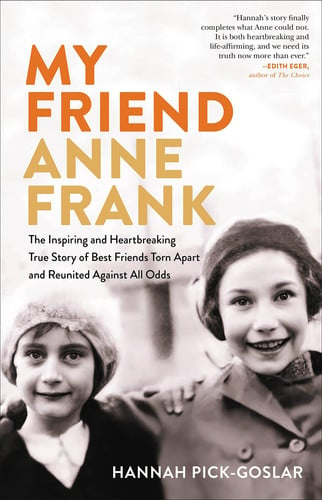
My friend Anne Frank: the inspiring and heartbreaking true story of best friends torn apart and reunited against all odds

Pick-Goslar, Hannah,Kraft, Dina
"In 1933, Hannah Pick-Goslar and her family fled Nazi Germany to live in Amsterdam, where she struck up a close friendship with her next-door neighbor, an outspoken and fun-loving young girl named Anne Frank. For several years, the inseparable pair enjoyed a carefree childhood of games, sleepovers, and treats with the other children in their neighborhood of Rivierenbuurt. But in 1942, Hannah and Anne's lives abruptly changed forever. As the Nazi occupation of Amsterdam progressed, Anne and the Frank family seemingly vanished, leaving behind unmade beds and dishes in the sink--but no trace of Anne's precious diary. Torn from her dear friend without warning, Hannah spent the next two years tormented by questions about Anne's fate, wondering if she had, by some miracle, managed to escape danger. In this long-awaited memoir, Hannah shares the story of her childhood during the Holocaust, from the introduction of anti-Jewish laws in Amsterdam to the gradual disappearance of classmates and, eventually, the Frank family, to Hannah and her family's imprisonment in the Bergen-Belsen concentration camp. As Hannah chronicles the experiences of her own life during and after the war, she provides a searing look at what countless children endured at the hands of the Nazi regime, as well as an intimate, never-before-seen portrait of the most recognizable victim of the Holocaust. Culminating in an astonishing fateful reunion, My Friend Anne Frank is the profoundly moving story of childhood and friendship during one of the darkest periods in the world's history"--Dust jacket flap.
Little, Brown Spark 2023 313 pages

Begin: a portrait

Hurwitz, Harry Zvi
Menachem Begin, Prime Minister of Israel from 1977 to 1983, principal figure of the Israeli right, co-author of the historic peace between Israel and Egypt, and arguably one of the principal figures in the history of the Jewish People in the 20th century, is carefully portrayed in this extraordinary biography by Harry Hurwitz, a trusted friend and compatriot. Begin the man, the elected leader of Israel, and by force of personality, character and ideas, one of the Israeli Prime Ministers who became a leader of the Jewish People, is what Hurwitz excels at revealing. Here is the story of Begin's life told with the insights of a journalist who was also a close friend of more than forty years. The struggle of Begin's life, his early attachment to the Zionist prophet Vladimir Ze'ev Jabotinsky, his life in Poland, his suffering during the Holocaust, and his leadership of the Irgun Zvai Leumi's revolt against British rule in Eretz Yisrael, is the well-told prelude to his thirty years as a leader of the opposition to Israel's Labor government. Especially rich in detailing the years of Begin's Premiership, the reader will be enthralled by the careful review of these six momentous years, and enriched by the opportunity to read many of Begin's most important speeches and statements. Hurwitz believes that Begin is best understood when he speaks for himself, and he skillfully weaves together a well paced biography with the public utterances of his subject. This biographical portrait succeeds in giving the reader a vivid sense of what motivated Menachem Begin to seek peace with Egypt, to demand much of the 'peace process' and to deal firmly with the enemies of Israel and the Jewish People. Though not a study of ideas, every reader will come away with an understanding of Begin's view of the world, the strategic needs of the State of Israel, the importance of democratic values in Israeli life, and his commitment to the security and continuity of the Jewish People. In the end the author's admiration for his subject is a case well made.
B'nai B'rith Books 1994 255 pages

Alice's book: how the Nazis stole my grandmother's cookbook

Urbach, Karina
"What happened to the books that were too valuable to burn? Alice Urbach had her own cooking school in Vienna, but in 1938 she was forced to flee to England, like so many others. Her younger son was imprisoned in Dachau, and her older son, having emigrated to the United States, became an intelligence officer in the struggle against the Nazis. Returning to the ruins of Vienna in the late 1940s, she discovers that her bestselling cookbook has been published under someone else's name. Now, eighty years later, the historian Karina Urbach - Alice's granddaughter - sets out to uncover the truth behind the stolen cookbook, and tells the story of a family torn apart by the Nazi regime, of a woman who, with her unwavering passion for cooking, survived the horror and losses of the Holocaust to begin a new life in America. Impeccably researched and incredibly moving, Alice's Book sheds light on an untold chapter in the history of Nazi crimes against Jewish authors"--Publisher's description.
Maclehose Press/Quercus 2022 413 pages

Turbulent souls: a Catholic son's return to his Jewish family

Dubner, Stephen J.
Two years ago, Stephen J. Dubner wrote a cover story for the New York Times Magazine called "Choosing My Religion." It became one of the most widely discussed articles in the magazine's history. Turbulent Souls, the book that grew out of that article, is an intimate memoir of a man in search of a Jewish heritage he never knew he had. It is also a loving portrait of his parents. Stephen Dubner's family was as Catholic as they come. His devout parents attended mass at every opportunity and named their eight children after saints. Stephen, the youngest child, became an altar boy, studied the catechism, and learned the traditional rituals of the Church -- never suspecting that the religion he embraced was not his by blood. Turbulent Souls is Dubner's personal account of his family; tumultuous journey from Judaism to Catholicism -- and in his own case, back to Judaism -- and the effects, some tragic, some comic, of those spiritual transformations. His parents were Jews, born in Brooklyn to immigrant parents, but -- independent of each other and, indeed, before they met -- each converted to Christianity, only to be shunned by their families. After their marriage, they closed the door on Judaism so firmly that their children had no inkling that their background was far different from what it seemed: They didn't know, for instance, that their mother had a first cousin named Ethel Rosenberg, who was executed for treason in one of the most controversial cases of the cold war era. Stephen Dubner's is a story about discovery: of relatives he never knew existed, of family history he'd never learned, and of a faith he'd never thought of as his own and, in fact, knew nothing about. It's a fascinating, thoughtful, and thought-provoking exploration of a subject of intense interest to spiritually minded men and women everywhere.
W. Morrow 1998-10-17 320 pages

Once we were slaves: the extraordinary journey of a multiracial Jewish family

Leibman, Laura Arnold
"An obsessive genealogist and descendent of one of the most prominent Jewish families since the American Revolution, Blanche Moses firmly believed her maternal ancestors were Sephardic grandees. Yet she found herself at a dead end when it came to her grandmother's maternal line. Using family heirlooms to unlock the mystery of Moses's ancestors, Once We Were Slaves overturns the reclusive heiress's assumptions about her family history to reveal that her grandmother and great-uncle, Sarah and Isaac Brandon, actually began their lives as poor Christian slaves in Barbados. Tracing the siblings' extraordinary journey throughout the Atlantic World, Leibman examines artefacts they left behind in Barbados, Suriname, London, Philadelphia, and, finally, New York, to show how Sarah and Isaac were able to transform themselves and their lives, becoming free, wealthy, Jewish, and-at times-white. While their affluence made them unusual, their story mirrors that of the largely forgotten population of mixed African and Jewish ancestry that constituted as much as ten percent of the Jewish communities in which the siblings lived, and sheds new light on the fluidity of race-as well as on the role of religion in racial shift-in the first half of the nineteenth century"--
Oxford University Press 2021 294 pages

Rahel Varnhagen: the life of a Jewish woman

Arendt, Hannah
"Rahel Varnhagen: The Life of a Jewish Woman was Hannah Arendt's first book, largely completed when she went into exile from Germany in 1933, though it would not be published until the 1950s. It is the biography of a remarkable, complicated, troubled, passionate woman, an important figure in German romanticism, the person who in a sense founded the Goethe cult that would become central to German cutural life in the nineteenth century, as well as someone who confronted and bore the burden of being both a woman in a man's world and an assimilated Jew in Germany with unusual determination. Rahel Levin Varnhagen, was, Hannah Arendt writes, "neither beautiful nor attractive... and possessed no talents with which to employ her extraordinary intelligence and passionate originality." Arendt sets out to tell the story of Rahel's life as Rahel might have told it and, in doing so, to reveal the way in which intellectual and social assimilation works out in one person's destiny. On her deathbed Rahel is reported to have said, "The thing which all my life seemed to me the greatest shame, which was the misery and misfortune of my life--having been born a Jewess--this I should on no account now wish to have missed." Only because she had remained both a Jew and a pariah, Hannah Arendt observes, "did she find a place in the history of European humanity.""--
New York Review Books 2021 236 pages

Tom Stoppard: a life

Lee, Hermione
"A perfect match of writer and subject: one of our most brilliant biographers takes on one of our greatest living playwrights--with his cooperation and access to a trove of hitherto unseen material. Tom Stoppard is a towering and beloved literary figure. Known for his dizzying narrative inventiveness and intense attention to language, he deftly deploys art, science, history, politics, and philosophy in works that span a remarkable spectrum of literary genres: theater, radio, film, TV, journalism, and fiction. His most acclaimed creations--Rosencrantz and Guildenstern are Dead, The Real Thing, Arcadia, The Coast of Utopia, Shakespeare in Love--remain as fresh and moving as when they dazzled their first audiences. Stoppard's life, too, is fascinating: born in Czechoslovakia, he escaped the Nazis with his mother and spent his early years in Singapore and India before arriving in England at age eight. Skipping university, he embarked on a brilliant career, becoming close friends over the years with an astonishing array of writers, actors, directors, musicians, and political figures, from Peter O'Toole, Harold Pinter, and Stephen Spielberg to Mick Jagger and Vaclav Havel. Having long described himself as a "bounced Czech," Stoppard was surprised to learn late in life of his Jewish family and the relatives he lost to the Holocaust, secrets his mother had kept from him. Lee's in-depth analysis seamlessly weaves Stoppard's life and work together into a vivid, insightful, and always riveting portrait of a remarkable man"--
Alfred A. Knopf 2021 872 pages

The boy who lost his birthday: a memoir of loss, survival, and triumph

Berkowits, Laszlo
The Boy Who Lost His Birthday is the uplifting story of one man's journey from boyhood in rural Hungary to triumph over oppression during the Holocaust and finally to a role as a spiritual leader in America. Rabbi Laszlo Berkowits' compelling memoir recounts his happy childhood memories in Derecske, Hungary where he was a member of a thriving Jewish community and aspired to become a cantor. Stricken with wartime poverty, Berkowits and his father left their home and family behind to seek work in Budapest. It was there that they were rounded up with other Budapest Jews and shipped by sealed train to Auschwitz in the summer of 1944. Berkowits vividly narrates his treacherous experience as a sixteen year-old boy surviving in the notorious Nazi concentration camp until its liberation by American troops. After recovery in Sweden, Berkowits immigrated to America were he completed his education, joined the United States Army, and became a chaplain's assistant. After leaving the Army, he undertook graduate study at Hebrew Union College, married, and became the founding rabbi of the largest Jewish congregation in Virginia, Temple Rodef Shalom. Berkowits' story shows that he emerged victorious over deprivation, cruelty, and tragedy to become an exemplar of American success.
Hamilton Books 2008 81 pages

Philip Roth: a counterlife

Nadel, Ira Bruce
"This account of Philip Roth traces the psychological and artistic origins of his creative life. It examines the major events of his career, while identifying a series of personal themes in his writing, from his relationship with Judaism to family, marriage, Eastern Europe and America. It addresses his private challenges from romance and health, to surviving as a writer burdened with success. The book also reflects how living outside the United States, initially in Italy and then England, plus his visits to Eastern Europe and exposure to their oppressed writers affected his writing. In particular, it primed him for a new engagement with American political and social history, resulting in a renewed determination to re-write America through his American trilogy and The Plot Against America. Although chronology is the framework, this is a thematic reading of Roth's life and career with attention to family, self-identity and success. A set of contrasting angles form this approach, beginning with his prolonged sense of discontent, yet public image of success, his search for sustained relationships but then decision to end them, his idealization of his parents but persistent undercurrent of criticism. Three overlapping issues provide the impetus for this reading: the aesthetic, the emotional and the historical. The lasting importance of such themes as anger, betrayal and failure has a vital role in understanding Roth's character and work. So, too, does his sense of performance on and off the page. Location is also significant and there are extensive discussions of Newark, London, Iowa, Prague and rural Connecticut. Particular attention to writers of the Holocaust, notably Primo Levi and Aharon Appelfeld, and contemporaries such as Saul Bellow and Bernard Malamud, also frame the narrative along with discussions of John Updike, Cynthia Ozick, Norman Mailer, Nadine Gordimer and Nicole Krauss. Works receiving special attention are Portnoy's Complaint, The Ghost Writer, Sabbath's Theater and the American trilogy. The shifting patterns of Roth's writing style, often related to changes in his physical and psychological health, are also considered. But more importantly is Roth's character and how early incidents formed later behavior, especially his inability to forget the past, particularly an insult or criticism. Analysis of his life with his two wives, Margaret (Maggie) Williams and Claire Bloom also occurs, as well as his relationships with other women. Further commentary focuses on Roth's illnesses and his life after he publically announced that he had stopped writing"--
Oxford University Press 2021 546 pages

Philip Roth: stung by life

Zipperstein, Steven J.
"Philip Roth (1933-2018) is one of the most celebrated American writers of his age. Born in Newark, New Jersey -- where his short stories and thirty-one books were often set -- he wrote with immense ambition and drive, along with a keen awareness of what must be done to produce great literature. Yet despite rubbing shoulders with the Kennedys and engaging in a spate of famous and infamous romances, he viewed himself as socially withdrawn, living much like an "unchaste monk" (his words). In this original and lucid biography, Steven J. Zipperstein captures Roth's complex life and the astonishing range of his self-reflective writings-from "Goodbye, Columbus" and "Portnoy's complaint" to the Pulitzer Prize-winning "American pastoral" and "The plot against America." Employing extensive archival research and well over one hundred interviews, including conversations with Roth himself, Zipperstein provides an intimate and probing look at one of the twentieth century's most influential authors, placing his work in the context of Jewishness, freedom, and sexuality in America"-- Provided by publisher.
Yale University Press 2025-10-14 346 pages

Family sayings

Ginzburg, Natalia
Family Sayings is Natalia Ginzburg's masterpiece and a classic of contemporary Italian literature. Although it asks to be read as fiction, the author, one of Italy's finest twentieth-century writers, admits that it is highly autobiographical. The book spans the period from the rise of Fascism through World War II (in which her first husband perished at the hands of the Nazis) and its aftermath. Its subject is the other people in Ginzburg's family. Woven around the inconsequential, revealing remarks that are repeated in a family until they become its affectionate private code, rich in memory and association, this is one of the rare true evocations of a family in modern literature. Family Sayings is at the same time a living history that documents the life of the assimilated Jewish Ginzburg family and the culture to which they belonged. Winner of the Strega Prize-Italy's Pulitzer for literature-this intimate and candid portrait is no less relevant today than when it was first published in 1963. --
Arcade Pub 2013 181 pages

Shut up, I'm talking: and other diplomacy lessons I learned in the Israeli government : a memoir

Levey, Gregory
"Shut Up, I'm Talking" is a smart, hilarious insider take on Israeli politics that reads like the bastard child of Thomas Friedman and David Sedaris. Now a political writer for Salon, Gregory Levey stumbled into a job as speechwriter for the Israeli delegation to the United Nations at age twenty-five and suddenly found himself, like a latter-day Zelig, in the company of foreign ministers, U.S. senators, and heads of state. Much to his surprise, he was soon attending U.N. sessions and drafting official government statements. The situation got stranger still when he was transferred to Jerusalem to write speeches for Prime Minister Ariel Sharon. "Shut Up, I'm Talking" is a startling account of Levey's journey into the nerve center of Middle Eastern politics at one of the most turbulent times in Israeli history. During his three years in the Israeli government, the Second Intifada continued on in fits and starts, Yasser Arafat died, Hamas came to power, and Ariel Sharon fell into a coma. Levey was repeatedly thrust into highly improbable situations -- from being the sole "Israeli" delegate (even though he's Canadian) at the U.N. General Assembly, with no idea how "his" country wanted to vote; to nearly inciting an international incident with his high school French translation of an Arab diplomat's anti-Israel remarks; to communicating with Israeli intelligence about the suspected perpetrators of suicide bombings; to being offered leftover salami from Ariel Sharon's lunch. As Levey got better acquainted with the personalities in the government's inner sanctum, he witnessed firsthand the improvisational and ridiculously casual nature of the country's behind-the-scenes leadership -- and realized that he wasn't the only one faking his way through politics. With sharp insight and great appreciation for the absurd, Levey offers the first-ever look inside Israel's politics from the perspective of a complete outsider, ultimately concluding that the Israeli government is no place for a nice Jewish boy.
Free Press 2008-04-22 267 pages

Jacob's cane: a Jewish family's journey from the four lands of Lithuania to the ports of London and Baltimore

New, Elisa
Drawn to an image of her great-grandfather's ornately carved cane, scholar Elisa New embarked on a journey to discover the origins of her precious family heirloom. Treading back across the paths of her ancestors, she travels from Baltimore to the Baltic to London in order to find and understand an immigrant world profoundly affected by modern German culture, from the Enlightenment through the Holocaust. Deeply ambitious in its narrative sweep, Jacob's Cane captures the rich texture of life on several continents as New's family searches to establish itself in the tobacco trade. A fascinating history of one family's story of progress, innovation, and struggle, Jacob's Cane will change the way we think about the Jewish American experience.
Basic Books 2009-09-22 328 pages

Legacy: one family, a cup of tea and the company that took on the world

Harding, Thomas
A panoramic new history of modern Britain, as told through the story of one extraordinary family, and one groundbreaking company. In the early 1800s, Lehmann Gluckstein and his family escaped the pogroms of Eastern Europe and made their way to Whitechapel in London's East End. There, starting with nothing, they worked tirelessly to pull themselves out of poverty, creating a small tobacco factory that grew to become the largest catering company in the world: J. Lyons. For over a century, Lyons was on every high street, in every home, in every coffee and teacup. It was an ascent from rags to riches in the face of many obstacles: poverty, hatred and anti-Semitism stood between this poor immigrant family and the British Dream. Legacy charts the rise and fall of one of the most influential dynasties in British history through the lives of five astonishing generations. Both sweeping and intimate, it is a story of sacrifice and selflessness, betrayal and personal tragedy, and Empire and its cost. It is also an illuminating new exploration of Britain and its place in the world, from the bestselling author of Hanns and Rudolf and The House by the Lake.
William Heinemann 2019 561 pages

Karl Marx: philosophy and revolution

Avineri, Shlomo
"Karl Marx (1818-1883)--philosopher, historian, sociologist, economist, current affairs journalist, and editor--was one of the most influential and revolutionary thinkers of modern history, but he is rarely thought of as a Jewish thinker, and his Jewish background is either overlooked or misrepresented. Here, distinguished scholar Shlomo Avineri argues that Marx's Jewish origins did leave a significant impression on his work. Marx was born in Trier, then part of Prussia, and his family had enjoyed equal rights and emancipation under earlier French control of the area. But then its annexation to Prussia deprived the Jewish population of its equal rights. These developments led to the reluctant conversion of Marx's father, and similar tribulations radicalized many young intellectuals of that time who came from a Jewish background. Avineri puts Marx's Jewish background in its proper and balanced perspective, and traces Marx's intellectual development in light of the historical, intellectual, and political contexts in which he lived."--Publisher's description.
Yale University Press 2019-08-06 217 pages

Loud and clear: the memoir of an Israeli fighter pilot

Spector, Iftach
A recently retired Israeli Air Force general and its second-highest-scoring fighter ace, Iftach Spector is one of Israel’s living legends. He was the leader of the flight that attacked the USS Liberty in 1967. After the 1967 and 1973 wars, in which he commanded a squadron of fighter-bombers, he rose to head the IAF’s Training and War Lessons Section and later became its the Chief of Operations. He was one of the eight Israeli pilots who attacked Saddam Hussein’s nuclear reactor at Osirik in 1981. In 2003, his career took an even more dramatic turn: he was the senior signatory of the famous “Pilots’ Letter,” in which Spector and 27 other Israeli pilots stated their refusal to bomb targets in Palestine where collateral damage would likely be severe. His maverick conscience is well on display in this artfully written memoir, which is currently a 10-week-and-counting bestseller in Israel and has been licensed in Brazil as well. The son of a family that immigrated to Palestine at the turn of the 20th century, whose father and mother served in the Palmach, Israel’s early clandestine commando force, Spector has written a rich and reflective meditation on loyalty, on what is right and wrong in war, and on his dedication to the idea and reality of the state of Israel. The Pilots’ Letter ended Spector’s military career, but also made him one of the most compelling and celebrated defenders of the conscience of the Jewish state. In that battle, as in his previous battles against Nasser’s MiGs, his mother’s constant lesson to him sustained him: “All from within.” General Spector’s first book, A DREAM IN BLACK AND AZURE (1992; never translated into English), won the Sade Literary Award, given to him personally by Prime Minister Yitzhak Rabin. He has a B.A. in history and Middle East Studies from Tel Aviv University and a masters in political science from UCLA, both with honors.
Zenith Press 2009-06-15 426 pages