132 results for "Memoir"

Never far away: the Auschwitz chronicles of Anna Heilman

Heilman, Anna
Memoirs of a Jew born in Warsaw in 1928. Describes the German occupation and life in the Warsaw ghetto. Anna and her sister, Esther (Estusia) Wacjblum, joined Hashomer Hatzair and later participated in the ghetto uprising. They escaped from the ghetto and joined their parents on the "Aryan side". The family was deported in May 1943 to Majdanek, where the parents were killed. The two sisters were sent to Auschwitz, where they worked at the Weichsel-Metall-Union munitions factory and were active in the resistance. They participated in preparations for the October 1944 uprising in Auschwitz, smuggling gunpowder from the factory to members of the Sonderkommando. In January 1945 Esther and three other women were executed for their role in the uprising. Anna was sent on a death march in January 1945; she was liberated in Neustadt in May. After the war she immigrated to Israel, and then to Canada. In June 1991 she and her sister Sabina, who had escaped the Holocaust, participated in the dedication at Yad Vashem of a memorial to the four women who were hanged at Auschwitz for their resistance activities.
University of Calgary Press 2001-11-30 159 pages

At the entrance to the Garden of Eden: a Jew's search for hope with Christians and Muslims in the Holy Land

Klein Halevi, Yossi
A brilliantly observed memoir of an unprecedented and remarkable spiritual journey. While religion has fuelled the often violent conflict plaguing the Holy Land, Yossi Klein Halevi wondered whether it could be a source of unity as well. To find the answer, this religious Israeli Jew began a two–year exploration to discover a common language with his Christian and Muslim neighbours. He followed their holiday cycles, befriended Christian monastics and Islamic mystics, and joined them in prayer in monasteries and mosques in Israel, the West Bank, and Gaza. At the Entrance to the Garden of Eden traces that remarkable spiritual journey. Halevi candidly reveals how he fought to reconcile his own fears and anger as a Jew to relate to Christians and Muslims as fellow spiritual seekers. He chronicles the difficulty of overcoming multiple obstacles注eological, political, historical, and psychological注at separate believers of the three monotheistic faiths. And he introduces a diverse range of people attempting to reconcile the dichotomous heart of this sacred place柠struggle central to Israel, but which resonates for us all.
Perennial 2002-06-18 315 pages

Landscapes of memory: a Holocaust girlhood remembered

Kluger, Ruth
Ruth Kluger is one of the child-survivors of the Holocaust. In 1942, at the age of eleven, she was deported to the Nazi "family camp" Theresienstadt with her mother. They would move to two other camps (including Auschwitz-Birkenau) before the war ended. 'Landscapes of memory' is the story of Ruth's life. Of a childhood spent in the Nazi camps and her refusal to forget the past as an adult in America. 'It is not in our power to forgive: memory does that for us,' says Kluger. Not erasing a single detail, not even the inconvenient ones, she writes frankly about the troubled relationship with her mother even through their years of internment, and of her determination not to forgive and absolve the past. It is this memory, pure and harsh, this anger, savage and profound, that makes Kluger's memoir so unforgettable. A gripping narrative and a superb meditation on the relationship between private memory and history, on forgiveness and redemption, 'Landscapes of memory' will become a classic of our times.
Bloomsbury 2004 272 pages

My name is Anne, she said, Anne Frank

Maarsen, Jacqueline van
A touching and intimate autobiography, this account recalls the author's remarkable childhood friendship with Anne Frank while attending a special school for Jewish children in Amsterdam during the late 1930s. With the story of her initial meeting and bonding with Anne Frank, Jacqueline van Maarsen's memoir recollects her family's near escape from the Netherlands only months after the Frank family went into hiding-or moved to Switzerland, as van Maarsen was lead to believe-and provides a revealing look into life under Nazi occupation. Written by a one-time friend who only discovered the truth about Anne's fate after the war ended, this memoir is a moving, firsthand recollection of a youthful friendship in the foreboding days of World War II.
Arcadia 2008-03-28 176 pages

All rivers run to the sea: memoirs

Wiesel, Elie
In this first volume of his two-volume autobiography, Wiesel takes us from his childhood memories of a traditional and loving Jewish family in the Romanian village of Sighet through the horrors of Auschwitz and Buchenwald and the years of spiritual struggle, to his emergence as a witness for the Holocaust's martyrs and survivors and for the State of Israel, and as a spokesman for humanity. With 16 pages of black-and-white photographs.
A.A. Knopf 1995 432 pages

The boy who lost his birthday: a memoir of loss, survival, and triumph

Berkowits, Laszlo
The Boy Who Lost His Birthday is the uplifting story of one man's journey from boyhood in rural Hungary to triumph over oppression during the Holocaust and finally to a role as a spiritual leader in America. Rabbi Laszlo Berkowits' compelling memoir recounts his happy childhood memories in Derecske, Hungary where he was a member of a thriving Jewish community and aspired to become a cantor. Stricken with wartime poverty, Berkowits and his father left their home and family behind to seek work in Budapest. It was there that they were rounded up with other Budapest Jews and shipped by sealed train to Auschwitz in the summer of 1944. Berkowits vividly narrates his treacherous experience as a sixteen year-old boy surviving in the notorious Nazi concentration camp until its liberation by American troops. After recovery in Sweden, Berkowits immigrated to America were he completed his education, joined the United States Army, and became a chaplain's assistant. After leaving the Army, he undertook graduate study at Hebrew Union College, married, and became the founding rabbi of the largest Jewish congregation in Virginia, Temple Rodef Shalom. Berkowits' story shows that he emerged victorious over deprivation, cruelty, and tragedy to become an exemplar of American success.
Hamilton Books 2008 81 pages

Turbulent souls: a Catholic son's return to his Jewish family

Dubner, Stephen J.
Two years ago, Stephen J. Dubner wrote a cover story for the New York Times Magazine called "Choosing My Religion." It became one of the most widely discussed articles in the magazine's history. Turbulent Souls, the book that grew out of that article, is an intimate memoir of a man in search of a Jewish heritage he never knew he had. It is also a loving portrait of his parents. Stephen Dubner's family was as Catholic as they come. His devout parents attended mass at every opportunity and named their eight children after saints. Stephen, the youngest child, became an altar boy, studied the catechism, and learned the traditional rituals of the Church -- never suspecting that the religion he embraced was not his by blood. Turbulent Souls is Dubner's personal account of his family; tumultuous journey from Judaism to Catholicism -- and in his own case, back to Judaism -- and the effects, some tragic, some comic, of those spiritual transformations. His parents were Jews, born in Brooklyn to immigrant parents, but -- independent of each other and, indeed, before they met -- each converted to Christianity, only to be shunned by their families. After their marriage, they closed the door on Judaism so firmly that their children had no inkling that their background was far different from what it seemed: They didn't know, for instance, that their mother had a first cousin named Ethel Rosenberg, who was executed for treason in one of the most controversial cases of the cold war era. Stephen Dubner's is a story about discovery: of relatives he never knew existed, of family history he'd never learned, and of a faith he'd never thought of as his own and, in fact, knew nothing about. It's a fascinating, thoughtful, and thought-provoking exploration of a subject of intense interest to spiritually minded men and women everywhere.
W. Morrow 1998-10-17 320 pages

Seed of Sarah: memoirs of a survivor

Isaacson, Judith Magyar
Memoirs of the author's youth in Kaposvar, Hungary, her experiences during the Holocaust and immediately after, and a return visit to Hungary in 1977. A ghetto was established in Kaposvar in May 1944, and in July the Jews were deported to Auschwitz. In August, Isaacson, her mother, and her aunt were transported to a labor camp in Hessisch Lichtenau, Germany. In spring 1945 the Jews were transferred to Camp Tekla, a small Hungarian Jewish women's camp in Leipzig, where they were liberated by the American army.
University of Illinois Press 1991-06 193 pages

The dream: a memoir

Bernstein, Harry
During the hard and bitter years of his youth in England, Harry Bernstein’s selfless mother never stops dreaming of a better life in America, no matter how unlikely. Then, one miraculous day when Harry is twelve years old, steamship tickets arrive in the mail, sent by an anonymous benefactor. Suddenly, a new life full of the promise of prosperity seems possible–and the family sets sail for America, meeting relatives in Chicago. For a time, they get a taste of the good life: electric lights, a bathtub, a telephone. But soon the harsh realities of the Great Depression envelop them. Skeletons in the family closet come to light, mafiosi darken their doorstep, family members are lost, and dreams are shattered. In the face of so much loss, Harry and his mother must make a fateful decision–one that will change their lives forever. And though he has struggled for so long, there is an incredible bounty waiting for Harry in New York: his future wife, Ruby. It is their romance that will finally bring the peace and happiness that Harry’s mother always dreamed was possible.
Ballantine Books 2009-04-07 279 pages

Feeling Jewish: (a book for just about anyone)

Baum, Devorah
In this sparkling debut, a young critic offers an original, passionate, and erudite account of what it means to feel Jewish--even when you're not. Self-hatred. Guilt. Resentment. Paranoia. Hysteria. Overbearing Mother-Love. In this witty, insightful, and poignant book, Devorah Baum delves into fiction, film, memoir, and psychoanalysis to present a dazzlingly original exploration of a series of feelings famously associated with modern Jews. Reflecting on why Jews have so often been depicted, both by others and by themselves, as prone to "negative" feelings, she queries how negative these feelings really are. And as the pace of globalization leaves countless people feeling more marginalized, uprooted, and existentially threatened, she argues that such "Jewish" feelings are becoming increasingly common to us all. Ranging from Franz Kafka to Philip Roth, Sarah Bernhardt to Woody Allen, Anne Frank to Nathan Englander, Feeling Jewish bridges the usual fault lines between left and right, insider and outsider, Jew and Gentile, and even Semite and anti-Semite, to offer an indispensable guide for our divisive times.
Yale University Press 2017-01-01 282 pages

GI Jews: how World War II changed a generation

Moore, Deborah Dash
Whether they came from Sioux Falls or the Bronx, over half a million Jews entered the U.S. armed forces during the Second World War. Uprooted from their working- and middle-class neighborhoods, they joined every branch of the military and saw action on all fronts. Deborah Dash Moore offers an unprecedented view of the struggles these GI Jews faced, having to battle not only the enemy but also the prejudices of their fellow soldiers. Through memoirs, oral histories, and letters, Moore charts the lives of fifteen young Jewish men as they faced military service and tried to make sense of its demands. From confronting pork chops to enduring front-line combat, from the temporary solace of Jewish worship to harrowing encounters with death camp survivors, we come to understand how these soldiers wrestled with what it meant to be an American and a Jew. Moore shows how military service in World War II transformed this generation of Jews, reshaping Jewish life in America and abroad. These men challenged perceptions of Jews as simply victims of the war, and encouraged Jews throughout the diaspora to fight for what was right. At the same time, service strengthened Jews' identification with American democratic ideals, even as it confirmed the importance of their Jewish identity. GI Jews is a powerful, intimate portrayal of the costs of a conflict that was at once physical, emotional, and spiritual, as well as its profound consequences for these hitherto overlooked members of the "greatest generation."
Belknap 2006-04 368 pages

Shut up, I'm talking: and other diplomacy lessons I learned in the Israeli government : a memoir

Levey, Gregory
"Shut Up, I'm Talking" is a smart, hilarious insider take on Israeli politics that reads like the bastard child of Thomas Friedman and David Sedaris. Now a political writer for Salon, Gregory Levey stumbled into a job as speechwriter for the Israeli delegation to the United Nations at age twenty-five and suddenly found himself, like a latter-day Zelig, in the company of foreign ministers, U.S. senators, and heads of state. Much to his surprise, he was soon attending U.N. sessions and drafting official government statements. The situation got stranger still when he was transferred to Jerusalem to write speeches for Prime Minister Ariel Sharon. "Shut Up, I'm Talking" is a startling account of Levey's journey into the nerve center of Middle Eastern politics at one of the most turbulent times in Israeli history. During his three years in the Israeli government, the Second Intifada continued on in fits and starts, Yasser Arafat died, Hamas came to power, and Ariel Sharon fell into a coma. Levey was repeatedly thrust into highly improbable situations -- from being the sole "Israeli" delegate (even though he's Canadian) at the U.N. General Assembly, with no idea how "his" country wanted to vote; to nearly inciting an international incident with his high school French translation of an Arab diplomat's anti-Israel remarks; to communicating with Israeli intelligence about the suspected perpetrators of suicide bombings; to being offered leftover salami from Ariel Sharon's lunch. As Levey got better acquainted with the personalities in the government's inner sanctum, he witnessed firsthand the improvisational and ridiculously casual nature of the country's behind-the-scenes leadership -- and realized that he wasn't the only one faking his way through politics. With sharp insight and great appreciation for the absurd, Levey offers the first-ever look inside Israel's politics from the perspective of a complete outsider, ultimately concluding that the Israeli government is no place for a nice Jewish boy.
Free Press 2008-04-22 267 pages

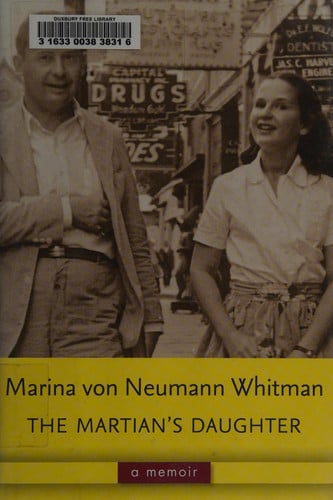
The Martian's daughter: a memoir

Whitman, Marina von Neumann
One of the five Hungarian scientific geniuses dubbed "the Martians" by their colleagues, John von Neumann is often hailed as the greatest mathematician of the twentieth century and even as the greatest scientist after Einstein. He was a key figure in the Manhattan Project; the inventor of game theory; the pioneer developer of the modern stored-program electronic computer; and an adviser to the top echelons of the American military establishment. In The Martian's Daughter , Marina von Neumann Whitman reveals intimate details about the famed scientist and explores how the cosmopolitan environment in which she was immersed, the demanding expectations of her parents, and her own struggles to emerge from the shadow of a larger-than-life parent shaped her life and work. Unfortunately, von Neumann did not live to see his daughter rise to become the first or highest-ranking woman in a variety of arenas. Whitman became a noted academic during the 1960s and '70s, casting her teaching and writing in the framework of globalization before the word had been invented; became the first woman ever to serve on the President's Council of Economic Advisers and participated actively in U.S. efforts to reshape the international monetary and financial system during the early 1970s; pioneered the role of women on the boards of leading multinational corporations; and became the highest-ranking female executive in the American auto industry in the 1980s. In her memoir, Whitman quotes from personal letters from her father and describes her interactions with such figures as Roger Smith of GM and President Nixon. She also details the difficulties she encountered as an early entrant into a world dominated by men and how she overcame the obstacles to, in her words, "have it all."
University of Michigan Press 2012-08-31 308 pages

Shanda: a memoir of shame and secrecy

Pogrebin, Letty Cottin
"In her deeply engaging, astonishingly candid memoir, author and activist Letty Cottin Pogrebin exposes the fiercely-guarded lies and intricate cover-ups woven by dozens of members of her extended family. Beginning with her own long-suppressed secret, the story spirals through the hidden lives of her parents and relatives--revealing the truth about their origins, personal traumas, marital misery, abandoned children, religious transgressions, sexual identity, radical politics, and supposedly embarrassing illnesses. While unmasking their charades and disguises, Pogrebin also showcases her family's remarkable talent for reinvention in a narrative that is, by turns, touching, searing, and surprisingly universal." --
Post Hill Press 2022 429 pages

Free as a Jew: a personal memoir of national self-liberation

Wisse, Ruth R.
"First came parents with the good sense to flee Europe in 1940 and the good fortune to reach the land of freedom. Their daughter, Ruth, grew up in the shadow of genocide--but in tandem with the birth of Israel, which remained her lodestar. She learned that although Jewishness is biologically transmitted, democracy is not, and both require intensive, intelligent transmission through education in each and every generation. They need adults with the confidence to teach their importance. Ruth tried to take on that challenge as dangers to freedom mounted and shifted sides on the political spectrum. At the high point of her teaching at Harvard University, she witnessed the unraveling of standards of honesty and truth until the academy she left was no longer the one she had entered."--Book flap.
Wicked Son 2021-09-21 359 pages

The art of resistance: my four years in the French underground : a memoir

Rosenberg, Justus
"In 1937, as the Nazis gained control and anti-Semitism spread in the Free City of Danzig, a majority German city on the Baltic Sea, sixteen-year-old Justus Rosenberg was sent to Paris to finish his education in safety. Three years later, France fell to the Germans. Alone and in danger, penniless, and cut off from contact with his family in Poland, Justus fled south. A chance meeting led him to Varian Fry, an American journalist in Marseille helping thousands of men and women, including many artists and intellectuals--among them Hannah Arendt, Marc Chagall, Andre Breton, and Max Ernst--escape the Nazis. With his German background, understanding of French culture, and fluency in several languages, including English, Justus became an invaluable member of Fry's refugee network as a spy and scout. The spry blond who looked even younger than his age flourished in the underground, handling counterfeit documents, secret passwords, black market currency, surveying escape routes, and dealing with avaricious gangsters. But when Fry was eventually forced to leave France, Gussie, as he was affectionately known, could not get out. For the next four years, Justus relied on his wits and skills to escape captivity, survive several close calls with death, and continue his fight against the Nazis, working with the French Resistance and later, becoming attached with the United States Army. At the war's end, Justus emigrated to America, and built a new life. Justus' story is a powerful saga of bravery, daring, adventure, and survival with the soul of a spy thriller. Reflecting on his past, Justus sees his life as a confluence of circumstances. As he writes, 'I survived the war through a rare combination of good fortune, resourcefulness, optimism, and, most important, the kindness of many good people.'" -- Publisher's description.
William Collins 2020 288 pages

Rue Ordener, Rue Labat

Kofman, Sarah
Rue Ordener, Rue Labat is a moving memoir by the distinguished French philosopher Sarah Kofman. It opens with the horrifying moment in July 1942 when the author’s father, the rabbi of a small synagogue, was dragged by police from the family home on Rue Ordener in Paris, then transported to Auschwitz—“the place,” writes Kofman, “where no eternal rest would or could ever be granted.” It ends in the mid-1950s, when Kofman enrolled at the Sorbonne. The book is as eloquent as it is forthright. Kofman recalls her father and family in the years before the war, then turns to the terrors and confusions of her own childhood in Paris during the German occupation. Not long after her father’s disappearance, Kofman and her mother took refuge in the apartment of a Christian woman on Rue Labat, where they remained until the Liberation. This bold woman, whom Kofman called Mémé, undoubtedly saved the young girl and her mother from the death camps. But Kofman’s close attachment to Mémé also resulted in a rupture between mother and child that was never to be fully healed. This slender volume is distinguished by the author’s clear prose, the carefully recounted horrors of her childhood, and the uncommon poise that came to her only with the passage of many years.
University of Nebraska Press 1996 85 pages