101 results for "Neuroscience"

The Village Effect

Susan Pinker
In her surprising, entertaining and persuasive new book, award-winning author and psychologist Susan Pinker shows how face-to-face contact is crucial for learning, happiness, resilience and longevity. From birth to death, human beings are hard-wired to connect to other human beings. Face to face contact matters: tight bonds of friendship and love heal us, help children learn, extend our lives and make us happy. Looser in-person bonds matter, too, combining with our close relationships to form a personal "village" around us, one that exerts unique effects. And not just any social networks will do: we need the real, face-to-face, in-the-flesh encounters that tie human families, groups of friends and communities together. Marrying the findings of the new field of social neuroscience together with gripping human stories, Susan Pinker explores the impact of face-to-face contact from cradle to grave, from city to Sardinian mountain village, from classroom to workplace, from love to marriage to divorce. Her results are enlightening and enlivening, and they challenge our assumptions. Most of us have left the literal village behind, and don't want to give up our new technologies to go back there. But, as Pinker writes so compellingly, we need close social bonds and uninterrupted face-time with our friends and families in order to thrive--even to survive. Creating our own "village effect" can make us happier. It can also save our lives.
Random House Digital Inc. 2014-08-26 336 pages

Science ink: tattoos of the science obsessed

Zimmer, Carl
"This mind-blowing illustrated collection showcases hundreds of tattoos dedicated to numerous scientific arenas, from evolutionary biology and neuroscience to mathematics and astrophysics, with a brief note from each inked individual highlighting the reasons for selecting the tattoo. Best of all, each example is a leaping-off point for best-selling science essayist and lecturer Zimmer to muse about the subject, whether it's the importance of a tattoo of Darwin's finches or the significance of the uranium atom inked into the chest of a young radiologist"--
Sterling 2014 271 pages

Look again: the power of noticing what was always there

Sharot, Tali,Sunstein, Cass R.
A neuroscience professor and a Harvard law professor team up in this groundbreaking work, based on decades of research in the psychological and biological sciences, that shows how disrupting our routines can lead to seeing, feeling and noticing again--and embracing much-needed change to live happier, more fulfilling lives.
One Signal Publishers, Atria 2024-02-27 271 pages

Your symphony of selves: discover and understand more of who we are

Fadiman, James,Gruber, Jordan
"Why you are a different you at different times and how that's both normal and healthy. Reveals that each of us is made up of multiple selves, any of which can come to the forefront in different situations. Offers examples of healthy multiple selves from psychology, neuroscience, pop culture, literature, and ancient cultures and traditions. Explores how to harmonize our selves and learn to access whichever one is best for a given situation"--
Park Street Press 2020 434 pages

Capture

Kessler, David A.
Why do we think, feel and act in ways we wished we did not? For decades, New York Times bestselling author Dr. David A. Kessler has studied this question with regard to tobacco, food and drugs. Over the course of these investigations, he identified one underlying mechanism common to a broad range of human suffering. This phenomenon—capture—is the process by which our attention is hijacked and our brains commandeered by forces outside of our control. In Capture , Dr. Kessler considers some of the most profound questions we face as human beings: What are the origins of mental afflictions—from everyday unhappiness to addiction and depression—and how are they connected? Where does healing and transcendence fit into this realm of emotional experience? Analyzing an array of insights from psychology, medicine, neuroscience, literature, philosophy and theology, Dr. Kessler deconstructs centuries of thinking, examining the central role of capture in mental illness and questioning traditional labels that have obscured our understanding of it. He explores the concept of capture through the emotionally resonant stories of both well-known and unknown people caught in its throes. Dr. Kessler argues that the closer we come to fully comprehending the nature of capture, the better the chance to alleviate its effects and successfully change our thoughts and behaviour. Capture offers insight into how we form thoughts and emotions, manage trauma and heal. For the first time, we can begin to understand the underpinnings of not only mental illness, but also our everyday worries and anxieties.
Harper Perennial 2017-03-07 336 pages

Theoretical neuroscience: computational and mathematical modeling of neural systems

Dayan, Peter
Theoretical neuroscience provides a quantitative basis for describing what nervous systems do, determining how they function, and uncovering the general principles by which they operate. This text introduces the basic mathematical and computational methods of theoretical neuroscience and presents applications in a variety of areas including vision, sensory-motor integration, development, learning, and memory. The book is divided into three parts. Part I discusses the relationship between sensory stimuli and neural responses, focusing on the representation of information by the spiking activity of neurons. Part II discusses the modeling of neurons and neural circuits on the basis of cellular and synaptic biophysics. Part III analyzes the role of plasticity in development and learning. An appendix covers the mathematical methods used, and exercises are available on the book's Web site.
MIT Press 2001 460 pages

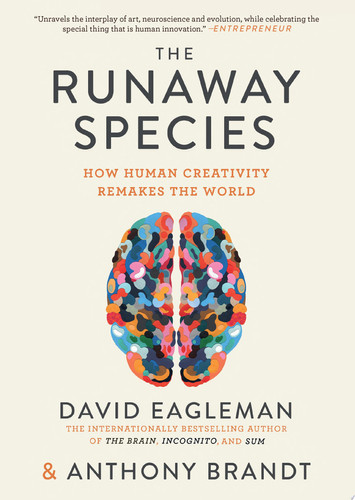
The Runaway Species How Human Creativity Remakes the World

David Eagleman,Anthony Brandt
This enlightening examination of creativity looks “at art and science together to examine how innovations . . . build on what already exists and rely on three brain operations: bending, breaking and blending” ( The Wall Street Journal ) The Runaway Species is a deep dive into the creative mind, a celebration of the human spirit, and a vision of how we can improve our future by understanding and embracing our ability to innovate. David Eagleman and Anthony Brandt seek to answer the question: what lies at the heart of humanity’s ability—and drive—to create? Our ability to remake our world is unique among all living things. But where does our creativity come from, how does it work, and how can we harness it to improve our lives, schools, businesses, and institutions? Eagleman and Brandt examine hundreds of examples of human creativity through dramatic storytelling and stunning images in this beautiful, full–color volume. By drawing out what creative acts have in common and viewing them through the lens of cutting–edge neuroscience, they uncover the essential elements of this critical human ability, and encourage a more creative future for all of us. “ The Runaway Species approach[es] creativity scientifically but sensitively, feeling its roots without pulling them out.” — The Economist
Catapult 2018-06-19 304 pages

The Sweet Spot The Pleasures of Suffering and the Search for Meaning

Paul Bloom
"This book will challenge you to rethink your vision of a good life. With sharp insights and lucid prose, Paul Bloom makes a captivating case that pain and suffering are essential to happiness. It's an exhilarating antidote to toxic positivity." --Adam Grant, #1 New York Times bestselling author of Think Again and host of the TED podcast WorkLife One of Behavioral Scientist's "Notable Books of 2021" From the author of Against Empathy, a different kind of happiness book, one that shows us how suffering is an essential source of both pleasure and meaning in our lives Why do we so often seek out physical pain and emotional turmoil? We go to movies that make us cry, or scream, or gag. We poke at sores, eat spicy foods, immerse ourselves in hot baths, run marathons. Some of us even seek out pain and humiliation in sexual role-play. Where do these seemingly perverse appetites come from? Drawing on groundbreaking findings from psychology and brain science, The Sweet Spot shows how the right kind of suffering sets the stage for enhanced pleasure. Pain can distract us from our anxieties and help us transcend the self. Choosing to suffer can serve social goals; it can display how tough we are or, conversely, can function as a cry for help. Feelings of fear and sadness are part of the pleasure of immersing ourselves in play and fantasy and can provide certain moral satisfactions. And effort, struggle, and difficulty can, in the right contexts, lead to the joys of mastery and flow. But suffering plays a deeper role as well. We are not natural hedonists--a good life involves more than pleasure. People seek lives of meaning and significance; we aspire to rich relationships and satisfying pursuits, and this requires some amount of struggle, anxiety, and loss. Brilliantly argued, witty, and humane, Paul Bloom shows how a life without chosen suffering would be empty--and worse than that, boring.
HarperCollins Publishers 2021-11-02 304 pages

Brain and behavior: a cognitive neuroscience perspective

Eagleman, David
Brain and Behavior: A Cognitive Neuroscience Perspective addresses the central aims of cognitive neuroscience, seeking to examine the brain not only by its components but also by their functions. It highlights the principles, discoveries, and remaining mysteries of modern cognitive neuroscience. Brain and Behavior covers a wide swath of territory critical for understanding the brain, from the basics of the nervous system, to sensory and motor systems, sleep, language, memory, emotions and motivation, social cognition, and brain disorders. Throughout the narrative, the authors emphasize the dynamically changing nature of the brain, through the mechanisms of neuroplasticity. Wherever possible, they refer to elements of neuroscience that are encountered in everyday life. Key points and concepts are illustrated using case studies of rare but illuminating brain disorders. Brain and Behavior pulls together the best current knowledge about the brain while acknowledging current areas of ignorance and pointing students towards the most promising directions for future research.
Oxford University Press 2016 666 pages

Mayim's vegan table: more than 100 great-tasting and healthy recipes from my family to yours

Bialik, Mayim
"While she's an actress with a PhD in neuroscience, at the end of the day Mayim Bialik is a mom, one who knows what it's like to be a busy parent with little time to spend in the kitchen. She shares the concerns of parents everywhere: when it comes to nutrition and feeding your family, you want healthy meals, but also food that everyone can enjoy, and a balanced lifestyle that's inexpensive and fuss-free. Not only does this book share more than 100 easy plant-based recipes, but Mayim has also teamed up with pediatrician Jay Gordon to offer: basic nutritional information about a plant-based diet; the real deal on raising kids on a plant-based diet (myths and misperceptions, debunked); vegan family essentials (including a list of what to always keep in the pantry); tips and strategies for easy meal planning and healthy eating out."--Page four of cover.
Da Capo Press, Incorporated 2014-02-11 223 pages

Principles of neural science

Eric R. Kandel,James H. Schwartz
Now in resplendent color, the new edition continues to define the latest in the scientific understanding of the brain, the nervous system, and human behavior. Each chapter is thoroughly revised and includes the impact of molecular biology in the mechanisms underlying developmental processes and in the pathogenesis of disease. Important features to this edition include a new chapter - Genes and Behavior; a complete updating of development of the nervous system; the genetic basis of neurological and psychiatric disease; cognitive neuroscience of perception, planning, action, motivation and memory; ion channel mechanisms; and much more.
E. Arnold 1983 749 pages

Well-being: the foundations of hedonic psychology

Kahneman, Daniel
The nature of well-being is one of the most enduring and elusive subjects of human inquiry. Well-Being draws upon the latest scientific research to transform our understanding of this ancient question. With contributions from leading authorities in psychology, social psychology, and neuroscience, this volume presents the definitive account of current scientific efforts to understand human pleasure and pain, contentment and despair. The distinguished contributors to this volume combine a rigorous analysis of human sensations, emotions, and moods with a broad assessment of the many factors, from heredity to nationality, that bear on our well-being. Using the tools of experimental science, the contributors confront the puzzles of human likes and dislikes. Why do we grow accustomed and desensitized to changes in our lives, both good and bad? Does our happiness reflect the circumstances of our lives or is it determined by our temperament and personality? Why do humans acquire tastes for sensations that are initially painful or unpleasant? By examining the roots of our everyday likes and dislikes, the book also sheds light on some of the more extreme examples of attraction and aversion, such as addiction and depression. Among its wide ranging inquiries, Well-Being examines systematic differences in moods and behaviors between genders, explaining why women suffer higher rates of depression and anxiety than men, but are also more inclined to express positive emotions. The book also makes international comparisons, finding that some countries' populations report higher levels of happiness than others. The contributors deploy an array of methods, from the surveys and questionnaires of social science to psychological and physiological experiments, to develop a comprehensive new approach to the study of well-being. They show how the sensory pleasures of the body can tells us something about the higher pleasures of the mind and even how the effectiveness of our immune system can depend upon the health of our social relationships.
Russell Sage Foundation 1999-07-08 593 pages

The art of controversy: political cartoons and their enduring power

Navasky, Victor S.
"A lavishly illustrated, witty, and learned look at the awesome power of the political cartoon throughout history to enrage, provoke, and amuse. As a former editor of The New York Times Magazine and the longtime editor of The Nation, Victor Navasky knows just how incendiary--and transformative--cartoons can be. Here Navasky guides readers through some of the greatest cartoons ever sketched--by George Grosz, David Levine, Herblock, Honore Daumier, Thomas Nast, Ralph Steadman, et al.--as he asks what makes cartoons so uniquely positioned to affect our minds and our hearts. Incorporating neuroscience, psychology, and a sweeping historical view of the cartoon's evolution, The Art of Controversy is a book for all lovers of satire, politics, and the vastly underappreciated and endlessly surprising art form of the political cartoon. "--
Alfred A. Knopf 2013 231 pages

This is your brain on sports: the science of underdogs, the value of rivalry, and what can we learn from the T-shirt cannon

Wertheim, L. Jon,Sommers, Sam
This is Your Brain on Sports is the book for sports fans searching for a deeper understanding of the games they watch and the people who play them. Sports Illustrated executive editor and bestselling author L. Jon Wertheim teams up with Tufts psychologist Sam Sommers to take readers on a wild ride into the inner world of sports. Through the prism of behavioral economics, neuroscience, and psychology, they reveal the hidden influences and surprising cues that inspire and derail us—on the field and in the stands—and by extension, in corporate board rooms, office settings, and our daily lives. In this irresistible narrative romp, Wertheim and Sommers usher us from professional football to the NBA to Grand Slam tennis, from the psychology of athletes self-handicapping their performance in the boxing ring or the World Series, to an explanation of why even the glimpse of a finish line can lift us beyond ordinary physical limits. They explore why Tom Brady and other starting NFL quarterbacks all seem to look like fashion models; why fans of teams like the Cubs, Mets, and any franchise from Cleveland love rooting for a loser; why the best players make the worst coaches; why hockey goons (and fans) would rather fight at home than on the road; and why the arena t-shirt cannon has something to teach us about human nature. In short, this book is an entertaining and thought-provoking journey into how psychology and behavioral science collide with the universe of wins-and-losses, coaching changes, underdogs, and rivalry games. — Boston Globe, Best Books of 2016, Sports
Three Rivers Press 2017-02-07 288 pages

Prozac on the couch: prescribing gender in the era of wonder drugs

Metzl, Jonathan
Pills replaced the couch; neuroscience took the place of talk therapy; and as psychoanalysis faded from the scene, so did the castrating mothers and hysteric spinsters of Freudian theory. Or so the story goes. In Prozac on the Couch , psychiatrist Jonathan Michel Metzl boldly challenges recent psychiatric history, showing that there’s a lot of Dr. Freud encapsulated in late-twentieth-century psychotropic medications. Providing a cultural history of treatments for depression, anxiety, and other mental illnesses through a look at the professional and popular reception of three “wonder drugs”—Miltown, Valium, and Prozac—Metzl explains the surprising ways Freudian gender categories and popular gender roles have shaped understandings of these drugs. Prozac on the Couch traces the notion of “pills for everyday worries” from the 1950s to the early twenty-first century, through psychiatric and medical journals, popular magazine articles, pharmaceutical advertisements, and popular autobiographical "Prozac narratives.” Metzl shows how clinical and popular talk about these medications often reproduces all the cultural and social baggage associated with psychoanalytic paradigms—whether in a 1956 Cosmopolitan article about research into tranquilizers to “cure” frigid women; a 1970s American Journal of Psychiatry ad introducing Jan, a lesbian who “needs” Valium to find a man; or Peter Kramer’s description of how his patient “Mrs. Prozac” meets her husband after beginning treatment. Prozac on the Couch locates the origins of psychiatry’s “biological revolution” not in the Valiumania of the 1970s but in American popular culture of the 1950s. It was in the 1950s, Metzl points out, that traditional psychoanalysis had the most sway over the American imagination. As the number of Miltown prescriptions soared (reaching 35 million, or nearly one per second, in 1957), advertisements featuring uncertain brides and unfaithful wives miraculously cured by the “new” psychiatric medicines filled popular magazines. Metzl writes without nostalgia for the bygone days of Freudian psychoanalysis and without contempt for psychotropic drugs, which he himself regularly prescribes to his patients. What he urges is an increased self-awareness within the psychiatric community of the ways that Freudian ideas about gender are entangled in Prozac and each new generation of wonder drugs. He encourages, too, an understanding of how ideas about psychotropic medications have suffused popular culture and profoundly altered the relationship between doctors and patients.
Duke University Press 2003-04-16 275 pages

The Peace of Mind Prescription An Authoritative Guide to Finding the Most Effective Treatment for Anxiety and Depression

Dennis S. Charney,Charles B. Nemeroff
The Ultimate Guide to Identifying, Treating, and Overcoming Depression and Anxiety Two world-renowned psychiatrists have created a comprehensive and empowering guide to the science and treatment of anxiety and depression. At the heart of their message is the idea that treatment can and must be tailored to the individual and that armed with the right information, patients can get the support they need from their health-care providers. Practical and authoritative, The Peace of Mind Prescription has been unanimously praised as a valuable resource that offers hope to millions of sufferers. Dennis S. Charney, M.D., is the Dean of Research and the Anne and Joel Ehrenkranz Professor in the departments of psychiatry, neuroscience, and pharmacology and biochemistry at the Mount Sinai School of Medicine. Charles B. Nemeroff, M.D., Ph.D., is the Reunette W. Harris Professor and chairman of the department of psychiatry and behavioral sciences at Emory University's School of Medicine.
Houghton Mifflin 2006 259 pages

The future of the brain: the promise and perils of tomorrow's neuroscience

Rose, Steven P. R.
Brain repair, smart pills, mind-reading machines--modern neuroscience promises to soon deliver a remarkable array of wonders as well as profound insight into the nature of the brain. But these exciting new breakthroughs, warns Steven Rose, will also raise troubling questions about what it means to be human. In The Future of the Brain, Rose explores just how far neuroscience may help us understand the human brain--including consciousness--and to what extent cutting edge technologies should have the power to mend or manipulate the mind. Rose first offers a panoramic look at what we now know about the brain, from its three-billion-year evolution, to its astonishingly rapid development in the embryo, to the miraculous process of infant development. More important, he shows what all this science can--and cannot--tell us about the human condition. He examines questions that still baffle scientists and he explores the potential threats and promises of new technologies and their ethical, legal, and social implications, wondering how far we should go in eliminating unwanted behavior or enhancing desired characteristics, focusing on the new "brain steroids" and on the use of Ritalin to control young children. The Future of the Brain is a remarkable look at what the brain sciences are telling us about who we are and where we came from--and where we may be headed in years to come.
Oxford University Press 2006 344 pages

Learning and Memory

Mark A. Gluck,Eduardo Mercado,Catherine E. Myers
The new edition of this comprehensive textbook on learning and memory offers an engaging and enhanced pedagogy. Instructors can assign the chapters they want from four distinctive modules - introduction, learning, memory, and integrative topics. Each chapter addresses behavioural processes, then the underlying neuroscience, then relevant clinical perspectives. The book is further distinguished by its full-colour presentation and coverage that includes comparisons between studies of human and nonhuman brains, and extended coverage of animal learning. With its modular organization, consistent chapter structure, and contemporary perspective, this groundbreaking survey is ideal for courses on learning and memory, and is easily adaptable to courses that focus on either learning or memory.
Macmillan Learning 2016-02-15 640 pages

Voice Lessons for Parents What to Say, How to Say it, and When to Listen

Wendy Mogel
New York Times bestselling author and host of the podcast Nurture vs Nurture Dr. Wendy Mogel “ teaches parents the dialect needed to converse with their daughters and sons at every stage of life” ( Chicago Tribune). Dr. Wendy Mogel, “one of the most astute psychologists on the planet (Angela Duckworth, New York Times bestselling author of Grit ) observed a pattern in her practice: when parents speak to their children their pitch tends to rise, and they come across as pleading, indignant, wounded, outraged. Their tone and body language signal, I can’t handle it when you act like a child. In response, Dr. Mogel developed a remarkably effective series of “voice lessons,” for parents who were struggling to communicate. The results were immediate: a shift in vocal style led to calmer kids, who listened more attentively and responded with warmth, respect, and sincerity. In Voice Lessons for Parents , Mogel elaborates on her novel clinical approach, revealing how each age and stage of a child’s life brings new opportunities to connect . Drawing from a range of sources including neuroscience, fairy tales, and anthropology, Mogel offers specific guidance for talking to children across the expanse of childhood and adolescence. She also explains the best ways to talk about your child to partners, exes, and grandparents, as well as to teachers, coaches, and caretakers. And she addresses the distraction of digital devices—how they impact our interactions with our families, and what we can do about it.
Simon and Schuster 2019-04-09 336 pages

Learning and Memory From Brain to Behavior

Mark A. Gluck,Eduardo Mercado,Catherine E. Myers
This textbook shows how developments in neuroscience have changed the field of learning and memory in the last ten years. A comprehensive, accessible and engaging introduction to learning and memory, the authors cover behavioural processes, brain systems, and clinical perspectives, incorporating findings both in animals and in humans.
Worth Publishers, Incorporated 2010-03 554 pages