560 results for "Physics"

Obsession

Jonathan Kellerman
With scores of millions of books in print, translation into two dozen languages, and one of the most popular heroes in contemporary fiction to his name, #1 New York Times bestselling author Jonathan Kellerman is the unequivocal “master of the psychological thriller” (People). In his newest novel Kellerman delivers a tour de force–poignant, dark, and chilling–that illuminates a shadowy world where impulse rules. Tanya Bigelow was a solemn little girl when Dr. Alex Delaware successfully treated her obsessive-compulsive symptoms. Now, at nineteen, she still seems older than her years–but her problems go beyond hyper-maturity. Patty Bigelow, Tanya’s aunt and adoptive mother, has made a deathbed confession of murder and urged the young woman to seek Delaware’s help. The doctor recalls Patty as a selfless E.R. nurse struggling to raise a child on her own–a woman seemingly incapable of the “terrible thing” she has admitted. But for Tanya’s peace of mind, Delaware agrees to investigate, and he enlists LAPD detective Milo Sturgis in the search for the phantom victim of a crime that may never have occurred. Armed with only the vaguest details, psychologist and cop follow a trail twisting from L.A.’s sleaziest low-rent districts to its overblown mansions, retracing Patty and Tanya’s nomadic and increasingly puzzling life to the doorsteps of a sullen heroin addict; a randy real-estate broker; and a brilliant, enigmatic physics student. Suddenly a very real murder tears open a terrifying tunnel into the past, where secrets–and bodies–are buried. As the tension mounts, Delaware and Sturgis uncover a tangled history of desperation, vengeance, and death–a legacy of evil that refuses to die. Dramatic, action-packed, and filled with the psychological detail that only Jonathan Kellerman can provide, Obsession is a whodunit, a whydunit–and something unique: a did-it-even-happen? This is Kellerman at his heart-racing best. From the Hardcover edition.
Random House Publishing Group 2008-02-26 464 pages

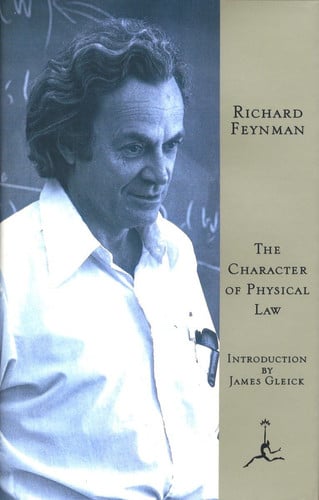
The character of physical law

Feynman, Richard P.
Like any set of oral reflections, The Character of Physical Law has special value as a demonstration of the mind in action. The reader is particularly lucky in Richard Feynman - one of the most eminent and imaginative modern physicists. In these Messenger Lectures, originally delivered at Cornell University and recorded for television by the BBC, Richard Feynman offers an overview of selected physical laws and gathers their common features into one broad principle of invariance. He maintains at the outset that the importance of a physical law is not ''how clever we are to have found it out - but . . . how clever nature is to pay attention to it'' and steers his discussions toward a final exposition of the elegance and simplicity of all scientific laws. Rather than an essay on the most significant achievements in modern science, The Character of Physical Law is a statement of what is most remarkable in nature. Feynman's enlightened approach, his wit, and his enthusiasm make this a memorable exposition of the scientist's craft. The law of gravitation is the author's principal example. Relating the details of its discovery and stressing its mathematical character, he uses it to demonstrate the essential interaction of mathematics and physics. He views mathematics as the key to any system of scientific laws, suggesting that if it were possible to fill out the structure of scientific theory completely, the result would be an integrated set of mathematical axioms. The principles of conservation, symmetry, and time irreversibility are then considered in relation to developments in classical and modern physics, and in his final lecture, Feynman develops his own analysis of the process and future of scientific discovery.
Modern Library 1994-11-08 167 pages

The Upright Thinkers

Mlodinow, Leonard
How did a near-extinct species, eking out a meager existence with stone axes, become the dominant power on earth, able to harness a knowledge of nature ranging from tiny atoms to the vast structures of the universe? Leonard Mlodinow takes us on an enthralling tour of the history of human progress, from our time on the African savannah through the invention of written language, all the way to modern quantum physics. Along the way, he explores the colorful personalities of the great philosophers, scientists, and thinkers, and traces the cultural conditions—and the elements of chance—that influenced scientific discovery. Deeply informed, accessible, and infused with the author’s trademark humor and insight, The Upright Thinkers is a stunning tribute to humanity’s intellectual curiosity and an important book for any reader with an interest in the scientific issues of our day.
Random House US 2016-04-19 352 pages

A New Kind of Science and a New Kind of Science Explorer

Stephen Wolfram
Physics and computer science genius Stephen Wolfram, whose Mathematica computer language launched a multimillion-dollar company, now sets his sights on a more daunting goal: understanding the universe. Wolfram lets the world see his work in A New Kind of Science , a gorgeous, 1,280-page tome more than a decade in the making. With patience, insight, and self-confidence to spare, Wolfram outlines a fundamental new way of modeling complex systems. On the frontier of complexity science since he was a boy, Wolfram is a champion of cellular automata--256 "programs" governed by simple nonmathematical rules. He points out that even the most complex equations fail to accurately model biological systems, but the simplest cellular automata can produce results straight out of nature--tree branches, stream eddies, and leopard spots, for instance. The graphics in A New Kind of Science show striking resemblance to the patterns we see in nature every day. Wolfram wrote the book in a distinct style meant to make it easy to read, even for nontechies; a basic familiarity with logic is helpful but not essential. Readers will find themselves swept away by the elegant simplicity of Wolfram's ideas and the accidental artistry of the cellular automaton models. Whether or not Wolfram's revolution ultimately gives us the keys to the universe, his new science is absolutely awe-inspiring. --Therese Littleton
Wolfram Media, Incorporated 2002-05 1197 pages

THE EMPEROR'S NEW MIND: Concerning Computers, Minds, and the Laws of Physics

Penrose, Roger
For decades, proponents of artificial intelligence have argued that computers will soon be doing everything that a human mind can do. Admittedly, computers now play chess at the grandmaster level, but do they understand the game as we do? Can a computer eventually do everything a human mind can do? In this absorbing and frequently contentious book, Roger Penrose--eminent physicist and winner, with Stephen Hawking, of the prestigious Wolf prize--puts forward his view that there are some facets of human thinking that can never be emulated by a machine. Penrose examines what physics and mathematics can tell us about how the mind works, what they can't, and what we need to know to understand the physical processes of consciousness. He is among a growing number of physicists who think Einstein wasn't being stubborn when he said his "little finger" told him that quantum mechanics is incomplete, and he concludes that laws even deeper than quantum mechanics are essential for the operation of a mind. To support this contention, Penrose takes the reader on a dazzling tour that covers such topics as complex numbers, Turing machines, complexity theory, quantum mechanics, formal systems, Godel undecidability, phase spaces, Hilbert spaces, black holes, white holes, Hawking radiation, entropy, quasicrystals, the structure of the brain, and scores of other subjects. The Emperor's New Mind will appeal to anyone with a serious interest in modern physics and its relation to philosophical issues, as well as to physicists, mathematicians, philosophers and those on either side of the AI debate.
Oxford University Press 1990 466 pages

The Logic of Scientific Discovery

Karl R. Popper
2024 Hardcover Reprint of Original 1959 Edition. Exact facsimile of the original edition, not reproduced with Optical Recognition Software. This book by one of the world's foremost philosophers of science presented a striking new picture of the logical character of scientific discovery--a picture which does full justice to the liberating effect of the Einsteinian revolution in physics and its immense impact upon scientific thought in general. For this new English edition Dr. Popper did his own translation and has written 150 pages of entirely new text. Ernest Nagel considered this work "a first rate contribution to the logic of scientific method. The book contains a very interesting chapter on quantum mechanics, which performs one of the few sensible analyses of the Indeterminacy Principle which I have seen in print... The book is highly stimulating and contains much that is bed-rock for future work."--From the Dusk Jacket.
Martino Fine Books 2024-03-07 482 pages

Customized Complete Statistical Physics

Frederick Reif
This last volume of the Berkeley Physics Course is devoted to the study of large-scale systems consisting of many atoms or molecules: thus it provides an introduction to the subjects of statistical mechanics, kinetic theory, thermo- dynamics, and heat. The approach is not patterned upon the historical development of these subjects and does not pro- ceed along conventional lines. The aim has been to adopt a modern point of view and to show, in as systematic and simple way as possible, how the basic notions of atomic theory lead to a conceptual framework capable of describing and predicting the properties of macroscopic systems.
McGraw-Hill/Primis Custom Publishing 1998-03 420 pages

Six Not-So-Easy Pieces-Book/CD Package

Richard P. Feynman
No twentieth-century American scientist is better known to a wider spectrum of people than Richard P. Feynman (1918–1988)—physicist, teacher, author, and cultural icon. His autobiographies and biographies have been read and enjoyed by millions of readers around the world, while his wit and eccentricities have made him the subject of TV specials and even a theatrical film.The spectacular reception of the book and audio versions of Feynman's Six Easy Pieces (published in 1995) resulted in a worldwide clamor for “More Feynman! More Feynman!” The outcome is these six additional lectures, drawn from the celebrated three-volume Lectures on Physics. Though slightly more challenging than the first six, these lectures are more focused, delving into the most revolutionary discovery in twentieth-century physics: Einstein's Theory of Relativity.No single breakthrough in twentieth-century physics (with the possible exception of quantum mechanics) changed our view of the world more than that of Einstein's discovery of relativity. The notions that the flow of time is not a constant, that the mass of an object depends on its velocity, and that the speed of light is a constant no matter what the motion of the observer, at first seemed shocking to scientists and laymen alike. But, as Feynman shows so clearly and so entertainingly in the lectures chosen for this volume, these crazy notions are no mere dry principles of physics, but are things of beauty and elegance. No one—not even Einstein himself—explained these difficult, anti-intuitive concepts more clearly, or with more verve and gusto, than Richard Feynman.
Basic Books 1997-03-09 184 pages

The road to reality: a complete guide to the laws of the universe

Penrose, Roger
This guide to the universe aims to provide a comprehensive account of our present understanding of the physical universe, and the essentials of its underlying mathematical theory. It attempts to convey an overall understanding--a feeling for the deep beauty and philosophical connotations of the subject, as well as of its intricate logical interconnections. While a work of this nature is challenging, no particular mathematical knowledge is assumed, the early chapters providing the essential background for the physical theories described in the remainder of the book. There is also enough descriptive material to carry the less mathematically inclined reader through, as well as some 450-500 figures. The book counters the common complaint that cutting-edge science is fundamentally inaccessible.
Vintage Books 2007-01-09 1099 pages

Survival of the richest: escape fantasies of the tech billionaires

Rushkoff, Douglas
"The tech elite have a plan to survive the apocalypse: they want to leave us all behind. Five mysterious billionaires summoned theorist Douglas Rushkoff to a desert resort for a private talk. The topic? How to survive the "Event": the societal catastrophe they know is coming. Rushkoff came to understand that these men were under the influence of The Mindset, a Silicon Valley-style certainty that they and their cohort can break the laws of physics, economics, and morality to escape a disaster of their own making-as long as they have enough money and the right technology. In Survival of the Richest, Rushkoff traces the origins of The Mindset in science and technology through its current expression in missions to Mars, island bunkers, AI futurism, and the metaverse. In a dozen urgent, electrifying chapters, he confronts tech utopianism, the datafication of all human interaction, and the exploitation of that data by corporations. Through fascinating characters-master programmers who want to remake the world from scratch as if redesigning a video game and bankers who return from Burning Man convinced that incentivized capitalism is the solution to environmental disasters-Rushkoff explains why those with the most power to change our current trajectory have no interest in doing so. And he shows how recent forms of anti-mainstream rebellion-QAnon, for example, or meme stocks-reinforce the same destructive order. This mind-blowing work of social analysis shows us how to transcend the landscape The Mindset created-a world alive with algorithms and intelligences actively rewarding our most selfish tendencies-and rediscover community, mutual aid, and human interdependency. In a thundering conclusion, Survival of the Richest argues that the only way to survive the coming catastrophe is to ensure it doesn't happen in the first place"--
W.W. Norton & Company, Inc 2022-09-06 212 pages

The Evolution Of Physics

Albert Elnstein,Leopold Infeld
This work has been selected by scholars as being culturally important, and is part of the knowledge base of civilization as we know it. This work is in the "public domain in the United States of America, and possibly other nations. Within the United States, you may freely copy and distribute this work, as no entity (individual or corporate) has a copyright on the body of the work. Scholars believe, and we concur, that this work is important enough to be preserved, reproduced, and made generally available to the public. We appreciate your support of the preservation process, and thank you for being an important part of keeping this knowledge alive and relevant.
Creative Media Partners, LLC 2022-10-26 342 pages

Wholeness and the implicate order

Bohm, David
David Bohm was one of the foremost scientific thinkers and philosophers of our time. Although deeply influenced by Einstein, he was also, more unusually for a scientist, inspired by mysticism. Indeed, in the 1970s and 1980s he made contact with both J. Krishnamurti and the Dalai Lama whose teachings helped shape his work. In both science and philosophy, Bohm's main concern was with understanding the nature of reality in general and of consciousness in particular. In this classic work he develops a theory of quantum physics which treats the totality of existence as an unbroken whole. Writing clearly and without technical jargon, he makes complex ideas accessible to anyone interested in the nature of reality.
Routledge 2002 284 pages

Extraterrestrial Civilizations

Isaac Asimov
Isaac Asimov concludes that we are not alone! Using the most up-to-date astronomical research as the backdrop for speculation, Asimov confronts the possibilities of other-worldly life head-on in Extraterrestrial Civilizations . In what will surely become one of the most provocative books ever written on the possibilities of life elsewhere in the universe, the incomparable Isaac Asimov provides chilling, hopeful, and exciting new insights. Here is astounding speculation about where the next giant step for mankind will take us. . . . Praise for Extraterrestrial Civilizations "[Isaac] Asimov holds our attention as he builds a meticulous case. We are not alone. It's just a matter of time until we know for sure." -- Miami Herald "Intriguing" -- Publishers Weekly
Fawcett Columbine 1980 282 pages

Einstein on Einstein: autobiographical and scientific reflections

Gutfreund, Hanoch,Renn, Jürgen
"Einstein begins his Autobiographical Notes with one problem he never quite solved: "What, precisely, is thinking?" To answer, he turns inward to the very shape of his thoughts, the ongoing struggle to connect local observation, or what he calls the "momentary and personal," to the larger "mental grasp of things." Einstein situates his greatest discoveries amongst the other twentieth-century breakthroughs in the field and closely examines how these discoveries punctuated and propelled his own intellectual development. The autobiography expands what we know about Einstein's childhood education, readings in philosophy, and journey to the theory of general relativity. In this book, Autobiographical Notes is accompanied by introductions, essays, and commentary by Hanoch Gutfreud and Jürgen Renn, who draw on biographical information, written correspondence, and their knowledge of Einstein scholarship to render these difficult texts accessible to readers. They have also collected critical writings by Einstein's contemporaries alongside Einstein's own responses to these interlocutors, as well as Einstein's Autobiographical Sketch, composed just before his death in 1955, which is published for the first time in English"--
Princeton University Press 2020-05-12 197 pages

My life as a quant: reflections on physics and finance

Derman, Emanuel
In My Life as a Quant, Emanuel Derman relives his exciting journey as one of the first high-energy particle physicists to migrate to Wall Street. Page by page, Derman details his adventures in this field—analyzing the incompatible personas of traders and quants, and discussing the dissimilar nature of knowledge in physics and finance. Throughout this tale, he also reflects on the appropriate way to apply the refined methods of physics to the hurly-burly world of markets.
Wiley 2004 292 pages