134 results for "Physics"

Galileo and the Science Deniers

Mario Livio
Although Galileo Galilei lived and died centuries ago, his story is more relevant to our lives than we might realize. Today we face enormous challenges such as climate change that are disregarded or questioned by those who fear that their implications will damage business profitability. Others posit a false dichotomy between religion and science in order to reject scientific evidence whose implications they fear. Galileo confronted this problem 400 years ago. His discoveries were based on observation and experiment. His telescopes revealed previously unknown planets, moons orbiting other planets, and other discoveries that essentially confirmed the Copernican universe that the Church had rejected as heretical because Church theologians insisted on a literal reading of the Bible. Even St. Augustine in the fifth century maintained that the Bible pertained to the realm of faith, not reason. But when Galileo argued essentially the same position before an ecclesiastical court in Rome, he was forbidden from publishing any more books. Livio's life of Galileo shows us how the great thinker made his discoveries about the heavens and also formulated fundamental laws of physics. As an astrophysicist, Livio brings insight into how Galileo reasoned his way to his conclusions, which we know today were accurate. Along with Newton, Galileo remains one of the two great figures at the dawn of the scientific revolution. He insisted on reaching the widest audience possible, publishing his work in Italian rather than Latin as had been the case until his time, when vernacular languages were rapidly replacing Latin throughout Europe. Galileo believed that every educated person should know science as well as literature. Did Galileo actually say at the end of his trial when he was forced to recant his discoveries, as legend has it, And still it moves, referring to the motion of the earth around the sun? Not likely, says Livio, but Galileo nonetheless remains an inspiration to scientists and those who value open-minded inquiry, which as Livio reminds us, remains threatened even today.
Simon & Schuster Paperbacks 2020 304 pages

The Los Alamos Primer

Robert Serber
Unabridged declassified value reproduction of The Los Alamos Primer by Robert Serber, in full color with all censor markings. This is the booklet given to new workers at Los Alamos during World War II, to catch them up on how to build a practical fission bomb. The Primer was driven by Robert Oppenheimer asking his protégé Robert Serber to summarize all knowledge and possible solutions known as of April 1943 in a series of lectures. Serber did such an excellent job that the notes from the series was turned into The Los Alamos Primer. Serber was known as an expert that bridged theory and reality, and so was also chosen to be one of the first Americans to enter Hiroshima and Nagasaki to assess the atomic damage in 1945. Touch a piece of history in this slim volume with the full text at an affordable price.
Chump Change 1943-04 32 pages

Special Relativity and Classical Field Theory The Theoretical Minimum

Leonard Susskind,Art Friedman
A funny, insightful, and self-contained guide to Einstein's relativity theory and classical field theories--including electromagnetism Physicist Leonard Susskind and data engineer Art Friedman are back. This time, they introduce readers to Einstein's special relativity and Maxwell's classical field theory. Using their typical brand of real math, enlightening drawings, and humor, Susskind and Friedman walk us through the complexities of waves, forces, and particles by exploring special relativity and electromagnetism. It's a must-read for both devotees of the series and any armchair physicist who wants to improve their knowledge of physics' deepest truths.
Basic Books 2019-05-07 448 pages

Physics for Entertainment

Yakov Perelman
Published in 1913, a best-seller in the 1930s and long out of print, Physics for Entertainment was translated from Russian into many languages and influenced science students around the world. Among them was Grigori Yakovlevich Perelman, the Russian mathematician (unrelated to the author), who solved the Poincaré conjecture, and who was awarded and rejected the Fields Medal. Grigori's father, an electrical engineer, gave him Physics for Entertainment to encourage his son's interest in mathematics. In the foreword, the book's author describes the contents as "conundrums, brain-teasers, entertaining anecdotes, and unexpected comparisons," adding, "I have quoted extensively from Jules Verne, H. G. Wells, Mark Twain and other writers, because, besides providing entertainment, the fantastic experiments these writers describe may well serve as instructive illustrations at physics classes." The book's topics included how to jump from a moving car, and why, "according to the law of buoyancy, we would never drown in the Dead Sea." Ideas from this book are still used by science teachers today.
Amazon Digital Services LLC - Kdp 2011 270 pages

Doing physics: how physicists take hold of the world

Krieger, Martin H.
Doing Physics makes concepts of physics easier to grasp by relating them to everyday knowledge. Addressing some of the models and metaphors that physicists use to explain the physical world, Martin H. Krieger describes the conceptual world of physics by means of analogies to economics, anthropology, theater, carpentry, mechanisms such as clockworks, and machine tool design. The interaction of elementary particles or chemical species, for example, can be related to the theory of kinship—who can marry whom is like what can interact with what. Likewise, the description of physical situations in terms of interdependent particles and fields is analogous to the design of a factory with its division of labor among specialists. For the new edition, Krieger has revised the text and added a chapter on the role of mathematics and formal models in physics. Doing Physics will be of special interest to economists, political theorists, anthropologists, and sociologists as well as philosophers of science.
Indiana University Press 2012-11-19 218 pages

The Pope of Physics Enrico Fermi and the Birth of the Atomic Age

Gino Segrè,Bettina Hoerlin
A New York Times Book Review Editors’ Choice Named a Best Book of the Year by Bloomberg (Chosen by Philip Tetlock), Booklist ’s Top 10 Science Books of the Year, and Shortlisted for Physics World ’s Book of the Year A Major Biography of the Nobel Prize–Winning Physicist, Enrico Fermi, a Leading Architect of the Atomic Age Enrico Fermi is unquestionably among the greats of the world’s physicists, the most famous Italian scientist since Galileo. Called “the Pope” by his peers, he was regarded as infallible in his instincts and research. His discoveries changed our world; they led to weapons of mass destruction and conversely to life-saving medical interventions. This unassuming man struggled with issues relevant today, such as the threat of nuclear annihilation and the relationship of science to politics. Fleeing Fascism and anti-Semitism, Fermi became a leading figure in America’s most secret project: building the atomic bomb. An examination of the human dramas that touched Fermi’s life as well as a thrilling history of scientific innovation in the twentieth century, this is the comprehensive biography that Fermi deserves.
Picador 2017-10-10 384 pages

Diamond Design A Study of the Reflection and Refraction and Refraction of Light in a Diamond (Classic Reprint)

Marcel Tolkowsky
Excerpt from Diamond Design: A Study of the Reflection and Refraction and Refraction of Light in a Diamond This book is written principally for students of precious stones and jewellers, and more particularly, for' diamond manufacturers and diamond cutters and polishers. The author will follow the evolution of the shape given to a cut diamond, and discuss the values of the various shapes and the reason for' the discarding of the old shapes and the practically universal adoption of the brilliant.' About the Publisher Forgotten Books publishes hundreds of thousands of rare and classic books. Find more at www.forgottenbooks.com This book is a reproduction of an important historical work. Forgotten Books uses state-of-the-art technology to digitally reconstruct the work, preserving the original format whilst repairing imperfections present in the aged copy. In rare cases, an imperfection in the original, such as a blemish or missing page, may be replicated in our edition. We do, however, repair the vast majority of imperfections successfully; any imperfections that remain are intentionally left to preserve the state of such historical works.
LULU Press 2018-04-19 114 pages

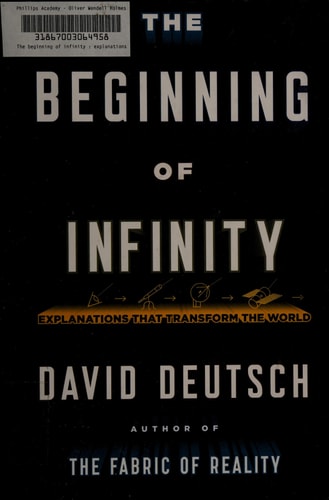
The beginning of infinity: explanations that transform the world

Deutsch, David
"A bold and all-embracing exploration of the nature and progress of knowledge from one of today's great thinkers. Throughout history, mankind has struggled to understand life's mysteries, from the mundane to the seemingly miraculous. In this important new book, David Deutsch, an award-winning pioneer in the field of quantum computation, argues that explanations have a fundamental place in the universe. They have unlimited scope and power to cause change, and the quest to improve them is the basic regulating principle not only of science but of all successful human endeavor. This stream of ever improving explanations has infinite reach, according to Deutsch: we are subject only to the laws of physics, and they impose no upper boundary to what we can eventually understand, control, and achieve. In his previous book, The Fabric of Reality, Deutsch describe the four deepest strands of existing knowledge-the theories of evolution, quantum physics, knowledge, and computation-arguing jointly they reveal a unified fabric of reality. In this new book, he applies that worldview to a wide range of issues and unsolved problems, from creativity and free will to the origin and future of the human species. Filled with startling new conclusions about human choice, optimism, scientific explanation, and the evolution of culture, The Beginning of Infinity is a groundbreaking book that will become a classic of its kind"--
Viking 2011 487 pages

Science And Human Values

Jacob Bronowski
Science and Human Values is a thought-provoking book by Jacob Bronowski that explores the relationship between science and human values. The author argues that science is not just a collection of facts and theories, but a way of thinking that shapes our understanding of the world and our place in it. He contends that science and human values are intimately connected, and that science has the power to transform our understanding of ourselves and the world around us.The book is divided into five chapters, each of which explores a different aspect of the relationship between science and human values. The first chapter discusses the nature of scientific inquiry and the role of imagination in scientific discovery. The second chapter examines the relationship between science and art, arguing that both are essential to our understanding of the world. The third chapter explores the ethical implications of scientific research, particularly in the areas of genetics and nuclear physics.The fourth chapter examines the role of science in shaping our understanding of human nature, while the final chapter discusses the implications of scientific progress for our future as a species. Throughout the book, Bronowski emphasizes the importance of human values in shaping scientific research and the need for scientists to be mindful of the ethical implications of their work.Overall, Science and Human Values is a thought-provoking and insightful book that challenges readers to think deeply about the relationship between science and human values. It is a must-read for anyone interested in the role of science in our lives and the ethical implications of scientific research.The Impact Of Science On Ethics And Human Values.This scarce antiquarian book is a facsimile reprint of the old original and may contain some imperfections such as library marks and notations. Because we believe this work is culturally important, we have made it available as part of our commitment for protecting, preserving, and promoting the world's literature in affordable, high quality, modern editions, that are true to their original work.
Literary Licensing, LLC 2011-09 98 pages

Atom and void: essays on science and community

Oppenheimer, J. Robert
J. Robert Oppenheimer was one of the outstanding physicists of his generation. He was also an immensely gifted writer and speaker, who thought deeply about the way that scientific discoveries have changed the way people live and think. Displaying his subtlety of thought and expression as do few other documents, this book of his lectures discusses the moral and cultural implications of developments in modern physics. Originally published in 1989. The Princeton Legacy Library uses the latest print-on-demand technology to again make available previously out-of-print books from the distinguished backlist of Princeton University Press. These editions preserve the original texts of these important books while presenting them in durable paperback and hardcover editions. The goal of the Princeton Legacy Library is to vastly increase access to the rich scholarly heritage found in the thousands of books published by Princeton University Press since its founding in 1905.
Princeton University Press 1989 155 pages

The Greatest Story Ever Told--So Far Why Are We Here?

Lawrence M. Krauss
From award-winning physicist, public intellectual, and the bestselling author of A Universe from Nothing Lawrence Krauss, comes “a masterful blend of history, modern physics, and cosmic perspective that empowers the reader to not only embrace our understanding of the universe, but also revel in what remains to be discovered” (Neil deGrasse Tyson, American Museum of Natural History). In this grand poetic vision of the universe, Lawrence Krauss tells the dramatic story of the discovery of the hidden world that underlies reality—and our place within it. Reality is not what you think or sense—it’s weird, wild, and counterintuitive, and its inner workings seem at least as implausible as the idea that something can come from nothing. With his trademark wit and accessible style, Krauss leads us to realms so small that they are invisible to microscopes, to the birth and rebirth of light, and into the natural forces that govern our existence. His unique blend of rigorous research and engaging storytelling invites us into the lives and minds of remarkable scientists who have helped unravel the unexpected fabric of reality with reasoning rather than superstition and dogma, and to explain how everything we see—and can’t see—came about. A passionate advocate for reason, Krauss gives the rationale for the seemingly irrational—and the mysteries and apparent contradictions of quantum physics, and explores what that means for our lives here on Earth—and beyond. At its core, The Greatest Story Ever Told—So Far is about the best of what it means to be human—an epic history of our ultimately purposeless universe that addresses the question, “Why are we here?”
Atria Books 2018-02-27 336 pages

Nanowires Building Blocks for Nanoscience and Nanotechnology

Anqi Zhang,Gengfeng Zheng,Charles M. Lieber
This book provides a comprehensive summary of nanowire research in the past decade, from the nanowire synthesis, characterization, assembly, to the device applications. In particular, the developments of complex/modulated nanowire structures, the assembly of hierarchical nanowire arrays, and the applications in the fields of nanoelectronics, nanophotonics, quantum devices, nano-enabled energy, and nano-bio interfaces, are focused. Moreover, novel nanowire building blocks for the future/emerging nanoscience and nanotechnology are also discussed.Semiconducting nanowires represent one of the most interesting research directions in nanoscience and nanotechnology, with capabilities of realizing structural and functional complexity through rational design and synthesis. The exquisite control of chemical composition, morphology, structure, doping and assembly, as well as incorporation with other materials, offer a variety of nanoscale building blocks with unique properties.
Springer International Publishing 2018-05-30 321 pages

Einstein His Life And Times

Philipp Frank
Much has been written about Albert Einstein, technical and biographical, but very little remains as valuable as this unique hybrid of a book written by Einstein's colleague and contemporary. Both rich in personal insights and grounded in a deep knowledge of twentieth-century science, Phillip Frank's biography anchors the reader with a lucid overview of physics and draws an intimate portrait of the Nobel Prize–winner.
Da Capo Press 2002-03-01 358 pages

The Interpretation of Nature and the Psyche

Carl Gustav Jung,Wolfgang Ernst Pauli
Carl Gustav Jung (1875-1961) and Wolfgang Ernst Pauli (1900 - 1958) were two of the greatest thinkers of modern times. Jung is the founder of Analytical Psychology and is one of the best known researchers in the field of Dream Interpretation and Symbolization. Pauli was one of the pioneers of Quantum Physics. In 1945, Pauli received the Nobel Prize in Physics after being nominated by Albert Einstein for his "decisive contribution through his discovery of a new law of Nature, the exclusion principle" involving spin theory underpinning the structure of matter and the whole of chemistry. Together they collaborated on this book that was First published in 1952 in German as Naturerklarung und Psyche. C. G. Jung: Synchronizitat als ein Prinzip akausaler Zusammenhange. W. Pauli: Der Einfluss archetypischer Vorstellungen auf die Bildung naturwissenschaftlicher Theorien bei Kepler. However, our reviewer, himself an eminent professor of mathematics, concludes, "After thoroughly studying their writings for many months now, I have come to see clearly that they are both utterly mad.""
Ishi Press International 2012-02 280 pages