86 results for "Poetry"

Time of Useful Consciousness

Lawrence Ferlinghetti
New Directions is proud to announce a riveting and galvanizing new book by Lawrence Ferlinghetti. At ninety-three, he shows more power than most any other poet at work today. Ferlinghetti describes his new book, Time of Useful Consciousness, as "a fragmented recording of the American stream-of-consciousness, always westward streaming; a people's poetic history in the tradition of William Carlos Williams' Paterson, Charles Olson's Maximus, Allen Ginsberg's Fall of America, and Ed Sanders' America: a History in Verse. 'Time of Useful Consciousness, is an aeronautical term denoting the time between when one loses oxygen and when one passes out, the brief time in which some life-saving action is possible."Ferlinghetti's first book since Poetry as Insurgent Art, the fierce and immediate Time of Useful Consciousness presents poetry written "in ways that those who see poetry as the province of the few and educated had never imagined" (The New York Times Book Review).
New Directions Publishing Corporation 2012-12-26 98 pages

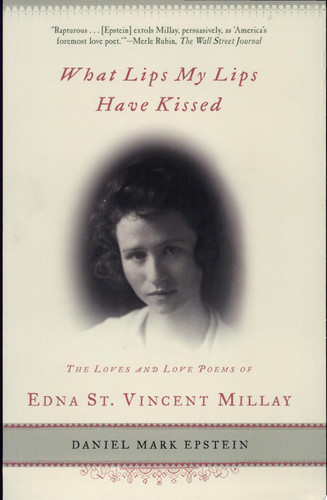
What Lips My Lips Have Kissed The Loves and Love Poems of Edna St. Vincent Millay

Daniel Mark Epstein
This is the story of a rare sort of American genius, who grew up in grinding poverty in Camden, Maine. Nothing could save the sensitive child but her talent for words, music, and drama, and an inexorable desire to be loved. When she was twenty, her poetry would make her famous; at thirty she would be loved by readers the world over. Edna St. Vincent Millay was widely considered to be the most seductive woman of her age. Few men could resist her, and many women also fell under her spell. From the publication of her first poems until the scandal over Fatal Interview twenty years later, gossip about the poet's liberated lifestyle prompted speculation about who might be the real subject of her verses. Using letters, diaries, and journals of the poet and her lovers that have only recently become available, Daniel Mark Epstein tells the astonishing story of the life, dedicated to art and love, that inspired the sublime lyrics of Edna St. Vincent Millay.
Macmillan 2002-09 300 pages

The book of Dede Korkut

Lewis, Geoffrey
The Book of Dede Korkut is a collection of twelve stories set in the heroic age of the Oghuz Turks, a nomadic tribe who had journeyed westwards through Central Asia from the ninth century onwards. The stories are peopled by characters as bizarre as they are unforgettable: Crazy Karchar, whose unpredictability requires an army of fleas to manage it; Kazan, who cheerfully pretends to necrophilia in order to escape from prison; the monster Goggle-eye; and the heroine Chichek, who shoots, races on horseback and wrestles her lover. Geoffrey Lewis's classic translation retains the odd and oddly appealing style of the stories, with their mixture of the colloquial, the poetic and the dignified, and magnificently conveys the way in which they bring to life a wild society and its inhabitants. This edition also includes an introduction, a map and explanatory notes.
Penguin Classics 2011 213 pages

Appreciation Painting, Poetry and Prose

Leo Stein
Leo Stein (1872-1947) was an influential art collector and critic. It has been Stein's ironic fate to be referred to as "Gertrude's brother," ironic as for many years he was her mentor and counsellor. Appreciation: Painting, Poetry and Prose is a model of lucidity, wisdom and classical simplicity. It ranges over a wide field of thought and criticism. Leo Stein's judgements on art and literature are crisp, perceptive and original. His approach to his subject is casual, anecdotal and, though often sharp and biting, finally mellow. Reading this book is like that rare experience of listening, enchanted, for an evening to a great conversationalist, a man informed and urbane, witty and wise.
Solis Press 2022-08 142 pages

Lawrence and the Women The Intimate Life of D.H. Lawrence

Elaine Feinstein
D. H. Lawrence is recognized as one of the greatest novelists of this century. His work is taught in schools and universities all over the world. Yet, more than thirty years after the failure to ban Lady Chatterley's Lover in England fundamentally changed the moral climate of that country and of America, Lawrence remains a controversial figure. Regarded by many women during his lifetime as a sexual prophet, in recent years his supposed misogyny has drawn fierce condemnation from feminist critics. In this new biography of Lawrence, Elaine Feinstein explores his relationships with the women in his own life, many of whom have their counterparts in his novels. She traces the obsessive nature of his love for his mother, Lydia; his difficult relationship with his first sweetheart, Jessie Chambers; his pursuit of the bisexual Helen Corke; and the failure of his youthful engagement to Louisa Burrows. She gives a fascinating account of his long, battling marriage to Frieda von Richthofen; his friendships with women writers like Katherine Mansfield and Catherine Carswell; and the attachment to Lawrence of patronesses such as Lady Ottoline Morrell, Lady Cynthia Asquith and Mabel Dodge Luhan. Lawrence and the Women investigates the paradoxes of Lawrence's personality. He was considered to have a rare understanding of women's sexuality, yet his own sexual relationships were unusually difficult. He put all his faith in the energies of the body, yet his own was frail and sickly. He argued that women needed to submit to men, but he never succeeded in dominating his own wife, Frieda. With a novelist's eye for detail and uncanny intuition about character, Elaine Feinstein probes the sources of Lawrence's attitudes toward women with candor and compassion. Always responsive to the poetry and power of his writing, she offers a fresh and surprising portrait of one of the most misunderstood literary figures of our time.
HarperCollins Publishers 1994-03-30 275 pages

Speak, old parrot

Abse, Dannie
2013 marks Dannie Abse's 90th birthday. In his lifetime he has published an astonishing array of work including poetry, fiction, criticism, plays and autobiography but it is as a poet that he is best known and loved. In Speak, Old Parrot he returns to themes of loss, love, medicine and its moral implications, the nature of creativity, Jewish folk tradition and the passing of time. The poems are observant of the outside world as well as the inner life and emotions but most of all they are a joy to read.
Hutchinson 2019-11-28 80 pages

Her

Ferlinghetti, Lawrence
"To all those who have for several years sought to discredit the new American literature, Lawrence Ferlinghetti has just dealt a most powerful blow," wrote French critic Pierre Lepape in 1961 when Her was published in France as La Quatrième Personne du Singulier. Calling it "a masterpiece of the young American novel," Lepape declared it was "the confirmation of a great American writer who, in the hall of American literary glories, takes the place left vacant by the death of Hemingway." Lepape went on to speak of the "incredible verbal virtuosity" by which the reader is led through this "laby-rêve," and it is this image of the "labyrinth-dream" which relates Her to the anti-novels of the young French school of Robbe-Grillet and Butor. Being thus very far from the kind of novels produced by Ferlinghetti's immediate contemporaries (whether Beat or academic) this book has met with little but bafflement among American critics. With well over 50,000 now in print Her nevertheless continues to make its own way.
New directions publ 1988 156 pages

Open City

John Seabrook,Thomas Beller,Daniel Pinchbeck,Arthur Nersessian,Betsy Bern,Martha McPhee
Open City features a dynamic mix of prominent writers, undiscovered aspirants, and lost treasures from writers of past eras. Including fiction, essays, poetry, and artwork by an exciting range of talents, Open City has presented new works by Michael Cunningham, Deborah Garrison, Rick Moody, David Foster Wallace, Geoffrey O'Brien, Sam Lipsyte, Meghan Daum, David Berman, and previously unpublished work by Delmore Schwartz, Richard Yates, Edvard Munch, and Ford Madox Ford. Praised in the pages of publications such as Harper's Bazaar, Library Journal, and The New York Times, Open City is today's most important literary journal. Open City #14 includes John Seabrook on ancestor hunting; Arthur Nersessian, from Fuck-Up to makeup; new fiction by Betsy Bern and Martha McPhee; and the original treatment for the improvised cult-classic film Waiting for Guffman.
Open City Books 2001-12 280 pages

Selected poems

Celan, Paul
One of the major twentieth-century European poets, Paul Celan wrote poetry of exceptional linguistic brilliance and intensity drawn from his experiences, particularly of the war years and the loss of his parents in the death camps. In his verse he sought to express 'not only what the experience felt like, but also a sense of living, with comprehension, inside the experience'. WINNER OF THE FIRST EUROPEAN TRANSLATION PRIZE
Penguin Books 1996 358 pages

Degeneration

Max Nordau
A sensational success when first published in 1893, the violent hatreds Degeneration roused among younger artists followed the author for the rest of his life. The book pursues a medicalised examination of some of the literary and artistic movements of the period. However, though taking inspiration from Cesare Lombroso's examination of genius and insanity, and to a lesser degree of criminal man, Nordau's language is anything but scientific. Rude and acerbic in tone, the author's sceptical disdain for his targets results in a vitriolic, vituperative, and systematic ripping to pieces of the prose, poetry, plays, and operatic works selected for analysis. One truly gets the sense of a middle-aged critic, seated on a leather armchair, looking down his nose at the works he is unable to enjoy. Nevertheless, he is not devoid of insight, and his criticisms are salutary when the targets have since become renowned philosophers, authors, or composers of the first rank. Why is it not surprising that such a book would inspire an embittered misanthrope, and later Stalinist, like György Lukács? According to Nordau's biographer, Degeneration caused an explosion of criticisms in Germany, to which followed a chain of explosions throughout Europe each time the work appeared in translation. Driven by utopian visions, Nordau stuck to his guns, but came in the end to regret going after some authors-like Zola-in the way that he did. Having pathologised him, the latter Nordau came to respect, and Zola bore him no umbrage. Others were, of course, less generous, and modern critics slate him for establishing the theory of degenerate art. Despite its bulk, Degeneration is written with clarity and precision, and proves an enormously entertaining read.
Spradabach Publishing 2024-05-30 1042 pages

A Study of Literature for Readers and Critics

David Daiches
"Why do we spend time reading and discussing books which tell of events which never in fact occurred?" The question is elementary - and yet, as David Daiches suggests in this provocative study, it is the elementary questions that are never answered. Although literary criticism today is more concerned with technique than with the basic question of value, the question of value underlies all the others. Professor Daiches therefore directs this book to the search for the basic function and purpose of imaginative prose and poetry. A Study of Literature is not, however, an obscure book of literary theory; it contains abundant and pungent examples and critical analyses - of prose fiction, of modern writing, and of the nature of poetry. "It's main purpose," as Professor Daiches says, "is to help the reader of works of imaginative literature to see what he is reading, to understand just what it is that he gets from different kinds of reading, and to discriminate between those different kinds."
W. W. Norton, Incorporated 1964-11 260 pages

The Education of a Young Poet

David Biespiel
"Biespiel’s supple memoir of becoming a poet will surely inspire other writers to embrace the bodily character of writing and feel the power and, sometimes, the emptiness of the act of writing poetry." — Publishers Weekly (starred review) The Education of a Young Poet is David Biespiel’s moving account of his awakening to writing and the language that can shape a life. Exploring the original source of his creative impulse—a great–grandfather who traveled alone from Ukraine to America in 1910, eventually settling as a rag peddler in the tiny town of Elma, Iowa—through the generations that followed, Biespiel tracks his childhood in Texas and his university days in the northeast, led along by the ""pattern and random bursts that make up a life." His book offers an intimate recollection of how one person forges a life as a writer during extraordinary times. From the Jewish quarter of Houston in the 1970s to bohemian Boston in the 1980s, from Russia’s Pale of Settlement to a farming village in Vermont, Biespiel remains alert to the magic of possibilities—ancestral journeys, hash parties, political rallies, family connections, uncertain loves, the thrill of sex, and lasting friendships. Woven throughout are reflections on the writer’s craft coupled with a classic coming–of–age tale that does for Boston in the 1980s what Hemingway’s A Moveable Feast did for Paris in the 1920s and Broyard’s Kafka Was the Rage did for Greenwich Village in the 1950s. Restless with curiosity and enthusiasm, The Education of a Young Poet is a singular and universal bildungsroman that movingly demonstrates, "in telling the story of one’s coming into consciousness, all languages are more or less the same."
Catapult 2018-10-09 192 pages

Modern American Poetry

Louis Untermeyer
This is a reproduction of the original artefact. Generally these books are created from careful scans of the original. This allows us to preserve the book accurately and present it in the way the author intended. Since the original versions are generally quite old, there may occasionally be certain imperfections within these reproductions. We're happy to make these classics available again for future generations to enjoy!
HardPress 2019-08-06 470 pages

Traité de Bave Et D'éternité

Isidore Isou
Literary Nonfiction. Poetry. Film. Jewish Studies. Edited by Julian Kabza. Translated by Ian Thompson, Anna O'Meara, Julian Kabza, Nadege LeJeune, and Charles Penwarden. Introduction by Adrian Martin. Forward by Frédérique Devaux. Interview with Isou by Roland Sabatier. Afterword by Erik Bullot. "Who is Isou? Some may know that he was the founder and leader of a movement in art and thought named Lettrism. Some may know the remarkable film he made a year before he wrote his manifesto, the Treatise on Slime and Eternity, a breakthrough work of feature-length experimentation that was to win fans including Stan Brakhage--Isou himself would coldly remark, many years later, that Jean-Luc Godard and Guy Debord (to name only two luminaries whom he considered his mortal enemies) stole everything from it. Some might have come to the legend of Isou through the fond passage devoted to him in Greil Marcus' book on the distant origins of punk, Lipstick Traces--a book whose subtitle evokes 'a secret history of the 20th century.' In that book, Marcus tells the fine story of his teenage niece stumbling upon the photos on his desk of a young Isou in the late 1940s, and mistaking the artist for a contemporary pop star. And Isou did indeed look the part--especially in a self-portrait which was an example of what the Lettrists called hypergraphics, a work mixing the media of photography, painting, drawing, and Lettrist poetry."--Adrian Martin, from the introduction "Isou chipped language down to the bone that it might build its flesh up again, fresh and new. It is one of the grand aesthetic visions of the late twentieth century. His cinema, in particular, is a marvelous document of the secret history of our times. Here at last is the book that, for Anglophone readers and beyond, cements his fleeting presence for all time."--McKenzie Wark "Long-overdue, this translation of Isou's masterpiece--together with its contextual essays and interviews by Martin, Devaux, Sabatier, and Bullot--will be a monumental resource for international research into the origins of the Lettrist movement along with postwar Experimental Film and Media Art."--Andrew V. Uroskie
Annex Press 2019 160 pages

A musical hell

Pizarnik, Alejandra
"An aura of legendary prestige surrounds the work of Alejandra Pizarnik," writes César Aira. Her last collection to be published before her suicide in 1972, A Musical Hell is the first book of poems by Pizarnik to be published in its entirety in the U.S. Pizarnik writes at the edge of poetic impossibility, opening with a blues singer, expanding into silence, and closing into a theater of shadows and songs of the drowned.
New Directions Publishing Corporation 2013 64 pages

Early American Poets

Louis Untermeyer
Early American Poets is a beautiful anthology of the poetry that helped define the American literary tradition. Louis Untermeyer has curated a selection of works from the likes of Whitman, Longfellow, and Poe, as well as many lesser-known poets. This book provides a fascinating glimpse into the early days of American poetry, and is sure to delight poetry lovers of all ages. This work has been selected by scholars as being culturally important, and is part of the knowledge base of civilization as we know it. This work is in the "public domain in the United States of America, and possibly other nations. Within the United States, you may freely copy and distribute this work, as no entity (individual or corporate) has a copyright on the body of the work. Scholars believe, and we concur, that this work is important enough to be preserved, reproduced, and made generally available to the public. We appreciate your support of the preservation process, and thank you for being an important part of keeping this knowledge alive and relevant.
LEGARE STREET Press 2023-07-22 370 pages