114 results for "Psychology"

What doctors feel: how emotions affect the practice of medicine

Ofri, Danielle
"By shedding light on how doctors cope with the stresses and responsibilities of patients, colleagues, lawyers, and their personal lives, she explains why it is important that patients know how emotions influence the way physicians treat their patients both medically and interpersonally. Exploring the full range of human emotion--from the fear of making a fatal mistake to the pride and elation of triumphing over death, What Doctors Feel allows patients at the other end of the stethoscope to have a good listen to the beat of the emotional life behind the white coat."--Beacon Press
Beacon Press 2014 224 pages

Joining the resistance

Gilligan, Carol
Since the publication of her landmark book In a Different Voice, Carol Gilligan has transformed the way we think about women and men and the relations between them. It was ‘the little book that started a revolution’, and with more than 800,000 copies in print it has become one of the most widely read and influential books ever written on gender and human development. In her new book Joining the Resistance Carol Gilligan reflects on the evolution of her thinking and shows how her key ideas were interwoven with her own life experiences. Her work began with the question of voice: who is speaking to whom, in what body, telling what stories about which relationships? By listening carefully she heard a voice that had been held in silence, and in the process realized the extent to which we – both women and men – had been telling false stories about ourselves. In her subsequent work Gilligan found that adolescent girls resisted pressures to disengage themselves from their honest voices, and by joining their resistance she opened the way for the development of a more humane way of thinking about personal and political relationships. For the central conviction of her work today – and the central thesis of this book – is that the requisites for love and the requisites for citizenship in a democratic society are one and the same. Both voice and the desire to live in relationships inherent in our human nature, together with the capacity to resist false authority. Combining autobiographical reflection with an analysis of key questions about gender and human development, this timely and highly readable book by one of America’s greatest contemporary thinkers will appeal to a wide readership.
Polity 2013-05-13 180 pages

Mind change: how digital technologies are leaving their mark on our brains

Greenfield, Susan
"Google. Facebook. Twitter. Repeat. We live in a world unimaginable even a few decades ago, one like no other in human history. It's a parallel world where we can be on the move in the real world, yet always hooked into an alternative time and place. And although it's a two-dimensional world of sight and sound, it offers instant information, connected identities, and constant novelty. In this world, our screen technologies are increasingly where we work, where we unwind, where we relieve our boredom and where we learn. The subsequent transformation in how we live and think is a vitally important issue, perhaps even the most important issue of our time. When toddlers are given iPads, and adults spend ten hours a day staring at a screen, can we afford to assume that our brave new screen technologies are harmless tools? Blending a wide range of scientific studies, news events, and cultural criticism with brio and verve, Mind Change presents an incisive snapshot of the global 'now.' Greenfield examines how the dawn of the Digital Age has already altered our cultural landscape, fueled an epidemic of oversharing, and transformed how we learn, remember and spread information -- and how these innovations are changing our physical brains. A warning cry, a shot across the bow, and a call to action, Mind Change explores the social, cultural and physiological ramifications of our new digital lifestyle"--
Random House 2015-02-10 348 pages

Payoff: the hidden logic that shapes our motivations

Ariely, Dan
"Payoff investigates the true nature of motivation, our partial blindness to the way it works, and how we can bridge this gap. With studies that range from Intel to a kindergarten classroom, Ariely digs deep to find the root of motivation--how it works and how we can use this knowledge to approach important choices in our own lives. Along the way, he explores intriguing questions such as: Can giving employees bonuses harm productivity? Why is trust so crucial for successful motivation? What are our misconceptions about how to value our work? How does your sense of your mortality impact your motivation?"--Baker & Taylor.
TED Books/Simon & Schuster 2016 103 pages

Casa Valentina

Fierstein, Harvey
THE STORY: Nestled in the Catskills—1962's land of dirty dancing and Borscht Belt comedy—an inconspicuous bungalow colony catered to a very special clientele: heterosexual men who delighted in dressing and acting as women. These white-collar professionals would discreetly escape their families to spend their weekends safely inhabiting their chosen female alter-egos. But given the opportunity to share their secret lives with the world, the members of this sorority had to decide whether the freedom gained by openness was worth the risk of personal ruin. Based on real events and infused with Fierstein's trademark wit, this moving, insightful, and delightfully entertaining work offers a glimpse into the lives of a group of "self-made women" as they search for acceptance and happiness in their very own Garden of Eden.
Dramatist Play Service, Inc 2015-01-01 64 pages

The evolutionary bases of consumption

Saad, Gad
The Evolutionary Bases of Consumption by Gad Saad applies Darwinian principles in understanding our consumption patterns and the products of popular culture that most appeal to individuals. The first and only scholarly work to do so, this is a captivating study of the adaptive reasons behind our behaviors, cognitions, emotions, and perceptions. This lens of analysis suggests how we come to make selections such as choosing a mate, the foods we eat, the gifts that we offer, and more. It also highlights how numerous forms of dark side consumption, including pathological gambling, compulsive buying, pornographic addiction, and eating disorders, possess a Darwinian etiology. Engaging and diverse in scope, the book maps consumption phenomena onto four key Darwinian modules: survival, reproduction, kin selection, and reciprocal altruism. As an interesting proposal, the author suggests that media and advertising contents exist in their particular forms because they are a reflection of our evolved human nature - negating the notion that they exist through the reverse causal link, as proposed by social constructivists. The link between evolutionary theory and consumption behaviors is detailed throughout the book via an examination of (among many others): appearance-enhancing products and services; financial and physical risk-taking; use of sexual imagery and the depictions of women in advertising; and television programs, movies, songs, music videos, literature, religion, and art. The Evolutionary Bases of Consumption will appeal to evolutionists who desire to explore new areas wherein evolutionary theory can be applied; consumer and marketing scholars who wish to learn about the ways in which biological-and evolutionary-based theorizing can be infused into the consumer behavior/marketing/advertising disciplines; as well as other interdisciplinary scholars interested in gaining knowledge about the power of evolutionary theory in explaining a wide range of behavioral phenomena.
Lawrence Erlbaum Associates 2007 339 pages

Identity economics: how our identities shape our work, wages, and well-being

Akerlof, George A.
In 1995, economist Rachel Kranton wrote future Nobel Prize-winner George Akerlof a letter insisting that his most recent paper was wrong. Identity, she argued, was the missing element that would help to explain why people - facing the same economic circumstances - would make different choices. This was the beginning of a fourteen-year collaboration - and of Identity Economics. Identity economics is a new way to understand people's decisions - at work, at school, and at home. With it, we can better appreciate why incentives like stock options work or don't; why some schools succeed and others don't; why some cities and towns don't invest in their futures - and much, much more. "Identity Economics" bridges a critical gap in the social sciences. It brings identity and norms to economics. People's notions of what is proper, and what is forbidden, and for whom, are fundamental to how hard they work, and how they learn, spend, and save. Thus people's identity - their conception of who they are, and of who they choose to be - may be the most important factor affecting their economic lives. And the limits placed by society on people's identity can also be crucial determinants of their economic well-being.
Princeton University Press 2011-09-26 185 pages

Ceremonial violence: a psychological explanation of school shootings

Fast, Jonathan
Ceremonial Violence analyzes the Columbine high school shooting and four other cases and explains for the first time why teenagers commit school rampage shootings. With his grasp of the elements of abnormal psychology, developmental psychology, sociology, and neurology that contribute to the homicidal mindset, Fast offers us a means of understanding and coming to terms with these tragedies.--From publisher description.
Overlook Press 2008-09-04 333 pages

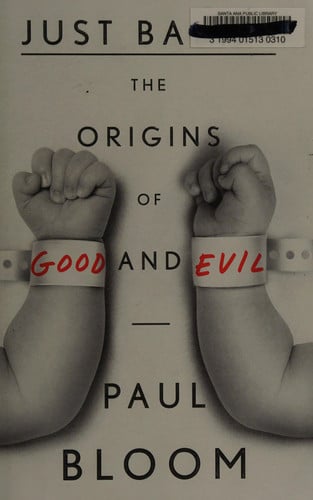
Just babies: the origins of good and evil

Bloom, Paul
"A leading cognitive scientist argues that a deep sense of good and evil is bred in the bone. From Sigmund Freud to Lawrence Kohlberg, psychologists have long believed that we begin life as amoral animals. After all, isn't it the parents' role to turn babies into civilized beings who can experience empathy and shame, and override selfish impulses? In Just Babies, Paul Bloom argues that humans are in fact hardwired with a sense of morality. Drawing upon years of original research at his Yale lab, he shows that babies and toddlers can judge the goodness and badness of others' actions; that they act to soothe those in distress; and that they feel guilt, shame, pride, and righteous anger. Yet this innate morality is tragically limited. Our natural strong moral feelings toward those in our own group--same family, same race--are offset by ingrained dislike, even hatred, of those in different groups. Put more simply, we are natural-born bigots. Vivid and intellectually probing, Just Babies argues that through intelligence and creativity we can transcend the primitive sense of morality we are born with. This erudite yet accessible book will captivate readers of Steven Pinker, Philip Zimbardo, and Robert Wright"--
Crown Publishers 2013 273 pages

Beyond doer and done to: recognition theory, intersubjectivity and the third

Benjamin, Jessica
In Beyond Doer and Done To, Jessica Benjamin, author of the path-breaking Bonds of Love, expands her theory of mutual recognition and its breakdown into the complementarity of "doer and done to." Her innovative theory charts the growth of the Third in early development through the movement between recognition and breakdown, and shows how it parallels the enactments in the psychoanalytic relationship. Benjamin's recognition theory illuminates the radical potential of acknowledgment in healing both individual and social trauma, in creating relational repair in the transformational space of thirdness. Benjamin's unique formulations of intersubjectivity make essential reading for both psychoanalytic therapists and theorists in the humanities and social sciences. Book jacket
Routledge, Taylor & Francis Group 2018 278 pages

On freedom

Sunstein, Cass R.
"In this pathbreaking book, New York Times bestselling author Cass Sunstein asks us to rethink freedom. He shows that freedom of choice isn't nearly enough. To be free, we must also be able to navigate life. People often need something like a GPS device to help them get where they want to go--whether the issue involves health, money, jobs, children, or relationships. In both rich and poor countries, citizens often have no idea how to get to their desired destination. That is why they are unfree. People also face serious problems of self-control, as many of them make decisions today that can make their lives worse tomorrow. And in some cases, we would be just as happy with other choices, whether a different partner, career, or place to live--which raises the difficult question of which outcome best promotes our well-being. Accessible and lively, and drawing on perspectives from the humanities, religion, and the arts, as well as social science and the law, On Freedom explores a crucial dimension of the human condition that philosophers and economists have long missed--and shows what it would take to make freedom real."--Page [2] of cover.
Princeton University Press 2019-02-26 127 pages

Why does patriarchy persist?

Gilligan, Carol,Snider, Naomi
"The election of an unabashedly patriarchal man as US President was a shock for many--despite decades of activism on gender inequalities and equal rights, how could it come to this? What is it about patriarchy that seems to make it so resilient and resistant to change? Undoubtedly it persists in part because some people benefit from the unequal advantages it confers. But is that enough to explain its stubborn persistence? In this highly original and persuasively argued book, Carol Gilligan and Naomi Snider put forward a different view: they argue that patriarchy persists because it serves a psychological function. By requiring us to sacrifice love for the sake of hierarchy, patriarchy protects us from the vulnerability of loving and becomes a defense against loss. Uncovering the powerful psychological mechanisms that underpin patriarchy, the authors show how forces beyond our awareness may be driving a politics that otherwise seems inexplicable."--Page 4 of cover
Polity Press 2018-10-22 168 pages

Burn rate: launching a startup and losing my mind

Dunn, Andy (Entrepreneur)
NATIONAL BESTSELLER • In this “gripping” ( TechCrunch ), “eye-opening” (Gayle King, Oprah Daily ) memoir of mental illness and entrepreneurship, the co-founder of the menswear startup Bonobos opens up about the struggle with bipolar disorder that nearly cost him everything. “Arrestingly candid . . . the most powerful book I’ve read on manic depression since An Unquiet Mind .”—Adam Grant, #1 New York Times bestselling author of Think Again and host of WorkLife At twenty-eight, fresh from Stanford’s MBA program and steeped in the move-fast-and-break-things ethos of Silicon Valley, Andy Dunn was on top of the world. He was building a new kind of startup—a digitally native, direct-to-consumer brand—out of his Manhattan apartment. Bonobos was a new-school approach to selling an old-school product: men’s pants. Against all odds, business was booming. Hustling to scale the fledgling venture, Dunn raised tens of millions of dollars while boundaries between work and life evaporated. As he struggled to keep the startup afloat, Dunn was haunted by a ghost: a diagnosis of bipolar disorder he received after a frightening manic episode in college, one that had punctured the idyllic veneer of his midwestern upbringing. He had understood his diagnosis as an unspeakable shame that—according to the taciturn codes of his fraternity, the business world, and even his family—should be locked away. As Dunn’s business began to take off, however, some of the very traits that powered his success as a founder—relentless drive, confidence bordering on hubris, and ambition verging on delusion—were now threatening to undo him. A collision course was set in motion, and it would culminate in a night of mayhem—one poised to unravel all that he had built. Burn Rate is an unconventional entrepreneurial memoir, a parable for the twenty-first-century economy, and a revelatory look at the prevalence of mental illness in the startup community. With intimate prose, Andy Dunn fearlessly shines a light on the dark side of success and challenges us all to take part in the deepening conversation around creativity, performance, and disorder.
Crown 2023-05-09 320 pages

The second self: computers and the human spirit

Turkle, Sherry
"In The Second Self, Sherry Turkle looks at the computer not as a 'tool,' but as part of our social and psychological lives; she looks beyond how we use computer games and spreadsheets to explore how the computer affects our awareness of ourselves, of one another, and of our relationship with the world. 'Technology,' she writes, 'catalyzes changes not only in what we do but in how we think.' First published in 1984, The Second Self is still essential reading as a primer in the psychology of computation. This twentieth anniversary edition allows us to reconsider two decades of computer culture - to (re)experience what was and is most novel in our new media culture and to view our own contemporary relationship with technology with fresh eyes. Turkle frames this classic work with a new introduction, a new epilogue, and extensive notes added to the original text. Turkle talks to children, college students, engineers, AI scientists, hackers, and personal computer owners - people confronting machines that seem to think and at the same time suggest a new way for us to think - about human thought, emotion, memory, and understanding. Her interviews reveal that we experience computers as being on the border between inanimate and animate, as both an extension of the self and part of the external world. Their special place betwixt and between traditional categories is part of what makes them compelling and evocative. (In the introduction to this edition, Turkle quotes a PDA user as saying, 'When my Palm crashed, it was like a death. I thought I had lost my mind.') Why we think of the workings of a machine in psychological terms - how this happens, and what it means for all of us - is the ever more timely subject of The Second Self." -
MIT Press 2005-09-30 372 pages

This is your brain on sports: the science of underdogs, the value of rivalry, and what can we learn from the T-shirt cannon

Wertheim, L. Jon,Sommers, Sam
This is Your Brain on Sports is the book for sports fans searching for a deeper understanding of the games they watch and the people who play them. Sports Illustrated executive editor and bestselling author L. Jon Wertheim teams up with Tufts psychologist Sam Sommers to take readers on a wild ride into the inner world of sports. Through the prism of behavioral economics, neuroscience, and psychology, they reveal the hidden influences and surprising cues that inspire and derail us—on the field and in the stands—and by extension, in corporate board rooms, office settings, and our daily lives. In this irresistible narrative romp, Wertheim and Sommers usher us from professional football to the NBA to Grand Slam tennis, from the psychology of athletes self-handicapping their performance in the boxing ring or the World Series, to an explanation of why even the glimpse of a finish line can lift us beyond ordinary physical limits. They explore why Tom Brady and other starting NFL quarterbacks all seem to look like fashion models; why fans of teams like the Cubs, Mets, and any franchise from Cleveland love rooting for a loser; why the best players make the worst coaches; why hockey goons (and fans) would rather fight at home than on the road; and why the arena t-shirt cannon has something to teach us about human nature. In short, this book is an entertaining and thought-provoking journey into how psychology and behavioral science collide with the universe of wins-and-losses, coaching changes, underdogs, and rivalry games. — Boston Globe, Best Books of 2016, Sports
Three Rivers Press 2017-02-07 288 pages

Anatomy of a secret life: the psychology of living a lie

Saltz, Gail
What do these people have in common? • The traveling businessman who brings prostitutes back to his hotel room • The wealthy woman who is arrested for shoplifting • The seemingly happily married man who cruises gay clubs They are all—despite differences in degree, gender, and age—living a double life, one of our most deeply ingrained, but poorly understood psychological drives. Now, Dr. Gail Saltz steps into the breach to explore —in detail and based on the latest research—our impulse to create and nurture alter egos. Saltz reveals how assuming a different identity can be healthy and tremendously liberating. For proof, we need look no further than the innumerable people who reinvent themselves by moving to the big city, or the countless pseudonymous bloggers. But, as she also makes clear, leading a secret life comes with potentially serious psychological risks. She shows that, in more extreme cases, leading a secret life can have devastating emotional, social and familial consequences—both for the person leading the secret life, and for those close to him or her. The definitive popular work on how a secret life is formed, lived, justified, and exposed, Saltz’s Anatomy includes contemporary case studies and historical examples (Lindbergh, T. E. Lawrence, Tchaikovsky, et cetera) of people who have risked it all for a taste of forbidden fruit.
Morgan Road Books 2006-04-11 205 pages

Poetry and repression: revisionism from Blake to Stevens

Bloom, Harold
This reinterpretation of the full sweep of English and American romantic poetry offers close readings of poems of Blake, Wordsworth, Shelley, Keats, Tennyson, Browning, Whitman, Yeats, and Stevens. It also reviews the crucial ideas of Emerson, Nietzsche, and in particular Freud, whose psychoanalytic theory of repression and defense Bloom undertakes to revise for purposes of literary criticism. "Bloom offers a fully defined alternative to the principal modes of contemporary criticism, from Freudian literary criticism (which he insists is neither Freudian nor literary criticism) to the New Criticism and structuralist and archetypal approaches. It is an original, vigorous, and passionate study which is both compelling and provocative."-The British Studies Monitor "Show me but one paragraph of Bloom's approaches to texts, and I'm hooked. . . . I find sheer delight in his ingenious ways."-Kenneth Burke "Bloom has made a remarkable contribution to poetic theory."-Phoebe Pettingell, The New Leader
Yale University Press 1976 293 pages