25 results for "Public Policy"

Don't Think, Smile! Notes on a Decade of Denial

Ellen Willis
If the 1970s were the "Me Decade," and the '80s were the years of the Reagan counterrevolution, then the '90s, writes Ellen Willis, were the Decade of Denial. In keeping with the mass media's glib assumption that a phenomenal increase in wealth for a minority meant genuine national prosperity, the 1990s saw an astounding refusal, on both the left and right, to question received wisdom or engage in substantive deliberation. Turning her acute eye to the decade's defining moments-imbroglios like those surrounding the O. J. Simpson trial, The Bell Curve, Monica-gate, and the Million Man March-Ellen Willis reveals the mindlessness behind the noise. Arguing that we suffer from a lack of true freedom, she demands that we radically rethink our country and ourselves to create a society in which we can fully enjoy life.
Beacon Press 2000-11-16 224 pages

After the Nazi racial state: difference and democracy in Germany and Europe

Fehrenbach, Heide,Eley, Geoff,Grossmann, Atina,Chin, Rita C-K
What happened to "race," race thinking, and racial distinctions in Germany, and Europe more broadly, after the demise of the Nazi racial state? This book investigates the afterlife of "race" since 1945 and challenges the long-dominant assumption among historians that it disappeared from public discourse and policy-making with the defeat of the Third Reich and its genocidal European empire. Drawing on case studies of Afro-Germans, Jews, and Turks—arguably the three most important minority communities in postwar Germany—the authors detail continuities and change across the 1945 divide and offer the beginnings of a history of race and racialization after Hitler. A final chapter moves beyond the German context to consider the postwar engagement with "race" in France, Britain, Sweden, and the Netherlands, where waves of postwar, postcolonial, and labor migration troubled nativist notions of national and European identity. After the Nazi Racial State poses interpretative questions for the historical understanding of postwar societies and democratic transformation, both in Germany and throughout Europe. It elucidates key analytical categories, historicizes current discourse, and demonstrates how contemporary debates about immigration and integration—and about just how much "difference" a democracy can accommodate—are implicated in a longer history of "race." This book explores why the concept of "race" became taboo as a tool for understanding German society after 1945. Most crucially, it suggests the social and epistemic consequences of this determined retreat from "race" for Germany and Europe as a whole. --
University of Michigan Press 2009 263 pages

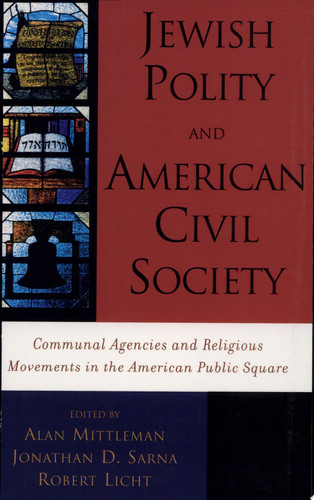
Jewish polity and American civil society: communal agencies and religious movements in the American public sphere

Alan Mittleman,Robert Licht,Jonathan D. Sarna
Jewish Polity and American Civil Society is a study of the civic and political engagements of American Jews as mediated by their communal and denominational institutions. The book explores how the various branches of the organized Jewish community seek to influence public affairs. Over the course of the last century, Jewish agencies and religious movements have tried to shape public debate and public policy on such issues as civil rights, church-state relations, and American foreign policy. The book sets the history of Jewish engagement in these areas into historical context; analyzes the motives, strategies, and tactics of various Jewish groups, and evaluates their successes and failures. The book also explores the underlying idea-the public philosophy-that informs American Jews' understanding of civic and political engagement.
Rowman & Littlefield 2002-07-23 420 pages

The paradox of American democracy: elites, special interests, and the betrayal of the public trust

Judis, John B.
John B. Judis, one of our most insightful political commentators, most rational and careful thinkers, and most engaged witnesses in Washington, has taken on a challenge that even the most concerned American citizens shrink from: forecasting the American political climate at the turn of the century. The Paradox of American Democracy is a penetrating examination of our democracy that illuminates the forces and institutions that once enlivened it and now threaten to undermine it. It is the well-reasoned discussion we need in this era of unrestrained expert opinions and ideologically biased testimony. The disenchantment with our political system can be seen in decreasing voter turnout, political parties co-opted by consultants and large contributors, the corrupting influence of "soft money," and concern for national welfare subverted by lobbying organizations and special-interest groups. Judis revisits particular moments -- the Progressive Era, the New Deal, the 1960s -- to discover what makes democracy the most efficacious and, consequently, most inefficacious. What has worked in the past is a balancing act between groups of elites --- trade commissions, labor relations boards, policy groups -- whose mandates are to act in the national interest and whose actions are governed by a disinterested pursuit of the common good. Judis explains how the displacment of such elites by a new lobbying community in Whashington has given rise to the cynicism that corrodes the current political system. The Paradox of American Democracy goes straight to the heart of every political debate in this country.
Pantheon Books 2000-02-15 305 pages

The NHS - beginning, middle and end? the autobiography of Dr John Marks

Marks, John
John Marks is something of a national treasure. Warm, funny, passionate, opinionated and occasionally contrary, he is a man whose life for more than 40 years marched in beat with that of the National Health Service. There is scarcely a medical issue or controversy in which John Marks was not involved. Abortion law reform, the doctors' 1970s revolt against the General Medical Council, the foundation of the Royal College of General Practitioners, countless NHS reorganizations, and the bloody battle over NHS pay beds and the pay of junior doctors are just a sample.Then there was the fierce, principled battle over how the medical profession and the public should respond to the terror of a new disease - AIDS. And the great war that was fought over the Conservatives introduction of market forces into the NHS in the late 1980s and early 1990s - an approach to running the NHS that lives on, reincarnated, under the current Labor government.In all of these John Marks played more than a walk-on part. In many he was a principal actor. For anyone wanting fully to understand the BMA's role in all this, this book is thus required reading. But it is much more than just a dry history of times past. It is laced with anecdote, from the horrifying to the hilarious, and on to high politics. John Marks' account of his life and times provides the tale of a warm, human, liberal and occasionally buccaneering man whose passion for life and causes leaves even those who do not always agree with him eager to count him among their friends.
Radcliffe Publishing Ltd 2008-05-20 279 pages