28 results for "Public Policy"

The empire and the five kings: America's abdication and the fate of the world

Lévy, Bernard-Henri
"The Empire and the Five Kings is a cri de coeur that draws upon lessons from history and the eternal touchstones of human culture to reveal the stakes facing the West as America retreats from its leadership role, a process that did not begin with Donald Trump's presidency and is not likely to end with him. The crisis is one whose roots can be found as far back as antiquity and whose resolution will require the West to find a new way forward if its principles and values are to survive."--Jacket flap.
Henry Holt and Company 2019 261 pages

Information wars: how we lost the global battle against disinformation & what we can do about it

Stengel, Richard
"In February of 2013, Richard Stengel, the former editor-in-chief of Time, joined the Obama administration as Under Secretary of State for Public Diplomacy and Public Affairs. Within days, two shocking events made world-wide headlines: ISIS executed American journalist James Foley on a graphic video seen by tens of millions, and Vladimir Putin's "little green men"-Russian special forces-invaded Crimea, amid a blizzard of Russian denials and false flags. What these events had in common besides their violent law-lessness is that they were the opening salvos in a new era of global information war, where countries and non-state actors use social media and disinformation to create their own narratives and undermine anyone who opposes them. Stengel was thrust onto the front lines of this battle as he was tasked with responding to the relentless weaponizing of information and grievance by ISIS, Russia, China, and others. He saw the scale of what he was up against and found himself hopelessly outgunned. Then, in 2016, the wars Stengel was fighting abroad came home during the presidential election, as "fake news" became a rallying cry and the Russians used the techniques they learned in Ukraine to influence the election here. Rarely has an accomplished journalist been not only a close observer but also a principal participant in the debates and decisions of American foreign policy. Stengel takes you behind the scenes in the ritualized world of diplomacy, from the daily 8:30 morning huddle with a restless John Kerry to a midnight sit-down in Saudi Arabia with the prince of darkness Mohammed bin Salman. The result is a rich account of a losing battle against trolls and bots-who are every bit as insidious as their names imply."--
Atlantic Monthly Press 2019-10 357 pages

America ascendant: a revolutionary nation's path to addressing its deepest problems and leading the 21st century

Greenberg, Stanley B.
"America is poised to lead the 21st Century, as it led the 20th. That will happen because the country is at a tipping point in the battle for its own renewal, a renewal that will allow America to be exceptional again. Our economy is on the move, fueled by revolutions in energy, immigration, innovation, big data and advanced manufacturing. America's energy independence has set off shockwaves. Just as important are the social transformations that are making the country ever more racially and culturally diverse, younger, a home to immigrants, and the metropolitan centers that foster a rising economic and cultural dynamism. While most other countries struggle profoundly with immigration and religious and racial differences, America's on a path to multicultural identity. Those revolutions in the economy, society and culture and are also producing a new American majority that embraces new values and new politics. Republicans are waging a counter-revolution and that is why America looks gridlocked and why the country is turning to Democrats to take on the country's growing challenges. The economic and social transformations leave people struggling to earn enough and reach the middle class. Families are under stress. Government is corrupted by big money. The American public is demanding the country address the dark side of our progress - and reforms are starting to happen. That is why Democrats will get to lead an era of reform and renewal comparable to the progressive era that mitigated the excesses of the Industrial Revolution. In this incisive book, expert strategist Greenberg draws on years of research and polling to illuminate how America is far from being gridlocked and he articulates a powerful vision of how American politics and America can be renewed"--
Thomas Dunne Books 2015-11-03 406 pages

A vulcan's tale: how the bush administration mismanaged the reconstruction of Afghanistan

Dov S. Zakheim
A firsthand account of how the Bush administration mismanaged its Afghan campaign, A Vulcan's Tale shines new and important light on the events and people behind the headlines in the immediate years following the September 11 attacks. The "Vulcans," so named by Condoleezza Rice, were eight foreign policy experts who advised George W. Bush during his 2000 presidential campaign. After Bush assumed the presidency, the Vulcans helped shape the administration’s foreign policy following 9/11, including the military operations in Afghanistan and Iraq. All were veterans of past administrations, having served under either Ronald Reagan or George H. W. Bush, and they included among their ranks Dov Zakheim. Made comptroller and chief financial officer for the Department of Defense in 2001, Zakheim was also named the DoD’s coordinator for Afghan civilian reconstruction in 2002. In A Vulcan's Tale , Zakheim draws on his own participation and intimate knowledge to analyze how the United States missed critical opportunities while it struggled to manage two wars, particularly the seemingly endless endeavor in Afghanistan. In his view, the Bush administration's disappointing results in Afghanistan were partly attributable to the enormity of the challenges, certainly. But flawed leadership and deficiencies of management, understanding, and forethought all played their parts as well. The power of the purse proved to be especially damaging. The Office of Management and Budget was slow to fund Defense's efforts at the outset of the Afghan conflict and then inadequately funded the State Department and the U.S. Agency for International Development, casting the die for several additional years of conflict. The invasion of Iraq siphoned off critical resources for Afghanistan, thereby further complicating that country's reconstruction. Even with public policy of the highest order, the devil still lurked in the details, as the DoD's "money man" was soon to discover while he struggled to fund and manage the reconstruction of civilian Afghanistan. A Vulcan's Tale is an authoritative, candid but fair account of how a wise and admirable goal can be waylaid by insufficient funding and ineffective coordination, with the result of faulty—or, at best, incomplete—implementation.
Brookings Institution Press 2013-07-10 335 pages

The art of peace: engaging a complex world

Pilon, Juliana Geran
Sun Tzu, author of 'The Art of War', believed that the acme of leadership consists in figuring out how to subdue the enemy with the least amount of fighting--a fact that America's Founders also understood, and practiced with astonishing success. For it to work, however, a people must possess both the ability and the willingness to use all available instruments of power in peace as much as in war. US foreign policy has increasingly neglected the instruments of civilian power and become overly dependent on lethal solutions to conflict. The steep rise in unconventional conflict has increased the need for diplomatic and other non-hard power tools of statecraft. The United States can no longer afford to sit on the proverbial three-legged national security stool ("military, diplomacy, development"), where one leg is a lot longer than either of the other two, almost forgetting altogether the fourth leg--information, especially strategic communication and public diplomacy. The United States isn't so much becoming militarized as DE civilianized. According to Sun Tzu, self-knowledge is as important as knowledge of one's enemy: "if you know neither yourself nor the enemy, you will succumb in every battle." Alarmingly, the United States is deficient on both counts. And though we can stand to lose a few battles, the stakes of losing the war itself in this age of nuclear proliferation are too high to contemplate.
Transaction Publishers 2016 385 pages

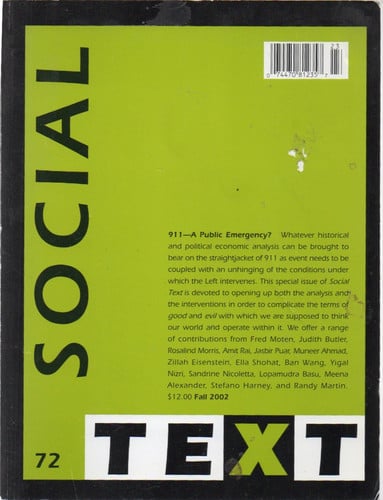
911 a Public Emergency?

Brent Hayes Edwards,Stefano Harney,Randy Martin,Ella Shohat,Timothy Mitchell,Fred Moten
Since September 11, public discourse has often been framed in terms of absolutes: an age of innocence gives way to a present under siege, while the United States and its allies face off against the Axis of Evil. This special issue of Social Text aims to move beyond these binaries toward thoughtful analysis. The editors argue that the challenge for the Left is to develop an antiterrorism stance that acknowledges the legacy of U.S. trade and foreign policy as well as the diversity of the Muslim faith and the dangers presented by fundamentalism of all kinds. Examining the strengths and shortcomings of area, race, and gender studies in the search for understanding, this issue considers cross-cultural feminism as a means of combating terrorism; racial profiling of Muslims in the context of other racist logics; and the homogenization of dissent. The issue includes poetry, photographic work, and an article by Judith Butler on the discursive space surrounding the attacks of September 11. This impressive range of contributions questions the meaning and implications of the events of September 11 and their aftermath. Contributors . Muneer Ahmad, Meena Alexander, Lopamudra Basu, Judith Butler, Zillah Eisenstein, Stefano Harney, Randy Martin, Rosalind C. Morris, Fred Moten, Sandrine Nicoletta, Yigal Nizri, Jasbir K. Puar, Amit S. Rai, Ella Shohat, Ban Wang
Duke University Press 2002-09-20 208 pages

Europe in crisis: bolt from the blue?

Berend, T. Iván
This book analyzes the European Great Recession of 2008-12, its economic and social causes, its historical roots, and the policies adopted by the European Union to find a way out of it. It contains explicit debates with several economists and analysts on some of the most controversial questions about the causes of the crisis and the policies applied by the European Union. It presents the cases of Iceland, Greece, and Ireland, the countries that first declined into crisis in Europe, each of them in a different way. Iceland is a case study for reckless banking practices, Greece of reckless public spending, and Ireland of reckless household indebtedness. At least seven other countries, mostly from the peripheries of Europe, had similarly reckless banking and spending practices. In the center of the book are the economic and social causes of the crisis. Contemporary advanced capitalism became financialized, de-industrialized and globalized and got rid of the "straitjacket" of regulations. Solid banking was replaced by high-risk, "casino-type" activity. The European common currency also had a structural problem - monetary unification without a federal state and fiscal unification. The other side of the same coin is European hyper-consumerism. A new lifestyle emerged during two super-prosperous periods in the 1950s to 1960s, and during the 1990s to 2006. Trying to find an exit policy, the European Union turned to strict austerity measures to curb the budget deficit and indebtedness. This book critically analyzes the debate around austerity policy. The creation of important supranational institutions, and of a financial supervisory authority and stability mechanisms, strengthens integration. The correction of the euro's structural mistake by creating a quasi-fiscal unification is even more important. The introduction of mandatory fiscal rules and their supervision promises a long-term solution for a well-functioning common currency. These measures, meanwhile, create a two-tier European Union with a fast-track core. This book suggests that the European Union will emerge stronger from the crisis. This book will be of particular interest to students and researchers of economics, history, political science and international finance, but will also prove profitable reading for practitioners and the interested public. Book jacket.
Routledge 2013 169 pages

The NHS - beginning, middle and end? the autobiography of Dr John Marks

Marks, John
John Marks is something of a national treasure. Warm, funny, passionate, opinionated and occasionally contrary, he is a man whose life for more than 40 years marched in beat with that of the National Health Service. There is scarcely a medical issue or controversy in which John Marks was not involved. Abortion law reform, the doctors' 1970s revolt against the General Medical Council, the foundation of the Royal College of General Practitioners, countless NHS reorganizations, and the bloody battle over NHS pay beds and the pay of junior doctors are just a sample.Then there was the fierce, principled battle over how the medical profession and the public should respond to the terror of a new disease - AIDS. And the great war that was fought over the Conservatives introduction of market forces into the NHS in the late 1980s and early 1990s - an approach to running the NHS that lives on, reincarnated, under the current Labor government.In all of these John Marks played more than a walk-on part. In many he was a principal actor. For anyone wanting fully to understand the BMA's role in all this, this book is thus required reading. But it is much more than just a dry history of times past. It is laced with anecdote, from the horrifying to the hilarious, and on to high politics. John Marks' account of his life and times provides the tale of a warm, human, liberal and occasionally buccaneering man whose passion for life and causes leaves even those who do not always agree with him eager to count him among their friends.
Radcliffe Publishing Ltd 2008-05-20 279 pages