45 results for "Public Policy"

Shades of Hiawatha: staging Indians, making Americans: 1880-1930

Trachtenberg, Alan
Winner of the 2005 Francis Parkman Prize A century ago, U.S. policy aimed to sever the tribal allegiances of Native Americans, limit their ancient liberties, and coercively prepare them for citizenship. At the same time millions of arriving immigrants sought their freedom by means of that same citizenship. In this subtle, eye-opening new work, Alan Trachtenberg argues that the two developments were, inevitably, juxtaposed: Indians and immigrants together preoccupied the public imagination, and together changed the idea of what it meant to be American. To begin with, programs of "Americanization" were organized for both groups, yet Indians were at the same time celebrated as noble "First Americans" and role models. Trachtenberg traces the peculiar effect of this implicit contradiction, with Indians themselves staging "The Song of Hiawatha" (which was also translated into Yiddish); Edward Curtis's poignant photographs memorializing vanishing heroism; and the Wanamaker department store making a fortune from commercialized versions of their once reviled cultures. By 1925 the national narrative had been rewritten, and citizenship was granted to Indians as a birthright, while the National Origins Act began to close the door on immigrants. "In Shades of Hiawatha," Trachtenberg eloquently suggests that we must re-create America's tribal creation story in new ways if we are to reaffirm its beckoning promise of universal liberty.
Hill and Wang 2004 369 pages

The age of federalism

Elkins, Stanley
When Thomas Jefferson took the oath of office for the presidency in 1801, the United States had just passed through twelve critical years, years dominated by some of the towering figures of our history and by the challenge of having to do everything for the first time. Washington, Hamilton, Madison, Adams, and Jefferson himself each had a share in setting the nation's important precedents, in organizing the public finances, and in attempting - though with minimal success - to compel respect for the American republic from the powers of Europe. The historical era bounded by those first years is brilliantly represented in The Age of Federalism. Written by esteemed historians Stanley Elkins and Eric McKitrick, The Age of Federalism gives us a reflective, deeply informed analytical survey of this extraordinary period. Ranging over the widest variety of concerns - political, cultural, economic, diplomatic, military - the authors keep in view not only the problems the new nation faced but also the particular individuals who tried, with mixed results, to solve them. They intersperse their account with subtly perceptive (and sometimes delightful) character sketches, not only of the great central figures - Washington and Jefferson, Talleyrand and Napoleon Bonaparte - but also of various lesser ones, such as George Hammond, Britain's frustrated minister to the United States, James McHenry, Adams's hapless Secretary of War, a pre-Chief Justice version of John Marshall, and others. They weave these lively profiles into an analysis of the major controversies of the time in an effort to recover something that is now two centuries out of reach, the psychology of a generation of nation-builders, not all of it attractive. The moral urgency of these issues, and the bitterness of the disagreements over them, reflected a fearful sense that the entire future hung on the particular way any one of them was settled. We thus see, for example, how the fight over Hamilton's Treasury system widened an ideological gulf between Hamilton and the Virginians, Madison and Jefferson, that became unbridgeable; how their divisions came to involve questions of foreign relations as well as domestic policy; and how the passions thus generated led to what everyone professed to deplore, the formation of political parties. The most complex issues and episodes are presented with a clarity and a connectedness that they have seldom had in previous treatments. We get a fresh reading of the Whiskey Rebellion of 1794, the Adams presidency, the XYZ Affair, the naval Quasi-War with France, and the desperate Federalist maneuvers in 1800, first to prevent the reelection of Adams and then to nullify the election of Jefferson. The statesmen of the founding generation, the authors concede, did "a surprising number of things right." Some things, however, went resoundingly wrong: the hopelessly underfinanced effort to construct a capital city on the Potomac (it would have made far more sense, the authors argue, to leave it in New York); the drive in 1798 to form a mighty army that virtually nobody wanted; and prosecutions under the Alien and Sedition Acts which turned into a comic nightmare. The Age of Federalism is the fruit of many years of study and discussion. It combines breadth of scholarship with those touches already familiar in the authors' previous handling of historical subjects: analogies, fascinating side-excursions, counterfactual projections, and understated irony, all couched in a prose that is graceful and lucid. With it, Stanley Elkins and Eric McKitrick have produced a comprehensive synthesis, long awaited by historians, of our early national era.
Oxford University Press 1993 925 pages

Getting to the heart of the matter: my 36 years in the Senate

Levin, Carl
"Representing Michigan for thirty-six years in the U.S. Senate, Carl Levin, the longest-serving senator in Michigan history, was known for his dogged pursuit of the truth, his commitment to holding government accountable, and his basic decency. Getting to the Heart of the Matter: My 36 Years in the Senate is his story - from his early days in Detroit as the son of a respected lawyer to the capstone of his career as chair of both the Senate Armed Services Committee and the Senate Permanent Subcommittee on Investigations. Levin's career placed him at the center of some of our nation's most critical points in modern times: from the aftermath of the 1967 Detroit riots, to the Clinton impeachment, through 9/11 and the wars in Iraq and Afghanistan, and the 2008 financial crisis. He met with numerous world leaders, including Egypt's Anwar Sadat and China's Jiang Zemin. Getting to the Heart of the Matter recounts Levin's experiences, thoughts, and actions during these historic moments. Consisting of seventeen chapters, the book takes the reader through Levin's early life in Detroit of the 1940s, 50s, and 60s where he met his wife, started a family, practiced law and served as the first General Counsel for the newly created Michigan Civil Rights Commission and the chief appellate defender for Detroit's Legal Aid Office. Elected to the Detroit City Council in 1969, where Levin served for eight years including four as Council president, the book describes how his fight against the Department of Housing and Urban Development's devastating housing practices in the neighborhoods of Detroit led him to run for the U.S. Senate with a pledge to make government work more effectively. Winning election six times, Levin had an illustrious career in the Senate where he challenged leaders in government and the private sector for the greater good of the nation. Levin describes how, as a Democrat, throughout his time in the Senate, he worked with Republican senators who often held different policy positions in order to find common ground to achieve national goals, and how he and his Senate staff searched for creative solutions to trade issues, support for the auto industry and manufacturing sector, U.S. military action in Iraq and Afghanistan, and efforts to protect the Great Lakes and the environment, among many other issues. Levin's hope in writing this memoir is that by sharing his deeply held beliefs about the responsibility of elected officials, the book will serve as a resource for people beginning a career in, or contemplating running for, public office. Readers with an interest in politics, history, facts, and perseverance will find kinship in this book" -- provided by the publisher
Wayne State University Press 2021 338 pages

The pre-emptive empire: a guide to Bush's kingdom

Landau, Saul
Saul Landau is an internationally known scholar, author, journalist, poet and activist. An Emmy-award-winning film maker, he does frequent radio and TV shows, and his work on human rights and Latin America have won him acclaim the world over. This, his latest book, is a scathing account of George W. Bush's world before and after the 9/11 terrorist attacks that will appeal to anyone who is disenchanted with the cynicism of Bush's government, and the blatant imperialism U.S. international policy -- or those who just want to learn about what's happening in US politics. Landau covers the topical and controversial issues -- from terrorism and US foreign policy to Bush's wondrous election victory; from Enron, Chile and Pinochet to Cuba, the Middle East, the IMF, the environment and sexual and cultural politics. He delves into the erosion of civil liberties and the proliferation of empire under the guise of pre-empting the scourge of terrorism. Landau reveals how Bush protects "his" terrorists -- those who perpetrate violence against Castro’s Cuba, and to whom he owes his presidency. He also examines how Bush has appointed former officials to high level posts in his cabinet despite their membership in a conspiracy to sell weapons of mass destruction to Iran in the 1980s. In "declassifying" Bush’s Empire, Landau dissects a post-9/11 world where deference to patriotism obliterates debate in Congress and the media. How can the notion of empire happily co-exist with the notion of a republic? In times like these, as dissenting voices are stifled and the public are denied access to the facts about their own security, Landau shows how democracy itself is under threat. He asks whether the already fragile world economy can survive in the new "security" culture of the post-9/11 world. This is an entertaining read from one of America's foremost cultural and political commentators. Above all, Landau makes a convincing case for the necessity of activism -- the book is not only funny but is also a ringing call for citizens to participate in making their own history.
Pluto Press 2003 182 pages

Rake's progress: my political midlife crisis

Johnson, Rachel
A unique, revealing and entertaining insight into the political dramas of recent times. Rachel Johnson was born into what has been described by some as the UK's most famous political family , and by others as 'Poundshop Kennedys'. She was always keen to avoid the family business at all costs and plough her own furrow as a broadcaster, novelist and journalist. But, after the referendum to leave the EU in 2016, she felt the heavy hand of fate. When an insurgent centre party burst onto the scene in 2019, she felt compelled to stand for something rather than nothing - which happened to be just as her own older brother, Boris , was making his final assault on Downing Street . As some joked, she went into politics to spend more time with her family. Rake's Progress tells the extraordinary story of what happened next. From long silences on the radio when asked tricky policy questions to loud curses from David Cameron during tennis matches, Rachel reveals all about her brief political career. Taking on Ann Widdecombe and the Brexit Party , would she and her party make history - or become a forgotten footnote in the rolling omnishambles of British politics? Beyond her own story, Rake's Progress highlights the importance of standing up for your beliefs and the challenges of life in the public eye, and takes the reader behind the scenes, from the campaign trail to the 'Westminster bubble' and the carpeted corridors of power. Written with great honesty and self-deprecating humour, this is a book that reveals the very human side of politics.
Simon & Schuster 2020 253 pages

Sandstorm: Middle East conflicts & America

Pipes, Daniel
As one of the world's most volatile areas, the Middle East receives disproportionate media coverage. But this coverage almost invariably presents the events of the day without providing the context needed to understand the implications and meaning of those events. The eighteen articles in this volume, which originally appeared in Orbis: A Journal of World Affairs in 1990 and 1991, provide insight into the context of Middle Eastern events. Arab politics, the Arab-Israeli conflict, the Persian Gulf, and U.S. policy are examined in detail. The main themes covered are security issues such as wars, terrorism, and hostage-taking, and attitudes, including public opinion in Lebanon and the United States and the Israeli security dilemma. Co-published with the Foreign Policy Research Institute.
University Press of America 1993-05-18 411 pages

Miniatures: views of Islamic and Middle Eastern politics

Pipes, Daniel,Chapman, Charlotte Gower
The volatility of Muslim and Middle Eastern politics has made these interrelated topics an overriding preoccupation of world and especially U.S. politics. Perhaps no region of the world has ever so dominated the American public discourse as the Middle East does today. As Daniel Pipes shows, this results mainly, but not exclusively, from the attacks of September 11, 2001 and the ensuing war on terrorism. Other sources of trouble include militant Islam, Muslims in the West, the Arab-Israeli conflict, the Iraq situation, relations with Saudi Arabia, the price of oil and gas, and U.S. policy toward all these issues. These are the central themes of the roughly one hundred essays in Daniel Pipes' Miniatures: Views of Islamic and Middle Eastern Politics.As Pipes notes, the Islamist war against America preceded the events of 9/11. Nevertheless, response to the earlier attacks had been inconsistent and somewhat nonchalant. Pipes shows how the State Department's annual report on Patterns of Global Terrorism veers into unreliability and even falsehood. He explains the problem in George W. Bush trying to decide what is true Islam and what not, in U.S. academics hiding the true meaning of the word "jihad," and in seventh-grade textbooks proselytizing for Islam. Pipes demonstrates that many seemingly devout Islamists are in fact impious frauds. When it comes to the Arab-Israeli conflict, Pipes indicates how the failure of the Oslo process could be discerned as early as 1994 and he shows how Yasir Arafat speaks one way to Arabs and another way to Israelis.This important collection, by one of the foremost experts in the field, presents original insights, accessibly written for Middle East specialists, political scientists, policymakers, journalists, and the interested public.
Routledge 2018-02-05 286 pages

Is democracy possible here? principles for a new political debate

Dworkin, Ronald
Politics in America are polarized and trivialized, perhaps as never before. In Congress, the media, and academic debate, opponents from right and left, the Red and the Blue, struggle against one another as if politics were contact sports played to the shouts of cheerleaders. The result, Ronald Dworkin writes, is a deeply depressing political culture, as ill equipped for the perennial challenge of achieving social justice as for the emerging threats of terrorism. Can the hope for change be realized? Dworkin, one the world's leading legal and political philosophers, identifies and defends core principles of personal and political morality that all citizens can share. He shows that recognizing such shared principles can make substantial political argument possible and help replace contempt with mutual respect. Only then can the full promise of democracy be realized in America and elsewhere. Dworkin lays out two core principles that citizens should share: first, that each human life is intrinsically and equally valuable and, second, that each person has an inalienable personal responsibility for identifying and realizing value in his or her own life. He then shows what fidelity to these principles would mean for human rights, the place of religion in public life, economic justice, and the character and value of democracy. Dworkin argues that liberal conclusions flow most naturally from these principles. Properly understood, they collide with the ambitions of religious conservatives, contemporary American tax and social policy, and much of the War on Terror. But his more basic aim is to convince Americans of all political stripes--as well as citizens of other nations with similar cultures--that they can and must defend their own convictions through their own interpretations of these shared values.
Princeton University Press 2006 177 pages

The Arab lobby: the invisible alliance that undermines America's interests in the Middle East

Bard, Mitchell Geoffrey
The so-called Israel lobby has been widely denounced and demonized in the global media, but as Mitchell Bard reveals, its power pales in comparison to the decades-long corruption of American interests by Arab governments. Indeed, for more than seventy years, U.S. policy in the Middle East has been shaped not by the power of a nefarious “Israel lobby” but by a misguided emphasis on pleasing and placating the Arab states. This outlook has ensured that the United States pays disproportionate attention to their demands, assisting Arab countries—all of them dictatorial regimes with abysmal human rights records—that do not share our values and often work to subvert our interests. In this authoritative history, Bard provides a timely and valuable corrective to the unbalanced view of Middle East affairs that is so widely promoted today. Bard shows that the Arab Lobby’s goals include feeding America’s oil addiction, obtaining more sophisticated weaponry, and weakening our alliance with a democratic Israel. It also seeks to influence public opinion through a well-funded publicity campaign and by injecting distorted views of the Middle East into high school and college textbooks. Bard’s valuable book brings a much-needed balance to a debate fraught with ignorance and propaganda.
Broadside books 2011-12-06 412 pages

America ascendant: a revolutionary nation's path to addressing its deepest problems and leading the 21st century

Greenberg, Stanley B.
"America is poised to lead the 21st Century, as it led the 20th. That will happen because the country is at a tipping point in the battle for its own renewal, a renewal that will allow America to be exceptional again. Our economy is on the move, fueled by revolutions in energy, immigration, innovation, big data and advanced manufacturing. America's energy independence has set off shockwaves. Just as important are the social transformations that are making the country ever more racially and culturally diverse, younger, a home to immigrants, and the metropolitan centers that foster a rising economic and cultural dynamism. While most other countries struggle profoundly with immigration and religious and racial differences, America's on a path to multicultural identity. Those revolutions in the economy, society and culture and are also producing a new American majority that embraces new values and new politics. Republicans are waging a counter-revolution and that is why America looks gridlocked and why the country is turning to Democrats to take on the country's growing challenges. The economic and social transformations leave people struggling to earn enough and reach the middle class. Families are under stress. Government is corrupted by big money. The American public is demanding the country address the dark side of our progress - and reforms are starting to happen. That is why Democrats will get to lead an era of reform and renewal comparable to the progressive era that mitigated the excesses of the Industrial Revolution. In this incisive book, expert strategist Greenberg draws on years of research and polling to illuminate how America is far from being gridlocked and he articulates a powerful vision of how American politics and America can be renewed"--
Thomas Dunne Books 2015-11-03 406 pages

Public matters: essays on politics, policy and religion

Galston, William A.
Product Description After preparing to lead a quiet life as a teacher and scholar of political theory, William Galston has spent the past quarter century crossing the boundaries between academia and public life, including a two-year stint as Deputy Assistant for Domestic Policy under President Clinton. Reflecting these boundary-crossings, Public Matters contains a selection of Galston's essays on politics, policy, and religion. Each is viewed through the prisms of history, theory, and ethical concerns. The essays on politics tell the story of Galston's efforts to help redirect the Democratic Party so that it speaks more clearly to the concerns of 21st century Americans. The essays in the policy section reflect the range of issues with which Galston has grappled as a political activist and public official. Finally, the essays on religion try to come to grips with the challenges that religion, taken seriously (as it should be) poses for the governance of constitutional democracies. Review "William Galston is a unique and indispensable voice, because he's a first-rate political theorist who is also active in the political arena. In this book he offers illuminating and wise comments on a wide range of topics ― the rise of New Democrats, the 2004 elections, preemptive war, the role of religion, and human embryo research. Written with style and panache, Public Matters is highly instructive ― and also a lot of fun." -- Cass Sunstein, University of Chicago Law School An excellent introduction to Galston's thinking on divisive policy questions (stem-cell research, the war in Iraq), the role of religion in public life, and the future of the Democratic Party. ― Commonweal Magazine There is no better example in America today of someone who is both a practical politician and a serious moral thinker than William Galston. His reflections on subjects from domestic politics to war and peace deserve the widest possible audience. -- Alan Wolfe, Director of the Boisi Center for Religion & American Public Life at Boston College About the Author William A. Galston is director of the Institute for Philosophy and Public Policy, Saul I. Stern Professor of Civic Engagement at the School of Public Policy at the University of Maryland, and director of the Center for Information & Research on Civic Learning & Engagement (CIRCLE). Galston is the author of five books and nearly one hundred articles in moral and political theory, American politics, and public policy.
Rowman & Littlefield Publishers 2005-09-20 183 pages

Beyond frozen conflict: scenarios for the separatist disputes of Eastern Europe

Waal, Thomas de,Twickel, Nikolaus von
The five unresolved separatist conflicts of the post-Soviet space in Eastern Europe are the biggest risk to Europe?s stability and security. Four of these - Abkhazia, South Ossetia in Georgia, Transnistria in Moldova, and Nagorny Karabakh contested between Armenia and Azerbaijan - date back to around the collapse of the Soviet Union in 1991-2, and became called ?frozen conflicts?. The fifth is Ukraine?s Donbas, which in 2014 saw large parts of its Donetsk and Luhansk regions violently separate from Kyiv at a cost of 13,000 human lives so far, due crucially to Russia?s supporting hybrid warfare there. This book is the first to give an up-to-date account of all five conflicts in an analytically consistent manner. It charts new territory in exploring systematically a full range of scenarios for the possible future of all five conflicts and offers a basis of sound information for officials, diplomats, scholars and the general public
Centre for European Policy Studies 2020-10-16 228 pages

Ben-Gurion's spy: the story of the political scandal that shaped modern Israel

Teveth, Shabtai
Ben-Gurion's Spy is a riveting exploration of the scandalous Lavon affair in Israel, which in 1963 toppled the government and ended the political life of David Ben-Gurion, the nation's founding father. In the early 1950s, a team of Israeli agents was ordered - without prior knowledge of either the cabinet or the military high command - to stage a series of bombings of American and British institutions in Egypt, in an attempt to forestall Great Britain's planned withdrawal from the Suez. Betrayed by their commander, the agents were captured and put on trial in Cairo. Who gave the orders for the sabotage attempts? Was it defense minister Pinhas Lavon, Ben-Gurion's hand-picked successor? Or was it Director of Military Intelligence Benyamin Givly, a cunning and ruthlessly ambitious officer? Both denied responsibility, and their dispute turned into a charade of character assassination, forgery, cover-up, and vendetta that forced Lavon's resignation in 1955. Ben-Gurion's Spy explores the political implications of the Lavon affair, demonstrating how the episode helped to usher in Menahem Begin's Likud - whose doctrine claims the whole of Palestine - and to initiate a radical shift in defense policy from restraint to violent, sometimes reckless, retribution. Unlike similar incidents like Iran-Contra or the Dreyfus affair, the Israeli analogue saw no judicial inquiry or public hearings, nor any published documents. Teveth fills in the vital information, employing classified documents including minutes of secret cabinet and military tribunal investigations, as well as interviews with key actors and the private correspondence of Givly and his doting secretary, Dalia Carmel.
Columbia University Press 1996 310 pages

So much to do: a full life of business, politics, and confronting fiscal crises

Ravitch, Richard
Every city and every state needs a Richard Ravitch. In sixty years on the job, whether working in business or government, he was the man willing to tackle some of the most complex challenges facing New York. Trained as a lawyer, he worked briefly for the House of Representatives, then began his career in his family's construction business. He built high-profile projects like the Whitney Museum and Citicorp Center but his primary energy was devoted to building over 40,000 units of affordable housing including the first racially integrated apartment complex in Washington, D.C. He dealt with architects, engineers, lawyers, bureaucrats, politicians, union leaders, construction workers, bankers, and tenants—virtually all of the people who make cities and states work. It was no surprise that those endeavors ultimately led to a life of public service. In 1975, Ravitch was asked by then New York Governor Hugh Carey to arrange a rescue of the New York State Urban Development Corporation, a public entity that had issued bonds to finance over 30,000 affordable housing units but was on the verge of bankruptcy. That same year, Ravitch was at Carey's side when New York City's biggest banks said they would no longer underwrite its debt and he became instrumental to averting the city's bankruptcy. Throughout his career, Ravitch divided his time between public service and private enterprise. He was chairman of the Metropolitan Transportation Authority from 1979 to 1983 and is generally credited with rebuilding the system. He turned around the Bowery Savings Bank, chaired a commission that rewrote the Charter of the City of New York, served on two Presidential Commissions, and became chief labor negotiator for Major League Baseball. Then, in 2008, after Governor Eliot Spitzer resigned in a prostitution scandal and New York State was in a post-financial-crisis meltdown, Spitzer's successor, David Paterson, appointed Ravitch Lieutenant Governor and asked him to make recommendations regarding the state's budgeting plan. What Ravitch found was the result of not just the economic downturn but years of fiscal denial. And the closer he looked, the clearer it became that the same thing was happening in most states. Budgetary pressures from Medicaid, pension promises to public employees, and deceptive budgeting and borrowing practices are crippling our states' ability to do what only they can do—invest in the physical and human infrastructure the country needs to thrive. Making this case is Ravitch's current public endeavor and it deserves immediate attention from both public officials and private citizens.
PublicAffairs 2014-04-29 254 pages

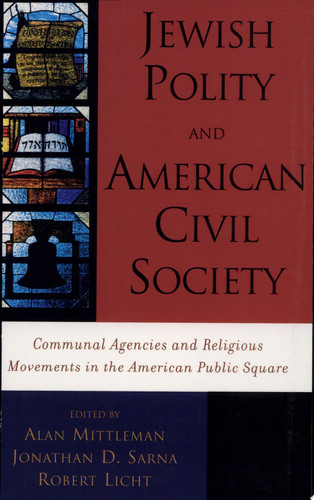
Jewish polity and American civil society: communal agencies and religious movements in the American public sphere

Alan Mittleman,Robert Licht,Jonathan D. Sarna
Jewish Polity and American Civil Society is a study of the civic and political engagements of American Jews as mediated by their communal and denominational institutions. The book explores how the various branches of the organized Jewish community seek to influence public affairs. Over the course of the last century, Jewish agencies and religious movements have tried to shape public debate and public policy on such issues as civil rights, church-state relations, and American foreign policy. The book sets the history of Jewish engagement in these areas into historical context; analyzes the motives, strategies, and tactics of various Jewish groups, and evaluates their successes and failures. The book also explores the underlying idea-the public philosophy-that informs American Jews' understanding of civic and political engagement.
Rowman & Littlefield 2002-07-23 420 pages

The paradox of American democracy: elites, special interests, and the betrayal of the public trust

Judis, John B.
John B. Judis, one of our most insightful political commentators, most rational and careful thinkers, and most engaged witnesses in Washington, has taken on a challenge that even the most concerned American citizens shrink from: forecasting the American political climate at the turn of the century. The Paradox of American Democracy is a penetrating examination of our democracy that illuminates the forces and institutions that once enlivened it and now threaten to undermine it. It is the well-reasoned discussion we need in this era of unrestrained expert opinions and ideologically biased testimony. The disenchantment with our political system can be seen in decreasing voter turnout, political parties co-opted by consultants and large contributors, the corrupting influence of "soft money," and concern for national welfare subverted by lobbying organizations and special-interest groups. Judis revisits particular moments -- the Progressive Era, the New Deal, the 1960s -- to discover what makes democracy the most efficacious and, consequently, most inefficacious. What has worked in the past is a balancing act between groups of elites --- trade commissions, labor relations boards, policy groups -- whose mandates are to act in the national interest and whose actions are governed by a disinterested pursuit of the common good. Judis explains how the displacment of such elites by a new lobbying community in Whashington has given rise to the cynicism that corrodes the current political system. The Paradox of American Democracy goes straight to the heart of every political debate in this country.
Pantheon Books 2000-02-15 305 pages

The militarization of Indian country

LaDuke, Winona
"When it became public that Osama bin Laden's death was announced with the phrase "Geronimo, EKIA!" many Native people, including Geronimo's descendants, were insulted to discover that the name of a Native patriot was used as a code name for a world-class terrorist. Geronimo descendant Harlyn Geronimo explained, "Obviously to equate Geronimo with Osama bin Laden is an unpardonable slander of Native America and its most famous leader." The Militarization of Indian Country illuminates the historical context of these negative stereotypes, the long political and economic relationship between the military and Native America, and the environmental and social consequences. This book addresses the impact that the U.S. military has had on Native peoples, lands, and cultures. From the use of Native names to the outright poisoning of Native peoples for testing, the U.S. military's exploitation of Indian country is unparalleled and ongoing."--Publisher's website.
Makwa Enewed 2012 92 pages

Left out: the politics of exclusion : essays, 1964-2002

Duberman, Martin B.
"One would be hard-pressed to name a more admirable contemporary American example of the intellectual engage than Martin Duberman. Historian, playwright, memoirist, biographer, social commentator, teacher, activist and assured podium performer, Duberman is an unapologetic, uncategorizable and nonsectarian radical whose constant questioning of conventional wisdoms - even on the left - has made him one of this country's pre-eminent participants in the political and cultural wars that have riven public life."â__In These Times"A marvelous collection of a lifetime of courageous writing by a deeply moral and reflective man who has engaged the greatest struggles of our times with an unflinching nerve, a wise heart and a brilliant intellect informed at all times by compassion."â__Jonathan KozolThe lives of â__outsidersâ__ have been the focus of Martin Duberman's work as a public intellectual for the past four decades. Best known for his biography of Paul Robeson, Duberman highlights the "banding together" of the excluded in Left Out. These identity-based movementsâ__black power, gay liberation, feminismâ__have created a vital and controversial change in American consciousness in recent decades. Duberman's collected essays trace this evolution of thought to the history of dissent from abolitionism through the New Left to today's organizing.Presenting summations of Duberman's views on such matters as race, foreign policy, gender and sexuality, Left Out offers incisive analyses of the split between class-based and identity-based politics on the Left. The "godfather" of the gay studies movement, Duberman has taken many brave and prescient stands. His writing shows why he is considered a deeply moral and wise man. For the first time available in paperback, this edition, updated through 2002, includes three new essays: "The State of Gay Studies," "Queer Economic Justice," and "Jewish Radicals, Effeminacy, and the Rise of Gay Chauvinism".
South End Press 2002 504 pages