166 results for "Science"

How to Ruin the United States of America

Ben Stein
On the heels of his very successful books, How to Ruin Your Life, How to Ruin Your Love Life, and How to Ruin Your Financial Life, Ben Stein, in collaboration with his pal Phil DeMuth, has tongue firmly in cheek once again as he comes up with surefire ways to ruin the greatest nation in the history of the human race. Try a few of these on for size: Trust the United Nations to protect us and our security. Make it unlawful to worship God or even to show images of the Ten Commandments. Convert our universities into fortresses of anti-Americanism, hatred of freedom, and centers of confusion and ignorance. Encourage contempt for the family and for the community. Allow Hollywood to brainwash us into believing that only suckers and criminals fight for their country. Treat the military, the police, firefighters, and teachers as losers and pay them starvation wages. Hey, does any of this sound familiar? Maybe that's because it's already happening! Ben and Phil give you all the information you'll ever need in order to successfully ruin the USA even further! Sardonic, humorous, but also angrily emphatic, this is a book every old-fashioned patriot really needs to read!
ReadHowYouWant.com 2010-06-21 168 pages

Great Society A New History

Amity Shlaes
The New York Times bestselling author of The Forgotten Man and Coolidge offers a stunning revision of our last great period of idealism, the 1960s, with burning relevance for our contemporary challenges. "Great Society is accurate history that reads like a novel, covering the high hopes and catastrophic missteps of our well-meaning leaders." --Alan Greenspan Today, a battle rages in our country. Many Americans are attracted to socialism and economic redistribution while opponents of those ideas argue for purer capitalism. In the 1960s, Americans sought the same goals many seek now: an end to poverty, higher standards of living for the middle class, a better environment and more access to health care and education. Then, too, we debated socialism and capitalism, public sector reform versus private sector advancement. Time and again, whether under John F. Kennedy, Lyndon Johnson, or Richard Nixon, the country chose the public sector. Yet the targets of our idealism proved elusive. What's more, Johnson's and Nixon's programs shackled millions of families in permanent government dependence. Ironically, Shlaes argues, the costs of entitlement commitments made a half century ago preclude the very reforms that Americans will need in coming decades. In Great Society, Shlaes offers a powerful companion to her legendary history of the 1930s, The Forgotten Man, and shows that in fact there was scant difference between two presidents we consider opposites: Johnson and Nixon. Just as technocratic military planning by "the Best and the Brightest" made failure in Vietnam inevitable, so planning by a team of the domestic best and brightest guaranteed fiasco at home. At once history and biography, Great Society sketches moving portraits of the characters in this transformative period, from U.S. Presidents to the visionary UAW leader Walter Reuther, the founders of Intel, and Federal Reserve chairmen William McChesney Martin and Arthur Burns. Great Society casts new light on other figures too, from Ronald Reagan, then governor of California, to the socialist Michael Harrington and the protest movement leader Tom Hayden. Drawing on her classic economic expertise and deep historical knowledge, Shlaes upends the traditional narrative of the era, providing a damning indictment of the consequences of thoughtless idealism with striking relevance for today. Great Society captures a dramatic contest with lessons both dark and bright for our own time.
HarperCollins Publishers 2020-11-24 528 pages

Rich Bitch A Simple 12-Step Plan for Getting Your Financial Life Together... Finally

Nicole Lapin
NEW YORK TIMES BESTSELLER In this New York Times bestseller, journalist and financial expert Nicole Lapin shows women how to take charge of their lives by taking charge of their money "You might not know this but stressing over money can harm your overall health. Let Nicole be the doctor for your financial health and you will feel better in more ways than you'd think." --Dr. Oz, host of the "Dr. Oz Show", and Lisa Oz, host of the "Lisa Oz Show" Do your eyes glaze over just thinking about the mumbo-jumbo language of finance? Do you break out into hives when faced with getting your financial life together? Well, sister, you are not alone. In Rich Bitch, money expert and financial journalist Nicole Lapin lays out a 12-Step Plan in which she shares her experiences--mistakes and all--of getting her own finances in order. She talks to you not like a lecturer but as your friend. And even though money is typically an "off-limits" conversation, nothing is off-limits here. Lapin rethinks every piece of financial "wisdom" you've ever heard and puts her own fresh, modern, sassy spin on it. Sure, there are some hard-and-fast rules about finance, but when it comes to your money, the only person who can tell you how to spend it is you. Should you invest in a 401(k)? Maybe not. Should you splurge on that morning latte? Likely yes. Instead of focusing on nickel-and-diming yourself, Nicole's advice focuses on investing in yourself so you don't have to stress over the little things. Rich Bitch rehabs whatever bad money habits you might have and provides a plan you can not only sustain, but also thrive on. You won't feel deprived but rather inspired to go after the rich life you deserve, and confident enough to call yourself a rich bitch.
HarperCollins Publishers 2019-11-05 400 pages

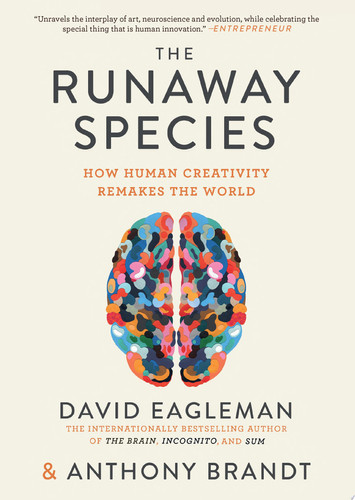
The Runaway Species How Human Creativity Remakes the World

David Eagleman,Anthony Brandt
This enlightening examination of creativity looks “at art and science together to examine how innovations . . . build on what already exists and rely on three brain operations: bending, breaking and blending” ( The Wall Street Journal ) The Runaway Species is a deep dive into the creative mind, a celebration of the human spirit, and a vision of how we can improve our future by understanding and embracing our ability to innovate. David Eagleman and Anthony Brandt seek to answer the question: what lies at the heart of humanity’s ability—and drive—to create? Our ability to remake our world is unique among all living things. But where does our creativity come from, how does it work, and how can we harness it to improve our lives, schools, businesses, and institutions? Eagleman and Brandt examine hundreds of examples of human creativity through dramatic storytelling and stunning images in this beautiful, full–color volume. By drawing out what creative acts have in common and viewing them through the lens of cutting–edge neuroscience, they uncover the essential elements of this critical human ability, and encourage a more creative future for all of us. “ The Runaway Species approach[es] creativity scientifically but sensitively, feeling its roots without pulling them out.” — The Economist
Catapult 2018-06-19 304 pages

Supercapitalism The Transformation of Business, Democracy, and Everyday Life

Robert B. Reich
Mid-twentieth-century capitalism has turned into global capitalism, and global capitalism - turbocharged, Web-based, and able to find and make almost anything just about anywhere - has turned into supercapitalism. But as Robert B. Reich makes clear in this eye-opening book, while supercapitalism is working wonderfully well to enlarge the economic pie, democracy - charged with caring for all citizens - is becoming less and less effective under its influence. Reich explains how widening inequalities of income and wealth, heightened job insecurity, and the spreading effects of global warming are the logical outcomes of supercapitalism. He shows us why companies, fighting harder than ever to maintain their competitive positions, have become even more deeply involved in politics; and how average citizens, seeking great deals and invested in the stock market to an unprecedented degree, are increasingly loath to stand by their values if it means biting the hands that feed them. As one of America's most influential voices, Reich sets out a clear course to a vibrant capitalism and a concurrent, equally vibrant democracy.
Scribe Publications 2008 272 pages

Get What's Yours The Secrets to Maxing Out Your Social Security

Laurence J. Kotlikoff,Philip Moeller,Paul Solman
"Learn the secrets to maximizing your Social Security benefits and earn up to thousands of dollars more each year with expert advice that you can't get anywhere else. Want to know how to navigate the forbidding maze of Social Security and emerge with the highest possible benefits? You could try reading all 2,728 rules of the Social Security system (and the thousands of explanations of these rules), but Kotlikoff, Moeller, and Solman explain Social Security benefits in an easy to understand and user-friendly style. What you don't know can seriously hurt you: wrong decisions about which Social Security benefits to apply for cost some individual retirees tens of thousands of dollars in lost income every year. How many retirees or those nearing retirement know about such Social Security options as file and suspend (apply for benefits and then don't take them)? Or start stop start (start benefits, stop them, then re-start them)? Or--just as important--when and how to use these techniques? Get What's Yours covers the most frequent benefit scenarios faced by married retired couples, by divorced retirees, by widows and widowers, among others. It explains what to do if you're a retired parent of dependent children, disabled, or an eligible beneficiary who continues to work, and how to plan wisely before retirement. It addresses the tax consequences of your choices, as well as the financial implications for other investments. Many personal finance books briefly address Social Security, but none offers the thorough, authoritative, yet conversational analysis found here. You've paid all your working life for these benefits. Now, get what's yours"--
Thorndike Press 2015 465 pages

From the ground up: a journey to reimagine the promise of America

Schultz, Howard,Gordon, Joanne
"From the longtime CEO and chairman of Starbucks, a bold, dramatic work about the new responsibilities that leaders, businesses, and citizens share in American society today--as viewed through the intimate lens of one man's life and work. What do we owe one another? How do we channel our drive, ingenuity, even our pain, into something more meaningful than individual success? And what is our duty in the places where we live, work, and play? These questions are at the heart of the American journey. They are also ones that Howard Schultz has grappled with personally since growing up in the Brooklyn housing projects and while building Starbucks from eleven stores into one of the world's most iconic brands. In From the Ground Up, Schultz looks for answers in two interwoven narratives. One story shows how his conflicted boyhood--including experiences he has never before revealed--motivated Schultz to become the first in his family to graduate from college, then to build the kind of company his father, a working-class laborer, never had a chance to work for: a business that tries to balance profit and human dignity. A parallel story offers a behind-the-scenes look at Schultz's unconventional efforts to challenge old notions about the role of business in society. From health insurance and free college tuition for part-time baristas to controversial initiatives about race and refugees, Schultz and his team tackled societal issues with the same creativity and rigor they applied to changing how the world consumes coffee. Throughout the book, Schultz introduces a cross-section of Americans transforming common struggles into shared successes. In these pages, lost youth find first jobs, aspiring college students overcome the yoke of debt, post-9/11 warriors replace lost limbs with indomitable spirit, former coal miners and opioid addicts pave fresh paths, entrepreneurs jump-start dreams, and better angels emerge from all corners of the country. From the Ground Up is part candid memoir, part uplifting blueprint of mutual responsibility, and part proof that ordinary people can do extraordinary things. At its heart, it's an optimistic, inspiring account of what happens when we stand up, speak out, and come together for purposes bigger than ourselves. Here is a new vision of what can be when we try our best to lead lives through the lens of humanity."--Dust jacket.
Random House 2019 352 pages

World Without Mind

Franklin Foer
Over the past few decades there has been a revolution in terms of who controls knowledge and information. This rapid change has imperilled the way we think. Without pausing to consider the cost, the world has rushed to embrace the products and services of four titanic corporations. We shop with Amazon; socialise on Facebook; turn to Apple for entertainment; and rely on Google for information. These firms sell their efficiency and purport to make the world a better place, but what they have done instead is to enable an intoxicating level of daily convenience. As these companies have expanded, marketing themselves as champions of individuality and pluralism, their algorithms have pressed us into conformity and laid waste to privacy. They have produced an unstable and narrow culture of misinformation, and put us on a path to a world without private contemplation, autonomous thought, or solitary introspection - a world without mind. In order to restore our inner lives, we must avoid being co-opted by these gigantic companies, and understand the ideas that underpin their success. Elegantly tracing the intellectual history of computer science - from the Descartes and the enlightenment to Alan Turing to Stuart Brand and the hippie origins of today's Silicon Valley - Foer exposes the dark underpinnings of our most idealistic dreams for technology. The corporate ambitions of Google, Facebook, Apple, and Amazon, he argues, are trampling longstanding liberal values, especially intellectual property and privacy. This is a nascent stage in the total automation and homogenization of social, political, and intellectual life. By reclaiming our private authority over how we intellectually engage with the world, we have the power to stem the tide. At stake is nothing less than who we are, and what we will become. There have been monopolists in the past but today's corporate giants have far more nefarious aims. They're monopolists who want access to every facet of our identities and influence over every corner of our decision-making. Until now few have grasped the sheer scale of the threat. Foer explains not just the looming existential crisis but the imperative of resistance.
Jonathan Cape Ltd 2017-09-28 272 pages

Three Days at Camp David How a Secret Meeting in 1971 Transformed the Global Economy

Jeffrey E. Garten
The former dean of the Yale School of Management and Undersecretary of Commerce in the Clinton administration chronicles the 1971 August meeting at Camp David, where President Nixon unilaterally ended the last vestiges of the gold standard--breaking the link between gold and the dollar--transforming the entire global monetary system. Over the course of three days--from August 13 to 15, 1971--at a secret meeting at Camp David, President Richard Nixon and his brain trust changed the course of history. Before that weekend, all national currencies were valued to the U.S. dollar, which was convertible to gold at a fixed rate. That system, established by the Bretton Woods Agreement at the end of World War II, was the foundation of the international monetary system that helped fuel the greatest expansion of middle-class prosperity the world has ever seen. In making his decision, Nixon shocked world leaders, bankers, investors, traders and everyone involved in global finance. Jeffrey E. Garten argues that many of the roots of America's dramatic retrenchment in world affairs began with that momentous event that was an admission that America could no longer afford to uphold the global monetary system. It opened the way for massive market instability and speculation that has plagued the world economy ever since, but at the same time it made possible the gigantic expansion of trade and investment across borders which created our modern era of once unimaginable progress. Based on extensive historical research and interviews with several participants at Camp David, and informed by Garten's own insights from positions in four presidential administrations and on Wall Street, Three Days at Camp David chronicles this critical turning point, analyzes its impact on the American economy and world markets, and explores its ramifications now and for the future.
Harper 2022 464 pages

Football for a Buck The Crazy Rise and Crazier Demise of the USFL

Jeff Pearlman
From Jeff Pearlman--the New York Times best-selling author of Three Ring Circus--comes the rollicking, outrageous story of the USFL, full of larger-than-life characters and you-can't-make-this-up stories featuring some of the biggest celebrities and buffoons in the game. The United States Football League--known fondly to millions of sports fans as the USFL--did not merely challenge the NFL, but cause its owners and executives to collectively shudder. In its three seasons from 1983-85, it secured multiple television deals, drew millions of fans and launched the careers of legends such as Steve Young, Jim Kelly, Herschel Walker, and Reggie White. But then it died beneath the weight of a particularly egotistical and bombastic team owner--a New York businessman named Donald J. Trump. In Football for a Buck, Jeff Pearlman draws on more than four hundred interviews to unearth all the salty, untold stories of one of the craziest sports entities to have ever captivated America. From 1980s drug excess to airplane brawls and player-coach punch outs, to backroom business deals and some of the most enthralling and revolutionary football ever seen, Pearlman transports readers back in time to this crazy, boozy, audacious, unforgettable era of the game. He shows how fortunes were made and lost on the backs of professional athletes and how, forty years ago, Trump was already a scoundrel and a spoiler. For fans of Terry Pluto's Loose Balls or Jim Bouton's Ball Four and of course Pearlman's own stranger-than-fiction narratives, Football for a Buck is sports as high entertainment--and a cautionary tale of the dangers of ego and excess.
HarperCollins Publishers 2019-09-10 400 pages

Evolutionary Psychology in the Business Sciences

Gad Saad
All individuals who operate in the business sphere, whether as consumers, employers, employees, entrepreneurs, or financial traders to name a few constituents, share a common biological heritage and are defined by a universal human nature. As such, it is surprising that so few business scholars have incorporated biological and evolutionary-informed theories within their conceptual toolboxes. This edited book addresses this lacuna by culling chapters at the intersection of the evolutionary behavioral sciences and specific business contexts including in marketing, consumer behavior, advertising, innovation and creativity, intertemporal choice, negotiations, competition and cooperation in organizational settings, sex differences in workplace patterns, executive leadership, business ethics, store design, behavioral decision making, and electronic communication. To reword the famous aphorism of T. G. Dobzhansky, nothing in business makes sense except in the light of evolution.
Springer Berlin Heidelberg 2014-09-28 371 pages

Data Science and Digital Business

Fausto Pedro García Márquez,Benjamin Lev
This book combines the analytic principles of digital business and data science with business practice and big data. The interdisciplinary, contributed volume provides an interface between the main disciplines of engineering and technology and business administration. Written for managers, engineers and researchers who want to understand big data and develop new skills that are necessary in the digital business, it not only discusses the latest research, but also presents case studies demonstrating the successful application of data in the digital business.
Springer International Publishing 2019-01-16 316 pages

Never Leave Well Enough Alone

Raymond Loewy
Never Leave Well Enough Alone, first published in 1951, is the classic introduction to modern industrial design by the 'father' of the movement - Raymond Loewy. Loewy (1893-1986) was responsible for transforming thousands of everyday objects into streamlined masterpieces, many of which are still popular and in-use in daily life today. Examples include corporate logos; packaging for Lucky Strike cigarettes and Pepsodent toothpaste; Studebaker and Greyhound automotive and bus design; buildings and household furnishings; and appliances such as toasters and refrigerators. This new reprint edition is formatted to Loewy's original design of 6 inches by 7 inches - his first foray into book design; and is illustrated throughout with drawings and photographic examples of his work.
Pathfinder Books 2023-05-15 466 pages

John L. Lewis An Unauthorized Biography

Saul Alinsky
This is the story of a 30 year, one-man war. The author confesses his bias - in favor of labor, in friendship with Lewis, but he manages to present Lewis convincingly, with his complicated personality, his inconsistencies, his dynamic power, his ruthless use of any means to his end. He traces the steps by which he reached the peak from the pits of Illinois mines. He tells how he created C.I.O. in protest over the limitations of A.F. of L.; of how he secured his own U.M.W. even at the cost of dictatorship. He goes behind the scenes for his breaks with Green, with Murray, with Roosevelt. But the end-all is gains for his miners - in pay, in safety, in security. Brilliant analysis, an unflaggingly interesting chapter in American labor, it provides an interesting insight into a fascinating part of American history. It's a reminder of what unions did achieve and it is a contrast to the comparative powerless of unions these days.
Must Have Books 2021-04-14 262 pages

Hopes and Prospects

Noam Chomsky
In this urgent new book, Noam Chomsky surveys the dangers and prospects of our early twenty-first century. Exploring challenges such as the growing gap between North and South, American exceptionalism (including under President Barack Obama), the fiascos of Iraq and Afghanistan, the U.S.-Israeli assault on Gaza, and the recent financial bailouts, he also sees hope for the future and a way to move forward - in the democratic wave in Latin America and in the global solidarity movements that suggest ''real progress toward freedom and justice.'' Hopes and Prospects is essential reading for anyone who is concerned about the primary challenges still facing the human race.
ReadHowYouWant.com 2010 544 pages

Revolt The Worldwide Uprising Against Globalization

Nadav Eyal
A well-written and thought-provoking account of the current crisis of globalization. Not everyone will agree with Eyal's interpretation, but few will remain indifferent.' --Yuval Noah Harari, author of SapiensRevolt is an eloquent and provocative challenge to the prevailing wisdom about the rise of nationalism and populism. With a vibrant and informed voice, Nadav Eyal illustrates how modern globalization is not sustainable. He contends that the collapse of the current world order is not so much about the imbalance between technological achievement and social progress or the breakdown of liberal democracy as it is about a passion to upend and destroy power structures that have become hollow, corrupt, or simply unresponsive to urgent needs. Eyal illuminates the benign and malignant forces that have so rapidly transformed our economic, political and cultural realities, shedding light not only on the economic and cultural revolution that has come to define our time but also on the counterrevolution waged by those it has marginalized and exploited.With a mixture of journalistic narrative, penetrating vignettes and original analysis, Revolt shows that the left and right have much in common. Eyal tells stories of distressed Pennsylvania coal miners, anarchist communes on the outskirts of Athens, a Japanese town with collapsing fertility rates, neo-Nazis in Germany and Syrian refugee families whom he accompanied from the shores of Greece to their destination in Germany. Into these reports from the present Eyal weaves lessons from the past, from the opium wars in China to colonialist Haiti to the Marshall Plan. With these historical ties, he shows that the revolts' roots have always been deep and strong, and that rather than seeing current uprisings as part of a passing phenomenon, we should recognize that revolt is the new status quo.
Pan Macmillan 2021 512 pages

Microtrends The Small Forces Behind Tomorrow's Big Changes

Mark Penn
The adviser to Senator Hillary Clinton, Bill Gates, and President Bill Clinton proves that small is big by identifying 75 hidden-in-plain-sight trends that are moving America, revealing that the nation is no longer a melting pot but a collection of communities with many individual tastes and lifestyles. "The ideas in his book will help you see the world in a new way." --Bill Clinton "Mark Penn has a keen mind and a fascinating sense of what makes America tick, and you see it on every page of Microtrends ." --Bill Gates In 1982, readers discovered Megatrends . In 2000, The Tipping Point entered the lexicon. Now, in Microtrends , one of the most respected and sought-after analysts in the world articulates a new way of understanding how we live. Mark Penn, the man who identified "Soccer Moms" as a crucial constituency in President Clinton's 1996 reelection campaign, is known for his ability to detect relatively small patterns of behavior in our culture-microtrends that are wielding great influence on business, politics, and our personal lives. Only one percent of the public, or three million people, is enough to launch a business or social movement. Relying on some of the best data available, Penn identifies more than 70 microtrends in religion, leisure, politics, and family life that are changing the way we live. Among them: People are retiring but continuing to work. Teens are turning to knitting. Geeks are becoming the most sociable people around. Women are driving technology. Dads are older than ever and spending more time with their kids than in the past. You have to look at and interpret data to know what's going on, and that conventional wisdom is almost always wrong and outdated. The nation is no longer a melting pot. We are a collection of communities with many individual tastes and lifestyles. Those who recognize these emerging groups will prosper. Penn shows readers how to identify the microtrends that can transform a business enterprise, tip an election, spark a movement, or change your life. In today's world, small groups can have the biggest impact.
Grand Central Publishing 2007-09 448 pages

Other People's Money and How The Bankers Use It

Louis D. Brandeis
Louis D. Brandeis was a Supreme Court Justice and a patriot. He wrote "Other People's Money and How Bankers Use It" to warn the American people about the greedy bankers that control the United States and drive us into financial ruin. The book attacked the use of investment funds to promote the consolidation of various industries under the control of a small number of corporations, which Brandeis alleged were working in concert to prevent competition. Brandeis harshly criticized investment bankers who controlled large amounts of money deposited in their banks by middle-class people. The heads of these banks, Brandeis pointed out, routinely sat on the boards of railroad companies and large industrial manufacturers of various products, and routinely directed the resources of their banks to promote the interests of their own companies. These companies, in turn, sought to maintain control of their industries by crushing small businesses and stamping out innovators who developed better products to compete against them. Brandeis supported his contentions with a discussion of the actual dollar amounts--in millions of dollars--controlled by specific banks, industries, and industrialists such as J. P. Morgan, noting that these interests had recently acquired a far larger proportion of American wealth than corporate entities had ever had before. He extensively cited testimony from a Congressional investigation performed by the Pujo Committee, named after Louisiana Representative Arsène Pujo, into self-serving and monopolistic business dealing. Chapter V of the book ("What Publicity Can Do") contains in its opening section a well-known line that has frequently been cited in support of regulation through disclosure obligations: "Sunlight is said to be the best of disinfectants; electric light the most efficient policeman."
Brian Westland 1914 108 pages

I Am Spartacus!

Kirk. Douglas
A "lively" memoir by the Hollywood legend about the making of Spartacus , with a foreword by George Clooney ( Los Angeles Times ). One of the world's most iconic movie stars, Kirk Douglas has distinguished himself as a producer, philanthropist, and author of ten works of fiction and memoir. Now, more than fifty years after the release of his enduring epic Spartacus , Douglas reveals the riveting drama behind the making of the legendary gladiator film. Douglas began producing the movie in the midst of the politically charged era when Hollywood's moguls refused to hire anyone accused of Communist sympathies. In a risky move, Douglas chose Dalton Trumbo, a blacklisted screenwriter, to write Spartacus . Trumbo was one of the "Unfriendly Ten," men who had gone to prison rather than testify before the House Un-American Activities Committee about their political affiliations. Douglas's source material was already a hot property, as the novel Spartacus was written by Howard Fast while he was in jail for defying HUAC. With the financial future of his young family at stake, Douglas plunged into a tumultuous production both on- and off-screen. As both producer and star of the film, he faced explosive moments with young director Stanley Kubrick, struggles with a leading lady, and negotiations with giant personalities, including Sir Laurence Olivier, Charles Laughton, Peter Ustinov, and Lew Wasserman. Writing from his heart and from his own meticulously researched archives, Kirk Douglas, at ninety-five, looks back at his audacious decisions. He made the most expensive film of its era--but more importantly, his moral courage in giving public credit to Trumbo effectively ended the notorious Hollywood blacklist. A master storyteller, Douglas paints a vivid and often humorous portrait in I Am Spartacus! The book is enhanced by newly discovered period photography of the stars and filmmakers both on and off the set.
Open Road Integrated Media, Incorporated 2014-01-21 220 pages