104 results for "Science"

The wires of war: technology and the global struggle for power

Helberg, Jacob
From the former news policy lead at Google, an urgent and groundbreaking account of the high-stakes global cyberwar brewing between Western democracies and the autocracies of China and Russia that could potentially crush democracy. From 2016 to 2020, Jacob Helberg led Google's global internal product policy efforts to combat disinformation and foreign interference. During this time, he found himself in the midst of what can only be described as a quickly escalating two-front technology cold war between democracy and autocracy. On the front-end, we're fighting to control the software--applications, news information, social media platforms, and more--of what we see on the screens of our computers, tablets, and phones, a clash which started out primarily with Russia but now increasingly includes China and Iran. Even more ominously, we're also engaged in a hidden back-end battle--largely with China--to control the Internet's hardware, which includes devices like cellular phones, satellites, fiber-optic cables, and 5G networks. This tech-fueled war will shape the world's balance of power for the coming century as autocracies exploit twenty-first-century methods to re-divide the world into twentieth century-style spheres of influence. Helberg cautions that the spoils of this fight are power over every meaningful aspect of our lives, including our economy, our infrastructure, our national security, and ultimately, our national sovereignty. Without a firm partnership with the government, Silicon Valley is unable to protect democracy from the autocrats looking to sabotage it from Beijing to Moscow and Tehran. The stakes of the ongoing cyberwar are no less than our nation's capacity to chart its own future, the freedom of our democratic allies, and even the ability of each of us to control our own fates, Helberg says. And time is quickly running out.
Avid Reader Press 2022 360 pages

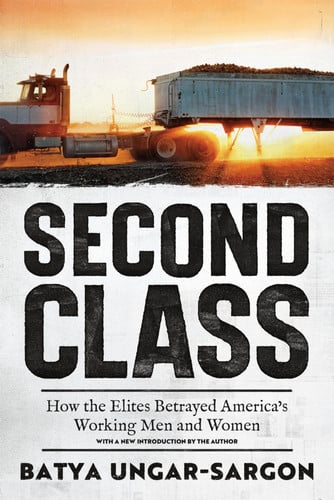
Second class: how the elite betrayed America's working men and women

Ungar-Sargon, Batya
A personal, journalistic ethnography of the modern American working class, based on the travels and interactions of the author through the American heartland. " Second Class is the most important book you will read all year. A political realignment is coming, and it's my hope that the end result will work in favor of our all-too-neglected American working class. When that realignment comes, Batya and her book will help lead the way." --Greg Lukianoff, CEO of the Foundation for Individual Rights in Education, and co-author of The Coddling of the American Mind Who is the American working class? Do they still have a fair shot at the American Dream? What do they think about their chances to secure the hallmarks of a middle-class life? While writing this book, Batya Ungar-Sargon visited states across the nation to speak with members of the American working class who are fighting tooth and nail to survive. In Second Class , working-class Americans of all races, political orientations, and occupations share their stories--cleaning ladies, health care aides, cops, truck drivers, fast food workers, electricians, and more. In their own words, these working-class Americans explain the struggles and triumphs of their increasingly precarious lives--as well as what policies they think would improve them. Second Class combines deep reporting with a look at the data and expert opinions on America's emergent class divide, in which the most basic elements of a secure and stable life are increasingly out of reach for those without a college education. America has broken its contract with its laboring class. So, how do we get back to the American Dream? How do we once again become the land of opportunity, the promised land, where hard work and commitment to family are enough to protect you from poverty? It's not that hard actually. All it would take, as this book illustrates, is for those in power to once again respect the dignity of work--and the American worker.
Encounter Books 2025 248 pages

The Road to Freedom Economics and the Good Society

Joseph E. Stiglitz
We are a nation born from the conviction that people must be free. But since the middle of the last century, that idea has been co-opted. Forces on the political Right have justified exploitation by cloaking it in the rhetoric of freedom, leading to pharmaceutical companies freely overcharging for medication, a Big Tech free from oversight, politicians free to incite rebellion, corporations free to pollute, and more. How did we get here? Whose freedom are we--and should we--be thinking about? In The Road to Freedom, Nobel prize winner Joseph E. Stiglitz dissects America's current economic system and the political ideology that created it, laying bare their twinned failure. "Free" and unfettered markets have only succeeded in delivering a series of crises: the financial crisis, the opioid crisis, and the crisis of inequality. While a small portion of the population has amassed considerable wealth, wages for most people have stagnated. Free and unfettered markets have exploited consumers, workers, and the environment alike. Such failures have fed populist movements that believe being free means abandoning any obligations citizens have to one another. As they grow in strength, these movements now pose a real threat to true economic and political freedom. As an economic advisor to presidents and as chief economist at the World Bank, Stiglitz has witnessed these profound changes firsthand. As he argues, the failures follow from the elites' unshakeable dedication to "the neoliberal experiment." Explicitly taking on giants such as Friedrich Hayek and Milton Friedman, Stiglitz exposes accepted ideas about our political and economic life for what they are: twisted visions that tear at the social fabric while they enrich the very few. The Road to Freedom breaks new ground, showing how economics--including recent advances in which Stiglitz has played such an important role--reframes how to think about freedom and the role of the state in a twenty-first century society. Drawing on the work of contemporary philosophers, Stiglitz explains a deeper, more humane way to assess freedoms--one that considers with care what to do when one person's freedom conflicts with another's. We must reimagine our existing economic and legal systems and embrace forms of collective action, including regulation and investment, if we are to create an innovative society in which everyone can flourish. The task could not be more urgent, and Stiglitz's latest book is essential reading for those committed to the American ideal of an economic and political system that delivers well-being, opportunity, and meaningful freedoms for all.
W. W. Norton, Incorporated 2026-02-24 384 pages

The Idealist Jeffrey Sachs and the Quest to End Poverty

Nina Munk
A powerful portrayal of Jeffrey Sachs's ambitious quest to end extreme global poverty, now a Signal paperback. "The poor you will always have with you," according to Matthew 26:11. But Jeffrey Sachs, economics superstar, special advisor to the Secretary General of the UN and the author of The End of Poverty , vehemently disagrees. In his view, poverty -- especially the extreme deprivation of sub-Saharan Africa -- can easily be eradicated. The vast sums spent in foreign aid over the decades has not come close to alleviating the dire subsistence problems of Africans. Sachs believed he knew the reason: the developed world simply hadn't spent enough. In 2006, Sachs, backed by tens of millions of donor dollars, launched the five-year Millennium Villages Project. Sachs would test his theories in villages in different African countries, then, with each success, scale up until until the program was continent-wide. His first village "make-over" was a small community in Sauri, Kenya, and the immediate effect was encouraging. With that first inkling of success achieved, Sachs rolled out a dozen model Millennium villages in ten countries. For the past six years, Nina Munk has reported deeply on the Project, following Sachs on official trips and listening in on conversations with heads of states, rival organisations and potential donors. And she has immersed herself in the lives of people in two of the remote villages: Ruhiira, in southwest Uganda, and Dertu, in the arid borderland between Kenya and Somalia. Accepting hospitality from these camel herders and smallhold farmers, and sharing in their struggles, Munk came to understand the on-the-ground issues challenging Sachs' one-size-fits-all approach to global poverty. The Idealist is the profound and moving story of what happened when the abstract theories of a brilliant, driven man met messy human reality.
McClelland & Stewart 2014-10-07 288 pages

Management? It's Not What You Think!

Mintzberg, Henry,Ahlstrand, Bruce,Lampel, Joseph
Whether you subscribe to the philosophy that management is an art and not a science or that it’s a science composed of best practices and systemic steps, one thing is for sure: there is no one easy way to describe what managers do. In this inspiring book, Henry Mintzberg, one of today’s most respected and controversial thinkers on management, joins forces with other leading business figures to provide a provocative mix of writing on management that inspires laughter as much as it brings forth tears (for poor old management itself!). Management? It’s Not What You Think! gets readers thinking as they never have before on topics including management terminology and buzzwords, myths and maxims, MBAs, management fads, leadership, strategy, and much more. With wit, intrigue, and plenty of food for thought, Mintzberg presents articles, book and journal excerpts, letters, web selections, and musings that will spark debate in managers of all types and experiences and renew their interest in doing what they do best--managing.
AMACOM 2025-08-05 192 pages

The economics of climate change: The stern review

Stern, Nicholas
There is now clear scientific evidence that emissions from economic activity, particularly the burning of fossil fuels for energy, are causing changes to the Earth's climate. A sound understanding of the economics of climate change is needed in order to underpin an effective global response to this challenge. The Stern Review is an independent, rigourous and comprehensive analysis of the economic aspects of this crucial issue. It has been conducted by Sir Nicholas Stern, Head of the UK Government Economic Service, and a former Chief Economist of the World Bank. The Economics of Climate Change will be invaluable for all students of the economics and policy implications of climate change, and economists, scientists and policy makers involved in all aspects of climate change.
Cambridge University Press 2008 500 pages

Climate justice: what rich nations owe the world - and the future

Sunstein, Cass R.
The social cost of carbon: The most important number you've never heard of—and what it means. If you’re injuring someone, you should stop—and pay for the damage you’ve caused. Why does this simple proposition, generally accepted, not apply to climate change? In Climate Justice , a bracing challenge to status quo thinking on the ethics of climate change, renowned author and legal scholar Cass Sunstein clearly frames what’s at stake and lays out the moral imperative: When it comes to climate change, everyone must be counted equally, regardless of when they live or where they live—which means that wealthy nations, which have disproportionately benefited from greenhouse gas emissions, are obliged to help future generations and people in poor nations that are particularly vulnerable.
The MIT Press 2025 195 pages

Administrative Behavior

Simon, Herbert A.
In this fourth edition of his ground-breaking work, Herbert A. Simon applies his pioneering theory of human choice and administrative decision-making to concrete organizational problems. To commemorate the fiftieth anniversary of the book's original publication, Professor Simon enhances his timeless observations on the human decision-making process with commentaries examining new facets of organizational behavior. Investigating the impact of changing social values and modem technology on the operation of organizations, the new ideas featured in this revised edition update a book that has become a worldwide classic. Named by Public Administration Review as "Book of the Half Century," Administrative Behavior is considered one of the most influential books on social science thinking, and was referred to by the Nobel Committee as "epoch-making." Written for managers and other professionals who wish to understand the decision-making processes at the heart of organization and management, it is also essential reading for students in business and management, economics, sociology, psychology computer science, government, and law.
The Macmillan Company 1957 259 pages

Manipulation: what it is, why it's bad, what to do about it

Sunstein, Cass R.
"New technologies are offering companies, politicians, and others unprecedented opportunity to manipulate us. Sometimes we are given the illusion of power - of freedom - through choice, yet the game is rigged, pushing us in specific directions that lead to less wealth, worse health, and weaker democracy. In, Manipulation, nudge theory pioneer and New York Times bestselling author, Cass Sunstein, offers a new definition of manipulation for the digital age, explains why it is wrong; and shows what we can do about it. He reveals how manipulation compromises freedom and personal agency, while threatening to reduce our well-being; he explains the difference between manipulation and unobjectionable forms of influence, including 'nudges'; and he lifts the lid on online manipulation and manipulation by artificial intelligence, algorithms, and generative AI, as well as threats posed by deepfakes, social media, and 'dark patterns,' which can trick people into giving up time and money. Drawing on decades of groundbreaking research in behavioral science, this landmark book outlines steps we can take to counteract manipulation in our daily lives and offers guidance to protect consumers, investors, and workers." --
Cambridge University Press 2025-08-28 219 pages

In an uncertain world: tough choices from Wall Street to Washington

Rubin, Robert Edward
Publisher's description: Robert Rubin was sworn in as the seventieth U.S. Secretary of the Treasury in January 1995 in a brisk ceremony attended only by his wife and a few colleagues. As soon as the ceremony was over, he began an emergency meeting with President Bill Clinton on the financial crisis in Mexico. This was not only a harbinger of things to come during what would prove to be a rocky period in the global economy; it also captured the essence of Rubin himself--short on formality, quick to get into the nitty-gritty. From his early years in the storied arbitrage department at Goldman Sachs to his current position as chairman of the executive committee of Citigroup, Robert Rubin has been a major figure at the center of the American financial system. He was a key player in the longest economic expansion in U.S. history.
Random House 2003 427 pages

Minds wide shut: how the new fundamentalisms divide us

Morson, Gary Saul,Schapiro, Morton Owen
A timely exploration of intellectual dogmatism in politics, economics, religion, and literature—and what can be done to fight it Polarization may be pushing democracy to the breaking point. But few have explored the larger, interconnected forces that have set the stage for this crisis: namely, a rise in styles of thought, across a range of fields, that literary scholar Gary Saul Morson and economist Morton Schapiro call “fundamentalist.” In Minds Wide Shut , Morson and Schapiro examine how rigid adherence to ideological thinking has altered politics, economics, religion, and literature in ways that are mutually reinforcing and antithetical to the open-mindedness and readiness to compromise that animate democracy. In response, they propose alternatives that would again make serious dialogue possible. Fundamentalist thinking, Morson and Schapiro argue, is not limited to any one camp. It flourishes across the political spectrum, giving rise to dueling monologues of shouting and abuse between those who are certain that they can’t be wrong, that truth and justice are all on their side, and that there is nothing to learn from their opponents, who must be evil or deluded. But things don’t have to be this way. Drawing on thinkers and writers from across the humanities and social sciences, Morson and Schapiro show how we might begin to return to meaningful dialogue through case-based reasoning, objective analyses, lessons drawn from literature, and more. The result is a powerful invitation to leave behind simplification, rigidity, and extremism—and to move toward a future of greater open-mindedness, moderation, and, perhaps, even wisdom.
Princeton University Press 2023-01-31 307 pages

Essays in positive economics

Friedman, Milton
"Stimulating, provocative, often infuriating, but well worth reading."—Peter Newman, Economica "His critical blast blows like a north wind against the more pretentious erections of modern economics. It is however a healthy and invigorating blast, without malice and with a sincere regard for scientific objectivity."—K.E. Boulding, Political Science Quarterly "Certainly one of the most engrossing volumes that has appeared recently in economic theory."—William J. Baumol, Review of Economics and Statistics
University of Chicago press 1953 328 pages

Get Smarter Life and Business Lessons

Seymour Schulich
Get Smarter is Schulich's original and informative attempt to impart lessons learned in a lifetime to today's youth by someone who has achieved success in both his personal and professional life. In short, stand-alone chapters he covers such universal issues as: Making decisions Choosing careers Handling business Dealing with adversity Managing relationships Investing lessons The objective (to paraphrase Oliver Wendell Holmes) is to stretch young people's minds with new ideas, age-old truths and insights such that they never return to their original dimensions. Readers of this book will derive considerable inspiration from the life and business lessons contained in it. Many business or life lesson books leave you with two or three main ideas. Seymour Schulich's hope is that each reader who invests in this book will leave with twenty to thirty ideas?and some that they can use to help transform or shape their lives. About The Author: Seymour Schulich, 67, is a Canadian self-made billionaire whose career has spanned stock brokerage, investment counseling, mining, and the oil industry. He is among Canada's greatest philanthropists, having donated in excess of $200 million. Over 650 scholarships are awarded annually to students in Schulich schools. He holds degrees in science (chemistry), an MBA and is a Chartered Financial Analyst (CFA). Derek Decloet, 33, is one of Canada's most respected business journalists. He is a widely read columnist for The Globe and Mail newspaper. He is married and lives in Toronto with his wife and son.
Good Times Books 2011 258 pages

Keynes for Our Times

Skidelsky, Robert
"John Maynard Keynes (1883-1946) was arguably the most important economist of the twentieth century; his ideas have fundamentally altered the way governments approach economic policy. Exploring the enduring relevance of his ideas, Robert Skidelsky emphasizes Keynes's conception of economics as a moral science. Keynes was deeply invested in the broader societal implications of economic policies, and this book highlights his belief in economics as a tool for achieving the good life. Skidelsky sheds new light on Keynes's views on capitalism, discusses his advocacy of low interest rates, and delves into his thoughts on economic instability. He also offers fresh insight into Keynes's ideas about money, his philosophical foundations, and his unique approach to uncertainty and probability. Ultimately, Skidelsky shows how Keynes's vision of an economic policy that prioritizes the common good can be adapted to help solve our current economic and political challenges"--
Yale University Press 2026-06-23 186 pages