48 results for "Science"

Rainbow Solidarity in Defense of Cuba

Leslie Feinberg
Featuring an insightful look at lesbian, gay, bisexual, and transgender (LGBT) life in Cuba, this chronicle illuminates the progress the country has made from centuries of backward attitudes and oppression to the current state of enlightenment. From the mores of the Colonial period to the roles that Hollywood, the CIA, and Wall Street played in depicting Cuba as a "police state" for gays and in reinforcing the oppression, this overview provides a backdrop of the past and illustrates the persecution and exploitation originally planted by Spanish colonialism and further cultivated by U.S. capitalism. Details on the gradual transformation follow as the narrative examines the impact of the political and institutional initiatives taken by Fidel Castro and the Cuban leadership to overcome bigotry and prejudice against LGBT people--among them free health care and education, guaranteed jobs and housing, special health care for AIDS victims, and widespread sex education.
World View Forum 2009 116 pages

Wrestling with the Angel of Democracy On Being an American Citizen

Susan Griffin
What does is it mean to be a citizen of the United States? Susan Griffin’s provocative investigation of that question takes us from the Declaration of Independence to the Iraq War, with many stops in between. Her conclusion: democracy is nothing less than a revolution of consciousness, and the revolution has just begun.
Shambhala Publications, Incorporated 2009-11-10 291 pages

Fear in Chile: lives under Pinochet

Politzer Kerekes, Patricia
"Like a García Márquez novel that has suddenly, horrifyingly, come to real life" ( New York Newsday ), Fear in Chile is an extraordinary collection of firstperson accounts of life under dictatorship. In the 1980s, shortly after Chile emerged from one of the century's most notorious reigns of terror, Chilean journalist Patricia Politzer interviewed figures including a revolutionary activist, a military leader loyal to General Augusto Pinochet, a bank clerk concerned with the status quo, the mother of one of the "disappeared," as well as a dozen other men and women from every political position and social stratum of Chilean life. The result is a broad, vivid, yet nonideological view of modern life under military rule, about which Ariel Dorfman writes, "I can think of no better introduction to my country." With the October 1998 arrest of General Pinochet in Great Britain and renewed world awareness of the horrendous crimes committed during his regime, Fear in Chile , updated with a new afterword by the author that considers the recent attempts to prosecute Pinochet for human-rights violations, offers a vivid portrait of Chile's Pinochet era.
New Press 2001 254 pages

And Then I Danced Traveling the Road to LGBT Equality

Mark Segal
"[A] swiftly written debut memoir...[Segal] vividly describes his firsthand experience as a teenager inside the Stonewall bar during the historic riots, his participation with the Gay Liberation Front, and amusing encounters with Elton John and Patti LaBelle . . . A jovial yet passionately delivered self-portrait inspiring awareness about LGBT history from one of the movement's true pioneers." --Kirkus Reviews "With great verve and spirit, Segal has rendered a lively and dramatic memoir of the early days of the gay rights struggle; the infighting over strategies and objectives; the long, hard road of progress; and a look at the challenges still ahead." --Booklist On December 11, 1973, Mark Segal disrupted a live broadcast of the CBS Evening News when he sat on the desk directly between the camera and news anchor Walter Cronkite, yelling, "Gays protest CBS prejudice!" He was wrestled to the studio floor by the stagehands on live national television, thus ending LGBT invisibility. But this one victory left many more battles to fight, and creativity was required to find a way to challenge stereotypes surrounding the LGBT community. Mark Segal's job, as he saw it, was to show the nation who gay people are: our sons, daughters, fathers, and mothers. Because of activists like Mark Segal, whose life work is dramatically detailed in this poignant and important memoir, today there are openly LGBT people working in the White House and throughout corporate America. An entire community of gay world citizens is now finding the voice that they need to become visible.
Open Lens 2015 302 pages

Madison's music: on reading the First Amendment

Neuborne, Burt
"Are you sitting down? It turns out that everything you learned about the First Amendment is wrong. For too long, we've been treating small, isolated snippets of the text as infallible gospel without looking at the masterpiece of the whole. Legal luminary Burt Neuborne argues that the structure of the First Amendment as well as of the entire Bill of Rights was more intentional than most people realize, beginning with the internal freedom of conscience and working outward to freedom of expression and finally freedom of public association. This design, Neuborne argues, was not to protect discrete individual rights--such as the rights of corporations to spend unlimited amounts of money to influence elections--but to guarantee that the process of democracy continues without disenfranchisement, oppression, or injustice. Neuborne, who was the legal director of the ACLU and has argued numerous cases before the Supreme Court, invites us to hear the "music" within the form and content of Madison's carefully formulated text. When we hear Madison's music, a democratic ideal flowers in front of us, and we can see that the First Amendment gives us the tools to fight for campaign finance reform, the right to vote, equal rights in the military, the right to be full citizens, and the right to prevent corporations from riding roughshod over the weakest among us. Neuborne gives us an eloquent lesson in democracy that informs and inspires."--
The New Press 2015 260 pages

Civil War on Race Street The Civil Rights Movement in Cambridge, Maryland

Peter B. Levy
Civil War on Race Street, so named because Race Street was the road that divided blacks and whites in Cambridge, Maryland, is a detailed examination of one of the most vibrant locally based struggles for racial equality during the 1960s. Beginning with an overview of Cambridge, particularly its history of racial and class relations, Peter Levy traces the emergence of the modern civil rights movement in this city on Maryland's Eastern Shore. Catalyzed by the arrival of freedom in 1962, the movement in Cambridge expanded in 1963 and 1964 under the leadership of Gloria Richardson, one of the most prominent (and one of the few female) civil rights leaders in the nation. In the years after her departure from Cambridge, the movement went into decline until 1967, when it underwent a brief revival that culminated with a riot allegedly incited by black power spokesman H. Rap Brown. In the wake of the riot, blacks and whites in Cambridge sought to rebuild their city and return to a politics of moderation. However, Spiro Agnew, then governor of Maryland, used the riot to advance his political career and the fortunes of the New Right, thereby garnering the attention of the public (as well as Richard Nixon) and achieving the vice-presidency in 1968. At the same time, H. Rap Brown saw his influence and that of the civil rights movement decline.
University Press of Florida 2003-01-31 264 pages

We the people. Volume 3. The Civil Rights revolution

Ackerman, Bruce A.
The Civil Rights Revolution carries Bruce Ackerman’s sweeping reinterpretation of constitutional history into the era beginning with Brown v. Board of Education . From Rosa Parks’s courageous defiance, to Martin Luther King’s resounding cadences in “I Have a Dream,” to Lyndon Johnson’s leadership of Congress, to the Supreme Court’s decisions redefining the meaning of equality, the movement to end racial discrimination decisively changed our understanding of the Constitution. “The Civil Rights Act turns 50 this year, and a wave of fine books accompanies the semicentennial. Ackerman’s is the most ambitious; it is the third volume in an ongoing series on American constitutional history called We the People . A professor of law and political science at Yale, Ackerman likens the act to a constitutional amendment in its significance to the country’s legal development.” —Michael O’Donnell, The Atlantic “Ackerman weaves political theory with historical detail, explaining how the civil rights movement evolved from revolution to mass movement and then to statutory law...This fascinating book takes a new look at a much-covered topic.” —Becky Kennedy, Library Journal
The Belknap Press of Harvard University Press 2018-07-09 432 pages

The Ethics of Liberty

Murray Newton Rothbard
LARGE PRINT EDITION! More at LargePrintLiberty.com. This book is a masterpiece of argumentation, and shockingly radical in its conclusions. Rothbard says that the very existence of the state--the entity with a monopoly privilege to invade private property--is contrary to the ethics of liberty. A society without a state is not only viable; it is the only one consistent with natural rights. In this volume, Rothbard first familiarizes the reader with Natural Law theory. After this ethical introduction, he goes on to address numerous ethical issues, showing how liberty is in the right in every case. In the final two sections, Rothbard enumerates the state's role in society as inherently anti-liberty, and details the structure of alternate theories of liberty.
CreateSpace Independent Publishing Platform 2014-06-22 360 pages

The Races of Mankind

Ruth Benedict,Gene Weltfish
2020 Reprint of the 1943 Edition. Full facsimile of the original edition and not reproduced with Optical Recognition software. Published on October 25, 1943, The Races of Mankind makes the argument that all the world's humans are biologically the same. Written by anthropologists Ruth Benedict and Gene Weltfish and illustrated by Ad Reinhardt, The Races of Mankind attacked Nazi party racial policies and urged mankind to see past superficial differences and live in harmony. The pamphlet was a publication of The Public Affairs Committee, a non-profit educational organization whose purpose was "to make available in summary and inexpensive form the results of research on economic and social problems to aid in the understanding and development of American policy" (Benedict and Weltfish, 1943). The idea of scientific racial equality, however, was not met with universal agreement. When the U.S. Army ordered 55,000 copies, members of Congress labeled the pamphlet "communistic" and its use by the Army was banned. Still, the scientific pamphlet's popularity grew, and by 1945 three-quarters of a million copies were in circulation (Abraham, 2012).
Martino Fine Books 2020-04-20 36 pages

Anatomy of the State

Murray Rothbard
2016 Reprint of Undated Original Edition [Circa 1965]. Full facsimile of the original edition, not reproduced with Optical Recognition Software. This gives a succinct account of Rothbard's view of the state. Following Franz Oppenheimer and Albert Jay Nock, Rothbard regards the state as a predatory entity. It does not produce anything but rather steals resources from those engaged in production. In applying this view to American history, Rothbard makes use of the work of John C. Calhoun How can an organization of this type sustain itself? It must engage in propaganda to induce popular support for its policies. Court intellectuals play a key role here, and Rothbard cites as an example of ideological mystification the work of the influential legal theorist Charles Black, Jr., on the way the Supreme Court has become a revered institution. A wealth of citations and references supports the basic premise.
Martino Fine Books 2016-07-11 30 pages

Hell no: your right to dissent in 21st-century America

Ratner, Michael
"Includes chapters on what today's activists must know about the threats posed by federal law enforcement agents and their tactics, as well as the actual text of the recently released FBI Domestic Investigations and Operations Guide in which the FBI spells out its approach to policing dissent. Hell No also includes information on several key security practices that offer the best protection from government surveillance and interference. With an introduction on What's Happened to Dissent Today looking at the protests at the Republican National Convention by CCR board chair Michael Ratner and constitutional rights expert Margaret Ratner Kunstler Hell Nois an indispensable tool in the effort to give free speech true meaning in a post-9/11 world"--
New Press, The 2011 164 pages

Israel and the Palestinian Refugees

Eyal Benvenisti,Chaim Gans,Sari Hanafi
This edited book offers diverse perspectives on the Palestinian refugee problem and the possible ways to facilitate its resolution. The book contains contributions of Israeli, Palestinian and other scholars, and its main goal is to initiate an informed dialogue that will bridge the “knowledge gap” between the different camps. The book is the cul- nation of a joint effort to assist people to realize how people on the other side envision the problem and the possible ways to resolve it, and to gain a comparative perspective on refugee problems and their reso- tion efforts in other parts of the world. The contributors come from - verse disciplines and backgrounds and their various contributions p- vide a comprehensive picture of the various aspects of the problem and of the possible means of its resolution. The Palestinian refugees problem is perhaps the most acute challenge to a peaceful settlement of the Israeli-Palestinian conflict. It is a challenge that scholars must address in a calm and detached manner, but at the same time a deeply emotional matter that even the most sophisticated scholars find difficult to engage without compromising their academic integrity. Despite these difficulties, we undertook the task of convening a meeting where the papers were presented and of the publication of this book because we think the contributions in this book provide p- spectives that contribute to the initiation of a constructive dialogue among the relevant communities.
Springer Berlin Heidelberg 2014-11-26 501 pages

Politics in Black and White Race and Power in Los Angeles

Raphael Sonenshein
This book reaches deep into the past of the city of Los Angeles and carries through to the dramatic events that have recently received global attention--the Rodney King beating and the uprising in South Central L.A. Tracing the evolution of an extraordinary biracial coalition in Los Angeles behind Mayor Tom Bradley, Raphael Sonenshein shows how "crossover" politics and racial violence coexist in urban America. While challenging the prevailing pessimism about biracial coalitions in general, he also compares their relative successes in Los Angeles to their disheartening failures in New York City. What emerges is a probing look at a crucial issue of politics in the United States: can whites and minorities find common ground?
Princeton University Press 1993 301 pages

More Things You Can Do to Defend Your Gun Rights

Alan M. Gottlieb,David B. Kopel
In September 1993, as the Second Amendment stood on the brink of disaster, our book, Things You Can Do to Protect Your Gun Rights was published. The gun rights movement, having fought a defensive, holding action in Washington since 1988, was under the greatest attack in history. Within a few months, the Brady Bill passed. As we expected, the passage of this reasonable law did not lead the anti-gun movement to moderate its demands; to the contrary, the anti-rights movement rolled out an even more ambitious agenda for choking the Second Amendment, and the media plunged into the greatest anti-gun feeding frenzy in American history. As with our first book, we hope that this book proves useful not just to Second Amendment activists, but to anyone who is fighting the good fight for freedom, humankind's oldest and noblest cause.
Merril Press 2010 180 pages

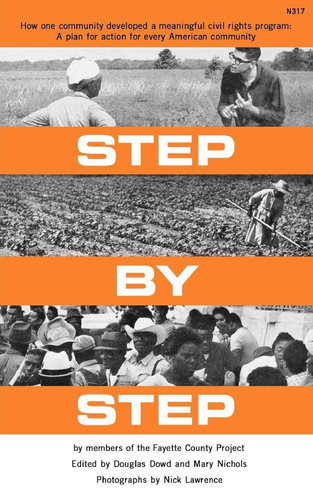
Step by Step Evolution and Operation of the Cornell Students' Civil-Rights Project in Tennessee, Summer, 1964

Douglas Dowd
The book arose out of the authors' experiences in a project which was itself unique: The Cornell-Tompkins Committee for Free and Fair Elections in Fayette County, Tennessee. The project entailed six to eight weeks of living in Fayette County by forty-five volunteers, mostly students from Cornell University, in the summer of 1964. The project was financed entirely, to an amount exceeding fifteen thousand dollars, by the contributions of students, faculty, and townspeople in and around Cornell University, and by contributions from more distant places solicited by those involved at Cornell.Of the many things learned from the Cornell project, one of the most important was how responsive a community can become when confronted with a concrete civil rights program, one with which it can identify, one small enough to be feasible and intelligible, but still compelling in terms of the needs involved.The authors believe that many thousands of Americans can find no good answer to the questions "What can I do." not because they are unwilling to do much, nor because there is little to be done, but because they lack the knowledge of what is needed where, and how and with whom one can go about responding to such needs. The book therefore undertakes, step by step, to describe and explain the development of the project at Cornell and its workings during the summer in Tennessee, and reasons that similar steps can be taken by others, with appropriate variations. It concludes with a detailed appendix listing civil rights projects and organizations desperately in need of help, whether in terms of money or volunteers or both.
W. W. Norton, Incorporated 1965-04 132 pages

Judaism and the American idea

Konvitz, Milton R.
This book is A thoughtful meditation on the values of Judaism and the ideals of the Declaration of Independence. As he makes clear, there is such a thing as the American-Hebraic idea, which is manifested in the ideals of human dignity, the Rule of Law, the democratic ideal, the rights of conscience, and the pursuit of happiness. It is certain to appeal to American Jews who are seeking identity as Americans and as Jews, and to any reader interesting in understanding why Jews feel rooted in modern America -- from AbeBooks website.
Cornell University Press 1978-11 223 pages