42 results for "Science"

The Greatest Story Ever Told--So Far Why Are We Here?

Lawrence M. Krauss
From award-winning physicist, public intellectual, and the bestselling author of A Universe from Nothing Lawrence Krauss, comes “a masterful blend of history, modern physics, and cosmic perspective that empowers the reader to not only embrace our understanding of the universe, but also revel in what remains to be discovered” (Neil deGrasse Tyson, American Museum of Natural History). In this grand poetic vision of the universe, Lawrence Krauss tells the dramatic story of the discovery of the hidden world that underlies reality—and our place within it. Reality is not what you think or sense—it’s weird, wild, and counterintuitive, and its inner workings seem at least as implausible as the idea that something can come from nothing. With his trademark wit and accessible style, Krauss leads us to realms so small that they are invisible to microscopes, to the birth and rebirth of light, and into the natural forces that govern our existence. His unique blend of rigorous research and engaging storytelling invites us into the lives and minds of remarkable scientists who have helped unravel the unexpected fabric of reality with reasoning rather than superstition and dogma, and to explain how everything we see—and can’t see—came about. A passionate advocate for reason, Krauss gives the rationale for the seemingly irrational—and the mysteries and apparent contradictions of quantum physics, and explores what that means for our lives here on Earth—and beyond. At its core, The Greatest Story Ever Told—So Far is about the best of what it means to be human—an epic history of our ultimately purposeless universe that addresses the question, “Why are we here?”
Atria Books 2018-02-27 336 pages

Our universe: the thrill of extragalactic exploration as told by leading experts

Alan Stern
The Universe in which we live is unimaginably vast and ancient, with countless star systems, galaxies, and extraordinary phenomena such as black holes, dark matter, and gamma ray bursts. What phenomena remain mysteries, even to seasoned scientists? Our Universe is a fascinating collection of essays by some of the world's foremost astrophysicists. Some are theorists, some computational modelers, some observers, but all offer their insights into the most cutting-edge, difficult, and curious aspects of astrophysics. Compiled, the essays describe more than the latest techniques and findings. Each of the ten contributors offers a more personal perspective on their work, revealing what motivates them and how their careers and lives have been shaped by their desire to understand our universe. S. Alan Stern is Director of the Department of Space Studies at Southwest Research Institute in Boulder, Colorado. He is a planetary scientist and astrophysicist with both observational and theoretical interests. Stern is an avid pilot and a principal investigator in NASA's planetary research program, and he was selected to be a NASA space shuttle mission specialist finalist. He is the author of more than 100 papers and popular articles. His most recent book is Pluto & Charon (Wiley, 1997). Contributors: Dr. John Huchra, Harvard University Dr. Esther Hu, University of Hawaii, Honolulu Dr. John Mather, NASA Goddard Space Flight Center Dr. Nick Gnedin, University of Colorado, Boulder Dr. Doug Richstone, University of Michigan, Ann Arbor Dr. Bohdan Paczynski, Princeton University, NJ Dr. Megan Donahue, Space Telescope Science Institute, Baltimore, MD Dr. Jerry Ostriker, Princeton University, New Jersey G. Bothun, University of Oregon, Eugene
Cambridge University Press 2001 152 pages

The fabric of reality: the science of parallel universes-- and its implications

Deutsch, David
For David Deutsch, a young physicist of unusual originality, quantum theory contains our most fundamental knowledge of the physical world. Taken literally, it implies that there are many universes “parallel” to the one we see around us. This multiplicity of universes, according to Deutsch, turns out to be the key to achieving a new worldview, one which synthesizes the theories of evolution, computation, and knowledge with quantum physics. Considered jointly, these four strands of explanation reveal a unified fabric of reality that is both objective and comprehensible, the subject of this daring, challenging book. The Fabric of Reality explains and connects many topics at the leading edge of current research and thinking, such as quantum computers (which work by effectively collaborating with their counterparts in other universes), the physics of time travel, the comprehensibility of nature and the physical limits of virtual reality, the significance of human life, and the ultimate fate of the universe. Here, for scientist and layperson alike, for philosopher, science-fiction reader, biologist, and computer expert, is a startlingly complete and rational synthesis of disciplines, and a new, optimistic message about existence.
Allen Lane 1997 390 pages

The sleepwalkers: a history of man's changing vision of the universe

Koestler, Arthur
Arthur Koestler's extraordinary history of humanity's changing vision of the universe In this masterly synthesis, Arthur Koestler cuts through the sterile distinction between 'sciences' and 'humanities' to bring to life the whole history of cosmology from the Babylonians to Newton. He shows how the tragic split between science and religion arose and how, in particular, the modern world-view replaced the medieval world-view in the scientific revolution of the seventeenth century. He also provides vivid and judicious pen-portraits of a string of great scientists and makes clear the role that political bias and unconscious prejudice played in their creativity.
Penguin Books 2014-09-30 571 pages

The accelerating universe: infinite expansion, the cosmological constant, and the beauty of the cosmos

Livio, Mario
Advance Praise for The Accelerating Universe " The Accelerating Universe is not only an informative book about modern cosmology. It is rich storytelling and, above all, a celebration of the human mind in its quest for beauty in all things." —Alan Lightman, author of Einstein's Dreams "This is a wonderfully lucid account of the extraordinary discoveries that have made the last years a golden period for observational cosmology. But Mario Livio has not only given the reader one clear explanation after another of what astronomers are up to, he has used them to construct a provocative argument for the importance of aesthetics in the development of science and for the inseparability of science, art, and culture." —Lee Smolin, author of The Life of the Cosmos "What a pleasure to read! An exciting, simple account of the universe revealed by modern astronomy. Beautifully written, clearly presented, informed by scientific and philosophical insights." —John Bahcall, Institute for Advanced Study "A book with charm, beauty, elegance, and importance. As authoritative a journey as can be taken through modern cosmology." —Allan Sandage, Observatories of the Carnegie Institution of Washington
Wiley 2001 274 pages

The Universe From Flat Earth to Quasar

Isaac Asimov
Does the Universe extend forever or is there an end somewhere? Does it expand and contract like an accordion with each cosmic spasm lasting millions of years? Was there a time when it exploded and will the flying fragments separated until our own fragment is virtually alone? Does it renew itself and is it eternal, unborn and undying? This is a complete scientific survey of all that is known about the Universe, presented with the clarity and precision so characteristic of the writing of Isaac Asimov. Beginning with chapters on the earth and our solar system, he guides the reader through exploration and discovery of the unimaginably distant reaches of outer space. Barely fifty years ago, their horizons of our known universe were pushed back. The Milky Way was recognized as only a drop in a huge black ocean; other galaxies were discovered; the Universe was found to be expanding - its rim many billions of light-years away. And as man daily probes further into the unknown, it is becoming clear that discoveries dwarfing all those of the past may actually be at hand.
Discus Books 1966 315 pages

The quark and the jaguar: adventures in the simple and the complex

Gell-Mann, Murray
This book is about how the wonderful diversity of the universe can arise out of a set of fairly simple basic laws. It is written by an expert in both the fundamental laws and the complex structures that they can produce.' Stephen Hawking's acclaim of Murray Gell-Mann's literary debut is typical of the reception the book received on first publication in 1994. From one of the twentieth century's greatest scientists comes this unique, highly personal vision of the connections between the basic laws of physics and the complexity and diversity of the natural world. THE QUARK AND THE JAGUAR - the simple and the complex - is an irresistibly engaging and rewarding introduction to the life's work of physicist, polymath and Nobel Laureate Murray Gell-Mann.
Abacus 2003 392 pages

The known unknowns: the unsolved mysteries of the cosmos

Krauss, Lawrence M.
Internationally known theoretical physicist and bestselling popular science writer Lawrence Krauss explores cosmology's greatest unanswered questions. Three of the most important words in science are 'I don't know'. Not knowing implies a universe of opportunities - the possibility of discovery and surprise. Our understanding of cosmology has advanced immeasurably over the last five hundred years of modern science, yet many fundamental mysteries of existence persist. How did our Universe begin, if it even had a beginning? How big is it? What's at the bottom of a black hole? How did life on Earth arise? Are we alone? Is time travel possible?These mysteries define the scientific forefront, the threshold of the unknown. To explore that threshold is to gain a deeper understanding of just how far science has progressed. In The Known Unknowns , internationally known theoretical physicist and bestselling popular science writer Lawrence Krauss explores cosmology's greatest known unknowns. Covering time, space, physical law, life and consciousness, Krauss introduces readers to the topics that will shape the state of science of the next few decades, and invites us to ponder and appreciate the universe in which we live.
Apollo Library 2023 240 pages

The God problem: how a godless cosmos creates

Bloom, Howard K.
God's war crimes, Aristotle's sneaky tricks, Galileos creationism, Newton's intelligent design, entropys errors, Einstein's pajamas, John Conway's game of loneliness, Information Theory's blind spot, Stephen Wolfram's New Kind Of Science, and six monkeys at six typewriters getting it wrong. What do these have to do with the birth of a universe and with your need for meaning? Everything, as you're about to see.
Prometheus Books 2012 708 pages

From the Closed World to the Infinite Universe

Alexandre Koyre
During the sixteenth and seventeenth centuries a radical change occurred in the patterns and framework of European thought. In the wake of Copernican theory and discoveries through the telescope, the notion of an ordered cosmos of "fixed stars" gave way to that of a universe infinite in both time and space-with significant and far-reaching consequences for human thought. Alexandre Koyré brilliantly interprets this revolution in terms of the change that occurred in our conception of the universe and our place in it, and illustrates the primacy of this change in the development of the modern world. "An important contribution to the problem of the transition from the world view characteristic of the medieval centuries to that which rapidly gained acceptance after the seventeenth century." (Philosophical Quarterly) "Koyré has provided the material and has illuminated it with uniformly perceptive and occasionally brilliant commentary.... An important contribution to the study of 17th-century thought." (Thomas S. Kuhn, Science) "A model of scholarliness without pedantry, of clarity without oversimplification." (Arthur Koestler, Encounter) "Surely a work that will be welcomed alike by the scientist, philosopher, and historian of ideas." (Philosophy and Phenomenological Research) Alexandre Koyré was a member of the Institute for Advanced Study, Princeton, and professor at the Ecole Pratique des Hautes Etudes in Paris. His books include Discovering Plato and Newtonian Studies.
Angelico Press 2016-05-31 322 pages

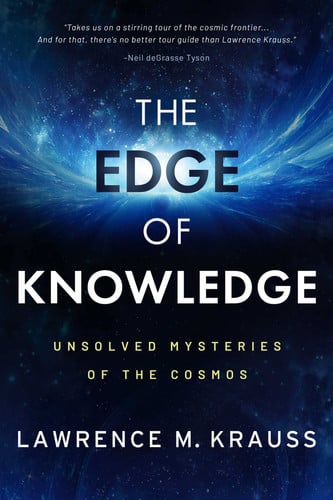
The edge of knowledge: unsolved mysteries of the cosmos

Krauss, Lawrence M.
Lawrence Krauss explores the greatest unanswered questions at the forefront of science today, and likely for the coming century and beyond. Internationally known theoretical physicist and bestselling author Lawrence Krauss explores science’s greatest unanswered questions. Three of the most important words in science are “I don't know.” Not knowing implies a Universe of opportunities—the possibility of discovery and surprise. Our understanding of science has advanced immeasurably over the last five hundred years, yet many fundamental mysteries of existence persist: How did our Universe begin? How big is the Universe? Is time travel possible? What’s at the center of a black hole? How did life on Earth arise? Are we alone? What is consciousness, and can we create it? These mysteries define the scientific forefront—the threshold of the unknown. To explore that threshold is to gain a deeper understanding of just how far science has progressed. Covering time, space, matter, life, and consciousness, Krauss introduces readers to topics that will shape the state of science for the next century, providing us all passport to our own journeys of exploration and discovery.
Post Hill Press 2023-05-09 220 pages

The Animate and The Inanimate

William Sidis
The Animate and the Inanimate was a book written by child prodigy and polymath William James Sidis (1898-1944), detailing his thoughts on the origins of life, cosmology, the potential reversibility of the second law through Maxwell's Demon, among other things. It was published in 1925, however it is suggested that Sidis was working on the theory as early as 1916. One motivation for writing this theory appears to be to explain psychologist and philosopher William James's "reserve energy" theory which claimed that there was "reserve energy" that could be used by people when put under extreme conditions, Sidis' own "forced prodigy" upbringing being a result of testing said theory. In The Animate and the Inanimate, William James Sidis states that the universe is infinite, as well as it containing sections of "negative tendencies" where various laws of physics were reversed that are juxtaposed with "positive tendencies", which switch over epochs of time. Sidis' theory at the time of its release was ignored, only to be found in an attic in 1979.
Independently Published 2020-02-08 146 pages

Let there be light: modern cosmology and Kabbalah : a new conversation between science and religion

Smith, Howard Alan
In Let There Be Light, Howard Smith, a research astrophysicist and traditionally observant Jew, explores how modern scientific understandings of the cosmos complement Judaism's ancient mystical theology, the Kabbalah. He argues that science and religion are not only compatible, but that a healthy, productive dialogue between the two sheds light on ethics, free will, and the nature of life, while at the same time rejecting fundamentalist misinterpretation and the pseudoscience of creationism. Written for a general audience, yet supported by the most current and accurate scientific research, the book discusses topics such as modern quantum mechanics and mystical notions of awareness; how Kabbalah's ten sefirot mirror the developing phases of an inflationary universe; and the surprising parallels that exist between the Big Bang theory and Kabbalah's origin theory. Smith delves into complex ideas without resorting to jargon or mathematical equations, creating an intelligent, authoritative work accessible to all readers.
New World Library 2006 280 pages

The first galaxies in the universe

Loeb, Abraham
"This book provides a comprehensive, self-contained introduction to one of the most exciting frontiers in astrophysics today: the quest to understand how the oldest and most distant galaxies in our universe first formed. Until now, most research on this question has been theoretical, but the next few years will bring about a new generation of large telescopes that promise to supply a flood of data about the infant universe during its first billion years after the big bang. This book bridges the gap between theory and observation. It is an invaluable reference for students and researchers on early galaxies. The First Galaxies in the Universe starts from basic physical principles before moving on to more advanced material. Topics include the gravitational growth of structure, the intergalactic medium, the formation and evolution of the first stars and black holes, feedback and galaxy evolution, reionization, 21-cm cosmology, and more. Provides a comprehensive introduction to this exciting frontier in astrophysics Begins from first principles Covers advanced topics such as the first stars and 21-cm cosmology Prepares students for research using the next generation of large telescopes Discusses many open questions to be explored in the coming decade "--
Princeton University Press 2013-01-15 540 pages

A Kabbalistic Universe

Zev ben Shimon Halevi
A Kabbalistic Universe is about how and why Existence came into being. It sets out the general scheme of the four Worlds of Emanation, Creation, Formation and Action and heir various archangelic, angelic, demonic and organic inhabitants. Drawing upon ancient, medieval and modern material this book brings the Kabbalistic tradition up to date so that the current generation can perceive what Existence is about and how they might play a conscious part in humanity's role of aiding God to behold God in the Mirror of Existence. This is a revised edition with additional graphics. These make the Divine principles involved more comprehensible. Once the terms and metaphysics are mastered, then new perceptions are possible regarding not only the structure and dynamics of Existence but also the workings of the angelics and demonics, Nature and the process of human evolution and its purpose.
KS Books Limited 2024-12-05 256 pages

The universe within: from quantum to cosmos

Turok, Neil
Turok explores the transformative scientific discovers of the past three centuries, from classical mechanics to the nature of light and the evolution of the cosmos, and shows how they created shifts in the organization of society. He argues that we are on the cusp of another major transformation: the coming quantum revolution that will supplant our current digital age.
House of Anansi Press 2012 292 pages