155 results for "Science"

Stone age economics

Sahlins, Marshall David
Stone Age Economics is a classic study of anthropological economics, first published in 1974. As Marshall Sahlins stated in the first edition, "It has been inspired by the possibility of 'anthropological economics,' a perspective indebted rather to the nature of the primitive economies than to the categories of a bourgeois science." Ambitiously tackling the nature of economic life and how to study it comparatively, the book includes six studies which reflect the author's ideas on revising traditional views of the hunter-gatherer and so-called primitive societies, revealing them to be the original affluent society. The book examines notions of production, distribution and exchange in early communities and examines the link between economics and cultural and social factors. It consists of a set of detailed and closely related studies of tribal economies, of domestic production for livelihood, and of the submission of domestic production to the material and political demands of society at large. Marshall Sahlins is one of the most prominent American anthropologists of our time. He holds the title of Charles F. Grey Distinguished Service Professor of Anthropology at the University of Chicago. His most recent book is How Natives Think: About Captain Cook, for Example.
Transaction Publishers 2011 348 pages

The three trillion dollar war: the true cost of the Iraq conflict

Stiglitz, Joseph E.
The true cost of the Iraq War is $3 trillion rather than the $50 billion projected by the White House. Apart from its tragic human toll, the Iraq War will be staggeringly expensive in financial terms. This sobering study by Nobel Prize winner Joseph E. Stiglitz and Harvard professor Linda J. Bilmes casts a spotlight on expense items that have been hidden from the U.S. taxpayer, including not only big-ticket items like replacing military equipment (being used up at six times the peacetime rate) but also the cost of caring for thousands of wounded veterans for the rest of their lives. Shifting to a global focus, the authors investigate the cost in lives and economic damage within Iraq and the region. Finally, with the chilling precision of an actuary, the authors measure what the U.S. taxpayer's money would have produced if instead it had been invested in the further growth of the U.S. economy. Written in language as simple as the details are disturbing, this book will forever change the way we think about the war.
W.W. Norton 2008-02-17 311 pages

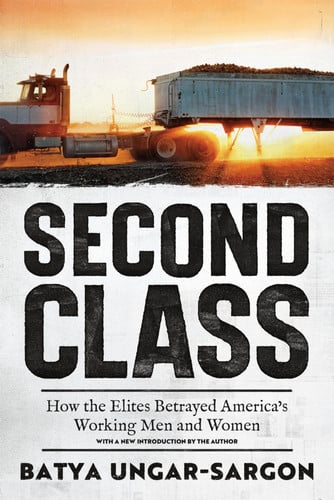
Second class: how the elite betrayed America's working men and women

Ungar-Sargon, Batya
A personal, journalistic ethnography of the modern American working class, based on the travels and interactions of the author through the American heartland. " Second Class is the most important book you will read all year. A political realignment is coming, and it's my hope that the end result will work in favor of our all-too-neglected American working class. When that realignment comes, Batya and her book will help lead the way." --Greg Lukianoff, CEO of the Foundation for Individual Rights in Education, and co-author of The Coddling of the American Mind Who is the American working class? Do they still have a fair shot at the American Dream? What do they think about their chances to secure the hallmarks of a middle-class life? While writing this book, Batya Ungar-Sargon visited states across the nation to speak with members of the American working class who are fighting tooth and nail to survive. In Second Class , working-class Americans of all races, political orientations, and occupations share their stories--cleaning ladies, health care aides, cops, truck drivers, fast food workers, electricians, and more. In their own words, these working-class Americans explain the struggles and triumphs of their increasingly precarious lives--as well as what policies they think would improve them. Second Class combines deep reporting with a look at the data and expert opinions on America's emergent class divide, in which the most basic elements of a secure and stable life are increasingly out of reach for those without a college education. America has broken its contract with its laboring class. So, how do we get back to the American Dream? How do we once again become the land of opportunity, the promised land, where hard work and commitment to family are enough to protect you from poverty? It's not that hard actually. All it would take, as this book illustrates, is for those in power to once again respect the dignity of work--and the American worker.
Encounter Books 2025 248 pages

Identity economics: how our identities shape our work, wages, and well-being

Akerlof, George A.
In 1995, economist Rachel Kranton wrote future Nobel Prize-winner George Akerlof a letter insisting that his most recent paper was wrong. Identity, she argued, was the missing element that would help to explain why people - facing the same economic circumstances - would make different choices. This was the beginning of a fourteen-year collaboration - and of Identity Economics. Identity economics is a new way to understand people's decisions - at work, at school, and at home. With it, we can better appreciate why incentives like stock options work or don't; why some schools succeed and others don't; why some cities and towns don't invest in their futures - and much, much more. "Identity Economics" bridges a critical gap in the social sciences. It brings identity and norms to economics. People's notions of what is proper, and what is forbidden, and for whom, are fundamental to how hard they work, and how they learn, spend, and save. Thus people's identity - their conception of who they are, and of who they choose to be - may be the most important factor affecting their economic lives. And the limits placed by society on people's identity can also be crucial determinants of their economic well-being.
Princeton University Press 2011-09-26 185 pages

Supercapitalism The Transformation of Business, Democracy, and Everyday Life

Robert B. Reich
Mid-twentieth-century capitalism has turned into global capitalism, and global capitalism - turbocharged, Web-based, and able to find and make almost anything just about anywhere - has turned into supercapitalism. But as Robert B. Reich makes clear in this eye-opening book, while supercapitalism is working wonderfully well to enlarge the economic pie, democracy - charged with caring for all citizens - is becoming less and less effective under its influence. Reich explains how widening inequalities of income and wealth, heightened job insecurity, and the spreading effects of global warming are the logical outcomes of supercapitalism. He shows us why companies, fighting harder than ever to maintain their competitive positions, have become even more deeply involved in politics; and how average citizens, seeking great deals and invested in the stock market to an unprecedented degree, are increasingly loath to stand by their values if it means biting the hands that feed them. As one of America's most influential voices, Reich sets out a clear course to a vibrant capitalism and a concurrent, equally vibrant democracy.
Scribe Publications 2008 272 pages

The Road to Freedom Economics and the Good Society

Joseph E. Stiglitz
We are a nation born from the conviction that people must be free. But since the middle of the last century, that idea has been co-opted. Forces on the political Right have justified exploitation by cloaking it in the rhetoric of freedom, leading to pharmaceutical companies freely overcharging for medication, a Big Tech free from oversight, politicians free to incite rebellion, corporations free to pollute, and more. How did we get here? Whose freedom are we--and should we--be thinking about? In The Road to Freedom, Nobel prize winner Joseph E. Stiglitz dissects America's current economic system and the political ideology that created it, laying bare their twinned failure. "Free" and unfettered markets have only succeeded in delivering a series of crises: the financial crisis, the opioid crisis, and the crisis of inequality. While a small portion of the population has amassed considerable wealth, wages for most people have stagnated. Free and unfettered markets have exploited consumers, workers, and the environment alike. Such failures have fed populist movements that believe being free means abandoning any obligations citizens have to one another. As they grow in strength, these movements now pose a real threat to true economic and political freedom. As an economic advisor to presidents and as chief economist at the World Bank, Stiglitz has witnessed these profound changes firsthand. As he argues, the failures follow from the elites' unshakeable dedication to "the neoliberal experiment." Explicitly taking on giants such as Friedrich Hayek and Milton Friedman, Stiglitz exposes accepted ideas about our political and economic life for what they are: twisted visions that tear at the social fabric while they enrich the very few. The Road to Freedom breaks new ground, showing how economics--including recent advances in which Stiglitz has played such an important role--reframes how to think about freedom and the role of the state in a twenty-first century society. Drawing on the work of contemporary philosophers, Stiglitz explains a deeper, more humane way to assess freedoms--one that considers with care what to do when one person's freedom conflicts with another's. We must reimagine our existing economic and legal systems and embrace forms of collective action, including regulation and investment, if we are to create an innovative society in which everyone can flourish. The task could not be more urgent, and Stiglitz's latest book is essential reading for those committed to the American ideal of an economic and political system that delivers well-being, opportunity, and meaningful freedoms for all.
W. W. Norton, Incorporated 2026-02-24 384 pages

Football for a Buck The Crazy Rise and Crazier Demise of the USFL

Jeff Pearlman
From Jeff Pearlman--the New York Times best-selling author of Three Ring Circus--comes the rollicking, outrageous story of the USFL, full of larger-than-life characters and you-can't-make-this-up stories featuring some of the biggest celebrities and buffoons in the game. The United States Football League--known fondly to millions of sports fans as the USFL--did not merely challenge the NFL, but cause its owners and executives to collectively shudder. In its three seasons from 1983-85, it secured multiple television deals, drew millions of fans and launched the careers of legends such as Steve Young, Jim Kelly, Herschel Walker, and Reggie White. But then it died beneath the weight of a particularly egotistical and bombastic team owner--a New York businessman named Donald J. Trump. In Football for a Buck, Jeff Pearlman draws on more than four hundred interviews to unearth all the salty, untold stories of one of the craziest sports entities to have ever captivated America. From 1980s drug excess to airplane brawls and player-coach punch outs, to backroom business deals and some of the most enthralling and revolutionary football ever seen, Pearlman transports readers back in time to this crazy, boozy, audacious, unforgettable era of the game. He shows how fortunes were made and lost on the backs of professional athletes and how, forty years ago, Trump was already a scoundrel and a spoiler. For fans of Terry Pluto's Loose Balls or Jim Bouton's Ball Four and of course Pearlman's own stranger-than-fiction narratives, Football for a Buck is sports as high entertainment--and a cautionary tale of the dangers of ego and excess.
HarperCollins Publishers 2019-09-10 400 pages

Economics rules: why economics works, when it fails, and how to tell the difference

Rodrik, Dani
The economics profession has become a favourite punching bag in the aftermath of the global financial crisis. Economists are widely reviled and their influence derided by the general public. Yet their services have never been in greater demand. To unravel the paradox, we need to understand both the strengths and weaknesses of economics. Dani Rodrik argues that the multiplicity of theoretical frameworks - what economists call 'models' that exist side by side is economics' great strength. Economists are trained to hold diverse, possibly contradictory models of the world in their minds. This is what allows them, when they do their job right, to comprehend the world, make useful suggestions for improving it, and to advance their stock of knowledge over time. In short, it is what makes economics a 'science' a different kind of science from physics or some other natural sciences, but a science nonetheless. But syncretism is not a comfortable state of mind, and economists often jettison it for misplaced confidence and arrogance, especially when they confront questions of public policy. Economists are prone to fads and fashions, and behave too often as if their discipline is about the search for the model that works always and everywhere, rather than a portfolio of models. Their training lets them down when it comes to navigating among diverse models and figuring out which one applies where. Ideology and political preferences frequently substitute for analysis in choosing among models.
Oxford University Press 2017-01-19 253 pages

The Idealist Jeffrey Sachs and the Quest to End Poverty

Nina Munk
A powerful portrayal of Jeffrey Sachs's ambitious quest to end extreme global poverty, now a Signal paperback. "The poor you will always have with you," according to Matthew 26:11. But Jeffrey Sachs, economics superstar, special advisor to the Secretary General of the UN and the author of The End of Poverty , vehemently disagrees. In his view, poverty -- especially the extreme deprivation of sub-Saharan Africa -- can easily be eradicated. The vast sums spent in foreign aid over the decades has not come close to alleviating the dire subsistence problems of Africans. Sachs believed he knew the reason: the developed world simply hadn't spent enough. In 2006, Sachs, backed by tens of millions of donor dollars, launched the five-year Millennium Villages Project. Sachs would test his theories in villages in different African countries, then, with each success, scale up until until the program was continent-wide. His first village "make-over" was a small community in Sauri, Kenya, and the immediate effect was encouraging. With that first inkling of success achieved, Sachs rolled out a dozen model Millennium villages in ten countries. For the past six years, Nina Munk has reported deeply on the Project, following Sachs on official trips and listening in on conversations with heads of states, rival organisations and potential donors. And she has immersed herself in the lives of people in two of the remote villages: Ruhiira, in southwest Uganda, and Dertu, in the arid borderland between Kenya and Somalia. Accepting hospitality from these camel herders and smallhold farmers, and sharing in their struggles, Munk came to understand the on-the-ground issues challenging Sachs' one-size-fits-all approach to global poverty. The Idealist is the profound and moving story of what happened when the abstract theories of a brilliant, driven man met messy human reality.
McClelland & Stewart 2014-10-07 288 pages

The economics of climate change: The stern review

Stern, Nicholas
There is now clear scientific evidence that emissions from economic activity, particularly the burning of fossil fuels for energy, are causing changes to the Earth's climate. A sound understanding of the economics of climate change is needed in order to underpin an effective global response to this challenge. The Stern Review is an independent, rigourous and comprehensive analysis of the economic aspects of this crucial issue. It has been conducted by Sir Nicholas Stern, Head of the UK Government Economic Service, and a former Chief Economist of the World Bank. The Economics of Climate Change will be invaluable for all students of the economics and policy implications of climate change, and economists, scientists and policy makers involved in all aspects of climate change.
Cambridge University Press 2008 500 pages

Climate justice: what rich nations owe the world - and the future

Sunstein, Cass R.
The social cost of carbon: The most important number you've never heard of—and what it means. If you’re injuring someone, you should stop—and pay for the damage you’ve caused. Why does this simple proposition, generally accepted, not apply to climate change? In Climate Justice , a bracing challenge to status quo thinking on the ethics of climate change, renowned author and legal scholar Cass Sunstein clearly frames what’s at stake and lays out the moral imperative: When it comes to climate change, everyone must be counted equally, regardless of when they live or where they live—which means that wealthy nations, which have disproportionately benefited from greenhouse gas emissions, are obliged to help future generations and people in poor nations that are particularly vulnerable.
The MIT Press 2025 195 pages

Raising the Floor How a Universal Basic Income Can Renew Our Economy and Rebuild the American Dream

Andy Stern
Raising the Floor confronts America's biggest economic challenge--the fundamental restructuring of the economy and the emerging disruptive technology that threaten secure jobs and income. Andy Stern convincingly shows why it is time to consider a universal basic income as the nation's twenty-first-century solution to increasing inequality. In 2010, troubled by watching families chase the now-elusive American Dream, Andy Stern began a five-year journey to investigate how technology will impact jobs and the future of work. Stern, formerly the head of the nation's most influential and fastest-growing union, the Service Employees International Union, investigated these issues with a wide range of CEOs, futurists, economists, workers, entrepreneurs, and investment bankers who are shaping the future. The sobering assessment that emerged from his research across the political spectrum, from libertarians at the CATO Institute to the leaders of the progressive left, is that this time is different: there will be meager benefits that come with full-time work and fewer good jobs overall. Facing such a challenging moment, Stern's solution is fittingly bold: to establish a universal basic income by eliminating many current government programs and adding new resources. At once vivid, provocative, and pragmatic, Raising the Floor will spark a national conversation about creating the new American Dream.
PublicAffairs 2020-12-01 272 pages

Manipulation: what it is, why it's bad, what to do about it

Sunstein, Cass R.
"New technologies are offering companies, politicians, and others unprecedented opportunity to manipulate us. Sometimes we are given the illusion of power - of freedom - through choice, yet the game is rigged, pushing us in specific directions that lead to less wealth, worse health, and weaker democracy. In, Manipulation, nudge theory pioneer and New York Times bestselling author, Cass Sunstein, offers a new definition of manipulation for the digital age, explains why it is wrong; and shows what we can do about it. He reveals how manipulation compromises freedom and personal agency, while threatening to reduce our well-being; he explains the difference between manipulation and unobjectionable forms of influence, including 'nudges'; and he lifts the lid on online manipulation and manipulation by artificial intelligence, algorithms, and generative AI, as well as threats posed by deepfakes, social media, and 'dark patterns,' which can trick people into giving up time and money. Drawing on decades of groundbreaking research in behavioral science, this landmark book outlines steps we can take to counteract manipulation in our daily lives and offers guidance to protect consumers, investors, and workers." --
Cambridge University Press 2025-08-28 219 pages

In an uncertain world: tough choices from Wall Street to Washington

Rubin, Robert Edward
Publisher's description: Robert Rubin was sworn in as the seventieth U.S. Secretary of the Treasury in January 1995 in a brisk ceremony attended only by his wife and a few colleagues. As soon as the ceremony was over, he began an emergency meeting with President Bill Clinton on the financial crisis in Mexico. This was not only a harbinger of things to come during what would prove to be a rocky period in the global economy; it also captured the essence of Rubin himself--short on formality, quick to get into the nitty-gritty. From his early years in the storied arbitrage department at Goldman Sachs to his current position as chairman of the executive committee of Citigroup, Robert Rubin has been a major figure at the center of the American financial system. He was a key player in the longest economic expansion in U.S. history.
Random House 2003 427 pages

Money and Government The Past and Future of Economics

Robert Skidelsky
A critical examination of economics's past and future, and how it needs to change, by one of the most eminent political economists of our time The dominant view in economics is that money and government should play only a minor role in economic life. Economic outcomes, it is claimed, are best left to the "invisible hand" of the market. Yet these claims remain staunchly unsettled. The view taken in this important new book is that the omnipresence of uncertainty makes money and government essential features of any market economy. Since Adam Smith, classical economics has espoused nonintervention in markets. The Great Depression brought Keynesian economics to the fore, but stagflation in the 1970s brought a return to small-state orthodoxy. The 2008 global financial crash should have brought a reevaluation of that stance; instead the response has been punishing austerity and anemic recovery. This book aims to reintroduce Keynes's central insights to a new generation of economists, and embolden them to return money and government to the starring roles in the economic drama that they deserve.
Yale University Press 2018 491 pages

Price Theory

Milton Friedman
Economics is sometimes divided into two parts: positive economics and normative economics. The former deals with how the economic problem is solved, while the latter deals with how the economic problem should be solved. The effects of price or rent control on the distribution of income are problems of positive economics. The desirability of these effects on income distribution is a problem of normative economics. Within economics, the major division is between monetary theory and price theory. Monetary theory deals with the level of prices in general, with cyclical and other fluctuations in total output, total employment, and the like. Price theory deals with the allocation of resources among different uses, the price of one item relative to another. Prices do three kinds of things. They transmit information, they provide an incentive to users of resources to be guided by this information, and they provide an incentive to owners of resources to follow this information. Milton Friedman's classic book provides the theoretical underpinning for and understanding of prices. Economics is not concerned solely with economic problems. It is a social science, and is therefore concerned primarily with those economic problems whose solutions involve the cooperation and interaction of different individuals. It is concerned with problems involving a single individual only insofar as the individual's behavior has implications for or effects upon other individuals. "Price Theory" is concerned not with economic problems in the abstract, but with how a particular society solves its economic problems.
Richest Man in Babylon Publ. 2009-06 288 pages

Managing the Global Commons The Economics of Climate Change

William D. Nordhaus
Provides a detailed analysis of the DICE model (Dynamic Integrated model of Climate and the Economy) as well as an extensive analysis of the model's results. Coping with the challenges of global warming is a daunting task for both scientists and economists, who must understand future changes, and for policy makers, who must ultimately choose policies to balance risks and costs. Managing the Global Commons presents a unique effort to encompass economic, scientific, and policy aspects of this great geophysical experiment. Managing the Global Commons provides a detailed analysis of the DICE model (Dynamic Integrated model of Climate and the Economy) as well as an extensive analysis of the model's results. DICE is the first dynamic model to include a closed-loop system that includes emissions, concentrations, climate change, damages, and emissions controls. The model is useful for estimating the costs and benefits of different paths for slowing climate change and for analyzing the impact of control strategies over time. The analysis contains a number of methodological advances and major findings - most importantly the construction of a small model to encompass the primary components of the climate and economic system within an optimization framework. Also included are new techniques and results concerning the role of uncertainty and the risk premium involved in policies to slow global warming. In addition, the analysis derives a set of uncertain representative scenarios that summarize the large number of potential outcomes into a manageable number to be used within an optimization framework and incorporated into a contingent-commodity framework. Nordhaus examines several different approaches to climate-change policy: no controls, economic optimization, geoengineering, stabilization of emissions and climate, and a ten-year delay in undertaking climate-change policies. Among these, there is a modest advantage of an efficient policy over no controls or a ten-year delay, while the three stabilization options would impose significant net costs. Overall, Nordhaus observes, the analysis reveals that even with major technological breakthroughs and stringent controls, the momentum of past greenhouse gas emissions coupled with great inertia in climate change policy will lead to an inevitable rendezvous with massive climate change.
MIT Press 1994 224 pages

The accidental theorist: and other dispatches from the dismal science

Krugman, Paul R.
Paul Krugman has made a reputation for himself by telling us the truth about economics however unlikely it may seem and however little we want to believe it. In this collection of sharp, witty essays, Krugman tackles bad economic ideas from across the political spectrum, giving us clear-eyed insights into unemployment, globalization, economic growth and financial speculation. The writing here brilliantly combines the acerbic style and clever analysis that has made Krugman famous.
Penguin 1999 204 pages