71 results for "Science"

Jerusalem: Or on Religious Power and Judaism

Mendelssohn, Moses
Moses Mendelssohn was a leading figure of the Enlightenment and the Jewish Haskalah. In his work Jerusalem or On Religious Power and Judaism, he argues for religious freedom and the separation of state and religious authority. Mendelssohn maintains that governments should regulate civil affairs while matters of faith belong to individual conscience and cannot be imposed through coercion. The book also defends Judaism as a rational religion compatible with Enlightenment ideals and is widely regarded as an important contribution to modern ideas of tolerance and civil equality.
Independently published 2026-06-03 88 pages

City of stone: the hidden history of Jerusalem

Benvenisti, Meron
Jerusalem is more than a holy city built of stone. Domain of Muslims, Jews, and Christians, Jerusalem is a perpetual contest, and its shrines, housing projects, and bulldozers compete in a scramble for possession. Now one of Jerusalem's most respected authorities presents a history of the city that does not fall prey to any one version of its past. Meron Benvenisti begins with a reflection on the 1996 celebration of Jerusalem's 3000-year anniversary as the capital of the Kingdom of Israel. He then juxtaposes eras, dynasties, and rulers in ways that provide grand comparative insights. But unlike recent politically motivated histories written to justify the claims of Jews and Arabs now living in Jerusalem, Benvenisti has no such agenda. His history is a polyphonic story that lacks victors as well as vanquished. He describes the triumphs and defeats of all the city's residents, from those who walk its streets today to the meddlesome ghosts who linger in its shadows. Benvenisti focuses primarily on the twentieth century, but ancient hatreds are constantly discovered just below the surface. These hostilities have created intense social, cultural, and political interactions that Benvenisti weaves into a compelling human story. For him, any claim to the city means recognizing its historical diversity and multiple populations. A native son of Jerusalem, Benvenisti knows the city well, and his integrated history makes clear that all of Jerusalem's citizens have enriched the Holy City in the past. It is his belief that they can also do so in the future.
University of California Press 1998-10-22 274 pages

Nietzsche, Heidegger, and Buber

Walter Kaufmann
21. "A Brief Evaluation of Nietzsche's Theory." Three Attempts to Discredit It. Stephen Potter, Est. Hitler. Women. St. Paul. Camus. -- 22. "Universal Laws" Versus "A Mere Working Hypothesis."--Part III: Nietzsche: Psychology of World Views, Psychohistory, and Masks -- 23. "Nietzsche's Third Major Contribution ... 'The Psychology of World Views.' " Resentment. Psychology of Faith. -- 24. "Nietzsche's Fourth Major Contribution ... He Pioneered Psychohistory."--25. "The Origin of the 'Bad Conscience.' " -- 26. "Nietzsche's Fifth and Final Contribution ... His Philosophy of Masks." The Relevant Material. Contrast with Sartre. -- 27. Nietzsche did not Think of Masks as Necessarily Inauthentic and Evil." Roles and Women. -- 28. "How can Nietzsche Reconcile His Non-Judgmental Attitude toward Masks ... with His Celebration of 'The Intellectual Conscience'?" -- 29. "Whatever is Profound Loves Masks." -- 30. "Many German Philosophers ... have Tried to Reconcile Kant and Nietzsche." -- Part IV: Heidegger's Dogmatic Anthropology -- 31. "It was Heidegger's Discovery of Nietzsche that Precipitated the Later Phase of his Philosophy." "I am no Philosopher." "I am a 'Christian theologian.'" -- 32. Heidegger's Reading of Nietzsche Rests on Three Very Clear and Simple Principles." -- 33. "The Central Point of my Critique of Heidegger is to Show How He Impeded the Discovery of the mind." "His Influence" "I shall Concentrate on S & Z." -- 34. First Thesis: Heidegger's 'Existential Ontology' is Dubious Anthropology." -- 35. "Second Thesis: Heidegger's Thinking is Deeply Authoritarian." -- 36. "He Says a Hundred Things I've been Unconsciously Hoping to Hear from Someone who Could Assert them with Authority." "Husserl's and Heidegger's Bias Against Empirical Science and Psychology in Particular was Rooted in their Hunger for Certainty and Apodictic Discourse
[distributor] Taylor & Francis, c/o Bookpoint 2017-09-20 308 pages

Spinoza, atheist

Nadler, Steven
"In 1656, a young Amsterdam merchant was excommunicated by his Portuguese-Jewish community in the harshest terms it had ever used. Baruch Spinoza was accused of unspecified "horrifying heresies," but the precise reasons for his expulsion remain a mystery. When he published his Theological-Political Treatise in 1670, which was condemned as "the most atheistic book ever written," he began to reveal to the world what his heresies may have been. Yet ever since the eighteenth century, most readers and scholars have assumed that Spinoza was a pantheist--even a "God-intoxicated man," as the poet Novalis put it. After all, how could a person whose books are suffused with talk of God be an atheist? In Spinoza, Atheist, Steven Nadler, one of the world's leading authorities on the philosopher, aims to settle the question and show that that's exactly what he was. Nadler makes a powerful case that there is no real divinity for Spinoza. God is Nature, and isn't an object of worshipful awe or religious reverence but can only be understood through philosophy and science. There is nothing supernatural--no mystery, ineffability, or sublimity. Spinoza does speak of "blessedness" and "salvation," but these, too, are to be understood in natural and rational terms, as the peace of mind and happiness that come from understanding ourselves and the world. Whether Spinoza believed in God is a fascinating and enduring controversy. Spinoza, Atheist promises to transform our understanding of his views and to make clear just how radical a thinker he was and remains."--
Princeton University Press 2026-04-07 244 pages

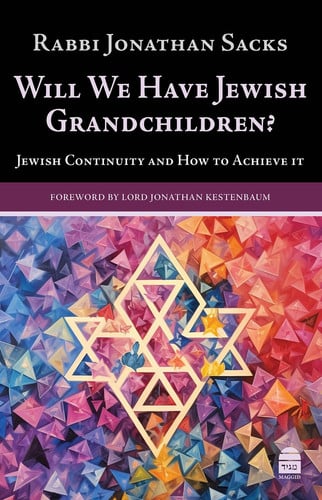
Will We Have Jewish Grandchildren?

Sacks, Jonathan
The Jewish people, having survived for thousands of years in the most adverse circumstances, including the Holocaust and horrific terrorist attacks, is today also threatened by intermarriage and assimilation. Jewish communities throughout the diaspora are experiencing demographic decline: Why has this happened, and can anything be done to reverse the trend? Times have changed and that, in consequence, communal priorities need to change also.In Will We Have Jewish Grandchildren?, Rabbi Sacks issues an inspiring summons to collective action to counteract the prevailing trend of assimilation and hand on the age-old faith and traditions to a new generation.
Maggid 2024-07-15 176 pages

Abraham Joshua Heschel: the call of transcendence

Held, Shai
"Abraham Joshua Heschel (1907-1972) was a prolific scholar, impassioned theologian, and prominent activist who participated in the black civil rights movement and the campaign against the Vietnam War. He has been hailed as a hero, honored as a visionary, and endlessly quoted as a devotional writer. In this sympathetic, yet critical, examination, Shai Held elicits the overarching themes and unity of Heschel's incisive and insightful thought. Focusing on the idea of transcendence - or the movement from self-centeredness to God-centeredness - Held puts Heschel into dialogue with contemporary Jewish thinkers, Christian theologians, devotional writers, and philosophers of religion"--From publisher's website
Indiana University Press 2013-11-04 333 pages

Taming the gods: religion and democracy on three continents

Buruma, Ian
Why religion must be separated from politics if democracy is to thrive around the world For eight years the president of the United States was a born-again Christian, backed by well-organized evangelicals who often seemed intent on erasing the church-state divide. In Europe, the increasing number of radicalized Muslims is creating widespread fear that Islam is undermining Western-style liberal democracy. And even in polytheistic Asia, the development of democracy has been hindered in some countries, particularly China, by a long history in which religion was tightly linked to the state. Ian Buruma is the first writer to provide a sharp-eyed look at the tensions between religion and politics on three continents. Drawing on many contemporary and historical examples, he argues that the violent passions inspired by religion must be tamed in order to make democracy work. Comparing the United States and Europe, Buruma asks why so many Americans―and so few Europeans―see religion as a help to democracy. Turning to China and Japan, he disputes the notion that only monotheistic religions pose problems for secular politics. Finally, he reconsiders the story of radical Islam in contemporary Europe, from the case of Salman Rushdie to the murder of Theo van Gogh. Sparing no one, Buruma exposes the follies of the current culture war between defenders of "Western values" and "multiculturalists," and explains that the creation of a democratic European Islam is not only possible, but necessary. Presenting a challenge to dogmatic believers and dogmatic secularists alike, Taming the Gods powerfully argues that religion and democracy can be compatible―but only if religious and secular authorities are kept firmly apart.
Princeton University Press 2012-08-26 144 pages

The fall and rise of the Islamic state

Feldman, Noah
"Noah Feldman tells the story behind the increasingly popular call for the establishment of the sharia--the law of the traditional Islamic state--in the modern Muslim world. Feldman goes back to the roots of classical Islamic law, under which executive power was balanced by the scholars who interpreted and administered the sharia. That balance was destroyed under Ottoman rule, resulting in the unchecked executive dominance that continues to distort politics in so many Muslim states. Feldman argues that a modern Islamic state could provide political and legal justice to today's Muslims through sharia--but only if new institutions emerge that restore this constitutional balance of power. In a new introduction, Feldman discusses developments in Egypt, Tunisia, Libya, and other Muslim-majority countries since the Arab Spring and describes how Islamists must meet the challenge of balance if the new Islamic states are to succeed."--P. [4] of cover.
Princeton University Press 2012-08-26 189 pages

The Day the Rabbi Disappeared Jewish Holiday Tales of Magic

Schwartz, Dr. Howard
Noted folklorist Howard Schwartz retells 12 Jewish tales from around the world. Each tale combines elements of magic with a link to a Jewish holiday, giving new perspectives on Rosh Hashanah, Yom Kippur, Hanukkah, Purim, and Passover--plus Shabbat, the weekly Sabbath. These memorable stories of holiday miracles and miraculous escapes have been passed down orally for thousands of years. Now the best of them--from "A Flock of Angels" to "The Enchanted Menorah" and "The Magic Winecup"--have been collected, and enriched by Monique Passicot's luminous illustrations.
Jewish Publication Society 2003 80 pages

Company C An AmericanS Life As a Citizen-Soldier in the Israeli Army

Haim Watzman
When American-born Haim Watzman immigrated to Israel, he was drafted into the army and, after eighteen months of compulsory service, was assigned to Company C, the reserve infantry unit that would define the next twenty years of his life. From 1984 until 2002, for at least a month a year, Watzman, who had never aspired to military adventure, was a soldier. Watzman was a soldier as he adjusted to his new country, raised his children, and pursued a career as a writer and translator. At times he defended his adopted country’s borders; at other times he patrolled beyond them, or that gray area, the occupied territories. A religiously observant Jew who opposed Israel’s presence in the West Bank and Gaza Strip, he served in uniform in conflicts that he demonstrated against in civilian clothes. Throughout, he developed a deep and abiding bond with the diverse men of Company C--a fellowship that cemented his commitment to reserve service even as he questioned the occupation he was enforcing. In this engrossing account of the first Intifada, the period of the Oslo Accords, and Israel’s reoccupation of the West Bank as lived by citizen-soldiers in the field, Watzman examines our obligations to country, friends, family, and God--and our duty to protect our institutions even as we fight to reform them.
Argo Navis 2012-10-20 328 pages

What is God?

Needleman, Jacob
In his most deeply personal work, religious scholar Needleman cuts a clear path through today's clamorous debates over the existence of God, illuminating an entirely new way of approaching the question of how to understand a higher power. I n this new book, philosopher Jacob Needleman? whose voice and ideas have done so much to open the West to esoteric and Eastern religious ideas in the twentieth and twenty-first centuries'intimately considers humanity's most vital question: What is God? Needleman begins by taking us more than a half century into the past, to his own experience as a brilliant, promising, Ivyeducated student of philosophy'atheistic, existential, and unwilling to blindly accept childish religiosity. But an unsettling meeting with the venerated Zen teacher D. T. Suzuki, combined with the sudden need to accept a dreary position teaching the philosophy of religion, forced the young academician to look more closely at the religious ideas he had once thought dead. Within traditional religious texts the scholar discovered a core of esoteric and philosophical ideas, more mature and challenging than anything he had ever associated with Judaism, Christianity, and the religions of the East. At the same time, Needleman came to realize'as he shares with the reader'that ideas and words are not enough. Ideas and words, no matter how profound, cannot prevent hatred, arrogance, and ultimate despair, and cannot prevent our individual lives from descending into violence and illusion. And with this insight, Needleman begins to open the reader to a new kind of understanding: The inner realization that in order to lead the lives we were intended for, the very nature of human experience must change, including the very structure of our perception and indeed the very structure of our minds. In What Is God? , Needleman draws us closer to the meaning and nature of this needed change'and shows how our present confusion about the purpose of religion and the concept of God reflects a widespread psychological starvation for this specific quality of thought and experience. In rich and varied detail, the book describes this inner experience'and how almost all of us, atheists and ?believers? alike, actually have been visited by it, but without understanding what it means and why the intentional cultivation of this quality of experience is necessary for the fullness of our existence.
Jeremy P. Tarcher/Penguin 2009-12-24 241 pages

Oedipus and Job in West African Religion

Meyer Author Fortes
This work has been selected by scholars as being culturally important and is part of the knowledge base of civilization as we know it. This work is in the public domain in the United States of America, and possibly other nations. Within the United States, you may freely copy and distribute this work, as no entity (individual or corporate) has a copyright on the body of the work. Scholars believe, and we concur, that this work is important enough to be preserved, reproduced, and made generally available to the public. To ensure a quality reading experience, this work has been proofread and republished using a format that seamlessly blends the original graphical elements with text in an easy-to-read typeface. We appreciate your support of the preservation process, and thank you for being an important part of keeping this knowledge alive and relevant.
Creative Media Partners, LLC 2021-09-09 92 pages

The making of the Arab-Israeli conflict, 1947-1951

Pappé, Ilan
"This seminal text by renowned Israeli historian, Ilan Pappe, discusses one of the most significant periods in the Arab-Israeli conflict. Based on archival material, it presents the reader with a comprehensive and general history of the origins and consequences of the 1948 war. While among Arabs, and especially Palestinians, the events of that year are known as the nakba - the catastrophe, the trauma, the disaster - for Jews, and in particular for Israelis, their victory in the war of 1948 is a veritable miracle. For them, against tremendous odds and through heroic military effort, the Jewish community succeeded in thwarting attempts by the Arab states to destroy it. Pappe shows here that in sharp contrast to the recollections and myths of both sides, the military events of 1948 were not decisive. The victory of the Zionist organization and the fate of the Palestinians was determined by politicians on both sides - in the discussions and decisions of the United Nations in 1947-8 and in the Arab League - long before a shot had been fired. He argues that Israel's failure to take advantage of the genuine opportunity for peace with the Arabs at the UN-sponsored Lausanne Conference in 1949 resulted in the prolonged and tragic conflict between Israel and the Arab states still very much alive today. Complete with a new foreword by the author, the book remains the authority on the subject for a new generation of readers."--
I.B. Tauris 2025-02-20 324 pages

History of Islamic philosophy

Oliver Leaman,Seyyed Hossein Nasr
Islamic philosophy has often been treated as being largely of historical interest, belonging to the history of ideas rather than to philosophical study. This volume successfully overturns that view. Emphasizing the living nature and rich diversity of the subject, it examines the main thinkers and schools of thought, discusses the key concepts of Islamic philosophy and covers a vast geographical area. This indispensable reference tool includes a comprehensive bibliography and an extensive index.
Routledge 2015-11-24 1232 pages