49 results for "Science"

The Violent Gang

Lewis Yablonsky
A newly revised and expanded edition of Dr. Lewis Yablonsky's classic study of violent urban gangs. Drawing on "live research" gathered while he was director of community crime-prevention program Yablonsky traces the "natural history" of two infamous New York City gangs. In their own words gang members tell why they murdered a fifteen-year-old polio victim and describe patterns of gang organization, leadership, alliances, warfare, and violence. Yablonsky also discusses programs for dealing with such groups and offers a new plan for gang control. In his introduction to his new edition, Dr. Yablonsky outlines significant parallels between the activities of teen-age gangs and the rebellious behavior of many of today's young people. There is also a new and vital chapter in the "patters of violence" that plague contemporary society. "... a model of powerful and incisive writing in the field of sociology.... An important and immensely useful work." - Los Angeles Times
Authors Choice Press 2009-06 348 pages

Survivors of the Holocaust Israel after the War

Hanna Yablonka
This book deals with the integration of thousands of survivors of the Holocaust into Israeli society in the early years of the new State's existence. Among the issues discussed are: the ways in which the survivors were recruited into the defence forces and the role they played in the War of Independence, the settlement of the immigrants in towns and villages abandoned by Arabs during the war and the immigrant youth.
Palgrave Macmillan UK 1999-01-01 337 pages

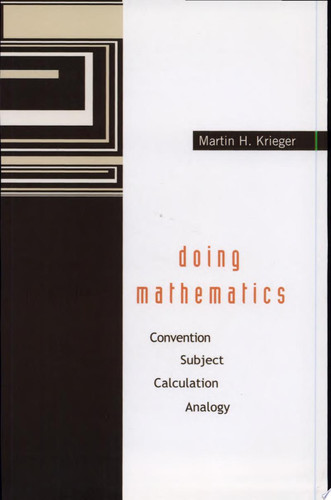
Doing mathematics: convention, subject, calculation, analogy

Krieger, Martin H.
This book discusses some ways of doing mathematical work and the subject matter that is being worked upon and created. It argues that the conventions we adopt, the subject areas we delimit, what we can prove and calculate about the physical world, and the analogies that work for mathematicians--all depend on mathematics, what will work out and what won't. And the mathematics, as it is done, is shaped and supported, or not, by convention, subject matter, calculation, and analogy. The causes studied include the central limit theorem of statistics, the sound of the shape of a drum, the connection between algebra and topology, the stability of matter, the Ising model, and the Langlands Program in number theory and representation theory. Contents: Convention: How Means and Variances are Entrenched as Statistics; Subject: The Fields of Topology; Appendix: The Two-Dimensional Ising Model of a Ferromagner; Calculation: Strategy, Structure, and Tactics in Applying Classical Analysis; Analogy; A Syzygy Between a research Program in Mathematics and a Research Program in Physics, Each of Which is Itself an Analogy; Mathematics in Concreto. Readership: Mathematicians, Physicists, philosophers and historians of science.
World Scientific 2003 454 pages

Society and nature: a sociological inquiry

Kelsen, Hans
In attempting to understand the psychological aspects of the developmental process and socialization, the distinct disciplines of sociology and psychology were brought together for the first time. Titles in this set analyze how behaviour is formed and learned. The set contains such classic works as Erich Fromm's 'The Sane Society' and Neil Smelser's 'Theory of Collective Behaviour'.
Routledge 2002 5762 pages

The Gini Methodology A Primer on a Statistical Methodology

Shlomo Yitzhaki,Edna Schechtman
Gini's mean difference (GMD) was first introduced by Corrado Gini in 1912 as an alternative measure of variability. GMD and the parameters which are derived from it (such as the Gini coefficient or the concentration ratio) have been in use in the area of income distribution for almost a century. In practice, the use of GMD as a measure of variability is justified whenever the investigator is not ready to impose, without questioning, the convenient world of normality. This makes the GMD of critical importance in the complex research of statisticians, economists, econometricians, and policy makers. This book focuses on imitating analyses that are based on variance by replacing variance with the GMD and its variants. In this way, the text showcases how almost everything that can be done with the variance as a measure of variability, can be replicated by using Gini. Beyond this, there are marked benefits to utilizing Gini as opposed to other methods. One of the advantages of using Gini methodology is that it provides a unified system that enables the user to learn about various aspects of the underlying distribution. It also provides a systematic method and a unified terminology. Using Gini methodology can reduce the risk of imposing assumptions that are not supported by the data on the model. With these benefits in mind the text uses the covariance-based approach, though applications to other approaches are mentioned as well.
Springer New York 2014-12-13 548 pages

Mind wars: brain research and national defense

Moreno, Jonathan D.
In his fascinating new book, Jonathan D. Moreno investigates the deeply intertwined worlds of cutting-edge brain science, U.S. defense agencies, and a volatile geopolitical landscape where a nation's weaponry must go far beyond bombs and men. The first-ever exploration of the connections between national security and brain research, Mind Wars: Brain Research and National Defense reveals how many questions crowd this gray intersection of science and government and urges us to begin to answer them. From neuropharmacology to neural imaging to brain-machine interface devices that relay images and sounds between human brains and machines, Moreno shows how national security entities seek to harness the human nervous system in a multitude of ways as a potent weapon against the enemy soldier. Moreno charts such projects as monkeys moving robotic arms with their minds, technology to read the brain’s thought patterns at a distance, the development of "anti-sleep" drugs to enhance soldiers’ battle performance and others to dampen their emotional reactions to the violence, and advances that could open the door to "neuroweapons"—virus-transported molecules to addle the brain. "As new kinds of weapons are added to the arsenal already at the disposal of fallible human leaders," Moreno writes, "we need to find new ways to address the problem"--of the ethical military application of so powerful and intimate a science. This book is the first step in confronting the quandaries inherent in this partnership of government and neuroscience, serves as a compelling wake-up call for scientists and citizens, and suggests that, with imagination, we might meet the needs of both security and civil liberty.
Dana Press 2006-11-17 210 pages

Contesting tears: the Hollywood melodrama of the unknown woman

Cavell, Stanley
What is marriage? Can a relationship dedicated to equality, friendship, and mutual education flower in an atmosphere of romance? What are the paths between loving another and knowing another? Stanley Cavell identified a genre of classic American films that engaged these questions in his study of comedies of remarriage, Pursuits of Happiness . With Contesting Tears , Cavell demonstrates that a contrasting genre, which he calls "the melodrama of the unknown woman," shares a surprising number and weave of concerns with those comedies. Cavell provides close readings of four melodramas he finds definitive of the genre: Letter from an Unknown Woman , Gaslight , Now Voyager , and Stella Dallas . The women in these melodramas, like the women in the comedies, demand equality, shared education, and transfiguration, exemplifying for Cavell a moral perfectionism he identifies as Emersonian. But unlike the comedies, which portray a quest for a shared existence of expressiveness and joy, the melodramas trace instead the woman's recognition that in this quest she is isolated. Part of the melodrama concerns the various ways the men in the films (and the audiences of the films) interpret and desire to force the woman's consequent inaccessibility. "Film is an interest of mine," Stanley Cavell has written, "or say a love, not separate from my interest in, or love of, philosophy." In Contesting Tears Cavell once again brilliantly unites his two loves, using detailed and perceptive musings on melodrama to reflect on philosophical problems of skepticism, psychoanalysis, and perfectionism. As he shows, the fascination and intelligence of such great stars as Ingrid Bergman, Bette Davis, and Barbara Stanwyck illuminate, as they are illuminated by, the topics and events of these beloved and enduring films.
University of Chicago Press 1996 255 pages

The dialectical imagination: a history of the Frankfurt School and the Institute of Social Research, 1923-1950

Jay, Martin
Herbert Marcuse, Erich Fromm, Max Horkheimer, Franz Neumann, Theodor Adorno, Leo Lowenthal--the impact of the Frankfurt School on the sociological, political, and cultural thought of the twentieth century has been profound. The Dialectical Imagination is a major history of this monumental cultural and intellectual enterprise during its early years in Germany and in the United States. Martin Jay has provided a substantial new preface for this edition, in which he reflects on the continuing relevance of the work of the Frankfurt School.
Heinemann 1973 382 pages

Victory and vexation in science: Einstein, Bohr, Heisenberg, and others

Holton, Gerald James
Never has the power of scientific research to solve existing problems and uncover new ones been more evident than it is today. Yet there exists widespread ignorance about the larger contexts within which scientific research is carried out. For example, the point of view some scientists adopt in their work or in their social commitments may become clearer if considered in light of the opposing views held by other scientists. This is a theme Gerald Holton addresses in his new collection. Whether considering conflicts between Heisenberg and Einstein, Bohr and Einstein, or P. W. Bridgman and B. F. Skinner; tracing I. I. Rabi's shift of attention from superb science to education and scientific statesmanship; or examining the emergence, in the last few decades, of the need to connect scientific research to societal needs--in each case, Holton demonstrates a masterly understanding of modern science and how it influences our world. The author shows why, at any given time--even in the mature phase of science--there exists no single "paradigm," but rather a spectrum of competing perspectives; and why so much good science has been based, from antiquity to today, on a relatively small number of presuppositions.
Harvard University Press 2005-05-30 229 pages

The Conduct of Inquiry: Methodology for Behavioural Science

Abraham Kaplan
In arguably the finest text ever written in the philosophy of social science, Abraham Kaplan emphasizes what unites the behavioral sciences more than what distinguishes them from one another. Kaplan avoids the bitter disputes among people doing methodology, claiming instead that what is important are those qualities intrinsic to the overall aspirations of the social sciences. He deals with special problems of various disciplines only so far as may be helpful in clarifying the general method of inquiry. The Conduct of Inquiry is a systematic, rounded, and wide-ranging inquiry into behavioral science. Kaplan is guided by the experience of sciences with longer histories, but he is bound neither to their problems nor to their solutions. Instead, he addresses the methodology of behavioral science in the broad sense of both method and science. The work is not a formal exercise in the philosophy of science but rather a critical and constructive assessment of the developing standards and strategies of contemporary social inquiry. He emphasizes the tasks, achievements, limitations, and dilemmas of the newer disciplines. Philosophers of science usually choose to write about the most fully developed sciences because problems are clearer there. The result is ordinarily of little benefit to the behavioral scientist, whose task is clarification of method; here the precedents and analogies of physical science are obscure or inappropriate. The Conduct of Inquiry goes a long way in drawing upon the strengths of social research insights without simplifying the common concerns of the scientific enterprise as a whole. As Leonard Broom noted when the book initially appeared: "Kaplan fills a gap and does so with admirable clarity and often engaging wit. It lacks pomposity, pedantry, and pretension, and it is bound to make an impact on the teaching of and, with luck, research in the behavioral sciences."
[distributor] Taylor & Francis, c/o Bookpoint 2017-07-14 428 pages

The universe within: from quantum to cosmos

Turok, Neil
Turok explores the transformative scientific discovers of the past three centuries, from classical mechanics to the nature of light and the evolution of the cosmos, and shows how they created shifts in the organization of society. He argues that we are on the cusp of another major transformation: the coming quantum revolution that will supplant our current digital age.
House of Anansi Press 2012 292 pages

The logic of liberty: reflections and rejoinders

Polanyi, Michael
A chemist and member of a family renowned for its learning in several disciplines, Michael Polanyi experienced first-hand the horrors of totalitarian government and worldwide war. He argued that centrally planned organizations-or governments-based solely on the methods of science threaten to foreclose a full human knowledge of the mysteries of existence and therefore pose a direct threat not only to academic freedom but also to social and political liberty. Michael Polanyi (1891-1976) was an internationally renowned scientist, philosopher, and professor whose other works include Personal Knowledge and The Tacit Dimension. Stuart D. Warner is Associate Professor of Philosophy at Roosevelt University, Chicago, Illinois.
Liberty Fund 1998 256 pages

The Qualitative-Quantitative Distinction in the Social Sciences

B. Glassner,Jonathan Moreno
Without of course adopting a Platonic metaphysics, the eighteenth-century philosophes were Grecophiles who regarded the Athenian philosophers as their intellectual forbearers and mentors. So powerful was their identification with c1assification that ancient ideas were taken as keys to the design of the modem world, but usually the ideas were taken separately and as divided from their systematic context. The power of number was an idea the En lightenment thinkers deployed with their legendary passion and vigor, particularly as an instrument for social reconstruction. It is no exaggemtion to say that the role of quantities in contemporary social scientific theorizing cannot be understood with any depth absent a recollection of the philosophes' axial development of the notion of quantification. It is a commonplace that for the philosophes progress required releasing human abilities to have power over nature. Aprerequisite for this power was knowledge of the underlying causes of natural events, knowledge that required quantitative precision. Enlightenment thinkers were sufficiently aware of themselves as products of their time to appreciate the importance of a liberal social environment to the knowledge enterprise; the supposition that the reverse is also the case, that enhanced knowledge could advance social conditions, came easily.
Springer Netherlands 2010-12-25 236 pages

Interdisciplinarity: reconfigurations of the social and natural sciences

Barry, Andrew,Born, Georgina
"The idea that research should become more interdisciplinary has become commonplace. According to influential commentators, the unprecedented complexity of problems such as climate change or the social implications of biomedicine demand interdisciplinary efforts integrating both the social and natural sciences. In this context, the question of whether a given knowledge practice is too disciplinary, or interdisciplinary, or not disciplinary enough has become an issue for governments, research policy makers and funding agencies. Interdisciplinarity, in short, has emerged as a key political preoccupation; yet the term tends to obscure as much as illuminate the diverse practices gathered under its rubric. This volume offers a new approach to theorising interdisciplinarity, showing how the boundaries between the social and natural sciences are being reconfigured." -- From the Routledge
Routledge 2013 278 pages

Mathematics, science and epistemology

Lakatos, Imre
EditorsG++ introduction Part I Philosophy of Mathematics 1 Infinite regress and foundations of mathematics 2 A renaissance of empiricism in the recent philosophy of mathematics? 3 Cauchy and the continuum: the significance of non-standard analysis for the history and philosophy of mathematics 4 What does a mathematical proof prove? 5 The method of analysis-synthesis Part II Critical Papers 6 The problem of appraising scientific theories: three approaches 7 Necessity, Kineale and Popper 8 Changes in the problem of inductive logic 9 On Popperian historiography 10 Anomalies versus G++crucial experimentsG++ 11 Understanding Toulmin Part III Science and Education 12 A letter to the director of the London School of Economics 13 The teaching of the history of science 14 The social responsibility of science References Lakatos bibliography Indexes.
Cambridge University Press 1978 285 pages