146 results for "Science"

Lions and scavengers: the true story of America (and her critics)

Shapiro, Ben
"In a world split between noble Lions and destructive Scavengers, only the brave can lead the way. Acclaimed writer and conservative thought leader Ben Shapiro knows that at the heart of today's conflicts--political, economic, and cultural--there's a dangerous lie: that all people are equal in ability, and that all inequality stems from oppression and exploitation. With his signature clarity and sharp insight, Shapiro refutes that lie, emphasizing that in a free country, inequality is rooted in differences of talent and work ethic--not oppression--and that the best solution to lack of success lies in duty and virtue. Lions, like America's founding fathers, strive for the highest good, building systems that promote freedom, prosperity, and equality of opportunity. Meanwhile, Scavengers degrade these ideals, spreading resentment and entitlement that threaten to dismantle the foundations of Western civilization. In Lions and Scavengers, Shapiro invites you to take up the mantle of the Lion and defend the principles that shape the freedom of a fair, powerful society. With the stakes higher than ever, this book is a gripping exploration of the ongoing war between those who cherish our nation and those who seek to undermine it. The triumph of the Lions is essential for America's continued success. It's a rallying cry for those who refuse to bow to the Scavengers' demands. It's time to fight back." -- Provided by publisher.
Threshold Editions 2025-09-02 256 pages

The coming of post-industrial society: a venture in social forecasting

Bell, Daniel
In 1976, Daniel Bell€™s historical work predicted a vastly different society developing—one that will rely on the “economics of information€ rather than the “economics of goods.€ Bell argued that the new society would not displace the older one but rather overlie some of the previous layers just as the industrial society did not completely eradicate the agrarian sectors of our society. The post-industrial society€™s dimensions would include the spread of a knowledge class, the change from goods to services and the role of women. All of these would be dependent on the expansion of services in the economic sector and an increasing dependence on science as the means of innovating and organizing technological change.Bell prophetically stated in The Coming of the Post-Industrial Society that we should expect “ new premises and new powers, new constraints and new questions—with the difference that these are now on a scale that had
Basic Books 1973-07-12 507 pages

Socialism: An Economic And Sociological Analysis (1951)

Mises, Ludwig Von
""Socialism: An Economic and Sociological Analysis"" is a seminal work by the Austrian economist and philosopher Ludwig von Mises. Originally published in 1922, this revised edition from 1951 offers a comprehensive critique of socialism, examining its economic and sociological implications. Mises argues that socialism, which seeks to eliminate private ownership of the means of production and replace it with collective ownership, is fundamentally flawed and cannot work in practice. He explores the reasons why socialist economies inevitably lead to inefficiency, misallocation of resources, and ultimately, economic collapse. Mises also examines the social and political implications of socialism, arguing that it leads to the destruction of individual freedom and the growth of authoritarianism. The book remains a classic in the field of economics and political philosophy, and is essential reading for anyone interested in understanding the strengths and weaknesses of socialist ideology.This scarce antiquarian book is a facsimile reprint of the old original and may contain some imperfections such as library marks and notations. Because we believe this work is culturally important, we have made it available as part of our commitment for protecting, preserving, and promoting the world's literature in affordable, high quality, modern editions, that are true to their original work.
Kessinger Publishing, LLC 2010-09-10 598 pages

ENEMIES AND ALLIES An Unforgettable Journey Inside the Fast-moving & Immensely Turbulent... Modern Middle East

JOEL C. ROSENBERG
USA Today bestseller! Do recent changes in the Middle East signal peace? One Arab country after another is signing historic, game-changing peace, trade, investment, and tourism deals with Israel. At the same time, Russia, Iran, and Turkey are forming a highly dangerous alliance that could threaten the Western powers. Meanwhile, the U.S. is drawing down its military forces in the Mideast and focusing on matters closer to home. Where’s it all heading? New York Times bestselling author Joel C. Rosenberg, based in Jerusalem, skillfully and clearly explains the sometimes-encouraging, sometimes-violent, yet rapidly shifting landscape in Israel and the Arab/Muslim world. Enemies and Allies will take readers behind closed doors in the Middle East and introduce them to the very kings and crown princes, presidents and prime ministers who are leading the change. Includes exclusive, never-before-published quotes, insights, and analysis from the author’s conversations with some of the most complex and controversial leaders in the world: Saudi Crown Prince Mohammed bin Salman (MBS) Egypt’s President Abdel Fattah el-Sisi Jordan’s King Abdullah II United Arab Emirates’ Crown Prince Mohammed bin Zayed (MBZ) Israeli prime minister Benjamin Netanyahu Israeli president Reuven Rivlin
Tyndale House Publishers 2022

Fighting Terrorism: How Democracies Can Defeat Domestic And International Terrorism

Netanyahu, Benjamin
Benjamin Netanyahu, the leader of Israels Likud Party & a noted authority on international terrorism, offers a compelling approach to understanding terrorism. He cites diverse examples to demonstrate that domestic terrorist groups are usually no match for an advanced technological society. But he sees a more potent threat from the new international terrorism, which is increasingly the product of Islamic militants, who draw their inspiration & directives from Iran & its growing cadre of satellite states. He advocates specific measures to combat them. An excellent road map to understanding terrorism — in moral, historical, & practical terms.
Diane Pub Co 1995-08-01 151 pages

The wires of war: technology and the global struggle for power

Helberg, Jacob
From the former news policy lead at Google, an urgent and groundbreaking account of the high-stakes global cyberwar brewing between Western democracies and the autocracies of China and Russia that could potentially crush democracy. From 2016 to 2020, Jacob Helberg led Google's global internal product policy efforts to combat disinformation and foreign interference. During this time, he found himself in the midst of what can only be described as a quickly escalating two-front technology cold war between democracy and autocracy. On the front-end, we're fighting to control the software--applications, news information, social media platforms, and more--of what we see on the screens of our computers, tablets, and phones, a clash which started out primarily with Russia but now increasingly includes China and Iran. Even more ominously, we're also engaged in a hidden back-end battle--largely with China--to control the Internet's hardware, which includes devices like cellular phones, satellites, fiber-optic cables, and 5G networks. This tech-fueled war will shape the world's balance of power for the coming century as autocracies exploit twenty-first-century methods to re-divide the world into twentieth century-style spheres of influence. Helberg cautions that the spoils of this fight are power over every meaningful aspect of our lives, including our economy, our infrastructure, our national security, and ultimately, our national sovereignty. Without a firm partnership with the government, Silicon Valley is unable to protect democracy from the autocrats looking to sabotage it from Beijing to Moscow and Tehran. The stakes of the ongoing cyberwar are no less than our nation's capacity to chart its own future, the freedom of our democratic allies, and even the ability of each of us to control our own fates, Helberg says. And time is quickly running out.
Avid Reader Press 2022 360 pages

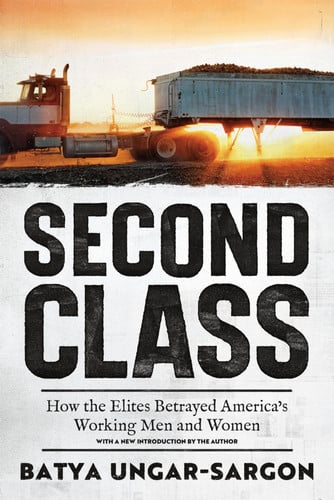
Second class: how the elite betrayed America's working men and women

Ungar-Sargon, Batya
A personal, journalistic ethnography of the modern American working class, based on the travels and interactions of the author through the American heartland. " Second Class is the most important book you will read all year. A political realignment is coming, and it's my hope that the end result will work in favor of our all-too-neglected American working class. When that realignment comes, Batya and her book will help lead the way." --Greg Lukianoff, CEO of the Foundation for Individual Rights in Education, and co-author of The Coddling of the American Mind Who is the American working class? Do they still have a fair shot at the American Dream? What do they think about their chances to secure the hallmarks of a middle-class life? While writing this book, Batya Ungar-Sargon visited states across the nation to speak with members of the American working class who are fighting tooth and nail to survive. In Second Class , working-class Americans of all races, political orientations, and occupations share their stories--cleaning ladies, health care aides, cops, truck drivers, fast food workers, electricians, and more. In their own words, these working-class Americans explain the struggles and triumphs of their increasingly precarious lives--as well as what policies they think would improve them. Second Class combines deep reporting with a look at the data and expert opinions on America's emergent class divide, in which the most basic elements of a secure and stable life are increasingly out of reach for those without a college education. America has broken its contract with its laboring class. So, how do we get back to the American Dream? How do we once again become the land of opportunity, the promised land, where hard work and commitment to family are enough to protect you from poverty? It's not that hard actually. All it would take, as this book illustrates, is for those in power to once again respect the dignity of work--and the American worker.
Encounter Books 2025 248 pages

The Road to Freedom Economics and the Good Society

Joseph E. Stiglitz
We are a nation born from the conviction that people must be free. But since the middle of the last century, that idea has been co-opted. Forces on the political Right have justified exploitation by cloaking it in the rhetoric of freedom, leading to pharmaceutical companies freely overcharging for medication, a Big Tech free from oversight, politicians free to incite rebellion, corporations free to pollute, and more. How did we get here? Whose freedom are we--and should we--be thinking about? In The Road to Freedom, Nobel prize winner Joseph E. Stiglitz dissects America's current economic system and the political ideology that created it, laying bare their twinned failure. "Free" and unfettered markets have only succeeded in delivering a series of crises: the financial crisis, the opioid crisis, and the crisis of inequality. While a small portion of the population has amassed considerable wealth, wages for most people have stagnated. Free and unfettered markets have exploited consumers, workers, and the environment alike. Such failures have fed populist movements that believe being free means abandoning any obligations citizens have to one another. As they grow in strength, these movements now pose a real threat to true economic and political freedom. As an economic advisor to presidents and as chief economist at the World Bank, Stiglitz has witnessed these profound changes firsthand. As he argues, the failures follow from the elites' unshakeable dedication to "the neoliberal experiment." Explicitly taking on giants such as Friedrich Hayek and Milton Friedman, Stiglitz exposes accepted ideas about our political and economic life for what they are: twisted visions that tear at the social fabric while they enrich the very few. The Road to Freedom breaks new ground, showing how economics--including recent advances in which Stiglitz has played such an important role--reframes how to think about freedom and the role of the state in a twenty-first century society. Drawing on the work of contemporary philosophers, Stiglitz explains a deeper, more humane way to assess freedoms--one that considers with care what to do when one person's freedom conflicts with another's. We must reimagine our existing economic and legal systems and embrace forms of collective action, including regulation and investment, if we are to create an innovative society in which everyone can flourish. The task could not be more urgent, and Stiglitz's latest book is essential reading for those committed to the American ideal of an economic and political system that delivers well-being, opportunity, and meaningful freedoms for all.
W. W. Norton, Incorporated 2026-02-24 384 pages

SNCC: The New Abolitionists

Howard Zinn
Howard Zinn tells the story of one of the most important political groups in American history. SNCC: The New Abolitionists influenced a generation of activists struggling for civil rights and seeking to learn from the successes and failures of those who built the fantastically influential Student Nonviolent Coordinating Committee. It is considered an indispensable study of the organization, of the 1960s, and of the process of social change. Includes a new introduction by the author.
Beacon Press 1965 286 pages

The case against the Iran deal: how can we now stop Iran from getting nukes?

Dershowitz, Alan M.
The greatest danger the world faces in the twenty-first century is an Iranian nuclear arsenal. That is why decisions regarding Iran's nuclear program may be the most important of our time. The negotiations that led to this bad deal were deeply flawed. But it doesn't follow that the deal should be rejected by Congress. If the President is right that rejecting this deal will be worse than accepting, then he has put us in the terrible position of choosing between bad and worse. In The Case Against the Iran Deal: How Can We Stop Iran From Getting Nukes? , Harvard Law Professor Emeritus Alan Dershowitz evaluates the pros and cons of the Iran nuclear agreement. He asks the fundamental questions about what the deal means, how it will be implemented, and whether we now have the capacity to stop Iran from developing nuclear weapons. As a lawyer with decades of negotiation experience, and a regular commentator on Middle Eastern politics, Dershowitz explains how we could have gotten a better deal, and offers a unique analysis of the Obama administration's negotiations with Iran and the implications of a deal for Israel, the Middle East, and the global community. It is a call for both intelligent reflection and for determined action to stop Iran from getting the bomb. The clock is ticking. We must find ways to repair the damage this deal threatens to do. This book proposes solutions along with its constructive criticism.
Rosetta Press 2015-07-30 285 pages

Kissinger on Kissinger Reflections on Diplomacy, Grand Strategy, and Leadership

Winston Lord,Henry Kissinger
In a series of riveting interviews, America's senior statesman discusses the challenges of directing foreign policy during times of great global tension. As National Security Advisor to Richard Nixon, Henry Kissinger transformed America's approach to diplomacy with China, the USSR, Vietnam, and the Middle East, laying the foundations for geopolitics as we know them today. Nearly fifty years later, escalating tensions between the US, China, and Russia are threatening a swift return to the same diplomatic game of tug-of-war that Kissinger played so masterfully. Kissinger on Kissinger is a series of faithfully transcribed interviews conducted by the elder statesman's longtime associate, Winston Lord, which captures Kissinger's thoughts on the specific challenges that he faced during his tenure as NSA, his general advice on leadership and international relations, and stunning portraits of the larger-than-life world leaders of the era. The result is a frank and well-informed overview of US foreign policy in the first half of the 70s—essential reading for anyone hoping to understand tomorrow's global challenges.
St. Martin's Publishing Group 2019-05-14 176 pages

The mission: the CIA in the 21st century

Weiner, Tim
"... Tells the gripping, high-stakes story of the CIA through the first quarter of the twenty-first century, revealing how the agency fought to rebuild the espionage powers it lost during the war on terror--and finally succeeded in penetrating the Kremlin. The struggle has life-and-death consequences for America and its allies. The CIA must reclaim its original mission: know thy enemies. The fate of the free world hangs in the balance"-- Provided by publisher.
Mariner Books 2025-07-15 454 pages

The Idealist Jeffrey Sachs and the Quest to End Poverty

Nina Munk
A powerful portrayal of Jeffrey Sachs's ambitious quest to end extreme global poverty, now a Signal paperback. "The poor you will always have with you," according to Matthew 26:11. But Jeffrey Sachs, economics superstar, special advisor to the Secretary General of the UN and the author of The End of Poverty , vehemently disagrees. In his view, poverty -- especially the extreme deprivation of sub-Saharan Africa -- can easily be eradicated. The vast sums spent in foreign aid over the decades has not come close to alleviating the dire subsistence problems of Africans. Sachs believed he knew the reason: the developed world simply hadn't spent enough. In 2006, Sachs, backed by tens of millions of donor dollars, launched the five-year Millennium Villages Project. Sachs would test his theories in villages in different African countries, then, with each success, scale up until until the program was continent-wide. His first village "make-over" was a small community in Sauri, Kenya, and the immediate effect was encouraging. With that first inkling of success achieved, Sachs rolled out a dozen model Millennium villages in ten countries. For the past six years, Nina Munk has reported deeply on the Project, following Sachs on official trips and listening in on conversations with heads of states, rival organisations and potential donors. And she has immersed herself in the lives of people in two of the remote villages: Ruhiira, in southwest Uganda, and Dertu, in the arid borderland between Kenya and Somalia. Accepting hospitality from these camel herders and smallhold farmers, and sharing in their struggles, Munk came to understand the on-the-ground issues challenging Sachs' one-size-fits-all approach to global poverty. The Idealist is the profound and moving story of what happened when the abstract theories of a brilliant, driven man met messy human reality.
McClelland & Stewart 2014-10-07 288 pages

Drone Warfare: Killing by Remote Control

Medea Benjamin
The CIA chief, Leon Panetta, calls drones the ‘only game in town’. The figures bear him out. Between 2004 and 2012, the US reportedly conducted over 350 drone strikes in Pakistan, killing between 2,600 and 3,400 people. Drone strikes have killed more than 200 children alone in Pakistan and Yemen. In 2000, the Americans had fewer than fifty aerial drones; ten years later, it had a fleet of nearly 7,500, and the US Air Force now trains more drone ‘pilots’ than bomber and fighter pilots combined. Drones are already a $ 5 billion business in the US alone. American activist Medea Benjamin, a co-founder of the peace group CODEPINK and the international human rights organization Global Exchange, provides the first extensive analysis of who is producing the drones, where they are being used, who controls these unmanned places, and what are the legal and moral implications of their use. Benjamin also looks at what activists, lawyers, and scientists across the globe are doing to ground these weapons.
Daily Star Books 2013 241 pages