44 results for "Science"

Man in the Shadows Inside the Middle East Crisis with a Man Who Led the Mossad

Efraim Halevy
Israel's Mossad is one of the world's most powerful intelligence agencies. Having served as its director, Efraim Halevy has witnessed the Middle East crisis from the inside-out. As the secret envoy to prime ministers ranging from Yitzhak Rabin to Ariel Sharon, Halevy was privy to many of the top-level negotiations that changed the landscape of the region—and, in turn, the rest of the modern world. In Man in the Shadows , he provides a fascinating, deeply informed look at the secret workings and global repercussions of Mossad's fight against Islamic terror, and writes with passion and authority about such topics as: • S eptember 11, 2001 : What the Mossad knew before and after the attacks; his critique of the 9/11 report; and his assertion that we haven't seen the worst of radical Islam • His candid thoughts about the Bush Administration; George Tenet and his dismissal; the assassination attempt of Hamas leader Khaled Mashal; and other key players in the war on terror • Iraq : From Operation Desert Storm to the WMD crisis to the war of the present day, Halevy offers a modern history of the region, as well as an action-plan for the future ...and more. By turns a powerful history lesson and a roadmap to world peace, Man in the Shadows is a must-read for the twenty-first century.
Macmillan 2008-02-05 320 pages

Because It Is Wrong Torture, Privacy and Presidential Power in the Age of Terror

Beneficial Professor of Law Charles Fried,Charles Fried,Gregory Fried
Can torture ever be justified? When is eavesdropping acceptable? Should a kidnapper be waterboarded to reveal where his victim has been hidden? Ever since 9/11 there has been an intense debate about the government's application of torture and the pervasive use of eavesdropping and data mining in order to thwart acts of terrorism. To create this seminal statement on torture and surveillance, Charles Fried and Gregory Fried have measured current controversies against the philosophies of Aristotle, Locke, Kant, and Machiavelli, and against the historic decisions, large and small, of Jefferson, Lincoln, and Pope Sixtus V, among many others. Because It Is Wrong not only discusses the behavior and justifications of Bush government officials but also examines more broadly what should be done when high officials have broken moral and legal norms in an attempt to protect us. This is a moral and philosophical meditation on some of the most urgent issues of our time.
W. W. Norton, Incorporated 2010-09-06 224 pages

Political Evil What It Is and How to Combat It

Alan Wolfe
A timely, eye-opening examination of political evil, a concept widely misunderstood and desperately in need of clarification in our ever more chaotic world. In an age of genocide, terrorism, ethnic cleansing, and torture, evil threatens us in ways radically different from tsunamis and financial panics. Nature unleashes its wrath and people rush to help the victims. Evil shows its face and we are paralyzed over how to respond. It was not always this way. During the twentieth century, thinkers as diverse as Hannah Arendt, Reinhold Niebuhr, Arthur Koestler, and George Orwell made evil central to everything they wrote. Acclaimed political scientist Alan Wolfe argues that in an age of partisan blame-assigning, therapeutic excuse-making, and theological question-dodging, we need to get serious about the problem of evil once again. While there will always be something incomprehensible about evil, we are very much capable of understanding and combating the use of evil means to obtain political ends. Looking at examples of political evil around the globe—in the Middle East, Darfur, the Balkans, and at home in the West—Wolfe shows us how seemingly small distinctions can make an immense difference in international response. And he makes clear that much-needed change can be initiated with a shift in how we talk and think about political evil. At once impassioned and pragmatic, Political Evil sheds essential light on the creation of policy and on a concrete path to a more practicable and just future.
Knopf Doubleday Publishing Group 2012-09-04 352 pages

The Mind of the Islamic State

Robert Manne
So often in history, it is ideas that kill ... What are the ideas that drive the Islamic State? How did it develop and systematise its unique form of apocalyptic violence? In this gripping account, Robert Manne shows how the Islamic State's worldview evolved, from the 1960s prison writings of Sayyid Qutb all the way to its elegant online magazine of horror, Dabiq. This gripping account reveals the crucial role of texts such as The Management of Savagery, and figures such as al-Zarqawi, who set out to pit Sunni against Shi'a, tearing Iraq apart. Shortly after the fall of Mosul in June 2014, US General Michael Nagata said of the new jihadist threat: 'We have not defeated the idea. We do not even understand the idea. By examining the beliefs and strategies at the heart of the Islamic State, Manne shows how a dark ideology came into being.
ReadHowYouWant.com, Limited 2016-10-24 224 pages

The Way of the World A Story of Truth and Hope in an Age of Extremism

Ron Suskind
National Bestseller Fully Updated Ron Suskind’s book promises to be a bracing international thriller – an ensemble of uranium merchants and panicked diplomats, stealthy Jihadist soldiers and CIA operatives, anxious Muslim children and angry world leaders – a diverse cast of players who will define the struggle between hope and fear in the modern era. Suskind will close the Bush years – a period he has helped to define – with a startling glimpse at what America actually faces across the roiling world. In the intelligence and military communities, the overwhelming concern is the uncontrolled spread of nuclear weapons and the ingredients from which weapons can be composed across a globe exploding with conflict and anti-American fervour. It is a failure of government that we are left with this overwhelming security issue – both domestically, where our security is deeply compromised, and internationally, where we face a host of seen and unseen threats. This book will explode in the middle of an election year with unparalleled disclosures and analysis. The book’s nature and timing will place it at the very centre of the election battle as it enters its final six months. It will be a must-read for anyone hoping to exercise truly informed consent.
Doubleday Canada 2009-08-25 448 pages

The Jewish Defense Organization's A History of Islamist Terrorism in America

Jewish Organization
Secret history of Islamist terrorism in America from Sirhan Sirhan to Major Hasan and how the JDO fights it. The JDO was founded in March 1982 in reaction to the demise of the Jewish Defense League (JDL). The JDO was never and never will be a Kahanist organization; instead it is based on principles first set forth by the Honorable Zev Jabotinsky, the founder of Revisionist Zionism. Jabotinsky, poet, statesman and militarist told Jewish audiences prior to the Holocaust to leave Europe. In 2010 JDO was able to get a meeting of the American Renaissance Party that was to be held at the Skyline Motel in Washington, D.C. cancelled despite the insistence of its manager that it take place. In February 2011 JDO quashed another meeting of this racist group with the help of the NAACP and City Council members Patrick Cannon and Councilman Warren Turner. These men had enough self-respect to stop these KKK jackasses from spewing their racial-hatred in Charlotte, North Carolina. Look what happened in Greensboro, North Carolina in 1979 when the Klan mowed down a "Death to the Klan" march staged by Communists. Declassified FBI documents revealed that JDO Chairman Mordechai Levy warned the FBI that the Klan was planning a violent attack but his intelligence was ignored due to his status as a Jewish militant. Just the opposite should have been true. In March 2011 the JDO was able to convince the landlord of the the Nazi-Holocaust revisionist scumy group The Institute of Historical Review not to renew their lease. In May 2011 the JDO held a demonstration in front of Nazi Headquarters on the Upper East Side of Manhattan. These are our latest actions - we've been staging these events and others for years and years. It is from this militant / activist point of view that the JDO research team studied the history of Islamist terrorism on American soil within certain parameters of interest. Rather than using a shotgun approach we zeroed in on terrorist plots in which bombs were actually constructed or shots were fired and excluded numerous conspiracies that the FBI nipped in the bud. Our researchers obtained the documents from every terrorism court case in the United States, conducted interviews, scoured the Internet in all languages, studied declassified government documents, filed FOIA requests then put the puzzle pieces together. We even collected the trash in front of the Permanent Observer Mission of Palestine to the United Nations at 115 East 65th Street in Manhattan and discovered cable traffic that indicated the PLO was using Syrian diplomatic pouches to smuggle bomb parts to various locations throughout the world. JDO turned these cables over to Israeli intelligence who cautioned JDO not to reveal its methodology as it was going to be applied to other hostile diplomatic installations. JDO waited for a year before revealing its discovery on local television. Shortly thereafter a car with two Arabic looking men parked outside JDO headquarters at 6 Bleecker Street in Manhattan. A JDO member displayed his semi-auto Uzi and invited the thugs upstairs. It was just another day in the 1980's at JDO Headquarters.
Jewish Defense Organization Press 2011 465 pages

Winning the Right War The Path to Security for America and the World

Philip H. Gordon
“An absolutely brilliant book . . . the most clearly argued critique yet of the Bush administration’s flawed approach to defeating jihadist terrorism.”—Peter Bergen, author of Holy War, Inc. Six years into the “war on terror,” are the United States and its allies safer than they were before it started? Sadly, we are not, and the reason is that we are fighting—and losing—the wrong war. In this paradigm-shifting book, Philip H. Gordon presents a new way of thinking about the war on terror and a new strategy for winning it. He draws a provocative parallel between the war on terror and the Cold War, showing how defense, development, diplomacy, and the determination to maintain our own values can again be deployed alongside military might to defeat a hostile and insidious ideology. Gordon also asks, “What would victory look like?”—a topic sorely missing from the debate today. He offers a positive vision of the world after the war on terror, which will end not when we kill or capture all potential terrorists but when their hateful ideology collapses. Gordon’s strategy for achieving this goal is achievable and realistic, but only if the United States changes course before it is too late.
Henry Holt and Company 2008-08-05 224 pages

The Border Canada, the US and Dispatches From the 49th Parallel

James Laxer
Insightful, prescient and often funny, The Border explores what it means to be Canadian and what Canada means to the giant to our south. If good fences make good neighbours, do we have the sort of fence that will allow us to maintain neighbourly relations with the world’s only superpower? In The Border , well-known political scientist and journalist James Laxer explores this question by taking the reader on a compelling 5000-mile journey into culture, politics, history, and the future of Canadian sovereignty. Long ignored (or celebrated) as “the world’s longest undefended border,” the line between us and the US is now a stress point. The attacks on the World Trade Center announced to the world that North America is no longer a quiet neighbourhood and made our relationship with the US one of the most pressing questions facing Canadians. The porousness of the border is sure to be more problematic as the world becomes more troubled. Canadian officials complain of American pornography, drugs, untaxed cigarettes and, especially, guns moving northwards. For their part, the FBI and US Customs Service blame Canada for the infiltration of Chinese gangs smuggling immigrants and, more urgently, third-world terrorist cells based north of the border. Drawing deeply from history and anecdote, Laxer shows that for all our neighbourly good will, the Canada-US border has been contentious since the American War of Independence. In the mid-1800s the Americans tried to seize the west coast up to the 54th parallel. On the other hand, until 1931 the Canadian Army’s “Defence Scheme Number One” was to launch a surprise attack on the US with Mexico and Japan as allies. But beyond the fraught politics of the border, Laxer discovers another legacy as well. Travelling the country from Campobello island in the east to Richmond BC in the west all the way up to the Alaska panhandle in the north, Laxer meets people who live within a stone’s throw of the foreigners on the other side, and who share with him tales of friendship and rivalry, smuggling and trade that have shaped the character of their communities.
National Geographic Books 2004-09-21 400 pages

Bush's Law The Remaking of American Justice

Eric Lichtblau
In the aftermath of 9/11, President Bush declared that the struggle against terrorism would be nothing less than a war—a war that would require new tools and a new mind-set. As legal sanction was given to covert surveillance and interrogation tactics, internal struggles brewed over programs and policies that threatened to tear at the constitutional fabric of the country. Bush's Law is the alarming account of the White House's efforts to prevent the publication of Eric Lichtblau's exposé on warrantless wiretapping—and an authoritative examination of how the Bush administration employed its “war on terror” to mask the most radical remaking of American justice in generations.
Knopf Doubleday Publishing Group 2009-05-05 368 pages

The Holy Land

Robert Zubrin
What if Americans were the terrorists, and a more civilized superpower found it necessary to put us down? What if contemporary Christian ministers preached salvation through murder of non-believing foreigners, and the US government recruited child suicide-assassins for this purpose? If you were an American living in such a crazed society, what would you do? If you were a civilized outsider, how would you deal with these insane savages? The Holy Land poses such predicaments, and more. In an attempt to save the Minervans from oppression in the central galaxy, the liberal Western Galactic Empire has relocated the sect to their ancient homeland of Kennewick, Washington. The fundamentalist fanatics ruling the USA find the presence of pagans in the holy city intolerable, however, and they launch an interstellar campaign of mass destruction in protest. Now, cast in a universe gone mad, the primitive Earthling POW Sergeant Hamilton and his case officer, the sophisticated Minervan priestess (3rd class) Aurora, must find the way out, or neither side will survive. In this madcap role-reversed science-fiction satire on the Mideast crisis and the War on Terrorism, the gloves come off. Written with wit and verve by Heinlein Award winner Robert Zubrin, the author of The Case for Mars, Entering Space, and First Landing, The Holy Land takes science fiction back to its Swiftian roots. Rarely since Czech humanist Karel Capek aimed his 1936 War with the Newts at fascism and appeasement has the medium been mobilized to such pointed effect. "A satiric tour de force" - School Library Journal "The duplicity, mendacity, and hypocrisy that characterize the present predicament in the Middle East are laid bare in Zubrin's engaing romp, with verve and biting wit." - National Review Online "Nothing is spared from Zubrin's satiric pen: religion, politics, economics, sex, war, psychology, philosophy - all are the objects of his barbs....The Holy Land is a surprisingly fine follow-up to Zubrin's other fictional and non-fiction works." - The Rocky Mountain News "It's a hoot." - The San Diego Union-Tribune.
Polaris Books 2003 298 pages

The bookman

Tidhar, Lavie
A masked terrorist has brought London to its knees ' there are bombs inside books, and nobody knows which ones. On the day of the launch of the first expedition to Mars, by giant cannon, he outdoes himself with an audacious attack.For young poet Orphan, trapped in the screaming audience, it seems his destiny is entwined with that of the shadowy terrorist, but how?Like a steam-powered take on V for Vendetta, rich with satire and slashed through with automatons, giant lizards, pirates, airships and wild adventure, The Bookman is the first of a series.File under: Steampunk [Serial killer | Alternate Victorian London | Exploding Books | Historical Crime]
Angry Robot 2010 412 pages

Freedom and terror: reason and unreason in politics

Kaplan, Abraham
This book examines reason and unreason in the legal and political responses to terrorism. Terrorism is often perceived as sheer madness, unreasonable use of extreme violence and senseless, futile political action. These assertions are challenged by this book. Combining traditional " thought (by Kaplan) on reason and unreason in terrorism with empirical explorations of post-modern terrorism and its use of communication platforms (by Weimann) the work uses interdisciplinary and cross disciplinary dimensions to provide a multidimensional picture of critical issues in current politics and a deeper examination of their implications than previously available. The book looks at various aspects of modern politics, from terrorism to protest, from decision-making to political discourse, applying the perspective of philosophical thought. To do so, political issues and actions are examined by using concepts such as reason, emotions, madness, magic, morality, absolutism, extremism, psychopathology, rationality and others. The analysis is rooted in theories and concepts derived from history, philosophy, religion, art, sociology, psychology, and political science. This book, which was mostly written by the late Abraham Kaplan, an American philosopher, and edited and updated by Gabriel Weimann, will be of much interest to students of political violence/terrorism, philosophy, war and conflict studies and political science in general.
Routledge 2011 189 pages

A Practical Guide to Winning the War on Terrorism

Adam Garfinkle
The military side of the war on terrorism, says Adam Garfinkle, is a necessary but not sufficient aspect of the solution. Weapons of mass destruction are activated by ideas of mass destruction, and these ideas arise from complex historical and social factors. A Practical Guide to Winning the War on Terrorism offers concrete steps for undermining the very notion that terrorism is a legitimate method of political struggle—and for changing the conditions that lead people to embrace it.
Independent Publishers Group (Chicago Review Press) 2013-10-01 226 pages

Law and the Long War The Future of Justice in the Age of Terror

Benjamin Wittes
An authoritative assessment of the new laws of war and a sensible and sophisticated roadmap for the future of liberty in the Age of Terror America is losing a crucial front in the ongoing war on terror. It is losing not to Al Qaeda, but to its own failure to construct a set of laws that will protect the American people during this global conflict. As debate continues to rage over the legality and ethics of war, Benjamin Wittes enters the fray with a sober-minded exploration of law in wartime that is definitive, accessible, and nonpartisan. Outlining how this country came to its current impasse over human rights and counterterrorism, Law and the Long War paves the way toward fairer, more accountable rules for a conflict without end.
Penguin Publishing Group 2009 310 pages

Turkey Terrorism, Civil Rights, and the European Union

Yonah Alexander,Edgar H. Brenner,Serhat Tutuncuoglu Krause
How do democratic societies maintain the balance between civil rights and security while continuing the fight on global terrorism? This work raises this issue and presents one country, Turkey, and its struggle to implement laws to combat terrorism and comply with the European Unione(tm)s civil rights standards. A collection of materials that reflects the legal responses in combating terrorism is an essential volume in any academic and professional collection as it provides a case-specific reference point in the fields of EU politics, law, and international relations. Turkey contains translations, contextual notes, and explanations from the editors of over 112 Turkish and EU documents ranging from martial law, PKK terror, Turkey-EU relations, human rights, and Turkish reforms. This resource book enables the reader to gauge Turkeye(tm)s prospects for success in establishing an effective government that at the same time protects the rights of the individual. This book will prove a valuable source for students and researchers of international politics, international relations and security studies.
Routledge 2014-04-28 24 pages

The Bookman Histories

Lavie Tidhar
The great game. When Mycroft Holmes is murdered, it is up to retired shadow detective Smith to track down his killer, leading him to stumble onto the greatest conspiracy of his life. Young Lucy Westerna, Holmes' protégé, must follow her own path to the truth, while on the other side of the world, a young Harry Houdini must face his greatest feat of escape -- death itself. As their paths converge the body count mounts up, the entire world is under threat, and in a foreboding castle in the mountains of Transylvania a mysterious old man weaves a spider's web of secrets and lies.
Angry Robot 2012 1022 pages

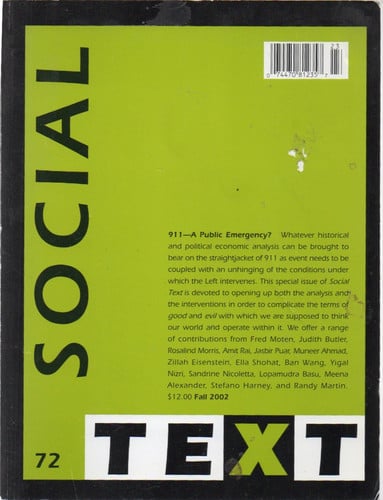
911 a Public Emergency?

Brent Hayes Edwards,Stefano Harney,Randy Martin,Ella Shohat,Timothy Mitchell,Fred Moten
Since September 11, public discourse has often been framed in terms of absolutes: an age of innocence gives way to a present under siege, while the United States and its allies face off against the Axis of Evil. This special issue of Social Text aims to move beyond these binaries toward thoughtful analysis. The editors argue that the challenge for the Left is to develop an antiterrorism stance that acknowledges the legacy of U.S. trade and foreign policy as well as the diversity of the Muslim faith and the dangers presented by fundamentalism of all kinds. Examining the strengths and shortcomings of area, race, and gender studies in the search for understanding, this issue considers cross-cultural feminism as a means of combating terrorism; racial profiling of Muslims in the context of other racist logics; and the homogenization of dissent. The issue includes poetry, photographic work, and an article by Judith Butler on the discursive space surrounding the attacks of September 11. This impressive range of contributions questions the meaning and implications of the events of September 11 and their aftermath. Contributors . Muneer Ahmad, Meena Alexander, Lopamudra Basu, Judith Butler, Zillah Eisenstein, Stefano Harney, Randy Martin, Rosalind C. Morris, Fred Moten, Sandrine Nicoletta, Yigal Nizri, Jasbir K. Puar, Amit S. Rai, Ella Shohat, Ban Wang
Duke University Press 2002-09-20 208 pages