99 results for "Social Media"

The Good Girls Revolt How the Women of Newsweek Sued their Bosses and Changed the Workplace

Lynn Povich
It was the 1960s--a time of economic boom and social strife. Young women poured into the workplace, but the "Help Wanted" ads were segregated by gender and the "Mad Men" office culture was rife with sexual stereotyping and discrimination. Lynn Povich was one of the lucky ones, landing a job at Newsweek , renowned for its cutting-edge coverage of civil rights and the "Swinging Sixties." Nora Ephron, Jane Bryant Quinn, Ellen Goodman, and Susan Brownmiller all started there as well. It was a top-notch job--for a girl--at an exciting place. But it was a dead end. Women researchers sometimes became reporters, rarely writers, and never editors. Any aspiring female journalist was told, "If you want to be a writer, go somewhere else." On March 16, 1970, the day Newsweek published a cover story on the fledgling feminist movement entitled "Women in Revolt," forty-six Newsweek women charged the magazine with discrimination in hiring and promotion. It was the first female class action lawsuit--the first by women journalists--and it inspired other women in the media to quickly follow suit. Lynn Povich was one of the ringleaders. In The Good Girls Revolt , she evocatively tells the story of this dramatic turning point through the lives of several participants. With warmth, humor, and perspective, she shows how personal experiences and cultural shifts led a group of well-mannered, largely apolitical women, raised in the 1940s and 1950s, to challenge their bosses--and what happened after they did. For many, filing the suit was a radicalizing act that empowered them to "find themselves" and fight back. Others lost their way amid opportunities, pressures, discouragements, and hostilities they weren't prepared to navigate. The Good Girls Revolt also explores why changes in the law didn't solve everything. Through the lives of young female journalists at Newsweek today, Lynn Povich shows what has--and hasn't--changed in the workplace.
PublicAffairs 2016-09-27 304 pages

Arrogance Rescuing America from the Media Elite

Bernard Goldberg
In his #1 New York Times bestseller, Bias, Emmy Award-winning journalist Bernard Goldberg created a national firestorm when he exposed the liberal biases of the so-called mainstream media. Now Goldberg takes on Big Journalism and punctures the bubble in which the media elites live and work-a culture of denial where contrary views are not welcome. With blistering wit and passion, Goldberg offers a twelve-step program to help journalists overcome their addiction to slanted news and exposes the main culprits of arrogance in the media. He reveals: How the media's coverage of the Jayson Blair scandal missed far more serious problems at the New York Times, Why the media refuse to shoot straight when the subject turns to guns, Which CBS News icon is "transparently liberal," according to commentator Andy Rooney, Why some think the top journalism school in America is an intellectual gulag, How some journalists, like Bob Costas and Tim Russert, do get it-and how they think American journalism can be made better. Book jacket.
Thorndike Press 2004 496 pages

Ideology and Utopia An Introduction to the Sociology of Knowledge

Karl Mannheim
This work has been selected by scholars as being culturally important, and is part of the knowledge base of civilization as we know it. This work is in the "public domain in the United States of America, and possibly other nations. Within the United States, you may freely copy and distribute this work, as no entity (individual or corporate) has a copyright on the body of the work. Scholars believe, and we concur, that this work is important enough to be preserved, reproduced, and made generally available to the public. We appreciate your support of the preservation process, and thank you for being an important part of keeping this knowledge alive and relevant.
Creative Media Partners, LLC 2022-10-26 352 pages

Five Lectures on Psycho-Analysis

Sigmund Freud
There exist, of course, few more famous figures in the field of psychology than Sigmund Freud. As the founding father of psychoanalysis, or the clinical method for treating psychopathology through dialogue between a patient and a psychoanalyst, his impact on the field of psychology cannot be overstated. This short work, "Five Lectures on Psycho-Analysis", is a collection of a series of lectures given by Freud at the 20th Anniversary Celebration of the founding of Clark University in Worcester, Massachusetts during September 1909 and was published as a collection in 1910. This event, at which Freud was awarded an honorary doctorate, received widespread media attention and marked the beginning of public popularity for Freud and his ideas. The publication of the lectures brought an even greater public attention to his theories. "Five Lectures on Psycho-Analysis" predates the more extensive collection "Introductory Lectures on Psychoanalysis", which is a series of lectures given by Freud from 1915 to 1917 and which delve more deeply into the topics of dreams, the unconscious mind, and the source of neuroses. "Five Lectures on Psycho-Analysis" is an excellent and accessible introduction to Freud's influential work in which he summarizes his basic ideas and speaks on the foundations of psychoanalysis. This edition is printed on premium acid-free paper and follows the translation of Harry W. Chase.
www.bnpublishing.com 2008-11-10 84 pages

World Without Mind

Franklin Foer
Over the past few decades there has been a revolution in terms of who controls knowledge and information. This rapid change has imperilled the way we think. Without pausing to consider the cost, the world has rushed to embrace the products and services of four titanic corporations. We shop with Amazon; socialise on Facebook; turn to Apple for entertainment; and rely on Google for information. These firms sell their efficiency and purport to make the world a better place, but what they have done instead is to enable an intoxicating level of daily convenience. As these companies have expanded, marketing themselves as champions of individuality and pluralism, their algorithms have pressed us into conformity and laid waste to privacy. They have produced an unstable and narrow culture of misinformation, and put us on a path to a world without private contemplation, autonomous thought, or solitary introspection - a world without mind. In order to restore our inner lives, we must avoid being co-opted by these gigantic companies, and understand the ideas that underpin their success. Elegantly tracing the intellectual history of computer science - from the Descartes and the enlightenment to Alan Turing to Stuart Brand and the hippie origins of today's Silicon Valley - Foer exposes the dark underpinnings of our most idealistic dreams for technology. The corporate ambitions of Google, Facebook, Apple, and Amazon, he argues, are trampling longstanding liberal values, especially intellectual property and privacy. This is a nascent stage in the total automation and homogenization of social, political, and intellectual life. By reclaiming our private authority over how we intellectually engage with the world, we have the power to stem the tide. At stake is nothing less than who we are, and what we will become. There have been monopolists in the past but today's corporate giants have far more nefarious aims. They're monopolists who want access to every facet of our identities and influence over every corner of our decision-making. Until now few have grasped the sheer scale of the threat. Foer explains not just the looming existential crisis but the imperative of resistance.
Jonathan Cape Ltd 2017-09-28 272 pages

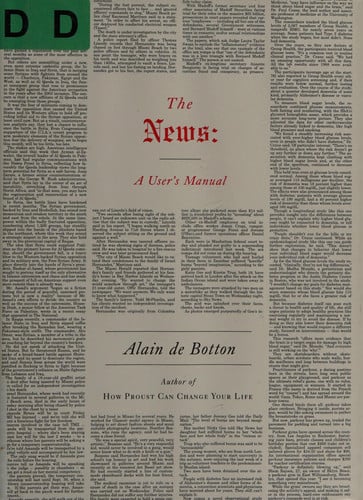
The News A User's Manual

Alain De Botton
From the author of The Architecture of Happiness , a thought-provoking look at the position that news has achieved in our lives. The news is everywhere. We can't stop constantly checking it on our computer screens, but what is this doing to our minds? We are never really taught how to make sense of the torrent of news we face every day, writes Alain de Botton, but this has a huge impact on our sense of what matters and of how we should lead our lives. In his dazzling new book, de Botton takes twenty-five archetypal news stories--including an airplane crash, a murder, a celebrity interview and a political scandal--and submits them to unusually intense analysis with a view to helping us navigate our news-soaked age. He raises such questions as: Why are disaster stories often so uplifting? What makes the love lives of celebrities so interesting? Why do we enjoy watching politicians being brought down? Why are upheavals in far-off lands often so boring? In The News: A User's Manual , de Botton has written the ultimate guide for our frenzied era, certain to bring calm, understanding and a measure of sanity to our daily (perhaps even hourly) interactions with the news machine.
McClelland & Stewart 2014-12-02 272 pages

After the Madness

Sol Wachtler
Driving down the Long Island Expressway in November of 1992, Sol Wachtler was New York's Chief Judge and heir apparent to the New York Governorship. Suddenly, three van loads of FBI agents swerved in front of him--bringing his car and his legal career to a halt. Wachtler's subsequent arrest, conviction and incarceration for harassing his longtime lover precipitated a media feeding frenzy, revealing to the world his struggles with romantic obsession, manic-depression and drug abuse. In this, his prison diary, Wachtler reveals the stark reality behind his vertiginous fall from the heights of the legal establishment to the underbelly of the criminal justice system. Sentenced to a medium security prison in Butner, North Carolina, Wachtler is stabbed by an unseen assailant, berated by prison guards, and repeatedly placed in solitary confinement with no explanation. Moreover, as a prisoner he confronts first hand the inequities of a system that his judicial rulings helped to construct and befriends the type of people he once sentenced to prison. With unflinching honesty, Wachtler draws upon his unique experience of living life on both sides of the bench to paint a chilling portrait of prison life interwoven with a no-holds-barred analysis of the shortcomings of the American legal justice system.
Open Road Integrated Media, Incorporated 2003-07 320 pages

A Preface to Politics

Walter Lippmann
Walter Lippmann (September 23, 1889 - December 14, 1974) was an American writer, reporter, and political commentator famous for being among the first to introduce the concept of Cold War, coining the term "stereotype" in the modern psychological meaning, and critiquing media and democracy in his newspaper column and several books, most notably his 1922 book Public Opinion.
CreateSpace Independent Publishing Platform 2016-03-07 120 pages

Microtrends The Small Forces Behind Tomorrow's Big Changes

Mark Penn
The adviser to Senator Hillary Clinton, Bill Gates, and President Bill Clinton proves that small is big by identifying 75 hidden-in-plain-sight trends that are moving America, revealing that the nation is no longer a melting pot but a collection of communities with many individual tastes and lifestyles. "The ideas in his book will help you see the world in a new way." --Bill Clinton "Mark Penn has a keen mind and a fascinating sense of what makes America tick, and you see it on every page of Microtrends ." --Bill Gates In 1982, readers discovered Megatrends . In 2000, The Tipping Point entered the lexicon. Now, in Microtrends , one of the most respected and sought-after analysts in the world articulates a new way of understanding how we live. Mark Penn, the man who identified "Soccer Moms" as a crucial constituency in President Clinton's 1996 reelection campaign, is known for his ability to detect relatively small patterns of behavior in our culture-microtrends that are wielding great influence on business, politics, and our personal lives. Only one percent of the public, or three million people, is enough to launch a business or social movement. Relying on some of the best data available, Penn identifies more than 70 microtrends in religion, leisure, politics, and family life that are changing the way we live. Among them: People are retiring but continuing to work. Teens are turning to knitting. Geeks are becoming the most sociable people around. Women are driving technology. Dads are older than ever and spending more time with their kids than in the past. You have to look at and interpret data to know what's going on, and that conventional wisdom is almost always wrong and outdated. The nation is no longer a melting pot. We are a collection of communities with many individual tastes and lifestyles. Those who recognize these emerging groups will prosper. Penn shows readers how to identify the microtrends that can transform a business enterprise, tip an election, spark a movement, or change your life. In today's world, small groups can have the biggest impact.
Grand Central Publishing 2007-09 448 pages

Toward a General Theory of Action

Talcott Parsons,Edward Shils
This work has been selected by scholars as being culturally important and is part of the knowledge base of civilization as we know it. This work is in the public domain in the United States of America, and possibly other nations. Within the United States, you may freely copy and distribute this work, as no entity (individual or corporate) has a copyright on the body of the work. Scholars believe, and we concur, that this work is important enough to be preserved, reproduced, and made generally available to the public. To ensure a quality reading experience, this work has been proofread and republished using a format that seamlessly blends the original graphical elements with text in an easy-to-read typeface. We appreciate your support of the preservation process, and thank you for being an important part of keeping this knowledge alive and relevant.
Creative Media Partners, LLC 2018-10-15 520 pages

Survival in the Shadows Seven Jews Hidden in Hitler's Berlin

Barbara Lovenheim
National bestseller: This "harrowing" true story of two Jewish families who survived hiding in the heart of the Nazi capital "honors the human spirit" (Andrea Dworkin). In January 1943, unable to flee Germany, the four members of the Arndt family went underground to avoid deportation to Auschwitz. Ellen Lewinsky and her mother, Charlotte, joined them; a year later, Bruno Gumpel arrived. Hiding in a small factory near Hitler's bunker, without identification cards or food-ration stamps, they were dependent on German strangers for survival. When Russian soldiers finally rescued the group in April 1945, the families were near death from starvation. But their will to live triumphed and two months later, four of the survivors--Erich Arndt and Ellen Lewinsky, and Ruth Arndt and Bruno Gumpel--reunited in a double wedding ceremony. Survival in the Shadows chronicles the previously untold story of the largest group of German Jews to have survived hiding in Berlin through the final and most deadly years of the Holocaust. Relayed to Barbara Lovenheim by three survivors from the group, the riveting story is a touching portrayal of the bravery of these seven Jews, and a heartfelt acknowledgment of the fortitude and humanity of the compassionate Germans who kept them alive.
Open Road Integrated Media, Incorporated 2016-10-18 233 pages

The Opposite of Hate A Field Guide to Repairing Our Humanity

Sally Kohn
“Brilliantly illustrates the immense and disarming power of changing course and driving not toward division, but toward civility and mutual respect.” -- Ms . magazine As a progressive commentator on Fox News and now CNN, Sally Kohn has made a career out of bridging intractable political differences. In this age of dangerous partisan resentment and rising bigotry, she decided to investigate hate itself--to better consider how we can stop it. With her trademark humor and humanity, Kohn introduces us to leading researchers and scientists who are exploring the evolutionary and cultural roots of hate. She travels to Rwanda, to the Middle East, and across the United States, talking with former terrorists and reformed white supremacists, and even sitting down with some of her own Twitter trolls. What she discovers is surprising: All of us harbor hate but the powerful acknowledgment that we are all in this together can lead us out of the wilderness. The opposite of hate is connection .
Algonquin Books 2019-03-26 272 pages

How to Become a Scandal Adventures in Bad Behavior

Laura Kipnis
A New York Times Book Review Editors' Choice We all relish a good scandal. Why do people feel compelled to act out their tangled psychodramas on the national stage, and why do we so enjoy watching them? The motifs are classic—revenge, betrayal, ambition, madness—though the pitfalls are ones we all negotiate daily. After all, every one of us is a potential scandal in the making: failed self-knowledge and colossal self-deception—the necessary ingredients—are our collective plight. How to Become a Scandal is "an extremely smart, funny, acid, and beautifully written meditation on a scary truth that we all try desperately to ignore" (David Shields, author of Reality Hunger: A Manifesto ).
Picador 2011-08-30 224 pages

The Female Thing Dirt, envy, sex, vulnerability

Laura Kipnis
From the author of the acclaimed Against Love comes a pointed, audacious, and witty examination of the state of the female psyche in the post-post-feminist world of the twenty-first century. Women remain caught between feminism and femininity, between self-affirmation and an endless quest for self-improvement, between playing an injured party and claiming independence. Rather than blaming the usual suspects—men, the media—Kipnis takes a hard look at culprits closer to home, namely women themselves. Kipnis serves up the gory details of the mutual displeasure between men and women in painfully hilarious detail. Is anatomy destiny after all? An ambitious and original reassessment of feminism and women’s ambivalence about it, The Female Thing breathes provocative new life into that age-old question.
Knopf Doubleday Publishing Group 2007-10-09 192 pages

Sociology Now

Michael S. Kimmel,Amy Aronson,Professor of Media Studies Amy Aronson, Ph.D.
Sociology Now reflects the discipline today and emphasizes the big questions about multiculturalism and globalization that sociologists ask. Sociology has always offered a way to make sense of the complex and sometimes contradictory forces that shape our social lives in any era. As Sociology Now explains sociology as both a body of knowledge and a "way of seeing," it shows how two such forces in particular have come to preoccupy sociologists and influence the way they look at the events and experiences of the early twenty first century: The first is globalization--the economic, political, cultural, and social interconnections among people and institutions all over the world. The second is multiculturalism--the recognition that race, ethnicity, class, gender, sexuality, religion, and other statu
Allyn & Bacon, Incorporated 2008-08 312 pages

The Good Society

Walter Lippmann
This work has been selected by scholars as being culturally important, and is part of the knowledge base of civilization as we know it. This work was reproduced from the original artifact, and remains as true to the original work as possible. Therefore, you will see the original copyright references, library stamps (as most of these works have been housed in our most important libraries around the world), and other notations in the work. This work is in the public domain in the United States of America, and possibly other nations. Within the United States, you may freely copy and distribute this work, as no entity (individual or corporate) has a copyright on the body of the work. As a reproduction of a historical artifact, this work may contain missing or blurred pages, poor pictures, errant marks, etc. Scholars believe, and we concur, that this work is important enough to be preserved, reproduced, and made generally available to the public. We appreciate your support of the preservation process, and thank you for being an important part of keeping this knowledge alive and relevant.
Creative Media Partners, LLC 2017-08-24 428 pages

Big Game The NFL in Dangerous Times

Mark Leibovich
“A raucous, smash-mouth, first-person takedown of the National Football League." —Wall Street Journal The New York Times bestseller From the #1 New York Times bestselling author of This Town , an equally merciless probing of America's biggest cultural force, pro football, at a moment of peak success and high anxiety Like millions of Americans, Mark Leibovich has spent more of his life tuned into pro football than he'd care to admit. Being a lifelong New England Patriots fan meant growing up on a steady diet of lovable loserdom. That is, until the Tom Brady/Bill Belichick era made the Pats the most ruthlessly efficient and polarizing sports dynasty of the modern NFL, and its fans the most irritating in all of Pigskin America. Leibovich kept his obsession quiet, making a nice career for himself covering that other playground for rich and overgrown children, American politics. Still, every now and then Leibovich would reach out to Tom Brady to gauge his willingness to subject himself to a profile. He figured that the chances of Brady agreeing were a Hail Mary at best, but Brady returned Mark's call in summer 2014 and kept on returning his calls through epic Patriots Super Bowl victory and defeat, and a scandal involving Brady--Deflategate--whose grip on sports media was as profound as its true significance was ridiculous. So began a four-year odyssey that took Mark Leibovich deeper inside the NFL than anyone has gone before. From the owners' meeting to the draft to the sidelines of crucial games, he takes in the show at the elbow of everyone from Brady to big-name owners to the cordially despised NFL Commissioner, Roger Goodell. Ultimately, BIG GAME is a chronicle of "peak football"--the high point of the sport's economic success and cultural dominance, but also the time when the dark side began to show. It is an era of explosive revenue growth, but also one of creeping existential fear. Players have long joked that NFL stands for "not for long," but as the true impact of concussions becomes inescapable background noise, it's increasingly difficult to enjoy the simple glory of football without the buzz-kill of its obvious consequences. And that was before Donald Trump. In 2016, Mark's day job caught up with him, and the NFL slammed headlong into America's culture wars. Big Game is a journey through an epic storm. Through it all, Leibovich always keeps one eye on Tom Brady and his beloved Patriots, through to the 2018 Super Bowl. Pro football, this hilarious and enthralling book proves, may not be the sport America needs, but it is most definitely the sport we deserve.
Penguin 2019-08-27 400 pages

The Glass Teat Essays

Harlan Ellison
The classic collection of criticism about television and American culture from the late, multi-award-winning legend. From 1968 through 1972, Harlan Ellison penned a series of weekly columns, sharing his uncompromising thoughts about contemporary television programming for the Los Angeles Free Press , a.k.a. "The Freep," a countercultural, underground newspaper. Sitcoms and variety shows, westerns and cop dramas, newscasts and commercials, Ellison left no pixilated stone unturned, expounding on the insipidness, hypocrisy, and malaise found in the glowing images projected into the faces of American audiences. The Glass Teat: Essays of Opinion on the Subject of Television collects fifty-two of Ellison's columns--including his 2011 introduction "Welcome to the Gulag," his unapologetic commentary about how cellphones and the internet have extended television's reach, eroding intelligence and freedom and creating a legion of bloodshot eyed zombies unable to communicate beyond their screens or think for themselves. Provocative and prescient, irreverent and insightful, Ellison's critical analyses of the glowing box that became the center of American life are even more relevant in the twenty-first century. Also available: The Other Glass Teat: Further Essays of Opinion on the Subject of Television
Open Road Integrated Media, Incorporated 2014-06 276 pages

The Hurried Child

David Elkind
With the first edition of The Hurried Child, David Elkind emerged as the voice of parenting reason, calling our attention to the crippling effects of hurrying our children through life. He showed that by blurring the boundaries of what is age appropriate, by expecting--or imposing--too much too soon, we force our kids to grow up too fast, to mimic adult sophistication while secretly yearning for innocence. In the more than two decades since this book first appeared, new generations of parents have inadvertently stepped up the assault on childhood, in the media, in schools, and at home. In the third edition of this classic (2001), Dr. Elkind provided a detailed, up-to-the-minute look at the Internet, classroom culture, school violence, movies, television, and a growing societal incivility to show parents and teachers where hurrying occurs and why. And as before, he offered parents and teachers insight, advice, and hope for encouraging healthy development while protecting the joy and freedom of childhood. In this twenty-fifth anniversary edition of the book, Dr. Elkind delivers important new commentary to put a quarter century of trends and change into perspective for parents today.
ReadHowYouWant.com 2010-09-07 424 pages