43 results for "Trade"

Barons of Labor The San Francisco Building Trades and Union Power in the Progressive Era

Michael Kazin
From the depression of the 1890s through World War I, construction tradesman held an important place in San Francisco's economic, political, and social life. Michael Kazin's award-winning study delves into how the city’s Building Trades Council (BTC) created, accumulated, used, and lost their power. He traces the rise of the BTC into a force that helped govern San Francisco, controlled its potential progress, and articulated an ideology that made sense of the changes sweeping the West and the country. Believing themselves the equals of officeholders and corporate managers, these working and retired craftsmen pursued and protected their own power while challenging conservatives and urban elites for the right to govern. What emerges is a long-overdue look at building trades as a force in labor history within the dramatic story of how the city's 25,000 building workers exercised power on the job site and within the halls of government, until the forces of reaction all but destroyed the BTC.
University of Illinois Press 1988-12 338 pages

Changing the Rules Adventures of a Wall Street Maverick

Muriel Siebert
When Mickie Siebert arrived in New York in the mid-1950s, she had $500 in her wallet and drove a used Studebaker. Almost fifty years later she is known as the "First Woman of Finance," the only woman to head a publicly traded national brokerage firm. Pithy, vastly entertaining, and full of behind-the-scenes anecdotes, Changing the Rules reveals how Siebert forged her phenomenal success in the chaotic and cutthroat world of Wall Street. Three four-letter words are behind Siebert's career success: One is work -- she learned everything there was to know about a company before recommending its stock. The second is luck -- as an analyst in training, she had the good fortune to follow a fledgling industry that nobody else wanted. (The "dog" industry was airlines.) The third word is risk -- she knew how to assess liability and make a decision. Siebert recounts the resistance of the good gray Stock Exchange when she dared to infiltrate the boys' club, threatening to have a Port-O-San delivered to the NYSE luncheon club if they didn't add a women's bathroom. She reveals the backstage stories about saving Lockheed and selling Conrail (at the time, the largest stock offering in Wall Street history), as well as the changes on the Street that led to May Day, 1975, when she was first in line as a discount broker (and considered a pariah by industry standards). She tells of her memorable encounters with such legendary figures as Captain Eddie Rickenbacker, the World War I flying ace who ran Eastern Airlines, and Robert Brimberg, the iconoclastic "Scarsdale Fats" whose investing acumen was the envy of the Street. Writing with equal candor about the politics of finance and the finance of politics, Siebert recalls her five years as Superintendent of Banking for New York State -- when she helped to prevent a national fiscal crisis during the Iran hostage situation -- and her experiences as a pro-choice Republican senatorial candidate. Siebert's reputation for rocking the boat is legendary, and Changing the Rules is both a fascinating biography of a true pioneer, and a valuable strategic and informational tool for anyone who deals with or dabbles in the money game.
Free Press 2007-08-22 240 pages

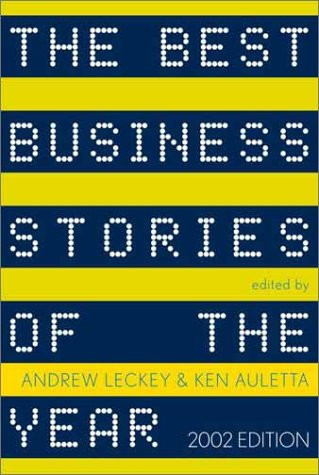
The Best Business Stories of the Year

Andrew Leckey,Ken Auletta
"[The editors] cast their net wide, picking up some excellent stories from nontraditional sources that even avid readers of the business press may have missed."-"USA Today," on the 2001 edition Series editor Andrew Leckey and guest editor Ken Auletta have scoured the print media, consulted with the editors of major business and general interest publications, and surveyed journalism school deans to find the best business stories from the last twelve months. Among those selected: Michael Lewis on teenage stock trader Jonathan Lebed, from "The New York Times Magazine"; James B. Stewart on the irrepressible Michael Milken, from "The New Yorker"; and many others from the pages of "The Wall Street Journal, Rolling Stone, Fortune, Rocky Mountain News, "and" Wired. " The second annual edition continues the excellence and comprehensive range of this fascinating anthology series.
Pantheon Books 2002 470 pages

Can global capitalism endure?

Robinson, William I.
"Global capitalism is facing an unprecedented crisis. The global economy is mired in prolonged stagnation. The worldwide social fabric is in decay. Civil strife and social upheaval are tearing up political systems and, in some cases, leading to the collapse of states. The planetary ecosystem is breaking down. Millions are fleeing, displaced by climate change, transnational corporate land grabs, wars and political persecution. How far into the future can global capitalism endure? In this urgent new study, sociologist William I. Robinson presents a "big picture" snapshot of the crisis of capitalism and the battle for the future of humanity. Drawing on 30 years of scholarship and activism, Robinson applies his original theory of global capitalism to the emerging digital age. He shows how global elites have pinned their hope on economic reactivation through the application of radical new digital technologies and financial strategies to the global economy and society. The rulers will turn to enhancing a global police state to contain mass rebellion as humanity enters a season of chaos and global civil war. The capitalist class and privileged strata of humanity may be able to survive collapse for decades to come even as a majority of humanity faces desperate struggles for survival that lead many to perish in the coming years. But there is eventually a terminal point to capitalist expansion as mass extinction and the radical alteration of the natural environment make life for our species and most others impossible. The only solution is a reversal of escalating inequalities through a radical redistribution of wealth and power downward as a first step in replacing the capitalist system, with its relentless pursuit of private profit at all cost, by an ecosocialism that prioritizes social need and harmony with the rest of nature. Theoretically sophisticated and engaging, this concise study will be satisfying to scholars yet accessible to a broader public concerned with the urgent political affairs of our day"--
Clarity Press, Inc 2022-08 114 pages

Tears of Mermaids The Secret Story of Pearls

Stephen G. Bloom
A round, luminescent pearl is the simplest and most perfect gem. Columbus sought—and found—this precious jewel coveted by his Spanish sovereigns, sparking popularity throughout Europe. Fashion icons Jacqueline Kennedy, Princess Grace, and Michelle Obama cherished them, making them iconic. And designer Coco Chanel raised them to new heights, bringing pearls— fake and real—to women everywhere. In Tears of Mermaids , Stephen G. Bloom travels 30,000 miles in an effort to trace a single pearl—from the moment a diver off the coast of Australia scoops an oyster containing a single luminescent pearl from the ocean floor to the instant a woman fastens the clasp of a strand containing the same orb. Bloom chronicles the never-before-told saga of the global pearl trade by gaining access to clandestine outposts in China, the Philippines, French Polynesia and Australia. He infiltrates high-tech pearl farms guarded by gun-toting sentries, farms for pearls in rural China, and even goes backstage at Christie's for a fast and furious auction of the most expensive pearl ever sold. Teeming with rogue humor and uncanny intelligence, Tears of Mermaids weaves a nonstop detective story whose main character is the world's most enduring jewel.
St. Martin's Press 2011-05-10 400 pages

The Anti-capitalistic Mentality

Ludwig Von Mises
2009 Reprint of original 1956 edition. Paperback, 114pp. Mises wrote and lectured extensively on behalf of classical liberalism and is seen as one of the leaders of the Austrian School of economics. Mises introduced praxeology as a more general conceptual foundation of the social sciences and established that economic laws were only arrived at through the means of methodological individualism firmly rejecting positivism and materialism as a foundation for the social sciences. Many of his works were on two related economic themes:1. Monetary economics and inflation; 2. The differences between government controlled economies and free trade.
Martino Publishing 2009 124 pages

Becoming an Entrepreneur (Expanded Edition) How to Succeed When You Don't Know What You Don't Know

Paul Pilzer
In Becoming an Entrepreneur, Paul Zane Pilzer shares the stories of his entrepreneur journey -- how he succeeded when he didn't know what he didn't know, and how you too can succeed as an entrepreneur! Pilzer is a masterful storyteller, sharing nuggets of wisdom and inspiration along with his infectious optimism to motivate any entrepreneur. Including: How Pilzer got rejected from Wharton's MBA program on April 10, 1974, but then accepted on April 17 - How to turn your rejections into acceptances. How Pilzer earned his first $1 million on the side while working full-time at Citibank. Should you quit before you are fired? How Apple violated Pilzer's trademark and offered a settlement that would have hurt their earnings and how he turned their offer into a balance sheet asset for Apple by making it a $1.25 million purchase of his startup's software. How there is a business opportunity almost every time you are an unhappy customer - Start a company to serve other unhappy customers. Let Paul Zane Pilzer mentor you to becoming an entrepreneur! Paul Zane Pilzer is a New York Times bestselling author, the founder of six companies, a world-renowned economist, a social entrepreneur, an adjunct professor, and the author of 13 books. He received his BA from Lehigh University in three years and his MBA from Wharton in 15 months. Pilzer became Citibank's youngest officer at age 22 and its youngest VP at age 26. At 24, he joined the faculty at New York University where he taught for 21 years and was student-rated "best professor" five times.
ZCI, Incorporated 2022-02-16 505 pages

Marxist Economic Theory

Ernest Mandel
CONTENTS: Introduction - Labour, Necessary product, Surplus Product - Exchange, Commodity, Value - Money, Capital, Surplus-value - The Development of Capital - The Contradictions of Capitalism - Trade - Credit - Money - Agriculture- Reproduction and the Growth of National Income - Periodical Crises - Monopoly Capitalism - Imperialism - The Epoch of Capitalist Decline - The Soviet Economy - The Economy of the Transition Period - Socialist Economy - Origin, Rise and Withering Away of Political Economy- Bibliography - Index
Merlin Press 1968 797 pages

Banking And Finance Among Jews In Renaissance Italy

Yehiel Nissim Da Pisa
Banking and Finance Among Jews in Renaissance Italy is a historical book written by Yehiel Nissim Da Pisa. The book explores the role of Jews in the banking and finance industry during the Renaissance period in Italy. It examines the economic, social, and political conditions that led to the emergence of Jewish bankers and financiers in Italy and their impact on the economy of the region. The book provides a detailed account of the Jewish banking families and their business practices, including their involvement in international trade and the creation of credit networks. It also discusses the challenges faced by Jewish bankers, including anti-Semitic attitudes and discriminatory laws. Through extensive research and analysis of primary sources, Da Pisa offers a comprehensive understanding of the Jewish banking and finance industry in Renaissance Italy. The book is an essential read for anyone interested in the history of banking and finance, Jewish history, and the Renaissance period.Text Language Is English And Hebrew.This scarce antiquarian book is a facsimile reprint of the old original and may contain some imperfections such as library marks and notations. Because we believe this work is culturally important, we have made it available as part of our commitment for protecting, preserving, and promoting the world's literature in affordable, high quality, modern editions, that are true to their original work.
Literary Licensing, LLC 2011-05 290 pages

The Economics of Russian Transition

Y. Gaidar
Russian analysts discuss postcommunist economic transformation. The end of the Cold War saw an unprecedented number of countries changing economic policies at the same time. One result has been the emergence of a new field of economics, postcommunist transformation theory. Written by prominent Russian analysts, the essays in this book discuss the economic policy problems that confront postcommunist countries. Most chapters focus on liberalization of the exchange rate and trade system, macroeconomic stabilization, and institutional reform. They also look at various policy options that have been pursued and their results. Underlying the book is the assumption that the transition to a market economy is both irreversible and the best path to sustained growth in Russia.
MIT Press 2003-05-09 1056 pages

Latin America in a New Era of Globalization Essays in Honor of Enrique V. Iglesias

Enrique V. Iglesias,Guillermo Calvo,Alicia Barsena,Oscar A. Echevarria,Gabriel Porcile,Nora Lustig,Luis Lopez-Calva,Eduardo Ortiz-Juarez,Jose Ocampo,Nancy Birdsall,Michel Camdessus,L. Enrique Garcia,Luis Moreno,Gert Rosenthal,Julio Sanguinetti,Ricardo Lagos
Latin America in a New Era of Globalization: Essays in Honor of Enrique V. Iglesias is the tribute a group of friends pays to Enrique Iglesias. By virtue of his roles and his actions, Enrique became, decades ago, a recognized and highly valued Latin American citizen who, throughout his career, he has made important contributions to development and democracy of the region, in addition to being a bridge between it and the rest of the world.His career has been one of prominence Chairman of the Central Bank, and then Minister of Foreign Affairs of Uruguay, Executive Secretary of the Economic Commission for Latin America and the Caribbean, President of the Inter-American Development Bank and, until a few months ago, Secretary General of the Ibero-American General Secretariat.As rightly pointed out by Enrique Garcia in Madrid on May 20th, 2014 at the presentation of the preliminary edition published by the CAF- Bank of Development in Latin America:The book project Latin America in a New Era of Globalization, Essays in Honor of Enrique V. Iglesias which we present in this document, is a well-deserved tribute to a Latin American citizen who has put his life and ideas at the service of the region, defending the dream that has guided generations and is synthesized in the virtuous trilogy: democracy, sustainable development and integration...There is no doubt that his thinking, his contributions to development and democracy are legacies that set examples for those people of Latin America -yesterday, today and tomorrow- who have deep convictions in free, equitable and prosperous societies, the need for greater regional integration and intelligent articulation internationally and, above all, in the capacity to forge their own destiny.
CreateSpace Independent Publishing Platform 2015-10-29 332 pages

The Great Mutual Fund Trap An Investment Recovery Plan

Gregory Arthur Baer,Gary S. Gensler
Convinced that your star mutual fund manager will help you beat the market? Eager to hear the latest stock picking advice on CNBC? FORGET ABOUT IT! "The" "Great Mutual Fund Trap "shows that the average mutual fund consistently underperforms the market, and that strategies for picking "above-average" funds -- everything from past performance to expert rankings -- are useless. Picking individual stocks on the advice of brokers and analysts works no better. The only sure things are the fees and commissions you'll pay. Fortunately, the news is not all bad. Investors willing to ignore the constant drumbeat of "trade frequently," "trust the experts," and "beat the market" now have the opportunity to do better. Using new investing products investors can earn higher returns with lower risks. Drawing on their years of Wall Street, Treasury and Federal Reserve experience, Gary Gensler and Gregory Baer offer a fresh and realistic look at how money is managed in America. From new indexing strategies to risk-managed stock selection, "The" "Great Mutual Fund Trap" offers investors an escape from high costs and immunity from seductive marketing messages. "From the Hardcover edition."
Broadway Books 2004-01-06 352 pages

Is NAFTA Constitutional?

Bruce Ackerman,David Golove
By a vote of 61 to 38, the Senate joined the House in declaring that "Congress approves...the North American Free Trade Agreement." The vote was virtually unnoticed, since the real battle over NAFTA was in the House. But there is a puzzle here. The President, the Framers assure us, "shall have Power, by and with the Advice and Consent of the Senate, to make Treaties, provided two thirds of the Senators present concur." Whatever happened to the Treaty Clause? Bruce Ackerman and David Golove tell the story of the Treaty Clause's being displaced in the twentieth century by a modern procedure in which the House of Representatives joins the Senate in the process of consideration, but simple majorities in both Houses suffice to commit the nation. This is called the Congressional-Executive Agreement, and is a response to a sea change in public opinion during and after World War II. This agreement substituted for a failed constitutional amendment that would have required all treaties to be approved by majorities in both Houses rather than by two-thirds of the Senate. The modern Congressional-Executive Agreement was self-consciously developed in order to make formal constitutional amendment unnecessary. So, is NAFTA constitutional? This book is reprinted from the Harvard Law Review .
Harvard University Press 2013-10 129 pages

Alternatives to Economic Globalization

John Cavanagh and Jerry Mander,Mander Jerry,Cavanagh John
The definitive document of the anti-corporate globalization movement-the consensus report of an alliance of leading activists, scholars, economists, researchers, and writers Offers a constructive, coherent, positive alternative to globalization-the very thing that the anti-corporate globalization movement is always accused of not putting forward The International Forum on Globalization consists of the leaders of over 60 organizations in 25 countries -including such prominent organizations as Friends of the Earth, the Third World Network, the Sierra Club, the Institute for Policy Studies, Public Citizen, Rainforest Action Network, and Food First Written by a premier group of 21 thinkers from around the world, the second edition of Alternatives to Economic Globalization lays out democratic, ecologically sound, socially just alternatives to corporate globalization more fully, specifically, and thoughtfully than has ever been done before. Focusing on constructive, achievable goals, the authors present ten governing principles for establishing truly sustainable societies and describe alternatives to the World Bank, the IMF, and the WTO that would better serve the needs of the planet. They offer detailed proposals for protecting vital goods and services from corporate exploitation, limiting corporate privileges and power, rebuilding economies to make them more responsive to human needs, and more. This revised and expanded edition features a new opening chapter on the global balance of power, a new section on the media and globalization, and a new final chapter on what ordinary citizens can do to fight the injustices of globalization. It also includes many new charts, sidebars, and other updated information.
ReadHowYouWant.com 2010-06 744 pages

Fueling the Future How the Battle Over Energy is Changing Everything

Andrew Heintzman,Evan Solomon
From trips to the market to lighting entire cities, power is pivotal to the simplest of everyday necessities. Wars are fought over it, the planet is polluted by it, but now its price has become too high. Are we capable of shifting to cleaner, safer, more reliable sources of energy? Fueling the Future gathers the best and brightest minds in the field Ñ thinkers like Jeremy Rifkin, L. Hunter Lovins, and Allison MacFarlane Ñ and uses their collective wisdom to tackle this pressing question from several angles. The experts predict what a world without oil, which is estimated to run out in 50 years, would be like. What new energy alternatives are available? The use of hydrogen and fuel cells is examined, with surprising conclusions. Fresh, efficient prose makes the experts' controversial answers readable and engaging, as well as thought provoking.
House of Anansi 2005 406 pages

The Last Good Job in America Work and Education in the New Global Technoculture

Stanley Aronowitz
Money, jobs, careers, training-all are topics often overheard in the conversation of middle-class Americans. One of the nation's leading critics of education, the world of work, and the labor movement, Stanley Aronowitz shows how new technologies, labor, and education all are deeply intertwined in our culture and everyday lives. This book reflects Aronowitz's thinking at a time when globalization has brought these connections to broad public attention. Aronowitz argues for the decline of "the job" as the backbone, along with family, of American society. Despite high employment, low wages and job insecurity leave many families at or below the poverty line. The career instability previously experienced mostly by blue-collar workers has spread to middle managers and high-level executives caught in the rapid movement of capital and technologies. In light of these facts, Aronowitz argues for a new social contract between employers and workers.
Bloomsbury Publishing PLC 2007-11-12 282 pages