44 results for "Trade"

Can global capitalism endure?

Robinson, William I.
"Global capitalism is facing an unprecedented crisis. The global economy is mired in prolonged stagnation. The worldwide social fabric is in decay. Civil strife and social upheaval are tearing up political systems and, in some cases, leading to the collapse of states. The planetary ecosystem is breaking down. Millions are fleeing, displaced by climate change, transnational corporate land grabs, wars and political persecution. How far into the future can global capitalism endure? In this urgent new study, sociologist William I. Robinson presents a "big picture" snapshot of the crisis of capitalism and the battle for the future of humanity. Drawing on 30 years of scholarship and activism, Robinson applies his original theory of global capitalism to the emerging digital age. He shows how global elites have pinned their hope on economic reactivation through the application of radical new digital technologies and financial strategies to the global economy and society. The rulers will turn to enhancing a global police state to contain mass rebellion as humanity enters a season of chaos and global civil war. The capitalist class and privileged strata of humanity may be able to survive collapse for decades to come even as a majority of humanity faces desperate struggles for survival that lead many to perish in the coming years. But there is eventually a terminal point to capitalist expansion as mass extinction and the radical alteration of the natural environment make life for our species and most others impossible. The only solution is a reversal of escalating inequalities through a radical redistribution of wealth and power downward as a first step in replacing the capitalist system, with its relentless pursuit of private profit at all cost, by an ecosocialism that prioritizes social need and harmony with the rest of nature. Theoretically sophisticated and engaging, this concise study will be satisfying to scholars yet accessible to a broader public concerned with the urgent political affairs of our day"--
Clarity Press, Inc 2022-08 114 pages

The Anti-capitalistic Mentality

Ludwig Von Mises
2009 Reprint of original 1956 edition. Paperback, 114pp. Mises wrote and lectured extensively on behalf of classical liberalism and is seen as one of the leaders of the Austrian School of economics. Mises introduced praxeology as a more general conceptual foundation of the social sciences and established that economic laws were only arrived at through the means of methodological individualism firmly rejecting positivism and materialism as a foundation for the social sciences. Many of his works were on two related economic themes:1. Monetary economics and inflation; 2. The differences between government controlled economies and free trade.
Martino Publishing 2009 124 pages

The Border Canada, the US and Dispatches From the 49th Parallel

James Laxer
Insightful, prescient and often funny, The Border explores what it means to be Canadian and what Canada means to the giant to our south. If good fences make good neighbours, do we have the sort of fence that will allow us to maintain neighbourly relations with the world’s only superpower? In The Border , well-known political scientist and journalist James Laxer explores this question by taking the reader on a compelling 5000-mile journey into culture, politics, history, and the future of Canadian sovereignty. Long ignored (or celebrated) as “the world’s longest undefended border,” the line between us and the US is now a stress point. The attacks on the World Trade Center announced to the world that North America is no longer a quiet neighbourhood and made our relationship with the US one of the most pressing questions facing Canadians. The porousness of the border is sure to be more problematic as the world becomes more troubled. Canadian officials complain of American pornography, drugs, untaxed cigarettes and, especially, guns moving northwards. For their part, the FBI and US Customs Service blame Canada for the infiltration of Chinese gangs smuggling immigrants and, more urgently, third-world terrorist cells based north of the border. Drawing deeply from history and anecdote, Laxer shows that for all our neighbourly good will, the Canada-US border has been contentious since the American War of Independence. In the mid-1800s the Americans tried to seize the west coast up to the 54th parallel. On the other hand, until 1931 the Canadian Army’s “Defence Scheme Number One” was to launch a surprise attack on the US with Mexico and Japan as allies. But beyond the fraught politics of the border, Laxer discovers another legacy as well. Travelling the country from Campobello island in the east to Richmond BC in the west all the way up to the Alaska panhandle in the north, Laxer meets people who live within a stone’s throw of the foreigners on the other side, and who share with him tales of friendship and rivalry, smuggling and trade that have shaped the character of their communities.
National Geographic Books 2004-09-21 400 pages

On the Contrary

Mary McCarthy
A master of the art of the essay, Mary McCarthy's 'On the Contrary' offers a thoughtful and incisive exploration of the issues and ideas that defined mid-century America. Whether reflecting on the challenges of feminism, the contradictions of politics, or the complexities of art and culture, McCarthy brings her trademark wit and erudition to bear on a wide range of topics. This work has been selected by scholars as being culturally important, and is part of the knowledge base of civilization as we know it. This work is in the "public domain in the United States of America, and possibly other nations. Within the United States, you may freely copy and distribute this work, as no entity (individual or corporate) has a copyright on the body of the work. Scholars believe, and we concur, that this work is important enough to be preserved, reproduced, and made generally available to the public. We appreciate your support of the preservation process, and thank you for being an important part of keeping this knowledge alive and relevant.
Creative Media Partners, LLC 2023-07-22 328 pages

Gray Mirror Disturbance. Fascicle I

Curtis Yarvin
"There is no current narrative, in or out of power, that tells our complete story. Should this disturb you? It should." Curtis Yarvin and Passage Press proudly present Yarvin's first original work exclusive to print with Gray Mirror: Fascicle I, Disturbance. Disturbance is the first in a series of four fascicles--novella-length volumes that compose the full book Gray Mirror. The purpose of Disturbance is to disrupt our sense of where we are. Our historical, political, and philosophical narratives are not infallible, Yarvin tells us, nor are our institutions of public and private power inevitable. Both are the results of contingent historical events. Different stories could be told. Different structures could hold power. In his trademark style of historical and cultural analysis, Yarvin asks: are these systems working out for us? If not, what can we do about it? How can we start living in the truth?" -- Amazon.
Passage Publishing 2024 236 pages

Never Give In Battling Cancer in the Senate

Sen. Arlen Specter
This is not simply the memoir of a cancer survivor. Nor is it just the memoir of a respected senator. This is an unprecedented glimpse into a man who is both. It is inspiration for people of all political persuasions; of how to persevere and succeed---despite what the doctors may say, despite what the tests might show. In early 2004, Senator Specter was in the midst of a grueling primary race, facing significant opposition from the right as he worked to win his party's nomination to run for reelection for his Pennsylvania senate seat. It would be the most difficult election in his quarter-century career in the Senate. Following on its heels were two more challenges---the general-election race and opposition to his elevation as Chairman of the Judiciary Committee, his lifelong ambition. He overcame all three challenges in time for his seventy-fifth birthday. But exhaustion and fatigue---initially thought to be the aftereffects of months of vigorous campaigning---were found to be far more serious. After a series of tests and consultation with several doctors, Specter was diagnosed with Hodgkin's disease, Stage IVB, the most advanced stage. He had received death sentences before and lived to tell about it. To Senator Specter, this diagnosis was another challenge. After all, he still had a job to do. His cancer treatments came as he reached the height of his power---surrounded by political storms that polarized Washington and threatened to shut the Senate down. His leadership positions made it his job to manage Supreme Court nominations and public- health appropriations as he faced his own illness. He had fought on public-health issues for years, but now it added potency to the message that the messenger was ailing himself. The phrase "Never give in" became Specter's mantra, invoking the famous words from Churchill in his battle with cancer. This moving book describes the treatment the Senator received and offers his advice on how to handle the side effects (both visible and private), hair loss, and of course, maintain a nearly daily squash regimen. So, how does one move forward when faced with mortality? It's simple. Work. "Never Give In brims with the singular tenacity and humor that have characterized Arlen Specter's nearly thirty years in the United States Senate. This book is both an entertaining read and an unflinching account of the experience of fighting an intensely personal battle on a highly public stage."---Michael J. Fox "Working with Arlen for many years on the Senate Judiciary Committee, I have witnessed firsthand his spirited battles on the political stage. Even while confronting his physical trials, Senator Specter continued to be a great asset to Pennsylvania, the Senate, and our country. Highlighted by insight that only Arlen could provide, Never Give In portrays a life of courage and fortitude." ---Senator Orrin Hatch (R-UT) "Understanding Arlen Specter's steely endurance is a key to understanding his success in the Senate and in life. Look up tenacity in the dictionary and you'll find Arlen's picture. Trial by fire has tempered him and made him stronger, and wiser."-- Senator Patrick Leahy (D-VT, Chairman, Senate Judiciary Committee) "Written in Senator Specter's trademark candor, Never Give In is a compelling tale of survival – both personal and political – from one of the Senate's most independent voices. Riding the train home with him now for almost 25 years, I count Arlen among my closest friends in the Senate. The words courageous and inspiring hardly do him justice – but trust me, he is both."-- Senator Joe Biden (D-DE) "I've been privileged to work side by side with Arlen for over 18 years. While I respect his intelligence and honesty, and value his friendship, perhaps most of all I have admired his toughness in the face of adversity. He just never gives up."—Senator Tom Harkin (D-IA)
St. Martin's Publishing Group 2009-07-07 288 pages

Marxist Economic Theory

Ernest Mandel
CONTENTS: Introduction - Labour, Necessary product, Surplus Product - Exchange, Commodity, Value - Money, Capital, Surplus-value - The Development of Capital - The Contradictions of Capitalism - Trade - Credit - Money - Agriculture- Reproduction and the Growth of National Income - Periodical Crises - Monopoly Capitalism - Imperialism - The Epoch of Capitalist Decline - The Soviet Economy - The Economy of the Transition Period - Socialist Economy - Origin, Rise and Withering Away of Political Economy- Bibliography - Index
Merlin Press 1968 797 pages

The Woman Worker and the Trade Unions

Theresa Wolfson
This work has been selected by scholars as being culturally important, and is part of the knowledge base of civilization as we know it. This work was reproduced from the original artifact, and remains as true to the original work as possible. Therefore, you will see the original copyright references, library stamps (as most of these works have been housed in our most important libraries around the world), and other notations in the work. This work is in the public domain in the United States of America, and possibly other nations. Within the United States, you may freely copy and distribute this work, as no entity (individual or corporate) has a copyright on the body of the work. As a reproduction of a historical artifact, this work may contain missing or blurred pages, poor pictures, errant marks, etc. Scholars believe, and we concur, that this work is important enough to be preserved, reproduced, and made generally available to the public. We appreciate your support of the preservation process, and thank you for being an important part of keeping this knowledge alive and relevant.
SWING 2015-08-24 230 pages

Literature is Freedom The Friedenspreis Acceptance Speech

Susan Sontag
Cultural Writing. Susan Sontag delivered LITERATURE IS FREEDOM as her acceptance speech after receiving the highly prestigious Friedenspreis des Deutschen Buchhandels, the Peace Prize of the German Book Trade. Past recipients of the prize, awarded annually since 1950, include Martin Buber, Hermann Hesse, Octovio Paz, Vaclav Havel, Chinua Achebe and Mario Vargas Llosa. Among other things this brilliant speech touches on the historical and philosophical roots of Sontag's fervent opposition to the U.S. occupation of Iraq.
Winterhouse Editions 2003 35 pages

Class ideology and ancient political theory: Socrates, Plato, and Aristotle in social context

Wood, Ellen Meiksins
The political thought of Socrates, Plato and Aristotle defended and justified the values and way of life of the declining and decaying landed aristocracy in opposition to Athenian democracy and the craftsmen, traders and labourers upon which it increasingly rested. Although the Socratics recognized and condemned aristocratic regeneration, they hoped that the outlook and conduct of the nobility could be revitalized so as once more to become the foundation of civic life in order to stem the levelling tide of democracy, the tyranny of the mob, and the vulgarity that they felt were endangering Greece and especially Athens. To be understood and appreciated fully, the classics of political theory must be viewed as basically ideological and much more closely and rigorously related to their social contexts than has usually been the case. The point of departure for this critique of the Socratics is a particular conception of the Greek polis and its significance for Western social organization, an interpretation differing from most standard treatments. Besides casting new light upon the political thought of the Socratics, this study should help to illuminate the aristocratic myth about the character of the demos which, immortalized by the Socratics, has been a cornerstone of anti-democratic ideology and social theory in the West ever since the ancient philosophers first recorded their fears of the 'mob'.
Oxford University Press 1978 275 pages

Is NAFTA Constitutional?

Bruce Ackerman,David Golove
By a vote of 61 to 38, the Senate joined the House in declaring that "Congress approves...the North American Free Trade Agreement." The vote was virtually unnoticed, since the real battle over NAFTA was in the House. But there is a puzzle here. The President, the Framers assure us, "shall have Power, by and with the Advice and Consent of the Senate, to make Treaties, provided two thirds of the Senators present concur." Whatever happened to the Treaty Clause? Bruce Ackerman and David Golove tell the story of the Treaty Clause's being displaced in the twentieth century by a modern procedure in which the House of Representatives joins the Senate in the process of consideration, but simple majorities in both Houses suffice to commit the nation. This is called the Congressional-Executive Agreement, and is a response to a sea change in public opinion during and after World War II. This agreement substituted for a failed constitutional amendment that would have required all treaties to be approved by majorities in both Houses rather than by two-thirds of the Senate. The modern Congressional-Executive Agreement was self-consciously developed in order to make formal constitutional amendment unnecessary. So, is NAFTA constitutional? This book is reprinted from the Harvard Law Review .
Harvard University Press 2013-10 129 pages

Alternatives to Economic Globalization

John Cavanagh and Jerry Mander,Mander Jerry,Cavanagh John
The definitive document of the anti-corporate globalization movement-the consensus report of an alliance of leading activists, scholars, economists, researchers, and writers Offers a constructive, coherent, positive alternative to globalization-the very thing that the anti-corporate globalization movement is always accused of not putting forward The International Forum on Globalization consists of the leaders of over 60 organizations in 25 countries -including such prominent organizations as Friends of the Earth, the Third World Network, the Sierra Club, the Institute for Policy Studies, Public Citizen, Rainforest Action Network, and Food First Written by a premier group of 21 thinkers from around the world, the second edition of Alternatives to Economic Globalization lays out democratic, ecologically sound, socially just alternatives to corporate globalization more fully, specifically, and thoughtfully than has ever been done before. Focusing on constructive, achievable goals, the authors present ten governing principles for establishing truly sustainable societies and describe alternatives to the World Bank, the IMF, and the WTO that would better serve the needs of the planet. They offer detailed proposals for protecting vital goods and services from corporate exploitation, limiting corporate privileges and power, rebuilding economies to make them more responsive to human needs, and more. This revised and expanded edition features a new opening chapter on the global balance of power, a new section on the media and globalization, and a new final chapter on what ordinary citizens can do to fight the injustices of globalization. It also includes many new charts, sidebars, and other updated information.
ReadHowYouWant.com 2010-06 744 pages

Fueling the Future How the Battle Over Energy is Changing Everything

Andrew Heintzman,Evan Solomon
From trips to the market to lighting entire cities, power is pivotal to the simplest of everyday necessities. Wars are fought over it, the planet is polluted by it, but now its price has become too high. Are we capable of shifting to cleaner, safer, more reliable sources of energy? Fueling the Future gathers the best and brightest minds in the field Ñ thinkers like Jeremy Rifkin, L. Hunter Lovins, and Allison MacFarlane Ñ and uses their collective wisdom to tackle this pressing question from several angles. The experts predict what a world without oil, which is estimated to run out in 50 years, would be like. What new energy alternatives are available? The use of hydrogen and fuel cells is examined, with surprising conclusions. Fresh, efficient prose makes the experts' controversial answers readable and engaging, as well as thought provoking.
House of Anansi 2005 406 pages

The Show Another Side of Santamaria's Movement

Mark Aarons
In 1942, on the recommendation of 26-year-old Bob Santamaria, Australia's Catholic bishops created a clandestine church organisation to smash the Communist Party's massive trade union base. Soon, The Movement, working closely with ASIO, became a sophisticated intelligence agency that would influence every corner of politics. Santamaria based his Movement (also called The Show) completely on the Communist Party, copying its spectacularly successful union-organising machinery. Within a decade, it had defeated communist power in many major unions. He also adopted the communists' strategy of infiltrating the Labor Party, and embarked on an aggressive program to transform it into a Catholic political machine, helping spark the great Labor Split of the mid-1950s. Ironically, in modelling the Movement on his enemy, Santamaria imported its most odious characteristic: Stalinism. He rapidly embraced the characteristics of a Stalinist leader, actively cultivating his own 'cult of personality'. Over time, this infected The Movement, as it adopted authoritarian practices and imposed anti-democratic policies on the unions it controlled, mirroring the communists' modus operandi . As in the Communist Party, this inevitably caused internal battles and catastrophic splits that undermined and, eventually, destroyed The Movement. Weaving together a rich story from previously secret archives of both The Movement and the Communist Party, ASIO's massive files, and extensive oralhistory interviews, The Show exposes a previously unseen side of Santamaria's Catholic Movement.
Scribe Publications Pty Limited 2018-10-02 288 pages

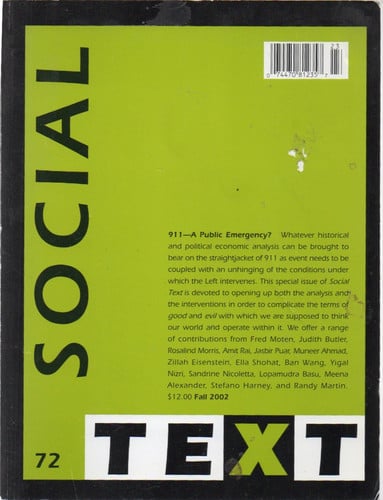
911 a Public Emergency?

Brent Hayes Edwards,Stefano Harney,Randy Martin,Ella Shohat,Timothy Mitchell,Fred Moten
Since September 11, public discourse has often been framed in terms of absolutes: an age of innocence gives way to a present under siege, while the United States and its allies face off against the Axis of Evil. This special issue of Social Text aims to move beyond these binaries toward thoughtful analysis. The editors argue that the challenge for the Left is to develop an antiterrorism stance that acknowledges the legacy of U.S. trade and foreign policy as well as the diversity of the Muslim faith and the dangers presented by fundamentalism of all kinds. Examining the strengths and shortcomings of area, race, and gender studies in the search for understanding, this issue considers cross-cultural feminism as a means of combating terrorism; racial profiling of Muslims in the context of other racist logics; and the homogenization of dissent. The issue includes poetry, photographic work, and an article by Judith Butler on the discursive space surrounding the attacks of September 11. This impressive range of contributions questions the meaning and implications of the events of September 11 and their aftermath. Contributors . Muneer Ahmad, Meena Alexander, Lopamudra Basu, Judith Butler, Zillah Eisenstein, Stefano Harney, Randy Martin, Rosalind C. Morris, Fred Moten, Sandrine Nicoletta, Yigal Nizri, Jasbir K. Puar, Amit S. Rai, Ella Shohat, Ban Wang
Duke University Press 2002-09-20 208 pages

And How Are the Children? Timeless Lessons from the Frontlines of Motherhood

Marjorie Margolies
Emmy-winning journalist, congresswoman, and the first single American to adopt internationally, Marjorie Margolies masterfully blends her personal narrative with national history and politics in this call-to-action memoir. Filled with the wisdom Marjorie Margolies gained as an athlete, educator, TV reporter, congressperson, world traveler, adoption advocate, parent, and grandparent, this memoir provides readers with an abundance of upbeat, prescriptive advice and inspiration with Marjorie's trademark self-effacing humor . Today, the world talks a lot about female empowerment, but when Marjorie was breaking through professional glass ceilings, she was unknowingly paving the way for the generations that followed in several different industries. After more than 25 years with NBC, she ran for U.S. Congress in 1991-as a registered Democrat in a historically Republican district of suburban Philadelphia-and she shocked the state and the country by winning by just over 1000 votes. She was the first woman elected in her own right in the state of Pennsylvania, but during her short tenure, Marjorie became the main target of Republicans taunts after she cast the deciding vote to approve President Clinton's budget. And How Are the Children? explores the life of a woman who was hardwired to shift paradigms and break down historic boundaries while managing a busy household and later dealing with heartbreaking tragedies including divorce and the death of a child. Her intention is for women of every generation to recognize themselves in her story and learn how to nurture themselves and the life decisions they have made.
Wyatt-MacKenzie Publishing 2021-11-30 260 pages

The Last Good Job in America Work and Education in the New Global Technoculture

Stanley Aronowitz
Money, jobs, careers, training-all are topics often overheard in the conversation of middle-class Americans. One of the nation's leading critics of education, the world of work, and the labor movement, Stanley Aronowitz shows how new technologies, labor, and education all are deeply intertwined in our culture and everyday lives. This book reflects Aronowitz's thinking at a time when globalization has brought these connections to broad public attention. Aronowitz argues for the decline of "the job" as the backbone, along with family, of American society. Despite high employment, low wages and job insecurity leave many families at or below the poverty line. The career instability previously experienced mostly by blue-collar workers has spread to middle managers and high-level executives caught in the rapid movement of capital and technologies. In light of these facts, Aronowitz argues for a new social contract between employers and workers.
Bloomsbury Publishing PLC 2007-11-12 282 pages

Lessons of struggle: South African internal opposition, 1960-1990

Marx, Anthony W.
This work provides an in-depth analysis of thirty years of South African opposition paying particular attention to the development of the Black Consciousness movement founded by Steve Biko, the ANC-aligned United Democratic Front, and the burgeoning trade unions. Marx demonstrates how each group's ideology, focusing respectively on racial assertiveness, national unity, and class organization, influenced each other, and shaped popular activism. His findings help to explain both the recent initiation of negotiations and possible future developments.
Oxford University Press 1992-03-05 347 pages

Nationalism, Communism and Canadian Labour The CIO, the Communist Party and the Canadian Congress of Labour, 1935-1956

Irving M. Abella
"The history of the Canadian Congress of Labour and the CIO in Canada traces the evolution of industrial unionism in Canada from the depression years of the 1930s to the 1950s. This is not simply a historical survey. Rather it is the dramatic story of the bitter, bloody, but successful struggle to create an industrial union movement in Canada and the equality fascinating story of the fierce but less successful battle to build a national union movement. It describes the Canadian Congress of Labour's attempts to establish itself as an autonomous labour organization independent of American control and details the efforts of the CIO and its Canadian affiliates to limit that autonomy. The author raises many significant questions concerning the presence of American unions in Canada and the crucial role played by the Communist party in the history of the Canadian labour movement. He rejects many of the standard interpretations of the history of the trade union movement and presents important new evidence to support his position. This study, based on archival sources that have never before been used - the files of the Canadian Congress of Labour and its affiliates - and supplemented by dozens of interviews, should stand as the definitive work on the growth of industrial and international unionism in Canada" - Publisher.
University of Toronto Press 1973 256 pages