160 results for "World History"

Who owns history? rethinking the past in a changing world

Foner, Eric
A thought-provoking new book from one of America's finest historians "History," wrote James Baldwin, "does not refer merely, or even principally, to the past. On the contrary, the great force of history comes from the fact that we carry it within us, are unconsciously controlled by it in many ways, and history is literally present in all that we do." Rarely has Baldwin's insight been more forcefully confirmed than during the past few decades. History has become a matter of public controversy, as Americans clash over such things as museum presentations, the flying of the Confederate flag, or reparations for slavery. So whose history is being written? Who owns it? In W ho Owns History? , Eric Foner proposes his answer to these and other questions about the historian's relationship to the world of the past and future. He reconsiders his own earlier ideas and those of the pathbreaking Richard Hofstadter. He also examines international changes during the past two decades--globalization, the collapse of the Soviet Union, the end of apartheid in South Africa--and their effects on historical consciousness. He concludes with considerations of the enduring, but often misunderstood, legacies of slavery, the Civil War, and Reconstruction. This is a provocative, even controversial, study of the reasons we care about history--or should.
Hill and Wang 2002-04-20 233 pages

Film after film: or, what became of 21st-century cinema?

Hoberman, J.
In this sly and thought-provoking essay, Village Voice film critic J. Hoberman suggests that it's possible to speak of a distinctive twenty-first century cinema, only a decade into the new millennium. The advent of a new digital technology has led to the displacement of the medium of film - and of the real, as digital image-making ends the necessity of having an actual world, let alone the need for a camera. The future history of motion pictures, Hoberman asserts, will be the history of animation. Meanwhile, the 2000 American presidential election and the trauma of 9/11 have reshaped the movies politically. The two events have combined to create a rupture in film history, perhaps presaging, as Susan Sontag forlornly predicted at the close of the century, the death of cinema, or at least cinephilia. This witty and allusive book, in the style of classic film theorist/critics like Andre Bazin and Siegfried Kracauer, expands on a much-discussed article by Hoberman from Artforum and includes considerations of global cinema's most important figures and films, from Lars von Trier and Zia Jiangke to WALL-E, Avatar, and Inception
Verso 2012 294 pages

The drowned and the saved

Levi, Primo
"In his final book before his death, Primo Levi returns once more to his time at Auschwitz in a moving meditation on memory, resiliency, and the struggle to comprehend unimaginable tragedy. Drawing on history, philosophy, and his own personal experiences, Levi asks if we have already begun to forget about the Holocaust. His last book before his death, Levi returns to the subject that would define his reputation as a writer and a witness. Levi breaks his book into eight essays, ranging from topics like the unreliability of memory to how violence twists both the victim and the victimizer. He shares how difficult it is for him to tell his experiences with his children and friends. He also debunks the myth that most of the Germans were in the dark about the Final Solution or that Jews never attempted to escape the camps. As the Holocaust recedes into the past and fewer and fewer survivors are left to tell their stories, The Drowned and the Saved is a vital first-person testament. Along with Elie Wiesel and Hannah Arendt, Primo Levi is remembered as one of the most powerful and perceptive writers on the Holocaust and the Jewish experience during World War II. This is an essential book both for students and literary readers. Reading Primo Levi is a lesson in the resiliency of the human spirit."--Publisher description.
Simon & Schuster Paperbacks 2017-06-20 190 pages

Three Days at Camp David How a Secret Meeting in 1971 Transformed the Global Economy

Jeffrey E. Garten
The former dean of the Yale School of Management and Undersecretary of Commerce in the Clinton administration chronicles the 1971 August meeting at Camp David, where President Nixon unilaterally ended the last vestiges of the gold standard--breaking the link between gold and the dollar--transforming the entire global monetary system. Over the course of three days--from August 13 to 15, 1971--at a secret meeting at Camp David, President Richard Nixon and his brain trust changed the course of history. Before that weekend, all national currencies were valued to the U.S. dollar, which was convertible to gold at a fixed rate. That system, established by the Bretton Woods Agreement at the end of World War II, was the foundation of the international monetary system that helped fuel the greatest expansion of middle-class prosperity the world has ever seen. In making his decision, Nixon shocked world leaders, bankers, investors, traders and everyone involved in global finance. Jeffrey E. Garten argues that many of the roots of America's dramatic retrenchment in world affairs began with that momentous event that was an admission that America could no longer afford to uphold the global monetary system. It opened the way for massive market instability and speculation that has plagued the world economy ever since, but at the same time it made possible the gigantic expansion of trade and investment across borders which created our modern era of once unimaginable progress. Based on extensive historical research and interviews with several participants at Camp David, and informed by Garten's own insights from positions in four presidential administrations and on Wall Street, Three Days at Camp David chronicles this critical turning point, analyzes its impact on the American economy and world markets, and explores its ramifications now and for the future.
Harper 2022 464 pages

The Seekers The Story of Man's Continuing Quest to Understand His World Knowledge Trilogy (3)

Daniel J. Boorstin
A New York Times Notable Book of the Year From the author of The Discoverers and The Creators , an incomparable history of man's essential questions: "Who are we?" and "Why are we here?" Daniel J. Boorstin, the bestselling and Pulitzer Prize-winning author of The Americans , introduces us to some of the great pioneering seekers whose faith and thought have for centuries led man's search for meaning. Moses sought truth in God above while Sophocles looked to reason. Thomas More and Machiavelli pursued truth through social change. And in the modern age, Marx and Einstein found meaning in the sciences. In this epic intellectual adventure story, Boorstin follows the great seekers from the heroic age of prophets and philosophers to the present age of skepticism as they grapple with the great questions that have always challenged man.
Knopf Doubleday Publishing Group 1999-10-26 368 pages

Morality Restoring the Common Good in Divided Times

Jonathan Sacks
A distinguished religious leader's "brilliant, urgent" (The Washington Post) case for reconstructing a shared framework of values. With liberal democracy embattled, our public discourse growing increasingly toxic, family life breaking down, and drug abuse and depression on the rise, many fear what the future holds. In Morality , respected faith leader and public intellectual Jonathan Sacks traces today's crisis to our loss of a strong, shared moral code and our elevation of self-interest over the common good. Sacks leads readers from ancient Greece to the Enlightenment to the present day to show that there is no liberty without morality and no freedom without responsibility, arguing that we all must play our part in rebuilding a common moral foundation. A major work of philosophy, this is an inspiring vision of a world in which we can all find our place and face the future without fear.
Basic Books 2022-08-30 384 pages

Reflections on gender and science

Keller, Evelyn Fox
Why are objectivity and reason characterized as male and subjectively and feeling as female? How does this characterization affect the goals and methods of scientific enquiry? This groundbreaking work explores the possibilities of a gender-free science and the conditions that could make such a possibility a reality. "Keller’s book opens up a whole new range of ideas for anyone who cares to think about the history of science, that is, the history of the modern world. . . Let us be glad to be in times when such a sparkling, innovative. . . book can be produced, a book to start all of us thinking in new directions.”--Ian Hacking, New Republic "A brilliant and sensitive undertaking that does credit not only to feminist scholarship but, in the end, to science as well.”--Barbara Ehrenreich, Mother Jones "This book represents the expression of a particular feminist perspective made all the more compelling by Keller’s evident commitment to and understanding of science. As a lively and important contribution to the scholarship of science, it will undoubtedly stimulate argument and controversy.”--Helen Longino, Texas Humanist "Provocative arguments, presented with authority.”-- Kirkus Reviews "Consistently thoughtful, provocative, and interconnected. . . A well-made book that will be useful in upper-level undergraduate and graduate women’s studies, philosophy, and history of science.”--E.C. Patterson, Choice "Written with grace and clarity, [this book] will stand as an important contribution to feminist theory, to the sociology of knowledge and to the continuing critique of the established scientific method.”--Lillian B. Rubin "A powerful book.”--Jessie Bernard
Yale University Press 1985 193 pages

Truth has a power of its own: conversations about a people's history

Zinn, Howard,Suarez, Ray
"Truth Has a Power of Its Own is an engrossing collection of never-before-published conversations with Howard Zinn, conducted by the distinguished broadcast journalist Ray Suarez in 2007, that covers the course of American history from Columbus to the War on Terror from the perspective of ordinary people--including slaves, workers, immigrants, women, and Native Americans. Viewed through the lens of Zinn's own life as a soldier, historian, and activist and using his paradigm-shifting People's History of the United States as a point of departure, these conversations explore the American Revolution, the Civil War, the labor battles of the nineteenth and twentieth centuries, U.S. imperialism from the Indian Wars to the War on Terrorism, World Wars I and II, the Cold War, and the fight for equality and immigrant rights, all from an unapologetically radical standpoint. Longtime admirers and a new generation of readers alike will be fascinated to learn about Zinn's thought processes, rationale, motivations, and approach to his now-iconic historical work."--Amazon.com.
The New Press 2022 223 pages

Specters of Marx - The State of the Debt, the Work of Mourning and the New International

Jacques Derrida
Published shortly after the fall of Communism in Eastern Europe and the dissolution of the Soviet regime, Specters of Marx is one of Derrida's most interesting and prophetic books. Whilst many in the West heralded the triumph of liberal democracy and "the end of history", Derrida takes several steps back to argue that whilst Communism may have disappeared in much of the world, the questions posed by Marx continue to haunt us. In his customary provocative style, he asks some uncomfortable questions: after the fall of Communism, can we preserve Marx's legacy of radicalism? How do we continue his philosophy of responsibility? Uncannily anticipating many of the challenges facing us today, Derrida argues that the capitalist system is plagued by a multitude of ills, including aggression, trade wars, debt, the exploitation of migrant labour and ethnic conflict. This Routledge Classics edition is a translation of the revised French edition and includes a debate between Derrida and Étienne Balibar on Marx and Marxism, published here in English for the first time. It also includes new corrections and additions to the text and footnotes made by Derrida after the book's initial publication in French. Translated by Peggy Kamuf and with a new Foreword by Peter Salmon, this Routledge Classics edition retains the original Editors' Introduction by Bernd Magnus and Stephen Cullenberg.
Routledge, Chapman & Hall, Incorporated 2026-02-16 320 pages

The Story of the Jews Volume Two Belonging: 1492-1900

Simon Schama
In the second of two volumes of this magnificently illustrated cultural history--the tie-in to the PBS and BBC series The Story of the Jews--Simon Schama details the story of the Jewish people, spanning from their expulsion from Spain in the Inquisition across six hundred years to the present day. It is a story like no other: an epic of endurance against destruction, of creativity in the face of oppression, joy amidst grief, the affirmation of life against the steepest of odds. It spans the centuries and the continents--from the Iberian Peninsula and the collapse of "the golden age" to the shtetls of Russia to the dusty streets of infant Hollywood. Its voices ring loud and clear, from the philosophical musings of Spinoza to the poetry written on slips of paper in concentraion camps. Within these pages, the Enlightenment unfolds, a great diaspora transforms a country, a Viennese psychaiatrist forever changes the conception of the human mind. And a great story unfolds. Not--as often imagined--of a culture apart, but of a Jewish world immersed in and imprinted by the peoples among whom they have dwelled, from the Egyptians to the Greeks, from the Arabs to the Christians, from the Soviets to America. Which makes the story of the Jews everyone's story, too.
HarperCollins Publishers 2020-07-28 800 pages

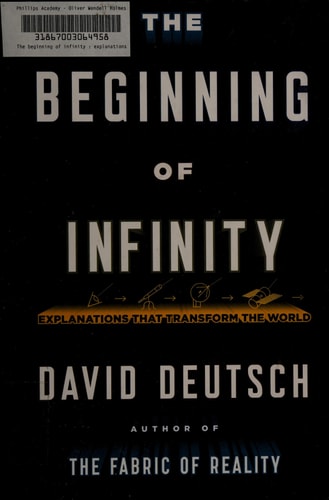
The beginning of infinity: explanations that transform the world

Deutsch, David
"A bold and all-embracing exploration of the nature and progress of knowledge from one of today's great thinkers. Throughout history, mankind has struggled to understand life's mysteries, from the mundane to the seemingly miraculous. In this important new book, David Deutsch, an award-winning pioneer in the field of quantum computation, argues that explanations have a fundamental place in the universe. They have unlimited scope and power to cause change, and the quest to improve them is the basic regulating principle not only of science but of all successful human endeavor. This stream of ever improving explanations has infinite reach, according to Deutsch: we are subject only to the laws of physics, and they impose no upper boundary to what we can eventually understand, control, and achieve. In his previous book, The Fabric of Reality, Deutsch describe the four deepest strands of existing knowledge-the theories of evolution, quantum physics, knowledge, and computation-arguing jointly they reveal a unified fabric of reality. In this new book, he applies that worldview to a wide range of issues and unsolved problems, from creativity and free will to the origin and future of the human species. Filled with startling new conclusions about human choice, optimism, scientific explanation, and the evolution of culture, The Beginning of Infinity is a groundbreaking book that will become a classic of its kind"--
Viking 2011 487 pages

All life is problem solving

Popper, Karl R.
'Never before has there been so many and such dreadful weapons in so many irresponsible hands.' - Karl Popper, from the Preface All Life is Problem Solving is a stimulating and provocative selection of Popper's writings on his main preoccupations during the last twenty-five years of his life. This collection illuminates Popper's process of working out key formulations in his theory of science, and indicates his view of the state of the world at the end of the Cold War and after the collapse of communism.
Routledge 1999 171 pages

Science And Human Values

Jacob Bronowski
Science and Human Values is a thought-provoking book by Jacob Bronowski that explores the relationship between science and human values. The author argues that science is not just a collection of facts and theories, but a way of thinking that shapes our understanding of the world and our place in it. He contends that science and human values are intimately connected, and that science has the power to transform our understanding of ourselves and the world around us.The book is divided into five chapters, each of which explores a different aspect of the relationship between science and human values. The first chapter discusses the nature of scientific inquiry and the role of imagination in scientific discovery. The second chapter examines the relationship between science and art, arguing that both are essential to our understanding of the world. The third chapter explores the ethical implications of scientific research, particularly in the areas of genetics and nuclear physics.The fourth chapter examines the role of science in shaping our understanding of human nature, while the final chapter discusses the implications of scientific progress for our future as a species. Throughout the book, Bronowski emphasizes the importance of human values in shaping scientific research and the need for scientists to be mindful of the ethical implications of their work.Overall, Science and Human Values is a thought-provoking and insightful book that challenges readers to think deeply about the relationship between science and human values. It is a must-read for anyone interested in the role of science in our lives and the ethical implications of scientific research.The Impact Of Science On Ethics And Human Values.This scarce antiquarian book is a facsimile reprint of the old original and may contain some imperfections such as library marks and notations. Because we believe this work is culturally important, we have made it available as part of our commitment for protecting, preserving, and promoting the world's literature in affordable, high quality, modern editions, that are true to their original work.
Literary Licensing, LLC 2011-09 98 pages

The Decline of the West, Vol. I: Form and Actuality

Spengler, Oswald
"The decline of the West, which at first sight may appear, like the corresponding decline of the Classical Culture, a phenomenon limited in time and space, we now perceive to be a philosophical problem that, when comprehended in all its gravity, includes within itself every great question of Being. "If therefore we are to discover in what form the destiny of the Western Culture will be accomplished, we must first be clear as to what culture is, what its relations are to visible history, to life, to soul, to nature, to intellect, what the forms of its manifestation are and how far these forms — peoples, tongues and epochs, battles and ideas, states and gods, arts and craftworks, sciences, laws, economic types and world ideas, great men and great events — may be accepted and pointed to as symbols."
Independently published 2020-08-11 484 pages

One discipline, four ways: British, German, French, and American anthropology

Barth, Fredrik,Gingrich, André,Parkin, Robert,Silverman, Sydel
One Discipline, Four Ways offers the first book-length introduction to the history of each of the four major traditions in anthropology—British, German, French, and American. The result of lectures given by distinguished anthropologists Fredrik Barth, Andre Gingrich, Robert Parkin, and Sydel Silverman to mark the foundation of the Max Planck Institute for Social Anthropology, this volume not only traces the development of each tradition but considers their impact on one another and assesses their future potentials. Moving from E. B. Taylor all the way through the development of modern fieldwork, Barth reveals the repressive tendencies that prevented Britain from developing a variety of anthropological practices until the late 1960s. Gingrich, meanwhile, articulates the development of German anthropology, paying particular attention to the Nazi period, of which surprisingly little analysis has been offered until now. Parkin then assesses the French tradition and, in particular, its separation of theory and ethnographic practice. Finally, Silverman traces the formative influence of Franz Boas, the expansion of the discipline after World War II, and the "fault lines" and promises of contemporary anthropology in the United States.
University of Chicago Press 2005-06-15 406 pages

The Ominous Parallels The End of Freedom in America

Leonard Peiloff,Leonard Peikoff
Dr. Peikoff identifies the cause of Nazism--and the ominous parallels between the intellectual history of Germany and of the United States. He demonstrates that there is a science which has been all but obliterated in the modern world. "Yet this science determines the destiny of nations and the course of history ...," he writes. "It is a science which has to be destroyed, if the catastrophes of our time were to become possible. The science is philosophy."
Penguin Group (USA) Incorporated 1983-06-07 352 pages

How everything became war and the military became everything: tales from the Pentagon

Brooks, Rosa
"A dynamic work of reportage" (The New York Times) written "with clarity and...wit" (The New York Times Book Review) about what happens when the ancient boundary between war and peace is erased. Once, war was a temporary state of affairs. Today, America's wars are everywhere and forever: our enemies change constantly and rarely wear uniforms, and virtually anything can become a weapon. As war expands, so does the role of the US military. Military personnel now analyze computer code, train Afghan judges, build Ebola isolation wards, eavesdrop on electronic communications, develop soap operas, and patrol for pirates. You name it, the military does it. In this "ambitious and astute" (The Washington Post) work, Rosa Brooks "provides a masterful analysis" (San Francisco Chronicle) of this seismic shift in how America wages war from an unconventional perspective--that of a former top Pentagon official who is the daughter of two anti-war protesters and married to an Army Green Beret. By turns a memoir, a work of journalism, a scholarly exploration of history, anthropology, and law, How Everything Became War and the Military Became Everything is an "illuminating" (The New York Times), "eloquent" (The Boston Globe), "courageous" (US News & World Report), and "essential" (The Dallas Morning News) examination of the role of the military today. Above all, it is a rallying cry, for Brooks issues an urgent warning: When the boundaries around war disappear, we undermine both America's founding values and the international rules and organizations that keep our world from sliding towards chaos. "--
Simon & Schuster 2017 438 pages

Present shock: when everything happens now

Rushkoff, Douglas
"An award-winning author explores how the world works in our age of "continuous now" Back in the 1970s, futurism was all the rage. But looking forward is becoming a thing of the past. According to Douglas Rushkoff, "presentism" is the new ethos of a society that's always on, in real time, updating live. Guided by neither history nor long term goals, we navigate a sea of media that blend the past and future into a mash-up of instantaneous experience. Rushkoff shows how this trend is both disorienting and exhilarating. Without linear narrative we get both the humiliations of reality TV and the associative brilliance of The Simpsons. With no time for long term investing, we invent dangerously compressed derivatives yet also revive sustainable local businesses. In politics, presentism drives both the Tea Party and the Occupy movement. In many ways, this was the goal of digital technology--outsourcing our memory was supposed to free us up to focus on the present. But we are in danger of squandering this cognitive surplus on trivia. Rushkoff shows how we can instead ground ourselves in the reality of the present tense. "--
Penguin Books 2014-02-25 296 pages