57 results for "World History"

The Pope of Physics Enrico Fermi and the Birth of the Atomic Age

Gino Segrè,Bettina Hoerlin
A New York Times Book Review Editors’ Choice Named a Best Book of the Year by Bloomberg (Chosen by Philip Tetlock), Booklist ’s Top 10 Science Books of the Year, and Shortlisted for Physics World ’s Book of the Year A Major Biography of the Nobel Prize–Winning Physicist, Enrico Fermi, a Leading Architect of the Atomic Age Enrico Fermi is unquestionably among the greats of the world’s physicists, the most famous Italian scientist since Galileo. Called “the Pope” by his peers, he was regarded as infallible in his instincts and research. His discoveries changed our world; they led to weapons of mass destruction and conversely to life-saving medical interventions. This unassuming man struggled with issues relevant today, such as the threat of nuclear annihilation and the relationship of science to politics. Fleeing Fascism and anti-Semitism, Fermi became a leading figure in America’s most secret project: building the atomic bomb. An examination of the human dramas that touched Fermi’s life as well as a thrilling history of scientific innovation in the twentieth century, this is the comprehensive biography that Fermi deserves.
Picador 2017-10-10 384 pages

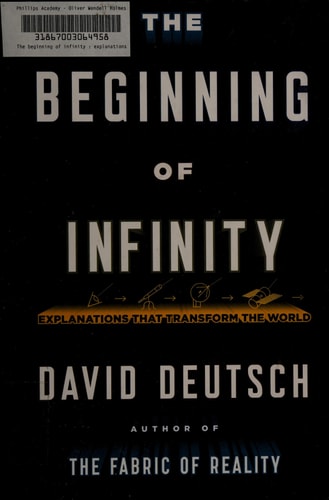
The beginning of infinity: explanations that transform the world

Deutsch, David
"A bold and all-embracing exploration of the nature and progress of knowledge from one of today's great thinkers. Throughout history, mankind has struggled to understand life's mysteries, from the mundane to the seemingly miraculous. In this important new book, David Deutsch, an award-winning pioneer in the field of quantum computation, argues that explanations have a fundamental place in the universe. They have unlimited scope and power to cause change, and the quest to improve them is the basic regulating principle not only of science but of all successful human endeavor. This stream of ever improving explanations has infinite reach, according to Deutsch: we are subject only to the laws of physics, and they impose no upper boundary to what we can eventually understand, control, and achieve. In his previous book, The Fabric of Reality, Deutsch describe the four deepest strands of existing knowledge-the theories of evolution, quantum physics, knowledge, and computation-arguing jointly they reveal a unified fabric of reality. In this new book, he applies that worldview to a wide range of issues and unsolved problems, from creativity and free will to the origin and future of the human species. Filled with startling new conclusions about human choice, optimism, scientific explanation, and the evolution of culture, The Beginning of Infinity is a groundbreaking book that will become a classic of its kind"--
Viking 2011 487 pages

All life is problem solving

Popper, Karl R.
'Never before has there been so many and such dreadful weapons in so many irresponsible hands.' - Karl Popper, from the Preface All Life is Problem Solving is a stimulating and provocative selection of Popper's writings on his main preoccupations during the last twenty-five years of his life. This collection illuminates Popper's process of working out key formulations in his theory of science, and indicates his view of the state of the world at the end of the Cold War and after the collapse of communism.
Routledge 1999 171 pages

Science And Human Values

Jacob Bronowski
Science and Human Values is a thought-provoking book by Jacob Bronowski that explores the relationship between science and human values. The author argues that science is not just a collection of facts and theories, but a way of thinking that shapes our understanding of the world and our place in it. He contends that science and human values are intimately connected, and that science has the power to transform our understanding of ourselves and the world around us.The book is divided into five chapters, each of which explores a different aspect of the relationship between science and human values. The first chapter discusses the nature of scientific inquiry and the role of imagination in scientific discovery. The second chapter examines the relationship between science and art, arguing that both are essential to our understanding of the world. The third chapter explores the ethical implications of scientific research, particularly in the areas of genetics and nuclear physics.The fourth chapter examines the role of science in shaping our understanding of human nature, while the final chapter discusses the implications of scientific progress for our future as a species. Throughout the book, Bronowski emphasizes the importance of human values in shaping scientific research and the need for scientists to be mindful of the ethical implications of their work.Overall, Science and Human Values is a thought-provoking and insightful book that challenges readers to think deeply about the relationship between science and human values. It is a must-read for anyone interested in the role of science in our lives and the ethical implications of scientific research.The Impact Of Science On Ethics And Human Values.This scarce antiquarian book is a facsimile reprint of the old original and may contain some imperfections such as library marks and notations. Because we believe this work is culturally important, we have made it available as part of our commitment for protecting, preserving, and promoting the world's literature in affordable, high quality, modern editions, that are true to their original work.
Literary Licensing, LLC 2011-09 98 pages

Idea makers: personal perspectives on the lives & ideas of some notable people

Wolfram, Stephen
This book of thoroughly engaging essays from one of today's most prodigious innovators provides a uniquely personal perspective on the lives and achievements of a selection of intriguing figures from the history of science and technology. Weaving together his immersive interest in people and history with insights gathered from his own experiences, Stephen Wolfram gives an ennobling look at some of the individuals whose ideas and creations have helped shape our world today. Contents includes biographical sketches of: Richard Feynman Kurt Godel Alan Turing John von Neumann George Boole Ada Lovelace Gottfried Leibniz Benoit Mandelbrot Steve Jobs Marvin Minsky Russell Towle Bertrand Russell Alfred Whitehead Richard Crandall Srinivasa Ramanujan Solomon Golomb
Wolfram Media, Inc 2016 239 pages

Bad Ideas? An Arresting History of Our Inventions

Robert Winston,Robert M. L. Winston
We are born with the instinct to create and invent. Indeed our ability to do so is what separates we humans from the rest of the animal world. The moment man first converted a stone to a useful tool set him on a relentless path toward greater control and power over his environment. But have our creative ideas always produced desirable results in line with their original good intention? How many ill-effects and dangers have they brought about along the way? And have they really served us well? Bad Ideas? traces the fascinating history of our attempts at self-improvement but also questions their value. The dubious consequences of the development of weaponry, for example, is self-evident from the primitive but lethal sling to the devastating nuclear bomb. But what of apparently more innocuous inventions such as farming, writing or medicine? All were initiated for the greater good but have nonetheless produced unforeseen fallout that continues to this day. What are their undesirable side-effects, how did they emerge over the years and where will they take us in the future? Written against a huge historical canvas, we join Robert Winston on a thrilling and inspiring journey from our earliest days to the present. We learn about the history of modern science, engineering, IT and much more, following the unexpected twists and turns of their progress. We meet the individuals who played a key role in their development, and share quirky anecdotes about their lives and brainwaves. Inspiring, unusual, and at times controversial, Bad Ideas? enables us by appreciating the past to look forward to the technological opportunities and ethical challenges of the future. In so doing it celebrates man's extraordinary capacity for achievement whilst warning us that his good intentions can sometimes end up as thoroughly bad ideas.
Bantam 2010 417 pages

The Greatest Story Ever Told--So Far Why Are We Here?

Lawrence M. Krauss
From award-winning physicist, public intellectual, and the bestselling author of A Universe from Nothing Lawrence Krauss, comes “a masterful blend of history, modern physics, and cosmic perspective that empowers the reader to not only embrace our understanding of the universe, but also revel in what remains to be discovered” (Neil deGrasse Tyson, American Museum of Natural History). In this grand poetic vision of the universe, Lawrence Krauss tells the dramatic story of the discovery of the hidden world that underlies reality—and our place within it. Reality is not what you think or sense—it’s weird, wild, and counterintuitive, and its inner workings seem at least as implausible as the idea that something can come from nothing. With his trademark wit and accessible style, Krauss leads us to realms so small that they are invisible to microscopes, to the birth and rebirth of light, and into the natural forces that govern our existence. His unique blend of rigorous research and engaging storytelling invites us into the lives and minds of remarkable scientists who have helped unravel the unexpected fabric of reality with reasoning rather than superstition and dogma, and to explain how everything we see—and can’t see—came about. A passionate advocate for reason, Krauss gives the rationale for the seemingly irrational—and the mysteries and apparent contradictions of quantum physics, and explores what that means for our lives here on Earth—and beyond. At its core, The Greatest Story Ever Told—So Far is about the best of what it means to be human—an epic history of our ultimately purposeless universe that addresses the question, “Why are we here?”
Atria Books 2018-02-27 336 pages

Global Brain The Evolution of Mass Mind from the Big Bang to the 21st Century

Howard Bloom
"As someone who has spent forty years in psychology with a long-standing interest in evolution, I'll just assimilate Howard Bloom's accomplishment and my amazement." --DAVID SMILLIE, Visiting Professor of Zoology, Duke University In this extraordinary follow-up to the critically acclaimed The Lucifer Principle, Howard Bloom--one of today's preeminent thinkers--offers us a bold rewrite of the evolutionary saga. He shows how plants and animals (including humans) have evolved together as components of a worldwide learning machine. He describes the network of life on Earth as one that is, in fact, a "complex adaptive system," a global brain in which each of us plays a sometimes conscious, sometimes unknowing role, and he reveals that the World Wide Web is just the latest step in the development of this brain. These are theories as important as they are radical. Informed by twenty years of interdisciplinary research, Bloom takes us on a spellbinding journey back to the big bang to let us see how its fires forged primordial sociality. As he brings us back via surprising routes, we see how our earliest bacterial ancestors built multitrillion-member research and development teams a full 3.5 billion years ago. We watch him unravel the previously unrecognized strands of interconnectedness woven by crowds of trilobites, hunting packs of dinosaurs, feathered flying lizards gathered in flocks, troops of baboons making communal decisions, and adventurous tribes of protohumans spreading across continents but still linked by primitive forms of information networking. We soon find ourselves reconsidering our place in the world. Along the way, Bloom offers us exhilarating insights into the strange tricks of body and mind that have organized a variety of life forms: spiny lobsters, which, during the Paleozoic age, participated in communal marching rituals; and bees, which, during the age of dinosaurs, conducted collective brainwork. This fascinating tour continues on to the sometimes brutal subculture wars that have spurred the growth of human civilization since the Stone Age. Bloom shows us how culture shapes our infant brains, immersing us in a matrix of truth and mass delusion that we think of as reality. Global Brain is more than just a brilliantly original contribution to the ongoing debate on the inner workings of evolution. It is a "grand vision," says the eminent evolutionary biologist David Sloan Wilson, a work that transforms our very view of who we are and why.
Turner Publishing Company 2001-08 384 pages

The eye of the lynx

Freedberg, David
Some years ago, David Freedberg opened a dusty cupboard at Windsor Castle and discovered hundreds of vividly colored, masterfully precise drawings of all sorts of plants and animals from the Old and New Worlds. Coming upon thousands more drawings like them across Europe, Freedberg finally traced them all back to a little-known scientific organization from seventeenth-century Italy called the Academy of Linceans (or Lynxes). Founded by Prince Federico Cesi in 1603, the Linceans took as their task nothing less than the documentation and classification of all of nature in pictorial form. In this first book-length study of the Linceans to appear in English, Freedberg focuses especially on their unprecedented use of drawings based on microscopic observation and other new techniques of visualization. Where previous thinkers had classified objects based mainly on similarities of external appearance, the Linceans instead turned increasingly to sectioning, dissection, and observation of internal structures. They applied their new research techniques to an incredible variety of subjects, from the objects in the heavens studied by their most famous (and infamous) member Galileo Galilei—whom they supported at the most critical moments of his career—to the flora and fauna of Mexico, bees, fossils, and the reproduction of plants and fungi. But by demonstrating the inadequacy of surface structures for ordering the world, the Linceans unwittingly planted the seeds for the demise of their own favorite method—visual description-as a mode of scientific classification. Profusely illustrated and engagingly written, Eye of the Lynx uncovers a crucial episode in the development of visual representation and natural history. And perhaps as important, it offers readers a dazzling array of early modern drawings, from magnificently depicted birds and flowers to frogs in amber, monstrously misshapen citrus fruits, and more.
University of Chicago Press 2002 513 pages

Gossip The Untrivial Pursuit

Joseph Epstein
Gossip is no trivial matter; despite its reputation, Epstein argues, it is an eternal and necessary human enterprise. Proving that he himself is a master of the art, Epstein serves up delightful mini-biographies of the Great Gossips of the Western World, along with many choice bits from his own experience. He also makes a powerful case that gossip has morphed from its old-fashioned best--clever, mocking, a great private pleasure--to a corrosive new-school version, thanks to the reach of the mass media and the Internet. Written in his trademark erudite and witty style, Gossip captures the complexity of this immensely entertaining subject.
HarperCollins Publishers 2012-11 256 pages

Science and the Common Understanding

J. Robert Oppenheimer
This work has been selected by scholars as being culturally important, and is part of the knowledge base of civilization as we know it. This work was reproduced from the original artifact, and remains as true to the original work as possible. Therefore, you will see the original copyright references, library stamps (as most of these works have been housed in our most important libraries around the world), and other notations in the work. This work is in the public domain in the United States of America, and possibly other nations. Within the United States, you may freely copy and distribute this work, as no entity (individual or corporate) has a copyright on the body of the work. As a reproduction of a historical artifact, this work may contain missing or blurred pages, poor pictures, errant marks, etc. Scholars believe, and we concur, that this work is important enough to be preserved, reproduced, and made generally available to the public. We appreciate your support of the preservation process, and thank you for being an important part of keeping this knowledge alive and relevant.
Creative Media Partners, LLC 2015-08-08 134 pages

From the Closed World to the Infinite Universe

Alexandre Koyre
During the sixteenth and seventeenth centuries a radical change occurred in the patterns and framework of European thought. In the wake of Copernican theory and discoveries through the telescope, the notion of an ordered cosmos of "fixed stars" gave way to that of a universe infinite in both time and space-with significant and far-reaching consequences for human thought. Alexandre Koyré brilliantly interprets this revolution in terms of the change that occurred in our conception of the universe and our place in it, and illustrates the primacy of this change in the development of the modern world. "An important contribution to the problem of the transition from the world view characteristic of the medieval centuries to that which rapidly gained acceptance after the seventeenth century." (Philosophical Quarterly) "Koyré has provided the material and has illuminated it with uniformly perceptive and occasionally brilliant commentary.... An important contribution to the study of 17th-century thought." (Thomas S. Kuhn, Science) "A model of scholarliness without pedantry, of clarity without oversimplification." (Arthur Koestler, Encounter) "Surely a work that will be welcomed alike by the scientist, philosopher, and historian of ideas." (Philosophy and Phenomenological Research) Alexandre Koyré was a member of the Institute for Advanced Study, Princeton, and professor at the Ecole Pratique des Hautes Etudes in Paris. His books include Discovering Plato and Newtonian Studies.
Angelico Press 2016-05-31 322 pages

Cleopatra's nose: essays on the unexpected

Boorstin, Daniel J.
This provocative new collection of essays by a Pulitzer Prize winner deals with the challenging themes of discovery and surprise in history. Cleopatra's Nose is not a miscellany but rather a selection of recent essays illustrating specific subjects that have preoccupied Boorstin for several decades. Tantalizing themes all: How sometimes discovery only increases our ignorance. What were the specific historical opportunities in the New World? How has the fourth kingdom - the kingdom of machines - contradicted Darwinian expectations, contributed to a confusion of statistics, created the need for the unnecessary, and highlighted the paradoxes of science and the politics of common sense? In a "personal postscript," Boorstin gives us a memorable and affectionate portrait of his father and optimistically celebrates the United States as the Land of the Unexpected.
Random House 1994-11-01 210 pages

How modern science came into the world: four civilizations, one 17th-century breakthrough

Cohen, H. F.
Once upon a time 'The Scientific Revolution of the 17th century' was an innovative concept that inspired a stimulating narrative of how modern science came into the world. Half a century later, what we now know as 'the master narrative' serves rather as a strait-jacket - so often events and contexts just fail to fit in. No attempt has been made so far to replace the master narrative. H. Floris Cohen now comes up with precisely such a replacement. Key to his path-breaking analysis-cum-narrative is a vision of the Scientific Revolution as made up of six distinct yet narrowly interconnected, revolutionary transformations, each of some twenty-five to thirty years' duration. This vision enables him to explain how modern science could come about in Europe rather than in Greece, China, or the Islamic world. It also enables him to explain how half-way into the 17th century a vast crisis of legitimacy could arise and, in the end, be overcome --
Amsterdam University Press 2010-11-01 784 pages

The last writings of Thomas S. Kuhn: incommensurability in science

Kuhn, Thomas S.
"This book contains the text of Thomas Kuhn's unfinished book, The Plurality of Worlds: An Evolutionary Theory of Scientific Development, which Kuhn himself described as "a return to the central claims of The Structure of Scientific Revolutions, and the problems that it raised but did not resolve." The Plurality of Worlds is preceded by two related texts that Kuhn publicly delivered but never published in English: his paper "Scientific Knowledge as a Historical Product" and his Shearman Memorial Lectures, "The Presence of Past Science." The book opens with an introduction by the editor that describes the origins and structure of The Plurality of Worlds, and sheds light on its central philosophical problems. Kuhn's aims in his last writings are bold. He sets out to develop an empirically grounded theory of meaning that would allow him to make sense of both the possibility of historical understanding and the inevitability of incommensurability between past and present science. Moreover, he intends to show that incommensurability is fully compatible with a robust notion of a real world that science investigates, with the rationality of scientific belief change, and with the idea that scientific development is progressive. This is a must-read follow-up to The Structure of Scientific Revolutions, one of the most important books of the twentieth century"--
University of Chicago Press 2022-11-30 302 pages

Don't Burn Anyone at the Stake Today

Alderman, Naomi
What’s the most useful thing you could know about your own life? In this era-defining book, developed from her groundbreaking Radio 4 essay series, Naomi Alderman turns her boundless curiosity and incisive thinking to a question that affects us all: how do we understand, and navigate, the epoch we’re living through? She calls this epoch the Information Crisis. The internet has flooded us with more knowledge, opinions, ideas, opportunities, as well as verbal attacks and misinformation, than ever before. It lets us learn more quickly and also spread falsehood more quickly, it brings us together and also divides us in new ways, it is now the lens through which we perceive and understand the world. There is no going back. But we have been here before. In fact, this is humanity’s third information crisis. The first, the invention of writing 5,000 years ago, and the second, the invention of the printing press 600 years ago, drastically reshaped our perceptions, interactions and mental landscapes in ways that feel acutely familiar. Overwhelmed by information, people become afraid and angry, unsettled and distressed, as well as more knowledgeable, educated and curious. By looking at those previous information crises, both the turmoil and the advances, Alderman asks what we can learn from the past to better understand our present, and prepare for our future. Drawing on the work of philosophers and historians, Don’t Burn Anyone at the Stake Today explores how new technology opens up new ways of being and helps us chart a way forward (once again), through the turbulent seas of information overload.[Bokinfo]
Penguin 2026-05-07 224 pages

Science and anti-science

Holton, Gerald James
What is good science? What goal--if any--is the proper end of scientific activity? Is there a legitimating authority that scientists mayclaim? Howserious athreat are the anti-science movements? These questions have long been debated but, as Gerald Holton points out, every era must offer its own responses. This book examines these questions not in the abstract but shows their historic roots and the answers emerging from the scientific and political controversies of this century. Employing the case-study method and the concept of scientific thematathat he has pioneered, Holton displays the broad scope of his insight into the workings of science: from the influence of Ernst Mach on twentiethcentury physicists, biologists, psychologists, and other thinkers to the rhetorical strategies used in the work of Albert Einstein, Niels Bohr, and others; from the bickering between Thomas Jefferson and the U.S. Congress over the proper form of federal sponsorship of scientific research to philosophical debates since Oswald Spengier over whether our scientific knowledge will ever be "complete." In a masterful final chapter, Holton scrutinizes the "anti-science phenomenon," the increasingly common opposition to science as practiced today. He approaches this contentious issue by examining the world views and political ambitions of the proponents of science as well as those of its opponents-the critics of "establishment science" (including even those who fear that science threatens to overwhelm the individual in the postmodern world) and the adherents of "alternative science" (Creationists, New Age "healers," astrologers). Through it all runs the thread of the author's deep historical knowledge and his humanistic understanding of science in modern culture. Science and Anti-Science will be of great interest not only to scientists and scholars in the field of science studies but also to educators, policymalcers, and all those who wish to gain a fuller understanding of challenges to and doubts about the role of science in our lives today.
Harvard University Press 1993 203 pages

African American Women and Christian Activism New York's Black YWCA, 1905-1945

Judith Weisenfeld
The middle class black women who people Judith Weisenfeld's history were committed both to social action and to institutional expression of their religious convictions. Their story provides an illuminating perspective on the varied forces working to improve quality of life for African Americans in crucial times. When undertaking to help young women migrating to and living alone in New York, Weisenfeld's protagonists chose to work within a national evangelical institution. Their organization of a black chapter of the Young Women's Christian Association in 1905 was a clear step toward establishing a suitable environment for young working women; it was also an expression of their philosophy of social uplift. And predictably it was the beginning of an equal rights struggle--to work as equals with white women activists. Growing and adapting as New York's black community evolved over the decades, the black YWCA assumed a central role both in the community's religious life and as a training ground for social action. Weisenfeld's analysis of the setbacks and successes closes with the National YWCA's vote in 1946 to adopt an interracial charter and move toward integration of local chapters, thus opening the door to a different set of challenges for a new generation of black activists. Weisenfeld's account gives a vibrant picture of African American women as significant actors in the life of the city. And it bears telling witness to the religious, class, gender, and racial negotiations so often involved in American social reform movements.
Harvard University Press 2013-10 239 pages