
52 results for "World Literature"

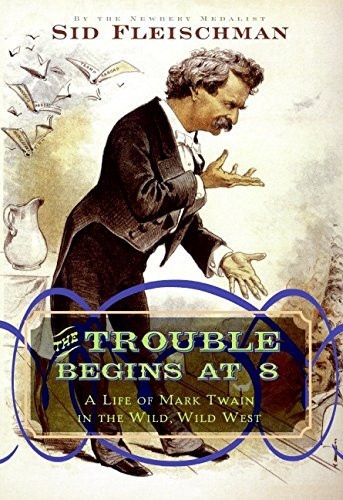
The trouble begins at 8: a life of Mark Twain in the wild, wild West

Fleischman, Sid
"Mark Twain was born fully grown, with a cheap cigar clamped between his teeth." So begins Sid Fleischman's ramble-scramble biography of the great American author and wit, who started life in a Missouri village as a barefoot boy named Samuel Clemens. Abandoning a career as a young steamboat pilot on the Mississippi River, Sam took a bumpy stagecoach to the Far West. In the gold and silver fields, he expected to get rich quick. Instead, he got poor fast, digging in the wrong places. His stint as a sagebrush newspaperman led to a duel with pistols. Had he not survived, the world would never have heard of Tom Sawyer or Huckleberry Finn—or red-headed Mark Twain. Samuel Clemens adopted his pen name in a hotel room in San Francisco and promptly made a jumping frog (and himself) famous. His celebrated novels followed at a leisurely pace; his quips at jet speed. "Don't let schooling interfere with your education," he wrote. Here, in high style, is the story of a wisecracking adventurer who came of age in the untamed West; an ink-stained rebel who surprised himself by becoming the most famous American of his time. Bountifully illustrated.
Greenwillow Books 2008 224 pages

Holocaust literature: a history and guide

Roskies, David G.,Diamant, Naomi
"What is Holocaust literature? When does it begin and how is it changing? Is there an essential core of diaries, eyewitness accounts of the concentration camps, tales of individual survival in hiding? Is it the same everywhere: in the West as in the East, in Australia as in the Americas, in poetry as in prose? Is this literature sacred and sui generis, or can it be studied in the light of other literatures? What of the perpetrators and bystanders, the hidden children, the children of Holocaust survivors: Do they speak with the same authority? What works of Holocaust literature will be read a hundred years from now--and why? Here, for the first time and told from beginning to end, is an historical survey of Holocaust literature in all genres, countries, and major languages. Beginning in wartime, it proceeds from the literature of mobilization and mourning in the Free World to the vast and varied literature produced in the Nazi-occupied ghettos, the bunkers and places of hiding, the transit and concentrations camps. Within weeks of the liberation, in displaced persons camps, a new memorial and testamentary literature begins to take shape. Moving from Europe to Israel, the U.S., and beyond, the authors situate the writings by real and proxy witnesses within three distinct postwar periods: a period of "communal memory," still internal and internecine; a period of "provisional memory" in the '60s and '70s that witnesses the birth of a self-conscious Holocaust genre; to the period of "authorized memory" in which we live today, following the collapse of the Soviet Union (1989-91), and the opening of the US Holocaust Museum (1993). Twenty book covers - first editions in their original languages - and an eminently readable guide to the "first hundred books" together show the multilingual scope, historical depth, the moral and artistic range of this extraordinary body of writing."--Publisher's website.
Brandeis University Press 2012 355 pages

Ex-friends

Podhoretz, Norman
Allen Ginsberg, Lionel and Diana Trilling, Lillian Hellman, Hannah Arendt, and Norman Mailer -- all are ex-friends of Norman Podhoretz, the renowned editor and critic and leading member of the group of New York intellectuals who came to be known as "the Family." As only a family member could, Podhoretz tells the story of these friendships, once central to his life, and shows how the political and cultural struggles of the past fifty years made them impossible to sustain. With wit, piercing insight, and startling honesty, we are introduced as never before to a type of person for whom ideas were often matters of life and death, and whose passing from the scene has left so large a gap in American culture. Podhoretz was the trailblazer of the now-famous journey of a number of his fellow intellectuals from radicalism to conservatism -- a journey through which they came to exercise both cultural and political influence far beyond their number. With this fascinating account of his once happy and finally troubled relations with these cultural icons, Podhoretz helps us understand why that journey was undertaken and just how consequential it became. In the process we get a brilliantly illuminating picture of the writers and intellectuals who have done so much to shape our world. Combining a personal memoir with literary, social, and political history, this unique gallery of stern and affectionate portraits is as entertaining as a novel and at the same time more instructive about postwar American culture than a formal scholarly study. Interwoven with these tales of some of the most quixotic and scintillating of contemporary American thinkers are themes that are introduced, developed, and redeveloped in a variety of contexts, with each appearance enriching the others, like a fugue in music. It is all here: the perversity of brilliance; the misuse of the mind; the benightedness of people usually considered especially enlightened; their human foibles and olympian detachment; the rigors to be endured and the prizes to be won and the prices to be paid for the reflective life. Most people live their lives in a very different way, and at one point, in a defiantly provocative defense of the indifference shown to the things by which intellectuals are obsessed, Norman Podhoretz says that Socrates' assertion that the unexamined life was not worth living was one of the biggest lies ever propagated by a philosopher. And yet, one comes away from Ex-Friends feeling wistful for a day when ideas really mattered and when there were people around who cared more deeply about them than about anything else. Reading of a time when the finest minds of a generation regularly gathered in New York living rooms to debate one another with an articulateness, a passion, and a level of erudition almost extinct, we come to realize how enviable it can be to live a life as poignantly and purposefully examined as Norman Podhoretz's is in Ex-Friends.
Free Press 1999-02-21 244 pages

Jefferson measures a moose

Rockliff, Mara
Thomas Jefferson was wild about numbers. He was constantly counting, measuring, and observing things that caught his interest. He loved sharing his discoveries and reading the discoveries of others. But when a famous Frenchman published a book about America, Jefferson was appalled: all the information in the book was wrong. The author insisted that America was a wretched, dismal place, where birds could not sing, dogs could not bark, and everything and everyone was puny and weak. Thomas Jefferson resolved to set the record straight - with numbers - and prove to the world that the new nation was worthy of investment.
Candlewick Press 2020-08-04 48 pages

Family sayings

Ginzburg, Natalia
Family Sayings is Natalia Ginzburg's masterpiece and a classic of contemporary Italian literature. Although it asks to be read as fiction, the author, one of Italy's finest twentieth-century writers, admits that it is highly autobiographical. The book spans the period from the rise of Fascism through World War II (in which her first husband perished at the hands of the Nazis) and its aftermath. Its subject is the other people in Ginzburg's family. Woven around the inconsequential, revealing remarks that are repeated in a family until they become its affectionate private code, rich in memory and association, this is one of the rare true evocations of a family in modern literature. Family Sayings is at the same time a living history that documents the life of the assimilated Jewish Ginzburg family and the culture to which they belonged. Winner of the Strega Prize-Italy's Pulitzer for literature-this intimate and candid portrait is no less relevant today than when it was first published in 1963. --
Arcade Pub 2013 181 pages

Moments of reprieve

Levi, Primo
“He is our Dante . . . writing a modern masterpiece about his journey into Hell . . . [that is] unique in the literature of the Holocaust.” — USA Today A Penguin Classic Primo Levi was one of the most astonishing voices to emerge from the twentieth century: a man who survived one of the ugliest times in history, yet who was able to describe his own Auschwitz experience with an unaffected tenderness. Levi was a master storyteller but he did not write fairytales. These stories are an elegy to the human figures who stood out against the tragic background of Auschwitz, “the ones in whom I had recognized the will and capacity to react, and hence a rudiment of virtue.” Each centers on an individual who—whether it be through a juggling trick, a slice of apple or a letter—discovers one of the “bizarre, marginal moments of reprieve.” For more than seventy years, Penguin has been the leading publisher of classic literature in the English-speaking world. With more than 1,800 titles, Penguin Classics represents a global bookshelf of the best works throughout history and across genres and disciplines. Readers trust the series to provide authoritative texts enhanced by introductions and notes by distinguished scholars and contemporary authors, as well as up-to-date translations by award-winning translators.
Joseph 1986 172 pages

Amos Oz: writer, activist, icon

Alter, Robert
"Amos Oz (1939-2018) was one of Israel's most prolific and prominent writers, as well as a regular contender for the Nobel Prize for Literature. He was the author of dozens of novels, essay collections, and novellas written between 1965 and shortly before his death. In this first published biography of Oz, the celebrated translator, literary critic, and biblical scholar Robert Alter explores Oz's relationship with his family, beginning with the suicide of his mother, Fania Klausner, when he was twelve years old, and goes on to review his time in Kibbutz Hulda, which he entered at fourteen following his separation from his father, Arieh Klausner; his family's right-wing Zionism; his writing career; his activism in support of a pluralistic Israel; and his work as an international lecturer. In examining Oz's life and work, Alter brings together testimony from Oz and his circle, as well as close readings of his central works, to present the inner world and public persona of Amos Oz.--Dust jacket.
Yale University Press 2023 176 pages

A view from the year 3000: a ranking of the 100 most influential persons of all time

Hart, Michael H.
This book speculates about the important inventions, scientific discoveries, and political and social developments, which may occur during the coming millennium. It does this by presenting -- through the eyes of a fictitious author living in the year 3000 -- a list of the 100 men and women who have had the greatest impact on world history and on the everyday lives of individuals. The hundred persons are ranked in order of their influence. The main section of the book consists of short biographies of those 100 persons, describing what each person accomplished, and why that person is so important. Forty-five of the entries are actual historical personages. These include such well known figures as Jesus Christ, Confucius, Charles Darwin, Christopher Columbus, Albert Einstein, and George Washington. Among the fifty-five entries from the third millennium are: Sue Ellen Green (who develops a cancer vaccine); Miguel Carranza (chief founder of the United World Federation); Stella Ricardo Garcia (architect and formscaper); Mika Kivikoski (who develops the technology to control the weather); and Shu Gungwu (who finds the solution to the baffling "mind-body problem"). Other topics treated include: space travel and space colonies; medical advances (such as artificial organs, and reversible sex-change operations); arts and entertainment (including music, literature, the visual arts, and sports and games); solar power; philosophy (including political theory, epistemology, semantics, and ethics); mathematics, pollution control, robots, brainwashing; nuclear warfare; robots; and artificial intelligence. The book includes a historical chart (listing the main events of both the actual past and the projected future), a list of honorable mentions (and their accomplishments); a glossary, and an extensive index.
Poseidon Press 1999 430 pages

Lights!, camera!, Alice! the thrilling true adventures of the first woman filmmaker

Rockliff, Mara
Meet Alice Guy-Blaché. She made movies--some of the very first movies, and some of the most exciting! Blow up a pirate ship? Why not? Crawl into a tiger's cage? Of course! Leap off a bridge onto a real speeding train? It will be easy! Driven by her passion for storytelling, Alice saw a potential for film that others had not seen before, allowing her to develop new narratives, new camera angles, new techniques, and to surprise her audiences again and again. With daring and vision, Alice Guy-Blaché introduced the world to a thrilling frontier of imagination and adventure, and became one of filmmaking's first and greatest innovators.
Chronicle Books 2018-09-11 60 pages

Abraham: the first historical biography

Rosenberg, David
The world's major religions-Judaism, Christianity, and Islam-find a common root in one man: Abraham. Yet Abraham looms so large in the realm of world religions that he has remained a ward of the Divine rather than a flesh-and-blood citizen of Humanity. In his monumental new book, David Rosenberg provides a long-overdue history of the patriarch; while revealing that the original story embedded in the Bible is actually our oldest historical biography. We also discover that the wandering ascetic of tradition cannot explain our deep-seated feelings for Abraham and his God. The road that Abraham traveled was marked by signs of civilization that we still recognize: libraries, museums, hotels, and houses of worship. He is a sophisticated, educated Sumerian; an artisan who became the first Jew. Moreover, through Rosenberg's audacious translation of the Abraham story from Genesis, we learn that many of the core tenets of the monotheistic tradition-the idea of God's covenant and the soul-are Sumerian in origin. Rosenberg first finds Abraham at his father's workshop in the cosmopolitan city of ancient Ur and follows his journey through what is today the Middle East. What kind of baggage-emotional, material, and spiritual-would Abraham have taken with him on his migration to a new land? Abraham does more than present a founding spiritual figure and his dynamic relationships with father, wife, and son. We witness this man as he transforms his heritage into an anxious embrace of religion with secular culture-the human condition in which we are still enfolded today.
Basic Books 2006-03-20 342 pages

A political education: coming of age in Paris and New York

Schiffrin, André
"Schiffrin evokes the bittersweet tang of emigre life in New York." --The New York Times Book Review Andre Schiffrin was born the son of one of France's most esteemed publishers, in a world peopled by some of the day's leading writers and intellectuals, such as Andre Gide, Jean-Paul Sartre, and Antoine de Saint-Exupery. But this world was torn apart when the Nazis marched into Paris on young Andre's fifth birthday. Beginning with the family's dramatic escape to Casablanca--thanks to the help of the legendary Varian Fry--and eventually New York, A Political Education recounts the surprising twists and turns of a life that saw Schiffrin become, himself, one of the world's most respected publishers. Emerging from the emigre community of wartime New York (a community that included his father's friends Hannah Arendt and Helen and Kurt Wolff), he would go on to develop an insatiable appetite for literature and politics: heading a national student group he renamed the Students for a Democratic Society--the SDS. leading student groups at European conferences, once, as an unwitting front man for the CIA. and eventually being appointed by Random House chief Bennett Cerf to head the very imprint cofounded by his father--Pantheon. There, he would discover and publish some of the world's leading writers, including Noam Chomsky, Michel Foucault, Art Spiegelman, Studs Terkel, and Marguerite Duras. But in a move that would make headlines, Schiffrin would ultimately rebel at corporate ownership and form his own publishing house--The New Press--where he would go on to set a new standard for independent publishing. A Political Education is a fascinating intellectual memoir that tells not only the story of a unique and important figure, but of the tumultuous political times that shaped him. From the Hardcover edition"--
Melville House 2014 281 pages

The house of twenty thousand books

Abramsky, Sasha
"The House of Twenty Thousand Books is journalist Sasha Abramsky's elegy to the vanished intellectual world of his grandparents, Chimen and Miriam, and their vast library of socialist literature and Jewish history. A rare book dealer and self-educated polymath who would go on to teach at Oxford and consult for Sotheby's, Chimen Abramsky drew great writers and thinkers like Isaiah Berlin and Eric Hobsbawm to his north London home; his library grew from his abiding passion for books and his search for an enduring ideology. The books, documents, and manuscripts that covered every shelf at 5 Hillway were testaments to Chimen's quest -- from the Jewish orthodoxy of his boyhood, to the Communism of his youth, to the liberalism of his mature years. The House of Twenty Thousand Books is at once the story of a fascinating family and chronicle of the embattled twentieth century. The House of Twenty Thousand Books includes 43 photos. "--
New York Review Books 2015 359 pages

The art of fiction

Salter, James
James Salter's exalted place in American letters is based largely on the intense admiration of other writers, but his work resonates far beyond the realm of fellow craftsmen, addressing themes--youth, war, erotic love, marriage, life abroad, friendship--that speak to us all. Following the publication of his first novel, Salter left behind a military career of great promise to write full-time and--through decades of searching, exacting work--became one of American literature's master stylists. Only months before he died, at the age of eighty-nine, he agreed to serve as the first Kapnick Writer-in-Residence at the University of Virginia, where he composed and delivered the three lectures presented in this book and introduced by his friend and fellow novelist, National Book Award-winning author John Casey. Salter speaks to us here with an easy intimacy, sharing his unceasing enchantment with the books that made up his reading life, including works by Balzac, Flaubert, Babel (whose prose is "like a handful of radium"), Dreiser, Celine, Faulkner. These talks provide an invaluable opportunity to see the way in which a great writer reads. They also offer a candid look at the writing life--the rejection letters, not one but two negative reviews in the New York Times for the same book, writing in the morning or at night and worrying about money during the long afternoons. Salter raises the question, Why does one write? For wealth? For admiration, or a sense of "importance"? Confronting a blank sheet that always offers too many choices, practicing a vocation that often demands one write instead of live, the answer for Salter was creating a style that captured experience, in a world where anything not written down fades away. -- Amazon.com.
University of Virginia Press 2016 77 pages

Sir Charlie: Chaplin, the funniest man in the world

Fleischman, Sid
See him? That little tramp twitching a postage stamp of a mustache, politely lifting his bowler hat, and leaning on a bamboo cane with the confidence of a gentleman? A slapstick comedian, he blazed forth as the brightest movie star in the Hollywood heavens. Everyone knew Charlie—Charlie Chaplin. When he was five years old he was pulled onstage for the first time, and he didn't step off again for almost three-quarters of a century. Escaping the London slums of his tragic childhood, he took Hollywood like a conquistador with a Cockney accent. With his gift for pantomime in films that had not yet acquired vocal cords, he was soon rubbing elbows with royalty and dining on gold plates in his own Beverly Hills mansion. He was the most famous man on earth—and he was regarded as the funniest. Still is. . . . He comes to life in these pages. It's an astonishing rags-to-riches saga of an irrepressible kid whose childhood was dealt from the bottom of the deck. Abundantly illustrated.
Greenwillow Books 2010-06-15 268 pages

Writing and being

Gordimer, Nadine
Whether talking about her own writing, interpreting the works of others, or giving us a window on the world that "we in South Africa are attempting to reconstruct," Nadine Gordimer has much to tell us about the art of fiction and the art of life. In this deeply resonant book Gordimer examines the tension for a writer between life's experiences and narrative creations. She asks first, where do characters come from--to what extent are they drawn from real life? We are touching on this question whenever we insist on the facts behind the fiction, Gordimer suggests, and here she tries to unravel the mysterious process that breathes "real" life into fiction. Exploring the writings of revolutionaries in South Africa, she shows how their struggle is contrastingly expressed in factual accounts and in lyrical poetry. Gordimer next turns to three writers linked by their search for a life that transcends their own time and place: in distinctive and telling ways, Naguib Mahfouz, Chinua Achebe, and Amos Oz defy accepted norms of loyalty to the mores and politics of their countries. Their search in Egypt, Nigeria, and Israel for a meaningful definition of home testifies to what it must be: the destination of the human spirit beyond national boundaries. Ending on a personal note, Gordimer reveals her own experience of "writing her way out of" the confines of a dying colonialism.
Harvard University Press 1995 145 pages

In the world of Sumer: an autobiography

Kramer, Samuel Noah
Samuel Noah Kramer is the leading authority on the interpretation and reading of civilization's oldest literature. His life and life's work are so thoroughly intertwined that his autobiography is also the story of the recovery of the language and literature of the Sumerians. From young Talmudist to the patriarch of Sumerology, Kramer recountshis long and distinguished career. Writing for the non-specialist, he paints a panoramic view of Sumerian literature and provides thumbnail sketches of the individuals with whom he collaborated.
Wayne State University Press 1988 253 pages

Forever fat: essays by the Godfather

Gutkind, Lee
Dubbed-some would say drubbed-the "godfather behind creative nonfiction" by Vanity Fair, Lee Gutkind takes the opportunity of these essays, and the rich material of his own life, to define, defend, and further expand the genre he has done so much to shape. The result is an explosive and hilarious memoir of Gutkind's colorful life as a motorcyclist, a medical insider, a sailor, a college professor, an over-aged insecure father, and a literary whipping boy. In Forever Fat Gutkind battles his weight, his ex-wives, his father, his rabbi, his psychiatrist, and his critics in a lifelong cross-country, cross-cultural search for stability and identity. And from Gutkind's battles, the reader emerges a winner, treated to a sometimes poignant, sometimes harrowing, sometimes uproarious, and always engrossing story of the simultaneous awakening of a man and his mission, and of the constant struggle, in literature and in life, to sort out memory and imagination. Here, enacted in technicolor terms, is the universal, symbolic truth that no matter how far you travel, over how many years, you will never completely shed the weighty baggage of adolescence. Yet, as Gutkind proves again and again, he has learned to describe his burden with an ever-lightening brilliance. Lee Gutkind is the founder and editor of the journal Creative Nonfiction. The author and editor of a dozen books, including the award-winning Many Sleepless Nights: The World of Organ Transplantation, he is a professor of English at the University of Pittsburgh and the director of the Mid-Atlantic Creative Nonfiction Writers' Conference at Goucher College.
University of Nebraska Press 2003 177 pages