52 results for "Young Adult"

MOST DANGEROUS : DANIEL ELLSBERG AND THE SECRET HISTORY OF THE VIETNAM WAR

Sheinkin, Steve
Most Dangerous: Daniel Ellsberg and the Secret History of the Vietnam War is New York Times bestselling author Steve Sheinkin's award-winning nonfiction account of an ordinary man who wielded the most dangerous weapon: the truth. “Easily the best study of the Vietnam War available for teen readers.”— Kirkus Reviews (starred review) A YALSA Excellence in Nonfiction Award winner A National Book Award finalist A Bulletin of the Center for Children's Books Blue Ribbon book A Los Angeles Times Book Prize for Young Adult Literature finalist Selected for the Notable Social Studies Trade Books for Young People List In 1964, Daniel Ellsberg was a U.S. government analyst, helping to plan a war in Vietnam. It was the height of the Cold War, and the government would do anything to stop the spread of communism—with or without the consent of the American people. As the fighting in Vietnam escalated, Ellsberg turned against the war. He had access a top-secret government report known as the Pentagon Papers, and he knew it could blow the lid off of years of government lies. But did he have the right to expose decades of presidential secrets? And what would happen to him if he did it? A lively book that interrogates the meanings of patriotism, freedom, and integrity, the National Book Award finalist Most Dangerous further establishes Steve Sheinkin—author of Newbery Honor book Bomb as a leader in children's nonfiction. This thoroughly-researched and documented book can be worked into multiple aspects of the common core curriculum. “Gripping.”— New York Times Book Review “A master of fast-paced histories...[this] is Sheinkin’s most compelling one yet. ”— Washington Post Also by Steve Sheinkin: Bomb: The Race to Build—and Steal—the World's Most Dangerous Weapon The Notorious Benedict Arnold: A True Story of Adventure, Heroism & Treachery Undefeated: Jim Thorpe and the Carlisle Indian School Football Team The Port Chicago 50: Disaster, Mutiny, and the Fight for Civil Rights Which Way to the Wild West?: Everything Your Schoolbooks Didn't Tell You About Westward Expansion King George: What Was His Problem?: Everything Your Schoolbooks Didn't Tell You About the American Revolution Two Miserable Presidents: Everything Your Schoolbooks Didn't Tell You About the Civil War Born to Fly: The First Women's Air Race Across America
FABER AND FABER 2018 400 pages

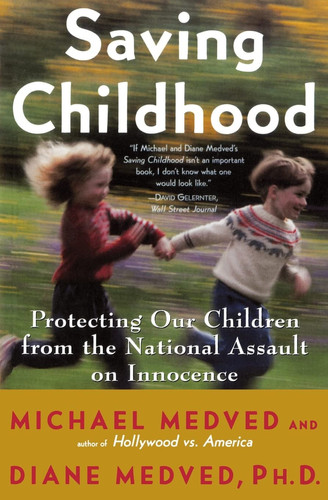
Saving childhood: how to protect your children from the national assault on innocence

Medved, Michael
Saving Childhood offers parents and grandparents practical strategies to cope with a society that seems perversely determined to frighten and corrupt its young. Cultural critic and popular radio host Michael Medved and his wife, psychologist Diane Medved, argue that in a mistaken effort to curb problems plaguing its youth, our culture has changed from protecting childhood as a precious time of growth to hammering even the smallest youngsters with a grim, harsh, and menacing view of the world. The Medveds systematically present unassailable scientific evidence, moving anecdotes, and personal experiences of raising their three young children to explain the attack from four primary directions--media, schools, peers, and even well-intentioned parents themselves. In a unique analysis the Medveds define innocence not as ignorance but as the result of three components--security, a sense of wonder and optimism. They empower parents and all who care about childhood with concrete, easily accomplished means to fend off the assault, as well as advice for handling hurdles such as the Internet, television, peer pressure, and the plague of pessimism. Saving Childhood enables us to restore and maintain for our children imagination, confidence, and hope for the future.
HarperCollinsPublishers 1998 324 pages

The ballerina of Auschwitz

Eger, Edith Eva,Schwall, Esmé
"Edie is a talented dancer and skilled gymnast with hopes of making the Olympics. Between her rigorous training and her struggle to find her place in a family where she's considered the daughter "with brains but no looks," Edie's too busy to dwell on the state of the world. But life in Hungary in 1943 is dangerous for a Jewish girl. Just as Edie falls in love for the first time, Europe collapses into war, and Edie's family is forced onto a train bound for the Auschwitz concentration camp. Even in that darkest of moments, Edie's beloved, Eric, kindles hope. "I'll never forget your eyes," he tells her through the slats of the cattle car. Auschwitz is horrifying beyond belief, yet through starvation and unthinkable terrors, dreams of Eric sustain Edie. Against all odds, Edie and her sister Magda survive, thanks to their sisterhood and sheer grit. In this young adult edition of her bestselling, award-winning memoir The Choice, renowned psychologist and Holocaust survivor Dr. Edith Eger gives readers a gift of hope and strength"--
Atheneum Books for Young Readers 2024-10 182 pages

Paying the price: college costs, financial aid, and the betrayal of the American dream

Goldrick-Rab, Sara
If you are a young person, and you work hard enough, you can get a college degree and set yourself on the path to a good life, right? Not necessarily, says Sara Goldrick-Rab, and with Paying the Price , she shows in damning detail exactly why. Quite simply, college is far too expensive for many people today, and the confusing mix of federal, state, institutional, and private financial aid leaves countless students without the resources they need to pay for it. Drawing on an unprecedented study of 3,000 young adults who entered public colleges and universities in Wisconsin in 2008 with the support of federal aid and Pell Grants, Goldrick-Rab reveals the devastating effect of these shortfalls. Half the students in the study left college without a degree, while less than 20 percent finished within five years. The cause of their problems, time and again, was lack of money. Unable to afford tuition, books, and living expenses, they worked too many hours at outside jobs, dropped classes, took time off to save money, and even went without adequate food or housing. In many heartbreaking cases, they simply left school—not with a degree, but with crippling debt. Goldrick-Rab combines that shocking data with devastating stories of six individual students, whose struggles make clear the horrifying human and financial costs of our convoluted financial aid policies. America can fix this problem. In the final section of the book, Goldrick-Rab offers a range of possible solutions, from technical improvements to the financial aid application process, to a bold, public sector–focused “first degree free” program. What’s not an option, this powerful book shows, is doing nothing, and continuing to crush the college dreams of a generation of young people.
The University of Chicago Press 2016-09-13 373 pages

An unconventional family

Bem, Sandra Lipsitz
In 1965, when psychologists Sandra and Daryl Bem met and married, they were determined to function as truly egalitarian partners and also to raise their children in accordance with gender-liberated, anti-homophobic, and sex-positive feminist ideals. During the next ten years, they exuberantly shared the details of their daily lives in both public lectures and the mass media in order to provide at least one concrete example of an alternative to the traditional heterosexual family. In the 1990s, Sandra Bem also published an award-winning book, The Lenses of Gender , which spelled out the feminist theory behind their feminist practices. This second book by Sandra Bem, an autobiographical account of the Bems` nearly thirty-year marriage, is both a personal history of the Bems` past and a social history of a key period in feminism`s past. It is also a look into feminism`s future, because the Bems` children, Emily and Jeremy, now in their early twenties, speak at length in the book as well. Bem analyzes what aspects of family background and psychological makeup led her and Daryl to bond so immediately and to become gender pioneers. She describes the egalitarianism and feminist child-rearing that they invented for their private needs and tells how these family agendas were transformed into public feminist discourse. Finally she reassesses this early feminist union now that the marriage has come to an end and the children are young adults, evaluating (with the help of lengthy interviews with Emily and Jeremy and a brief epilogue by Daryl) what the Bems` experiences--both positive and negative--have to say about the viability and necessity of nontraditional gender arrangements in society today.
Yale University Press 2001-01-01 224 pages

Thirty-life crisis: navigating my thirties, one drunk baby shower at a time

Schwartz, Lisa
"Lisa Schwartz's stories and musings are all about watching her friends adult like pros, while she tries to understand why she doesn't want or can't seem to find all the things they have for herself. Like a big sister who's already seen it all, Lisa will take readers through her own life experiences to say that one thing we all need to hear: you are so not alone. Unabashed and unfiltered, Schwartz's voice and candor will appeal to anyone in their thirties who just can't deal with the never-ending Facebook feed of friends' engagement photos and baby pictures, the trials of figuring out where their passion meets their career, and everything in between"--
Grand Central Publishing 2019-08-27 231 pages

Sugar Changed the World A Story of Magic, Spice, Slavery, Freedom, and Science

Marc Aronson,Marina Tamar Budhos
This globe-spanning history of sugar is "an epic story on a broad canvas that never loses sight of individual moments of human drama; a historical methodology infused with political, intellectual, cultural, and social strands; a complex sequence of cause and effect; an illuminating synthesis of primary and secondary sources; and a thoughtful marriage of words, picture, and design." (Horn Book starred review) Here is the story of how one product allows us to see the grand currents of world history in new ways. Using songs, oral histories, maps, and over 80 archival illustrations, Marc Aronson and Marina Budhos put a human face on this vast pageant. Time line, source notes, bibliography, and index included. The history of sugar runs like a bright band from religious ceremonies in India to Europe's Middle Ages, then on to Columbus, who brought the first cane cuttings to the Americas. Sugar caused the loss of countless lives, but it also planted the seeds of revolution that led to freedom in the American colonies, Haiti, and France. Cane, not cotton or tobacco, drove the bloody Atlantic slave trade and took the lives of countless Africans who toiled on vast sugar plantations under cruel overseers. And yet the very popularity of sugar gave abolitionists in England the one tool that could finally end the slave trade. Sugar moved, murdered, and freed millions; sugar changed the world.
Clarion Books 2010 166 pages

A house of cards: baseball card collecting and popular culture

Bloom, John
Baseball card collecting carries with it images of idealized boyhoods in the sprawling American suburbs of the postwar era. Yet since the mid-1970s, it has grown from a pastime for children to a big money pursuit taken seriously by adults. This work employs interviews with collectors, dealers, and hobbyists to ask what this hobby tells us about nostalgia, work, play, masculinity, and race and gender relations among collectors. These interviews reveal the hobby's alienating, lonely and unfulfilling aspects, and demonstrate the nostalgia experienced among collectors for the ideal childhood world many middle class white males experienced in the postwar years, when baseball card collecting was a form of play, not a money-making enterprise. The work links this nostalgia to anxieties about de-industrialization and the rise of the civil rights, feminist, and gay rights movements. It examines the gendered nature of swap meets as well as the views of masculinity expressed by the collectors: is the purpose of baseball card collecting to form a community of adults to reminisce or to inculcate young men with traditional masculine values? Is it to establish "connectedness" or to make money? Are collectors striving to reinforce the dominant culture or question it through their attempts to create their own meaning out of what are, in fact, mass-produced commercial artifacts?
University of Minnesota Press 1997 142 pages

Shari Lewis and Lamb Chop: the team that changed children's television

Segaloff, Nat,Lewis, Mallory
"For almost half a century, celebrated ventriloquist and entertainer Shari Lewis delighted generations of children and adults with the help of her trusted sock puppet sidekick Lamb Chop. For decades, the beloved pair were synonymous with children's television, educating and entrancing their young audience with their symbiotic personalities and their proclivity for song, dance, and the joy of silliness. But as iconic as their television personas were, relatively little inside knowledge has been revealed about Lewis herself and the life-changing moments that led her to the entertainment industry and perhaps, most importantly, to Lamb Chop. Renowned for her skills as a performer, Lewis was an equally skilled businesswoman. Operating in an era when women were largely left out of the conversation, she was one of the few women to run her own television production company. Whether it was singing, dancing, conducting, writing, drawing, or ventriloquism-a skill in which she was virtually unmatched-Lewis spent the entirety of her 65 years in pursuit of performative perfection. Constantly innovating and adapting to the needs of her audience and the market, Lewis extended the longevity of her career decade after decade. Her contributions, and that of Lamb Chop, and the rest of her puppet pals forever changed the history of children's television. Now, two decades after Lewis and Lamb Chop last graced television with their presence, Lewis' daughter Mallory and author Nat Segaloff have set the record straight about the iconic pair in Shari Lewis and Lamb Chop: The Team that Changed Children's Television. In this seminal biography, the pair pull the veritable wool from the eyes of audiences who adored the legendary entertainer to examine the joys, sorrows, triumphs, and sheer hard work that gave Lewis and Lamb Chop their enduring star power"--
The University Press of Kentucky 2022 191 pages

Master of Deceit J. Edgar Hoover and America in the Age of Lies

Marc Aronson
A fascinating and timely biography of J. Edgar Hoover from a Sibert Medalist. "King, there is only one thing left for you to do. You know what it is. . . . You better take it before your filthy, abnormal, fraudulent self is bared to the nation.” Dr. Martin Luther King received this demand in an anonymous letter in 1964. He believed that the letter was telling him to commit suicide. Who wrote this anonymous letter? The FBI. And the man behind it all was J. Edgar Hoover, the FBI's first director. In this unsparing exploration of one of the most powerful Americans of the twentieth century, accomplished historian Marc Aronson unmasks the man behind the Bureau- his tangled family history and personal relationships; his own need for secrecy, deceit, and control; and the broad trends in American society that shaped his world. Hoover may have given America the security it wanted, but the secrets he knew gave him — and the Bureau — all the power he wanted. Using photographs, cartoons, movie posters, and FBI transcripts, Master of Deceit gives readers the necessary evidence to make their own conclusions. Here is a book about the twentieth century that blazes with questions and insights about our choices in the twenty-first. Back matter includes an epilogue, an author’s note, source notes, a bibliography, and an index.
National Geographic Books 2019-03-12 240 pages

In their own voices: transracial adoptees tell their stories

Simon, Rita J.
Nearly forty years after researchers first sought to determine the effects, if any, on children adopted by families whose racial or ethnic background differed from their own, the debate over transracial adoption continues. In this collection of interviews conducted with black and biracial young adults who were adopted by white parents, the authors present the personal stories of two dozen individuals who hail from a wide range of religious, economic, political, and professional backgrounds. How does the experience affect their racial and social identities, their choice of friends and marital partners, and their lifestyles? In addition to interviews, the book includes overviews of both the history and current legal status of transracial adoption.
Columbia University Press 2000 392 pages

Let's face it: 90 years of living, loving, and learning

Douglas, Kirk
He has been one of the brightest stars in Hollywood, a hard-charging actor whose intensity on the screen has been mirrored in his personal life. As Kirk Douglas has grown older - he turned ninety in December 2006 - he has become less impetuous and more reflective. In this poignant and inspiring new memoir, Douglas contemplates what life is all about, weighing current events from his present frame of mind while summoning the passions of his younger days. Kirk Douglas is a born storyteller, and throughout Let's Face It he tells wonderful tales and shares favorite jokes and hard-won insights. In the book, he explores the mixed blessings of growing older and looks back at his childhood, his young adulthood, and his storied, glamorous, and colorful life and career in Hollywood. He tells delightful stories of the making of such films as Spartacus, Lust for Life, Champion, The Bad and the Beautiful, and many others. He includes anecdotes about his friends Frank Sinatra, Burt Lancaster, Lauren Bacall, Ronald Reagan, Ava Gardner, Henry Kissinger, Fred Astaire, Yul Brynner, John Wayne, and Johnny Cash. He reveals the secrets that have kept him and his wife, Anne, happily married for more than five decades, and talks fondly and movingly of times spent with his sons, Michael, Peter, Eric, and Joel, and his grandchildren. Douglas's life has been filled with pain as well as joy. In Let's Face It , he writes frankly for the first time about the tragic death of his son Eric from a drug overdose at age forty-five. Douglas tells what it was like to recover from several near-death episodes, including a helicopter crash, a stroke, and a cardiac event. He writes of his sadness that many of his closest friends are no longer with us; the book includes many moving stories such as one about a regular poker game at Frank Sinatra's house at which he and Anne have been fixtures along with Gregory Peck, Jack Lemmon, and their wives. Though many of the players are gone, the game continues to this day. In Let's Face It , Douglas reflects on how his Jewish faith has become more and more important to him over the years. He offers strong opinions on everything from anti-Semitism to corporate greed, from racism to Hurricane Katrina, and from the war in Iraq to the situation in Israel. He writes about the importance in his life of the need to improve education for all children and about how we need to care more about the world and less about ourselves. A must-read for every fan, this engrossing memoir provides an indelible self-portrait of a great star - while sharing the wit and wisdom Kirk Douglas has accumulated over a lifetime.
John Wiley & Sons 2007 238 pages

March on

Lucy Lang,Grace Lang
inspired by recent women's marches, sisters Lucy and Grace Lang's book for very young children honors the centennial of the passage of the 19th Amendment, which secured women's right to vote in the United States. As the world churns, all parents are striving to raise informed, courageous children, equipped to handle a changing and dangerous world in the most responsible and productive ways possible. March On! draws on the iconography of the women's march that started it all, the historic 1915 New York City women's march, highlighting the tremendous potential for collective activism, in rhyme, coupled with unique and diverse pictures to appeal to both children's imaginations and adults' familiarity with archetypal American imagery.
BOOKBABY 2020-04-11 24 pages

All grown up and no place to go: teenagers in crisis

Elkind, David
Once our society set aside time for adolescents to grow from children to adults, to become accustomed to their expanding bodies and minds. Now the markers that defined passage—differences in dress, behavior, and responsibilities—have vanished. The institutions that guarded adolescence, such as family and schools, now expect “young adults” to deal with adult issues. Those trends leave teens no time to be teens. All Grown Up and No Place to Go spotlights the pressures on teenagers to grow up quickly. The resulting problems range from common alienation to self-destructive behavior. Quoting teenagers themselves, Elkind shows why adolescence is a time of “thinking in a new key,” and how young people need this time to get used to the social and emotional changes their new thinking brings. Many of his ideas, such as the “imaginary audience” that makes teens so self-conscious, have become seminal in adolescent psychology.Already there are more than 175,000 copies of All Grown Up and No Place to Go in print. In this thoroughly revised edition, Elkind also explores the “post-modern family” in which teenagers are growing up. He helps parents and those who work with youth and understand teens in crucial ways, because the root of so many adolescent frictions is the gap between what teenagers need and what our culture provides.
Addison-Wesley 1998-01-07 290 pages