

7908 results for "Science"

The Year's Best Science Fiction No. 1

The baby business: how money, science, and politics drive the commerce of conception
Argues that recent advances in infertility treatment has led to the commercialization of children and that the field should be regulated by the government.

Real Science Behind The X Files

Structure and mechanism in protein science: a guide to enzyme catalysis and protein folding
The three-dimensional structure of proteins -- Chemical catalysis -- The basic equations of enzyme kinetics -- Measurement and magnitude of individual rate constants -- The pH dependence of enzyme catalysis -- Practical methods for kinetics and equilibria -- Detection of intermediates in enzymatic reactions -- Stereochemistry of enzymatic reactions -- Active-site-directed and enzyme-activated irreversible inhibitors : "affinity labels" and "suicide inhibitors" -- Conformational change, allosteric regulation, motors, and work -- Forces between molecules, and binding energies -- Enzyme-substrate complementarity and the use of binding energy in catalysis -- Specificity and editing mechanisms -- Recombinant DNA technology -- Protein engineering -- Case studies of enzyme structure and mechanism -- Protein stability -- Kinetics of protein folding -- Folding pathways and energy landscapes.

Tesseracts (Tesseracts (Paperback))
Product Description Each year Tesseract Books chooses a team of editors from among the best of Canadas writers, publishers and critics to select innovative and futuristic fiction and poetry from the leaders and emerging voices in Canadian speculative fiction. This is the anthology that started it all! Featuring fiction by Élisabeth Vonarburg and Hugo and Nebula award winning authors Spider Robinson, and William Gibson. Review "The reader who ventures into Tesseracts territory is assured of meeting some of our most able and gifted writers in surroundings that are at once wholly strange, and wholly familiar." - The Globe and Mail -"This anthology merits inclusion in any comprehensive collection, and it rewards the curiosity of the casual reader as well." - Locus Magazine - From the Author Hi, I'm Rhea Rose, one of the author's in this collection of science fiction and fantasy short stories. My story is called "Chronos' Christmas" and you can find that science fiction story here. If you google you can find the story available on other sites,too. My story was nominated for the Aurora Award (Canadian award) the year this collection was published, but I lost to Judith Merril who was also nominated and won for this collection. I was happy to see her get it! After all she did select my story for this, the first book in the Tesseracts legacy. Over the years my stories have appeared in many other of the Tesseracts collections. I'm hoping I can get Amazon to post the cover copy here, as they have for this one. About the Author The late Judith Merril is considered one of the most prolific authors and editors in the field of Science Fiction. Born in New York in 1923, she founded the Futurians, a group of SF writers and editors. Her first SF story, That Only a Mother, was published in 1948. Judith edited numerous SF anthologies including Dells Years Best SF from 1956-1967, and was the Books columnist for The Magazine of Fantasy and Science Fiction from 1965-69.

Personal knowledge: towards & post-critical philosophy
In this work the distinguished physical chemist and philosopher, Michael Polanyi, demonstrates that the scientist's personal participation in his knowledge, in both its discovery and its validation, is an indispensable part of science itself. Even in the exact sciences, "knowing" is an art, of which the skill of the knower, guided by his personal committment and his passionate sense of increasing contact with reality, is a logically necessary part. In the biological and social sciences this becomes even more evident. The tendency to make knowledge impersonal in our culture has split fact from value, science from humanity. Polanyi wishes to substitute for the objective, impersonal ideal of scientific detachment an alternative ideal which gives attention to the personal involvement of the knower in all acts of understanding. His book should help to restore science to its rightful place in an integrated culture, as part of the whole person's continuing endeavor to make sense of the totality of his experience. In honor of this work and his The Study of Man Polanyi was presented with the Lecomte de Noüy Award for 1959.

Zero-G Green Space
An exciting science fiction adventure from William Shatner—famous for his role as Captain Kirk on Star Trek —about the intrepid, eighty-year-old FBI deputy director Samuel Lord and his quest to stop the Chinese from using a weapon that (unknown to them) could destroy Earth. In the year 2050, the United States sends the FBI to govern its space station, the Empyrean. Under the command of former fighter pilot and FBI field agent Samuel Lord, the space-based “Zero-G” men are in charge of investigating terrorism, crime, corruption, and espionage beyond the Earth’s atmosphere and of keeping an eye on the rival Chinese and Russian stations. During the Zero-G team’s first days in space, a mysterious and beautiful scientist, Dr. May, shows up to the Empyrean claiming that important research has been stolen from her lab on the moon. Her arrival suspiciously coincides with timing of a tsunami that destroys part of the coast of Japan, and her unusual behavior makes Director Lord think that Dr. May might know more about the disaster than she’s letting on. Meanwhile, the Chinese space station has gone mysteriously silent. In this “tightly paced blend of police procedural, military SF, and space opera, set in an intriguing near-future world” ( Publishers Weekly ), Director Lord must connect the dots to discover who or what has caused the tsunami as well as subsequent disasters, and how Dr. May and the Chinese might be involved.

To Live Again
First published in 1969, this novel by one of the most prolific authors in the history of science fiction explores an idea that is truly "far out." Imagine a future world where death is not exactly the end. You can record everything about you that ever made you a distinct human being and then be implanted in the mind of someone living.

Essays on the anthropology of reason
This collection of essays explains and encourages new reflection on Paul Rabinows pioneering project to anthropologize the West. His goal is to exoticize the Western constitution of reality, emphasize those domains most taken for granted as universal, and show how their claims to truth are linked to particular social practices, hence becoming effective social forces. He has recently begun to focus on the core of Western rationality, in particular the practices of molecular biology as they apply to our understanding of human nature. This book moves in new directions by posing questions about how scientific practice can be understood in terms of ethics as well as in terms of power.The topics include how French socialist urban planning in the 1930s engineered the transition from city planning to life planning; how the discursive and nondiscursive practices of the Human Genome Project and biotechnology have refigured life, labor, and language; and how a debate over patenting cell lines and over the dignity of life required secular courts to invoke medieval notions of the sacred. Building on an ethnographic study of the invention of the polymerase chain reaction--which enables the rapid production of specific sequences of DNA in millions of copies Rabinow, in the final essay, reflects in dialogue with biochemist Tom White on the place of science in modernity, on science as a vocation, and on the differences between the human and natural sciences.

Mac Raboy's Flash Gordon. Volume 4
Thrill to the celestial dangers of space travel and the science fiction action of yesteryear's Flash Gordon weekly series! Ming the Merciless, the traitorous Klag, a mysterious creature known as "The Mind," and a host of villains and dangers oppose the hardy, heroic Flash in a reprint series that marks the first time that Mac Raboy's run on this acclaimed strip has ever been collected. From Alex Raymond to Reed Crandall to Al Williamson, stellar artists have long-contributed to the success of Flash Gordon, and Mac Raboy is in the same class of top talent. Beginning his comics career in 1940, Emanuel 'Mac' Raboy is perhaps best known for his work on Captain Marvel, Jr. and the Green Lama in the 1940s. In the Spring of 1948, he signed on with King Features to illustrate the 'Flash Gordon' Sunday page, and Mac Raboy's run on this serial was actually longer than Alex Raymond's. Join Flash, Dale, and Dr. Zarkov in these exquisitely drawn, fantastical adventures!

The Apex Book of World SF 3
"The Apex Book of SF series has proven to be an excellent way to sample the diversity of world SFF and to broaden our understanding of the genre's potentials." --Ken Liu, winner of the Hugo Award and author of "The Grace of Kings" These stories run the gamut from science fiction, to fantasy, to horror. Some are translations (from German, Chinese, French, Spanish, and Swedish), and some were written in English. The authors herein come from Asia and Europe, Africa and Latin America. Their stories are all wondrous and wonderful, and showcase the vitality and diversity that can be found in the field. They are a conversation, by voices that should be heart. And once again, editor Lavie Tidhar and Apex Publications are tremendously grateful for the opportunity to bring them to our readers. Featuring: Amal El-Mohtar Ange Athena Andreadis Benjanun Sriduangkaew Berit Ellingsen Biram Mboob Crystal Koo Fadzilshah Johanabos Karin Tidbeck Ma Boyong Myra Cakan Nelly Geraldine Garcia-Rosas Swapna Kishore Uko Bendi Udo Xia Jia Zulaikha Nurain Mudzor Cover art by Sophia Tuska.

The Apex Book of World SF 2
In The Apex Book of World SF 2, editor Lavie Tidhar collects short stories by science fiction and fantasy authors from Africa and Latin America. An expedition to an alien planet; Lenin rising from the dead; a superhero so secret he does not exist. In The Apex Book of World SF 2, World Fantasy Award nominated editor Lavie Tidhar brings together a unique collection of stories from around the world. Quiet horror from Cuba and Australia; surrealist fantasy from Russia and epic fantasy from Poland; near-future tales from Mexico and Finland, as well as cyberpunk from South Africa. In this anthology one gets a glimpse of the complex and fascinating world of genre fiction from all over our world. Featuring work from noted international authors such as Will Elliot, Hannu Rajaniemi, Shweta Narayan, Lauren Beukes, Ekaterina Sedia, Nnedi Okorafor, and Andrzej Sapkowski. "

Contemporary Chinese politics: new sources, methods, and field strategies
"Contemporary Chinese Politics: Sources, Methods, and Field Strategies considers how new and diverse sources and methods are changing the study of Chinese politics. Contributors spanning three generations in China studies place their distinct qualitative and quantitative methodological approaches in the framework of the discipline and point to challenges or opportunities (or both) of adapting new sources and methods to the study of contemporary China. How can we more effectively use new sources and methods of data collection? How can we better integrate the study of Chinese politics into the discipline of political science, to the betterment of both? How can we more appropriately manage the logistical and ethical problems of doing political research in the challenging Chinese environment? In addressing these questions, this comprehensive methodological survey will be of immense interest to graduate students heading into the field for the first time and experienced scholars looking to keep abreast of the state of the art in the study of Chinese politics"--

The young scientists: America's future and the winning of the Westinghouse
Examines the schools that have won the Westinghouse Science Talent Search, a prestigious national academic contest, and chronicles how these schools have created phenomenal science programs.

The third culture
Synopsis Providing an analysis of the intellectual culture of today that has science--not literature or philosophy--at its center, a guide to the latest scientific theories and research is also a provocative discussion of the predominance of science.

Ralph 124C 41+
2014 Reprint of 1950 Edition. Full facsimile of the original edition, not reproduced with Optical Recognition Software. "Ralph 124C 41+" by Hugo Gernsback is an early science fiction novel, written as a twelve-part serial in "Modern Electrics" magazine beginning in April 1911. It was compiled into novel/book form in 1925. It is considered one of the most influential science fiction stories of all time. The title itself is a play on words, ( 1 2 4 C 4 1 + ) meaning "One to foresee for one another". Some successful predictions from this novel include television (and channel surfing), remote-control power transmission, the video phone, transcontinental air service, solar energy in practical use, sound movies, synthetic milk and foods, artificial cloth, voiceprinting, tape recorders, and spaceflight. It also contains "...the first accurate description of radar, complete with diagram..." according to Arthur C. Clarke in his "non-genre" novel "Glide Path." (1963)

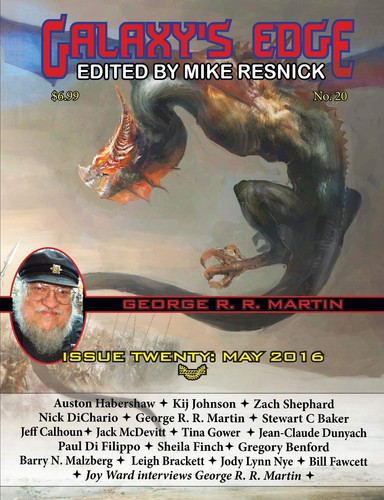
Galaxy's Edge Magazine Issue 20, May 2016 (George R. R. Martin Special)
A Magazine of Science Fiction and Fantasy ISSUE 12: May 2016 Mike Resnick, Editor Jean Rabe, Assistant Editor Shahid Mahmud, Publisher Stories by: Auston Habershaw, Kij Johnson, Shephard, Nick DiChario, George R. R. Martin, Stewart C Baker, Jeff Calhoun, Jack McDevitt, Tina Gower, Jean-Claude Dunyach, Paul Di Filippo, Sheila Finch Serialization: The Long Tomorrow by Leigh Brackett Columns by: Barry Malzberg, Gregory Benford Book Reviews: Jody Lynn Nye and Bill Fawcett Interview: Joy Ward interviews George R. R. Martin Galaxy's Edge is a Hugo-nominated bi-monthly magazine published by Phoenix Pick, the science fiction and fantasy imprint of Arc Manor, an award winning independent press based in Maryland. Each issue of the magazine has a mix of new and old stories, a serialization of a novel, columns by Barry Malzberg and Gregory Benford, book reviews by Jody Lynn Nye and Bill Fawcett and an interview conducted by Joy Ward.
Dr. Quantum in the Grandfather Paradox
Dr. Quantum- first introduced in the world wide hit film What The Bleep Do We Know?! is a series of adventures featuring the many-faceted fields of futuristic scientific thought. We follow Dr. Quantumand his UUSS (United Earth Science Services) team in the early 25th century in their endeavors to further the well being of the universes inhabiatnts through technology and science.

A matter of choices: memoirs of a female physicist
When Fay Ajzenberg-Selove became a nuclear physicist, the number of women in the field could be counted on one hand. In this engaging memoir, Fay Ajzenberg-Selove writes candidly about her difficult journey to international recognition in physics. She is frank about the ways being a woman has made a difference in her opportunities and choices as a scientist--and how, by being a woman, she has made a difference in the world of physics. Ajzenberg-Selove came to America at the age of 15 after narrowly escaping the Nazi takeover of France. She had planned to become an engineer like her father, but switched to physics after she was told the only engineering jobs open to women were in drafting: Marie Curie's example proved to her that women could do physics. Her first attempt at graduate work at Columbia University was a disaster, but she was sturck with the intellectual beauty of the field. After taking a Ph.D. in physics at University of Wisconsin, she did post-doctoral work with Thomas Lauritsen at the California Institute of Technology, where she began writing the first of a series of major review papers on the nuclear spectroscopy of the light nuclei, a subject of fundamental importance to nuclear physics, astrophysics, and applied physics. She continued this work and experimental research for thirty-eight years while teaching at Boston University, Haverford College, and the University of Pennsylvania. During her early career, Ajzenberg-Selove was shielded by her male mentors from experiencing much of the discrimination directed against women in science. Her simultaneous battles to become a tenured professor and to overcome breast cancer opened her eyes and confirmed her as a feminist. The lay reader and the scientist alike will be fascinated by Ajzenberg-Selove's clear portrayal of her interlinked lives as physicist, teacher, wife of particle physicist, Walter Selove, and a woman who relishes both competition and friendship in a male-dominated field. An invaluable book for anyone contemplating a career in science.
