2501 results for "American History"

China Doll

David Mamet
A very wealthy businessman buys a plane to carry his fianc�e, a non-US citizen, into Canada. However, an unexpected landing of the plane prompts an investigation into the man's affairs based on his tax payment history. As his assistant tries to help him put things back together, secrets are revealed, and it is discovered the man is a powerful political insider who's been evading tax law. The investigation deepens and his future is even more at risk.
Concord Theatricals 2017 66 pages

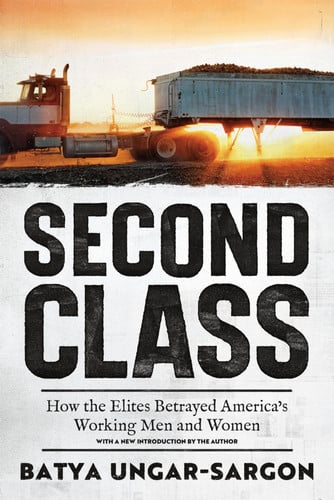
Second class: how the elite betrayed America's working men and women

Ungar-Sargon, Batya
A personal, journalistic ethnography of the modern American working class, based on the travels and interactions of the author through the American heartland. " Second Class is the most important book you will read all year. A political realignment is coming, and it's my hope that the end result will work in favor of our all-too-neglected American working class. When that realignment comes, Batya and her book will help lead the way." --Greg Lukianoff, CEO of the Foundation for Individual Rights in Education, and co-author of The Coddling of the American Mind Who is the American working class? Do they still have a fair shot at the American Dream? What do they think about their chances to secure the hallmarks of a middle-class life? While writing this book, Batya Ungar-Sargon visited states across the nation to speak with members of the American working class who are fighting tooth and nail to survive. In Second Class , working-class Americans of all races, political orientations, and occupations share their stories--cleaning ladies, health care aides, cops, truck drivers, fast food workers, electricians, and more. In their own words, these working-class Americans explain the struggles and triumphs of their increasingly precarious lives--as well as what policies they think would improve them. Second Class combines deep reporting with a look at the data and expert opinions on America's emergent class divide, in which the most basic elements of a secure and stable life are increasingly out of reach for those without a college education. America has broken its contract with its laboring class. So, how do we get back to the American Dream? How do we once again become the land of opportunity, the promised land, where hard work and commitment to family are enough to protect you from poverty? It's not that hard actually. All it would take, as this book illustrates, is for those in power to once again respect the dignity of work--and the American worker.
Encounter Books 2025 248 pages

Kate Remembered

A. Scott Berg
For seven decades Katharine Hepburn played a leading role in the popular culture of the twentieth century - reigning as an admired actress, a beloved movie star, and a treasured icon of the modern American woman. She also remained one of the most private of all the public figures of her time. In 1983 - at the age of seventy-five, her career cresting - the four-time Academy Award winner opened the door to biographer A. Scott Berg - then thirty-three - and began a special friendship, one that endured to the end of her illustrious life. From the start, Scott Berg felt that Katharine Hepburn intended his role to be not just that of a friend but also of a chronicler, a confidant who might record for posterity her thoughts and feelings. Over the next twenty years, Kate used their many hours together to reveal all that came to mind, often reflecting on the people and episodes of her past, occasionally on the meaning of life. Here are the stories from those countless intimate conversations, and much more. In addition to recording heretofore untold biographical details of her entire phenomenal career and her famous relationships with such men as Spencer Tracy and Howard Hughes, Kate Remembered also tells the amusing, often emotional story of one of the most touching friendships in her final years. Scott Berg provides his own memories of Katharine Hepburn offstage - quiet dinners in her town house in New York City, winter swims (she swam, he watched) in the Long Island Sound at Fenwick, her home in Connecticut, weekend visits with family members and dear friends...even some unusual appearances by the likes of Michael Jackson and Warren Beatty. Finally, Kate Remembered discusses the legendary actress's moving farewell, during which her mighty personality surrendered at last to her failing body - all the while remaining true to her courageous character. Kate Remembered is a book about love and friendship, family and career, Hollywood and Broadway - all punctuated by unforgettable lessons from an extraordinary life.
Penguin Publishing Group 2004-09-07 384 pages

Just around the corner: the paradox of the jobless recovery

Aronowitz, Stanley
Americans have always believed that economic growth leads to job growth. In this groundbreaking analysis, Stanley Aronowitz argues that this is no longer true. Just Around the Corner examines the state of the American economy as planned by Democrats and Republicans over the last thirty years. Aronowitz finds that economic growth has become "delinked" from job creation, and that unemployment and underemployment are a permanent condition of our economy. He traces the historical roots of this state of affairs and sees under the surface of booms and busts a continuum of economic austerity that creates financial windfalls for the rich at the expense of most Americans. Aronowitz also explores the cultural and political processes by which we have come to describe and accept economics in the United States. He concludes by presenting a concrete plan of action that would guarantee employment and living wages for all Americans. With both measured analysis and persuasive reasoning, Just Around the Corner provides an indispensable guide to our current economic predicament and a bold challenge to economists and policymakers.
Temple University Press 2005-03-14 163 pages

Major Problems in African American History

Barbara Krauthamer,Chad Williams
This text introduces you to both primary sources -- straight from the frontlines of history -- and analytical essays, and is designed to encourage critical thinking about the history and culture of African Americans. The carefully selected readings give you many opportunities to evaluate primary sources, test the interpretations of distinguished historians, and draw your own conclusions.
Cengage Learning 2018-07-12 616 pages

The populist persuasion: an American history

Kazin, Michael
"In The Populist Persuasion, the distinguished historian Michael Kazin guides readers through the expressions of conflict between powerful elites and "the people" that have run through our civic life, filling it with discord and meaning from the birth of the United States until the present day. Kazin argues persuasively that the power of populism lies in its adaptable nature. Across the political spectrum, commentators paste the label on forces and individuals who really have just one big thing in common: they are effective at blasting "elites" or "the establishment" for harming the interests and betraying the ideals of "the people" in nations that are committed, at least officially, to democratic principles. Kazin's classic book has influenced debates over populism since its publication. The new preface to this edition brings the story up to date by charting the present resurgence of populist discourse, which was front and center in the 2016 elections and in the Brexit debate"--
Cornell University Press 2017 387 pages

A new literary history of America

Greil Marcus,Werner Sollors,Henry B and Anne M Cabot Professor of English Literature and Professor of African and African American Studies Werner Sollors
America is a nation making itself up as it goes along--a story of discovery and invention unfolding in speeches and images, letters and poetry, unprecedented feats of scholarship and imagination. In these myriad, multiform, endlessly changing expressions of the American experience, the authors and editors of this volume find a new American history. In more than two hundred original essays, this book brings together the nation's many voices. From the first conception of a New World in the sixteenth century to the latest re-envisioning of that world in cartoons, television, science fiction, and hip hop, the book gives us a new, kaleidoscopic view of what "Made in America" means. Literature, music, film, art, history, science, philosophy, political rhetoric--cultural creations of every kind appear in relation to each other, and to the time and place that give them shape.--From publisher description.
Belknap Press of Harvard University Press 2009 1095 pages

Stagecoach Wells Fargo and the American West

Philip L. Fradkin
Sweeping in scope, as revealing of an era as it is of a company, Stagecoach is the epic story of Wells Fargo and the American West, by award-winning writer Philip L. Fradkin. The trail of Wells Fargo runs through nearly every imaginable landscape and icon of frontier folklore: the California Gold Rush, the Pony Express, the transcontinental railroad, the Civil and Indian Wars. From the Great Plains to the Rockies to the Pacific Ocean, the company's operations embraced almost all social, cultural, and economic activities west of the Mississippi, following one of the greatest migrations in American history. Fortune seekers arriving in California after the discovery of gold in 1849 couldn't bring the necessities of home with them. So Wells Fargo express offices began providing basic services such as the exchange of gold dust for coin, short-term deposits and loans, and reliable delivery and receipt of letters, money, and goods to and from distant places. As its reputation for speed and dependability grew, the sight of a red-and-yellow Wells Fargo stagecoach racing across the prairie came to symbolize not only safe passage but faith in a nation's progress. In fact, for a time Wells Fargo was the most powerful and widespread institution in the American West, even surpassing the presence of the federal government. Stagecoach is a fascinating and rare combination of Western and business history. Along with its colorful association with the frontier -- Wyatt Earp, Black Bart, Buffalo Bill -- readers will discover that swiftness, security, and connectivity have been constants in Wells Fargo's history, and that these themes remain just as important today, 150 years later.
Thorndike Press 2002 469 pages

The Destruction of Hillary Clinton

Bordo, Susan
"If you want to understand not only what happened in 2016, but what's going to happen tomorrow, this book is essential reading. Susan Bordo brings a scholar's rigor and a lioness' heart to this important work." --Paul Begala "Among the best books I've read on the 2016 election . . . the perfect companion to Clinton's What Happened ." --Peter Daou The Destruction of Hillary Clinton is an answer to the question many have been asking: How did an extraordinarily well-qualified, experienced, and admired candidate--whose victory would have been as historic as Barack Obama's--come to be seen as a tool of the establishment, a chronic liar, and a talentless politician? In this masterful narrative of the 2016 campaign year and the events that led up to it, Susan Bordo unpacks the Rights' assault on Clinton and her reputation, the way the left provoked suspicion and indifference among the youth vote, the inescapable presence of James Comey, questions about Russian influence, and the media's malpractice in covering the candidate. Urgent, insightful, and engrossing, The Destruction of Hillary Clinton is an essential guide to understanding the most controversial presidential election in American history.
Melville House 2017 244 pages

The Crossing

Howard Fast
Nobody has written more passionately or more vividly about the American Revolution than Howard Fast. The legendary living author of "Freedom Road and "Citizen Tom Paine, the Academy Award-winning screenwriter of "Spartacus and the triumphant survivor of Hollywood's notorious blacklist of the fifties, Howard Fast is a part of American history. This definitive new edition of Fast's novel, with photographs from the A&E film, reverberates with the dramatic events of Washington's re-crossing of the Delaware-a pivotal moment in the American Revolution. It is an amazing testament to Washington's leadership of the young volunteer army fighting in summer clothes against the bitter cold, the snow and the almost impassable Delaware River. Criss-crossing through Pennsylvania, Delaware, New Jersey, Connecticut and New York, this is also the tale of Colonel John Glover, the leader of a band of New England fishermen, of Tom Paine, the first American war correspondent; and the dreaded German Hessians themselves Dispelling the myths of history, Howard Fast has written an unforgettable and true account of a key event in America's struggle for independence that all Americans should know and understand.
Ibooks 1999 240 pages

The devil may care.\Fifty intrepid Americans and their quest for the unknown

Horwitz, Tony
Stripped naked and pursued across cactus-studded plains by a band of armed Blackfoot Indians, John Colter escaped certain death to become the one of the most durable characters in western American history. But Colter's harrowing tale was not beyond the ordinary when compared to the adventures of other American explorers. In The Devil May Care, popular historian and travel writer Tony Horwitz has culled through the American National Biography and selected fifty stirring biographies of adventurers who had no one's footsteps to follow in--and yet contributed enormously to our understanding of the world. Horwitz introduces us to fascinating individuals such as John Ledyard, the first American to see what would become the Pacific Northwest, and Elisha Kent Kane, America's first arctic hero, who stumbled upon an extremely strange remedy for scurvy while icebound off of Ellesmere Island. Having set off into the unknown many times himself as a foreign correspondent, Horwitz brings a subtle sense of humor and a reporter's eye for detail to a collection that offers a glimpse inside the lives of historic Americans who brazenly challenged danger as they pursued their wanderlust to extreme climates and forbidding environments. Beginning with a short essay, Horwitz seeks his own definition of exploration, drawing on some of his research into the voyages of Captain James Cook and considering its larger implications throughout history. Archival photographs as well as a lively and personal introduction to each story by Horwitz further enhance the appeal of a volume that winds its way through several centuries of American exploration, affirming that the best adventure stories are the true ones.
Oxford University Press 2003-10-16 283 pages

Jackie Robinson and the Integration of Baseball

Scott Simon
"An extraordinary book . . . invitingly written and brisk." --Chicago Tribune "Perhaps no one has ever told the tale [of Robinson's arrival in the major leagues] so well as [Simon] does in this extended essay." --The Washington Post Book World "Scott Simon tells a compelling story of risk and sacrifice, profound ugliness and profound grace, defiance and almost unimaginable courage. This is a meticulously researched, insightful, beautifully written book, one that should be read, reread, and remembered." --Laura Hillenbrand, author of the New York Times bestseller Seabiscuit The integration of baseball in 1947 had undeniable significance for the civil rights movement and American history. Thanks to Jackie Robinson, a barrier that had once been believed to be permanent was shattered--paving the way for scores of African Americans who wanted nothing more than to be granted the same rights as any other human being. In this book, renowned broadcaster Scott Simon reveals how Robinson's heroism brought the country face-to-face with the question of racial equality. From his days in the army to his ascent to the major leagues, Robinson battled bigotry at every turn. Simon deftly traces the journey of the rookie who became Rookie of the Year, recalling the taunts and threats, the stolen bases and the slides to home plate, the trials and triumphs. Robinson's number, 42, has been retired by every club in major league baseball--in homage to the man who had to hang his first Brooklyn Dodgers uniform on a hook rather than in a locker.
Wiley 2007-03-23 180 pages

Dead Heat

Joel C. Rosenberg
For Jon and Erin Bennett, the world seems to be spinning dangerously out of control. A new dictator is rising in Iraq. China is making threatening new moves toward Taiwan. North Korean forces appear ready to strike south. Israel is feverishly trying to complete the Third Temple. Oil prices are surging. And in the wake of an horrific war in the Middle East, President James MacPherson's second term is coming to an end. Now the battle to succeed him is heating up into one of the most fiercely contested presidential elections in American history, and the Bennetts realize the stakes could not be higher. Who will lead a bitterly divided country over the next four years? What can the U.S. do to shape the new world order? And just what role--if any--does the U.S. play in the last days? As the presidential campaign narrows into a dead heat, the Secret Service learns of a catastrophic plot to assassinate one of the candidates--but which one, and can the terrorists be stopped in time?
Tyndale House 2007

Believe me: how trusting women can change the world

Valenti, Jessica,Friedman, Jaclyn
"What would happen if we believed women? A groundbreaking anthology offers a potent rallying cry and theory of change Harvey Weinstein. Bill Cosby. Donald Trump. The most famous abusers in modern American history are finally starting to be outed for what they are. Women are speaking up and risking harassment to expose men's behavior that was previously only whispered about-and more people than ever are starting to believe them. How we respond to this moment could change everything. In Believe Me, contributors ask and answer the question: What would happen if we believed women? If we believed women about pleasure and reproduction, we would save a staggering amount of public health costs. If we believed survivors who aren't white or straight, we would strengthen our anti-rape efforts. If we believed black women when they talk about pain, we could save lives. Including contributions from Moira Donegan, Jamil Smith, Tatiana Maslany, and many more of the most important voices in feminism today, Believe Me is essential reading for the #MeToo era"--
Seal Press 2020-01-28 321 pages

SNCC: The New Abolitionists

Howard Zinn
Howard Zinn tells the story of one of the most important political groups in American history. SNCC: The New Abolitionists influenced a generation of activists struggling for civil rights and seeking to learn from the successes and failures of those who built the fantastically influential Student Nonviolent Coordinating Committee. It is considered an indispensable study of the organization, of the 1960s, and of the process of social change. Includes a new introduction by the author.
Beacon Press 1965 286 pages

Dangerous nation

Kagan, Robert
From the author of the immensely influential and best-selling Of Paradise and Power—a major reevaluation of America’s place in the world from the colonial era to the turn of the twentieth century. Robert Kagan strips away the myth of America’s isolationist tradition and reveals a more complicated reality: that Americans have been increasing their global power and influence steadily for the past four centuries. Even from the time of the Puritans, he reveals, America was no shining “city up on a hill” but an engine of commercial and territorial expansion that drove Native Americans, as well as French, Spanish, Russian, and ultimately even British power, from the North American continent. Even before the birth of the nation, Americans believed they were destined for global leadership. Underlying their ambitions, Kagan argues, was a set of ideas and ideals about the world and human nature. He focuses on the Declaration of Independence as the document that firmly established the American conviction that the inalienable rights of all mankind transcended territorial borders and blood ties. American nationalism, he shows, was always internationalist at its core. He also makes a startling discovery: that the Civil War and the abolition of slavery—the fulfillment of the ideals of the Declaration—were the decisive turning point in the history of American foreign policy as well. Kagan's brilliant and comprehensive reexamination of early American foreign policy makes clear why America, from its very beginning, has been viewed worldwide not only as a wellspring of political, cultural, and social revolution, but as an ambitious and, at times, dangerous nation.
Knopf 2006 527 pages

Soul of a nation: art in the age of Black power

Mark Benjamin Godfrey,Zoé Whitley
In the period of radical change that was 1963-1983, young black artists at the beginning of their careers in the USA confronted key questions and pressures. How could they make art that would stand as innovative, original, formally and materially complex, while also making work that reflected their concerns and experience as black Americans? This significant new publication, accompanying an exhibition at Tate Modern, surveys this crucial period in American art history, bringing to light previously neglected histories of twentieth-century black artists, including Sam Gilliam, Melvin Edwards, Jack Whitten, William T. Williams and Frank Bowling. This book features substantial essays from co-curators Mark Godfrey and Zoe Whitley, writing on abstraction and figuration respectively. It will also explore the art historical and social contexts with subjects including black feminism; AfriCOBRA and other artist-run groups; the role of museums in the debates of the period; and where visual art sat in relation to the Black Arts Movement.
Tate publishing 2017 256 pages

The American reader: words that moved a nation

Diane Ravitch
The American Reader is a stirring and memorable anthology that captures the many facets of American culture and history in prose and verse. The 200 poems, speeches, songs, essays, letters, and documents were chosen both for their readability and for their significance. These are the words that have inspired, enraged, delighted, chastened, and comforted Americans in days gone by. Gathered here are the writings that illuminate -- with wit, eloquence, and sometimes sharp words -- significant aspects of national conciousness. They reflect the part that all Americans -- black and white, native born and immigrant, Hispanic, Asian, and Native American, poor and wealthy -- have played in creating the nation's character.
Perennial 2000-09-05 629 pages