58,196 results in 0.08 seconds

Who owns the world's media? media concentration and ownership around the world

Noam, Eli M.
Media ownership and concentration has major implications for politics, business, culture, regulation, and innovation. It is also a highly contentious subject of public debate in many countries around the world. In Italy, Silvio Berlusconi's companies have dominated Italian politics. Televisa has been accused of taking cash for positive coverage of politicians in Mexico. Even in tiny Iceland, the regulation of media concentration led to that country's first and only public referendum. Who Owns the World's Media? moves beyond the rhetoric of free media and free markets to provide a dispassionate and data-driven analysis of global media ownership trends and their drivers. Based on an extensive data collection effort from scholars around the world, the book covers thirteen media industries, including television, newspapers, book publishing, film, search engines, ISPs, wireless telecommunication and others, across a ten to twenty-five year period in thirty countries. In many countries--like Egypt, China, or Russia--little to no data exists and the publication of these chapters will become authoritative resources on the subject in those regions. After examining each country, Noam and his collaborators offer comparisons and analysis across industries, regions, and development levels. They also calculate overall national concentration trends beyond specific media industries, the market share of individual companies in the overall national media sector, and the size and trends of transnational companies in overall global media. This definitive global study of the extent and impact of media concentration will be an invaluable resource for communications, public policy, law, and business scholars in doing research and also for media, telecom, and IT companies and financial institutions in the private sector.
Oxford University Press 2016 1412 pages

Witness: passing the torch of Holocaust memory to new generations

Eli Rubenstein
For 25 years, the March of the Living has organized visits for adults and students from all over the world to Poland, where millions of Jews were enslaved and murdered during WWII by Nazi Germany. The organization's goal is not only remembrance and ongoing witness to the terrible events of the past, but also a looking forward. They want to inspire participants to build a world free of oppression and intolerance, a world of freedom, democracy and justice for all members of the human family. Rooted in a touring exhibit launched at the United Nations, this book is a compilation of photographs and text that give firsthand accounts from the survivors who have participated in March of the Living programs, together with reaction and responses from the people, young students in particular, of many faiths and cultures who have traveled with the group over the years. "I tell my story for the purpose of improving humanity, drop by drop by drop," says Holocaust survivor and March of the Living participant Pinchas Gutter. At a recent memorial event, US President Barak Obama defined the purpose of Holocaust remembrance by praising Gutter's words: "Those are the words of one survivor... performing the sacred duty of memory that will echo throughout eternity. Those are good words for all of us to live by."
Second Story Press 2015 130 pages

Party in the Blitz The English Years

Elias Canetti
Elias Canetti originally intended Party in the Blitz to capture an image of his time in post-war London. Well known throughout Europe, Canetti scorned British intellectuals who weren't familiar with his work. By force of will alone he accumulated English followers, but not before being christened "the godmonster of Hampstead." Canetti's memories of various people in his social circle are brief and scathing brimstone sketches. T.S. Eliot, Iris Murdoch, Wittgenstein, Herbert Read, Bertrand Russell-Canetti rakes them all over the coals. To Canetti, T.S. Eliot was nothing more than an American emigrant trying desperately to act British, and Canetti's portrayal of Iris Murdoch, with whom he had an affair, is nothing short of brutal. Michael Hofmann's translation pulls no punches, delivering the goods on Canetti's searing injection: "when you write down your life, every page should contain something no one has ever heard about."
New Directions Publishing Corporation 2010-02 256 pages

From Ezra to the Last of the Maccabees

Elias Bickerman
A comprehensive survey of Jewish history from the end of the Babylonian exile to the Roman conquest of Judea. Contains detailed discussion of both major and minor figures, and argues for the importance of understanding the political and social context of ancient Jewish life. This work has been selected by scholars as being culturally important, and is part of the knowledge base of civilization as we know it. This work is in the "public domain in the United States of America, and possibly other nations. Within the United States, you may freely copy and distribute this work, as no entity (individual or corporate) has a copyright on the body of the work. Scholars believe, and we concur, that this work is important enough to be preserved, reproduced, and made generally available to the public. We appreciate your support of the preservation process, and thank you for being an important part of keeping this knowledge alive and relevant.
LEGARE STREET Press 2023-07-18 194 pages

Hegel and Marx: introductory lectures

Kedourie, Elie
Based on Elie Kedourie's celebrated lectures at the London School of Economics, this is a sparkling introduction to the often difficult, sometimes opaque writings of Hegel and Marx. With characteristic eloquence and clarity, Kedourie provides an authoritative exposition of the contributions made by these two thinkers in shaping the foundations of contemporary political philosophy. Hegel and Marx will be welcomed by students and scholars alike.
Blackwell 1995-05-01 216 pages

Spain and the Jews: the Sephardi experience : 1492 and after

Elie Kedourie
Five hundred years ago Jews living in Spain were given a Stark choice: be baptized or leave the country. the expulsion of the Sephardim - the term for Spain's Jews - was a turning point in the history of the Iberian Peninsula and one o the greatest upheavals in jeFive hundred years ago Jews living in Spain were given a stark choice: be baptized or leave the country. The expulsion of the Sephardim--the term for Spain's Jews--was a turning point in the history of the Iberian Peninsula and one of the greatest upheavals in Jewish history since the Diaspora.The Middle Ages was a time of uneasy co-operation between Christians and Jews, but in the 14th century a rising tide of religious fanaticism and anti-Semitism gradually engulfed Spain, leading to horrific massacres in 1391. Then, in March 1492, came the edict of the Catholic Monarchs, giving the Jews three months to leave. The converts who stayed faced bitter prejudice--hounded by the Inquisition, their descendants penalized for centuries--as the Spanish Crown tried to impose Catholic uniformity.Those who fled the persecution had to struggle to re-establish their communities elsewhere in Europe, the Ottoman empire and Morocco. Outstanding individuals such as Baruch Spinoza--the most important philosopher of the Dutch Golden Age--and Joseph Nasi--the financier-favorite of Sultan Suleiman the Magnificent--exemplify the achievements of the Sephardi exiles. Whether in Amsterdam, Istanbul or London, they seized the opportunities offered by a new world of empires and discovery.Published to mark the quincentenary of the Sephardi exodus, here at last is a complete and objective account of these traumatic events. Professor Elie Kedourie has gathered an international team of experts who piece together all aspects of the moving story: conditions in Spain leading up to 1492; the decree itself, and its consequences for Spanish Jewry; the experiences of the exiles and their contributions towards economic and intellectual life in their new countries. Professor Kedourie himself provides a stimulating and up-to-date assessment of the whole tragic episode--whose historic repercussions continue to this day.wish hostory since the diaspora. published to mark the quincentenary of the sephardi exodus, here is a complete and objective account of these traumatic events
Thames and Hudson 1992 248 pages

Against silence: the voice and vision of Elie Wiesel. Vols 1-3

Wiesel, Elie
An anthology of works - lectures, reviews, interviews, dialogues, forewords, essays, etc. In Vol. 1, section 1 (p. 89-240), "The Holocaust Era", deals with the Holocaust past, present, and future - also in connection with Jewish destiny. In Vol. 2, section 7 (p. 171-218), "Israel", contains several items relating to the Eichmann trial. Section 8 (p. 221-263), "Soviet Jewry", contains items devoted to antisemitism and the fate of the Jews in the USSR. In Vol. 3, sections 12-14 include literary works - television scripts, a drama, and stories, while section 15 (p. 57-125), "The Books: Genesis and Commentary", contains Wiesel's writings about his own books, including his Holocaust novels. Sections 18-19 deal with the President's Commission on the Holocaust and the U.S. Holocaust Memorial Council. Pp. 337-372 present a bibliography of works by Wiesel. Numerous short items in other sections of the volumes also relate to antisemitism.
Holocaust Library 1985 400 pages

The exiles return

De Waal, Elisabeth
"The Exiles Return is set in Occupied Vienna in 1954-5. It describes five people who grew up there before the war and have come back to see if they can re-establish the life they have lost. The novel begins with Professor Kuno Adler, who is Jewish and fled Vienna after the Anschluss (the events of March 1938 when Hitler's troops marched into Austria). He is returning from New York to try and take up his old life as a research scientist. We realise through his confrontation with officialdom and with the changed fabric of the city (the lime trees are there no longer, it is hard to know who behaved well during the war and who was a Nazi sympathiser) that a refugee who goes back has a very difficult time. Next we are introduced to a wealthy Greek named Kanakis..."--Publisher description.
Persephone Books 2013 310 pages

Come Join The Parade! Trifold Monograph by E.A. Kahane, 160 Images, 168 Pages, Macy's Thanksgiving Day Parade

E.a. Kahane
Come Join The Parade!" by E.A. KAHANE is a vibrant and captivating monograph that takes you on a visual journey through New York City's iconic Macy's Thanksgiving Day Parade. With 160 stunning images spanning 168 pages, this trifold book offers a unique perspective from the photographer's third-floor window on Central Park West, where Kahane has documented the parade for over 25 years. The brightly colored pages are accompanied by insightful essays from William M. Kahane and Harry Kahane, adding a personal touch to the experience. From the towering character balloons to the lively performances, this book invites you to immerse yourself in the joy and wonder of this beloved annual tradition. Measuring 9.5 x 11.5 inches, this hardcover monograph is a must-have for parade enthusiasts and anyone who appreciates the magic of New York City during the holiday season.
Printed in Italy by Graphicom 2024-10-15 168 pages

No room for a pup!

Suneby, Elizabeth,Molk, Laurel
"Mia wants a puppy more than anything, but her mom insists that they don't have room. So, Mia and her grandma invite some furry and feathered friends for a visit--Grandma's parrot, Mia's class bunny, a neighbor's cat, even the book club's pet pig. The apartment is overrun! But how will this yowling, squawking, snorting, snuffling chaos help Mia's cause? She plans to convince her mom that there's plenty of room for a pup--at least, once all the other animals are gone! This hilarious twist on the classic Yiddish folktale is a valuable reminder that there is always room for one more"--
Kids Can Press Ltd 2019-10-01 32 pages

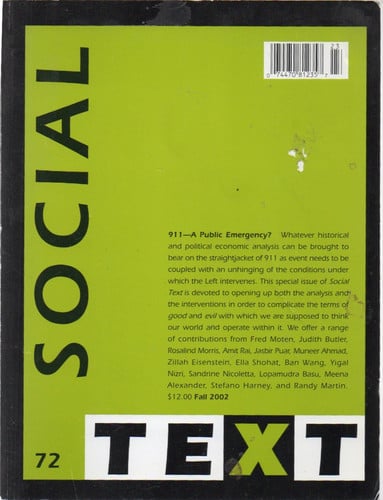
911 a Public Emergency?

Brent Hayes Edwards,Stefano Harney,Randy Martin,Ella Shohat,Timothy Mitchell,Fred Moten
Since September 11, public discourse has often been framed in terms of absolutes: an age of innocence gives way to a present under siege, while the United States and its allies face off against the Axis of Evil. This special issue of Social Text aims to move beyond these binaries toward thoughtful analysis. The editors argue that the challenge for the Left is to develop an antiterrorism stance that acknowledges the legacy of U.S. trade and foreign policy as well as the diversity of the Muslim faith and the dangers presented by fundamentalism of all kinds. Examining the strengths and shortcomings of area, race, and gender studies in the search for understanding, this issue considers cross-cultural feminism as a means of combating terrorism; racial profiling of Muslims in the context of other racist logics; and the homogenization of dissent. The issue includes poetry, photographic work, and an article by Judith Butler on the discursive space surrounding the attacks of September 11. This impressive range of contributions questions the meaning and implications of the events of September 11 and their aftermath. Contributors . Muneer Ahmad, Meena Alexander, Lopamudra Basu, Judith Butler, Zillah Eisenstein, Stefano Harney, Randy Martin, Rosalind C. Morris, Fred Moten, Sandrine Nicoletta, Yigal Nizri, Jasbir K. Puar, Amit S. Rai, Ella Shohat, Ban Wang
Duke University Press 2002-09-20 208 pages