5053 results for "Biography"

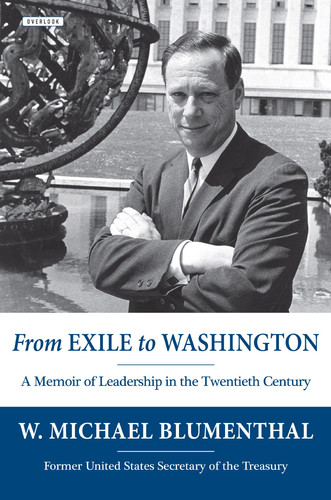
From Exile to Washington

Michael W. Blumenthal
In a life that has spanned nearly nine decades and has taken him across the world and back, W. Michael Blumenthal has borne witness to the worlds convulsions and transformations during the twentieth century. Born in Germany between the two world wars, Blumenthal narrowly escaped the Nazi horror, when, in 1939, he and his family fled to Shanghais chaotic Jewish ghetto, where they spent the entirety of the Second World War. From these fraught and humble beginnings, Blumenthal would emerge as a major leader in American business and politics. In the second half of the century, Blumenthal headed two major American corporations Bendix and Burroughs (later Unisys) served as a United States trade ambassador in the State Department and the White House, advising John F. Kennedy and Lyndon Johnson, and served under Jimmy Carter as the Secretary of the Treasury. After his retirement from business and politics, he began an entirely new chapter in his career, when he conceived and became director of Europes largest Jewish museum the Jewish Museum of Berlin a position he still holds today. An essential autobiography by one of Americas great political figures, From Exile to Washington is an engaging chronicle of the twentieth centurys greatest upheavals, and a tribute to a lifetime of courage, leadership and decisiveness.
Duckworth Publishers 2014-09-25 448 pages

The odd woman and the city: a memoir

Gornick, Vivian
"A contentious, deeply moving ode to friendship, love, and urban life in the spirit of Fierce Attachments A memoir of self-discovery and the dilemma of connection in our time, The Odd Woman and the City explores the rhythms, chance encounters, and ever-changing friendships of urban life that forge the sensibility of a fiercely independent woman who has lived out her conflicts, not her fantasies, in a city (New York) that has done the same. Running steadily through the book is Vivian Gornick's exchange of more than twenty years with Leonard, a gay man who is sophisticated about his own unhappiness, whose friendship has "shed more light on the mysterious nature of ordinary human relations than has any other intimacy" she has known. The exchange between Gornick and Leonard acts as a Greek chorus to the main action of the narrator's continual engagement on the street with grocers, derelicts, and doormen; people on the bus, cross-dressers on the corner, and acquaintances by the handful. In Leonard she sees herself reflected plain; out on the street she makes sense of what she sees. Written as a narrative collage that includes meditative pieces on the making of a modern feminist, the role of the flaneur in urban literature, and the evolution of friendship over the past two centuries, The Odd Woman and the City beautifully bookends Gornick's acclaimed Fierce Attachments, in which we first encountered her rich relationship with the ultimate metropolis"--
Farrar, Straus and Giroux 2015-05-19 175 pages

Sufi Vision and Initiation Meetings with Remarkable Beings

Samuel L. Lewis
A moving personal history of how Sufism and Zen came to America.... The story of meetings with remarkable beings like Swami Papa Ramdas, Nyogen Senzaki, Sokeian Sasaki, Mother Krishnabai, Pir-O-Murshid Hazrat Inayat Khan, the Rev. M.T. Kirby and others who sought to bring East and West together through the universality of genuine mystical experience... A sweeping and prophetic view of the last half-century of international relations with the East.... Political and religious turmoil in faraway Iands, organic agriculture and seed exchange for peace, the great mystics and sages of the 20th century--all play a part in this story of an American scholar and scientist's search for truth. "I have no fonder memory of the 60's than the appearance of this strange-looking man, who said things which made me first laugh, then smile, then later pause in appreciation of a spiritual original, a pioneer." - Dr. Jacob Needleman , author of The New Religions "Everytime I remember Sam, I end up laughing at myself. That's pretty good work for a dead-rascal-saint." - Ram Dass , author of Be Here Now "By being spiritual, Samuel Lewis expanded the range of being human; and by being human he deepened the meaning of being spiritual." - Moineddin Jablonski , spiritual successor of Murshid Samuel Lewis
Sufi Ruhaniat International 2015-02-25 406 pages

A Forehead Pressed Against A Window

Robert Rietti
The autobiography of Sir Robert Rietti, (1923-) About the Author: Robert Rietti comes from a distinguished Italian family dating back to the thirteenth century, when one of his ancestors was physician to the pope and who performed the first known blood transfusion, on the pontiff. Robert has had a varied career as an actor, director, playwright and broadcaster. He has also been responsible for dubbing many successful foreign films into English and specializes in re-voicing artists and completing the soundtrack of English-made pictures in which foreign artistes have also been used and whose accents may need correcting or replacing. He was nominated for the Golden Reel Award in Hollywood for his dubbing of Once Upon a Time in America. He also won the Oxford Film Festival Award for "The best foreign film in the English language" with his version of the Russian film Pavlova. After Jack Hawkins had lost the use of his voice through throat cancer, Robert undertook to imitate him and to record his dialogue in his last ten films. He has broadcast over 6,000 times and for over six years, recorded a weekly program from the BBC to the United States, as their answer to Alistair Cooke's Letter from America. His reading of D.H. Lawrence's Rocking Horse Winner won such acclaim that the recording was awarded the rare privilege of being buried in the BBC archives for future generations. Members of the Rietti family came to Britain 200 years ago and the grandmother of Benjamin Disraeli (British Prime Minister) was Rebecca Rietti.
Independent Publisher 2010 455 pages

Fisch Stories Reflections on Life, Liberty, and the Pursuit of Happiness

Robert O. Fisch
"I have been a Jew during Fascism, a bourgeois under Communism, a rebel defeated in an uprising, a refugee among the free, and a have-not amid plenty. This book contains over 60 stories that range from my youth in Hungary, the ordeal of a death march and concentration camps, the oppression of the Communist dictatorship, the promise and defeat of the Hungarian Revolution and, finally, my American years"--Preminary pages
R. Fisch 2009 154 pages

I Don't Drop Names Like Marilyn Monroe Just to Sell Books A Memoir by Richard Baer

Richard Baer
In the early 1950's, in Los Angeles, at 6 AM, John West, vice-president of the National Broadcasting Company in charge of west coast, gets a phone call from New York City on the NBC tie line. The caller is General David Sarnoff, chairman of the Board of RCA, the Radio Corporation of America, NBC's parent company. Awakened from sleep, Mr. West groggily says "Hello" "John, this is General Sarnoff." Mr. West swiftly clears the cobwebs. "Good morning, General, it's always good to hear from you." "John, you're acquainted with my nephew Richard Baer, aren't you?" "Yes, General, I am. He's a fine young man. I think very highly of him." "Last night I spoke with his mother, my sister. She's upset. The reason she's upset is that Richard has been out of work for four months and he has no prospects, so it looks like his life is going nowhere." "General, I'm surprised and sorry to hear that." "John, I want you to find Richard a job. And I want you to find him a job by nine o'clock this morning, your time. I'll be waiting for your call saying you took care of it. Goodbye."
iUniverse 2005-09 204 pages

Some Interesting Memories

Raymond M. Smullyan
Can a lady be kissed without being touched? Raymond Smullyan has been providing the world with such puzzle fun, chess problems, and logic quizzes for a long time. Now, he reviews his life and how all of this got started in a way that is just as interesting as his previous entertainments. Not surprisingly, there are more puzzles, but there are also new stories, many photos, and a look inside the many hobbies of the many personalities that is Raymond Smullyan. Some Interesting Memories is a "rambly" account taking you inside university life, meeting musicians, mathematicians, magicians, then, off to Eastern Philosophy, making stereoscopic viewers, or installing a 40-speaker sound system.
Thinkers' Press, Incorporated 2002-09 160 pages

Izzy

Peter C. Newman
A visionary who took no prisoners and a billionaire at least twice over, Izzy Asper ran his empire out of his briefcase. He was constantly in flight and flux, each of his improbable ventures feeding on the next. What made him so special was his ability to create warm, electric moments with his friends and loyalists, while inspiring loathing among his critics and enemies. Asper was always ahead of the pack, creating the country’s largest communications empire while remaining a certified outsider, more feared than loved for besting his peers at their power games. Peter C. Newman deconstructs the passionate life and turbulent times of the man who once confessed that he didn’t get ulcers, he gave them. Newman dissects Izzy’s feuds and friendships with some of Canada’s most powerful big-league players, including Conrad Black, with whom he frequently and violently jousted. But even as his political and business ventures swirled around him, Izzy would relax by playing jazz piano in lounges, whenever he could get a gig. In Izzy, Newman paints a portrait of a Canadian business tycoon the likes of which this country will never see again.
HarperCollins 2009-10-27 408 pages

In the beginning was the Ghetto

Oskar Rosenfeld
From February 1942 to July 1944, Oskar Rosenfeld served in the statistics department of the Lodz ghetto. A playwright and journalist, he kept his own notes on life and conditions in the ghetto for a fictionalized account he hoped to write one day. Though Rosenfeld eventually perished at Auschwitz, In the Beginning Was the Ghetto projects his voice at last to the wider world.
Northwestern University Press 2012-03 313 pages

Omer Fast

Omer Fast,René Zechlin,Sabine Schaschl
Omer Fast is one of the most distinctive film and video artists of the younger generation. In his award-winning four-channel video with multiple projections, Fast investigates how experience is transformed by memory. He refuses to frame memories according to the conventions of historical reconstruction just to turn them into a consumable narrative.Born 1972 in Jerusalem and living in Berlin, Omer Fast has achieved acclaim in exhibitions at internationally renowned museums, reaping honors including the prestigious Bucksbaum Award from the Whitney Museum of American Art in 2008. Fast is nominated for the 2009 Berlin Nationalgalerie Prize for Young Art.
KEHRER Heidelberg 2009 112 pages

Why I Left America and Other Essays

Oliver Wendell Harrington
Why I Left America and Other Essays by Oliver W. Harrington edited, with an introduction, by M. Thomas Inge To American black newspapers of the 1930s and 1940s "Ollie" Harrington was a prolific contributor of humorous and editorial cartoons. He emerged as an artist during the Harlem Renaissance and created Bootsie, the popular cartoon figure that became a fixture in black newspapers. Langston Hughes praised Harrington as America's greatest black cartoonist. After serving as a war correspondent in Italy, he returned to his homeland and the impediment of racism that pervaded American life. As director of public relations for the NAACP, he crusaded against America's policies of institutionalized racism, openly supporting leftist reform leaders. Upon hearing in this era of "red-baiting" that he was targeted for investigation, Harrington left America. In the culturally rich American community on the Left Bank in Paris that would come to include Chester Himes, James Baldwin, and Richard Wright, he became a fixture. In 1961 he found himself trapped behind the Berlin Wall, but he chose to remain in East Germany. His cartoons appeared in East German magazines and in the American Communist newspaper The Daily World. Although he became a favorite with Eastern Bloc students and intellectuals, in America Harrington was mainly forgotten. The autobiographical pieces included in Why I Left America and Other Essays, written mainly during the 1960s and 1970s, detail Oliver W. Harrington's experiences as an African American artist in exile. One theme that persists in these writings and his cartoons is his intolerance of racism. Hence, as an artist, he has found it impossible not to be political. One essay, from Ebony magazine, fuels speculation about the mysterious circumstances in the death of his friend Richard Wright. In another piece Harrington details how he created the celebrated Bootsie. He writes in others of his life in New York during the Harlem Renaissance and in Paris with fellow black expatriate figures. Why did this African American choose to live in exile for over forty years? In an affectionate foreword to this volume Richard Wright's daughter Julia gives clues to the answer. Her insights, along with M. Thomas Inge's introductory essay about Harrington's life and achievements, bring special focus to the experiences of an outstanding African American artist and social critic who has been virtually without recognition in his homeland. Oliver W. Harrington (1912-1995), cartoonist and political satirist, was an outspoken advocate for civil rights. He lived in exile in East Berlin for many years. M. Thomas Inge is the Robert Emory Blackwell Professor of Humanities at Randolph-Macon College.
University Press of Mississippi 1993 113 pages

Canada Made Me

Norman Levine
Norman Levine's Canada Made Me , first published in England in 1958, is a bitter, critical reassessment of the moral and cultural values of Canada. His account of his three-month journey from Halifax to Ucluelet, a fishing village on the west coast, is an unconventional portrait of Canada's underbelly. The book ends with the words: `I wondered why I felt so bitter about Canada. After all, it was all part of a dream, an experiment that could not come off. It was foolish to believe that you can take the throwouts, the rejects, the human kickabouts from Europe and tell them: Here you have a second chance. Here you can start a new life. But no one ever mentioned the price one had to pay; how much of oneself you had to betray.' Canada Made Me was regarded as so controversial that it did not appear in a Canadian edition until 1979. Critical opinion, however, has slowly swung around to the point the book was recently described in the Globe and Mail as a `laconic classic'. For this new edition Norman Levine has written an introduction which traces the book's publishing history and reputation.
Porcupine's Quill 1993 299 pages