58,196 results in 0.07 seconds

The great agnostic: Robert Ingersoll and American freethought

Jacoby, Susan
During the Gilded Age, Ingersoll raised his voice on behalf of Enlightenment reason, secularism, and the separation of church and state with a vigor unmatched since America's revolutionary generation. Jacoby restores Ingersoll to his rightful place in an American intellectual tradition, as a public figure who devoted his life to liberty of conscience belonging to the religious and nonreligious alike
Yale University Press 2013 246 pages

The Village Effect

Susan Pinker
In her surprising, entertaining and persuasive new book, award-winning author and psychologist Susan Pinker shows how face-to-face contact is crucial for learning, happiness, resilience and longevity. From birth to death, human beings are hard-wired to connect to other human beings. Face to face contact matters: tight bonds of friendship and love heal us, help children learn, extend our lives and make us happy. Looser in-person bonds matter, too, combining with our close relationships to form a personal "village" around us, one that exerts unique effects. And not just any social networks will do: we need the real, face-to-face, in-the-flesh encounters that tie human families, groups of friends and communities together. Marrying the findings of the new field of social neuroscience together with gripping human stories, Susan Pinker explores the impact of face-to-face contact from cradle to grave, from city to Sardinian mountain village, from classroom to workplace, from love to marriage to divorce. Her results are enlightening and enlivening, and they challenge our assumptions. Most of us have left the literal village behind, and don't want to give up our new technologies to go back there. But, as Pinker writes so compellingly, we need close social bonds and uninterrupted face-time with our friends and families in order to thrive--even to survive. Creating our own "village effect" can make us happier. It can also save our lives.
Random House Digital Inc. 2014-08-26 336 pages

What is it like to be a bat?

Nagel, Thomas
"This book is a fiftieth anniversary republication of Thomas Nagel's "What Is It Like to Be a Bat?", a classic in the philosophy of mind. Through its argument for the irreducible subjectivity of consciousness, it played an essential role in making the study of consciousness a central part of philosophy, psychology, and neuroscience. It also spurred the now flourishing scientific attention to the consciousness of non-human creatures: mammals, birds, fish, mollusks, and insects. The book also includes a second essay offering Nagel's more recent thoughts on the most promising positive response to the mind-body problem, as posed in the original essay"--
Oxford University Press 2024 64 pages

The rider

Krabbé, Tim
A literary sports classic, finally available in the U.S. Originally published in Holland in 1978, The Rider became an instant cult classic, selling over 100,000 copies. Brilliantly conceived and written at a breakneck pace, it is a loving, imaginative, and, above all, passionate tribute to the art of bicycle road racing. Not a dry history of the sport, The Rider is beloved as a bicycle odyssey, a literary masterpiece that describes in painstaking detail one 150-kilometer race in a mere 150 pages. We are, every inch of the way, inside amateur biker Tim Krabbé's head as his mind churns at top speed along with his furious peddling. Privy to his every thought-on the glory and vagaries of the sport itself, the weather, the characters and lineage of his rival cyclists, almost hallucinogenic anecdotes about great riders of the past-the book progresses kilometer by kilometer, thought by thought, and the reader is left breathless and exhilarated. A thrillingly realistic look at what it is like to compete in a road race, The Rider is the ultimate book for bike lovers as well as the arm-chair sports enthusiast.
Bloomsbury 2002-06-01 148 pages

In the garden of the North American martyrs: with a new preface from the author

Wolff, Tobias
Among the characters you'll find in this collection of twelve stories by Tobias Wolff are a teenage boy who tells morbid lies about his home life, a timid professor who, in the first genuine outburst of her life, pours out her opinions in spite of a protesting audience, a prudish loner who gives an obnoxious hitchhiker a ride, and an elderly couple on a golden anniversary cruise who endure the offensive conviviality of the ship's social director. --
Ecco, an imprint of HarperCollinsPublishers 2015-06-23 175 pages

Selected writings

Benjamin, Walter
In the frenzied final years of the Weimar Republic, amid economic collapse and mourning political catastrophe, Walter Benjamin emerged as the most original practicing literary critic and public intellectual in the German-speaking world. Volume 2 of Selected Writings, covering the years 1927 to 1934, displays the full spectrum of Benjamin's achievements at this pivotal stage in his career. Previously concerned chiefly with literary theory, Benjamin during these Years does pioneering work in new areas, from the stud of popular Culture (a discipline he virtually created) to theories of the media and the visual arts. His writings on the theory of modernity-most of them new to readers of English--develop ideas as important to an understanding of the twentieth century as an contained in his widely anthologiied essay "The Work of Art in the Age of Technological Reproducibility. This volume brings together previously untranslated writings on major figures such as Brecht, Valéry and Gide, and on subjects ranging from film, radio, and the novel to memory, kitsch, and the theory of language. We find the manifoldly inquisitive Benjamin musing on the new modes of perception opened tip by techniques of photographic enlargement and cinematic montage, on the life and work of & Goethe at Weimar, on the fascination of old toys and the mysteries of food, and on the allegorical significance of Mickey Mouse.
Belknap Press 1996 870 pages

Bad Boy Brawly Brown

Walter Mosley
Easy Rawlins is trying to stay as far from crime and its consequences as a black man can in 1964 L.A. But trouble still finds a way to his door. An old friend asks Easy to find his stepson, Brawly Brown, a good kid gone angry and missing. Too quickly Easy finds himself riding with a revolutionary group out to fight racism, dodging the police, who want to pin him for murder, and looking for the right kind of answers from the wrong kind of women. With little help from this world, Easy gets it from the next-from Mouse, his greatest friend and worst betrayal. But while Mouse's legacy may help Easy save young Brawly's life, it may cost him his own.
Grand Central Publishing 2003-07-01 360 pages

Cinnamon kiss

Mosley, Walter
It is the Summer of Love and Easy Rawlins is contemplating robbing an armored car. It's farther outside the law than Easy has ever traveled, but his daughter, Feather, needs a medical treatment that costs far more than Easy can earn or borrow in time. And his friend Mouse tells him it's a cinch. Then another friend, Saul Lynx, offers a job that might solve Easy's problem without jail time. He has to track the disappearance of an eccentric, prominent attorney. His assistant of sorts, the beautiful "Cinnamon" Cargill, is gone as well. Easy can tell there is much more than he is being told-Robert Lee, his new employer, is as suspect as the man who disappeared. But his need overcomes all concerns, and he plunges into unfamiliar territory, from the newfound hippie enclaves to a vicious plot that stretches back to the battlefields of Europe.
Little, Brown 2005-09-19 312 pages

The Manhattan nobody knows: an urban walking guide

Helmreich, William B.
Bill Helmreich walked every block of New York City -- six-thousand miles in all -- to write the award-winning The New York Nobody Knows. Now he has re-walked most of Manhattan -- 721 miles -- to write this new, one-of-a-kind walking guide to the heart of one of the world's greatest cities. Drawing on hundreds of conversations he had with residents during his block-by-block journey, The Manhattan Nobody Knows captures the unique magic and excitement of the island and highlights hundreds of facts, places, and points of interest that you won't find in any other guide. The guide covers every one of Manhattan's thirty-one distinct neighborhoods, from Marble Hill to the Financial District, providing a colorful portrait of each area's most interesting, unusual, and unfamiliar people, places, and things. Along the way you'll be introduced to an elderly Inwood man who lives in a cave; a Greenwich Village townhouse where Weathermen terrorists set up a bomb factory; a Harlem apartment building whose residents included W.E.B. DuBois and Thurgood Marshall; a tiny community garden attached to the Lincoln Tunnel; a Washington Heights pizza joint that sells some of the biggest slices in town; the story behind the "Birdman" of Washington Square Park; and much, much more. An unforgettably vivid chronicle of today's Manhattan, the book can also be enjoyed without ever leaving home -- but it's almost guaranteed to inspire you to get out and explore this fascinating metropolis.
Princeton University Press 2018-12-04 354 pages

Rogue state

Blum, William
The American Empire: To the American mind, these words sound like an oxymoron. Suggesting to Americans that their country has a compelling lust for political, economic and military hegemony over the rest of the world, divorced from any moral considerations, is akin to telling them of one's UFO abduction - except that they're more likely to believe the abduction story. William Blum has compiled evidence that will make believers of such sceptics. In 'Rogue State', he shows that 'close encounters' between the United States and alien nations have demonstrably been of the cruellest kind.
Zed Books 2003 308 pages

One damn thing after another: memoirs of an attorney general

Barr, William Pelham
"William Barr's first tenure as attorney general under President George H.W. Bush was largely the result of chance, while his second tenure under President Donald Trump a deliberate and difficult choice. In this candid memoir, Barr takes readers behind the scenes during seminal moments of the 1990s, from the LA riots to Pan Am 103 and Iran Contra. Thirty years later, Barr faced an unrelenting barrage of issues, such as Russiagate, the COVID outbreak, civil unrest, the impeachments, and the 2020 election fallout"--
William Morrow, an imprint of HarperCollinsPublishers 2022 595 pages

Live long and-- what I learned along the way

Shatner, William
Star Trek legend and veteran author William Shatner discusses the meaning of life, finding value in work, and living well whatever your age. "I have always felt," William Shatner says early in his newest memoir, that "like the great comedian George Burns, who lived to 100, I couldn’t die as long as I was booked." And Shatner is always booked. Still, a brief health scare in 2016 forced him to take stock. After mulling over the lessons he's learned, the places he's been, and all the miracles and strange occurrences he's witnessed over the course of an enduring career in Hollywood and on the stage, he arrived at one simple rule for living a long and good life: don't die. It's the only one-size-fits-all advice, Shatner argues in Live Long and..:What I Learned Along the Way, because everyone has a unique life―but, to help us all out, he's more than willing to share stories from his unique life. With a combination of pithy humor and thoughtful vulnerability, Shatner lays out his journey from childhood to peak stardom and all the bumps in the road. (Sometimes the literal road, as in the case of his 2,400-mile motorcycle trip across the country with a bike that didn't function.) William Shatner is one of our most beloved entertainers, and he intends never to stop entertaining. His funny, provocative, and poignant reflections offer an unforgettable read about a remarkable man.
Thomas Dunne Books 2018 214 pages

Getting Even

Woody Allen
After three decades of prodigious film work & some unfortunate tabloid adventures, it's easy to forget that Woody Allen began his career as one heck of a great comedy writer. Getting Even, a collection of his late '60s magazine pieces, offers a look into Allen's bag of shtick, back when it was new. From the supposed memoirs of Hitler's "Then, in January of '45, a plot by several generals to shave Hitler's moustache in his sleep failed when von Stauffenberg, in the darkness of Hitler's bedroom, shaved off one of the Führer's eyebrows instead..." Even tho the idea of writing jokes about old Adolf--or addled rabbis, or Maatjes herring--isn't nearly as fresh as it used to be, Getting Even still delivers plenty of laughs. At his best, Woody can achieve a level of transcendent craziness that no other writer can match. If you're looking for a book to dip into at random, or a gift for someone who's seen Sleeper 13 times, Getting Even is a classic, with 316,000 copies sold to date.
Warner 1972

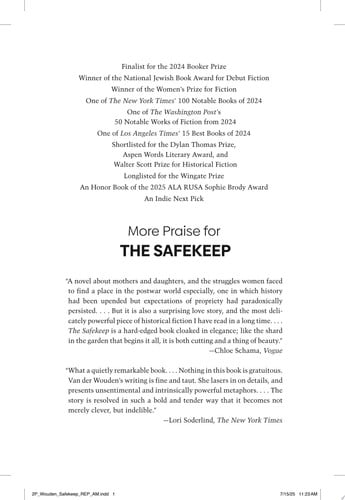
The safekeep

van der wouden, Yael
"*Shortlisted for the 202 Booker prize* "Remarkable...Compelling...Fine and taut...Indelible." -The New York Times "Moving, unnerving, and deeply sexy." -Tracy Chevalier, author of Girl with the Pearl Earring "A brilliant debut, as multi-faceted as a gem." -Kirkus Reviews A "razor-sharp, perfectly plotted" (The Sunday Times, London) tale of desire, suspicion, and obsession between two women staying in the same house in the Dutch countryside during the summer of 1961-a powerful exploration of the legacy of WWII and the darker parts of our collective past. A house is a precious thing... It is 1961 and the rural Dutch province of Overijssel is quiet. Bomb craters have been filled, buildings reconstructed, and the war is truly over. Living alone in her late mother's country home, Isabel knows her life is as it should be-led by routine and discipline. But all is upended when her brother Louis brings his graceless new girlfriend Eva, leaving her at Isabel's doorstep as a guest, to stay for the season. Eva is Isabel's antithesis: she sleeps late, walks loudly through the house, and touches things she shouldn't. In response, Isabel develops a fury-fueled obsession, and when things start disappearing around the house-a spoon, a knife, a bowl-Isabel's suspicions begin to spiral. In the sweltering peak of summer, Isabel's paranoia gives way to infatuation, leading to a discovery that unravels all Isabel has ever known. The war might not be well and truly over after all, and neither Eva-nor the house in which they live-are what they seem. Mysterious, sophisticated, sensual, and infused with intrigue, atmosphere, and sex, The Safekeep is "a brave and thrilling debut about facing up to the truth of history, and to one's own desires" (The Guardian)"--
Avid Reader Press 2025-05-27 262 pages